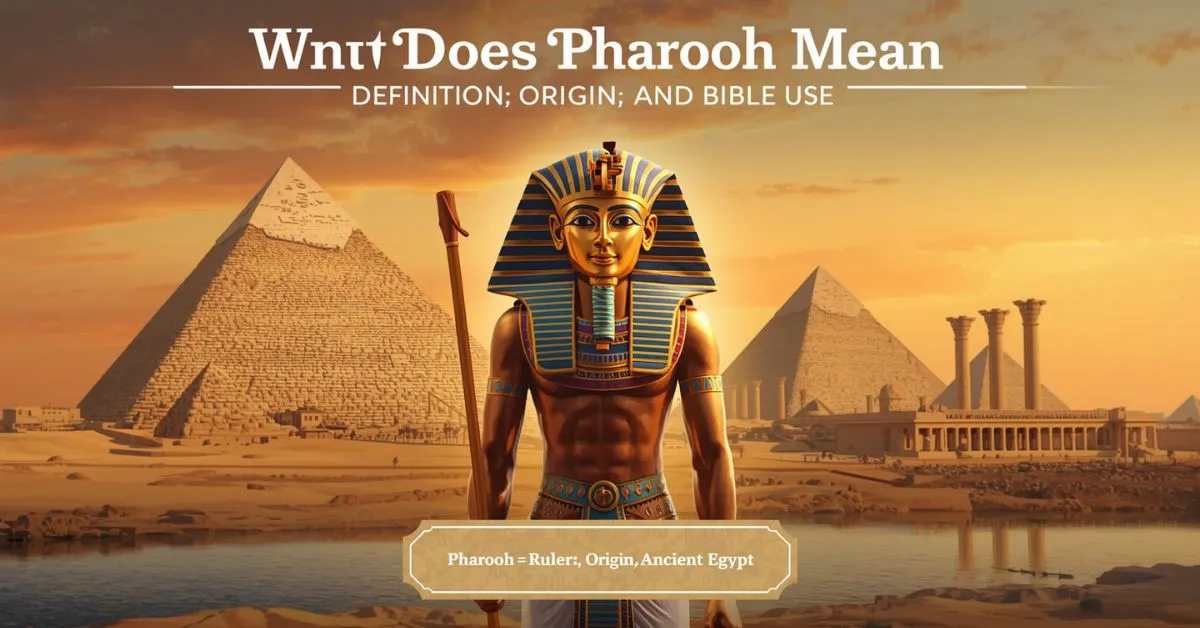
A pharaoh was the ruler of ancient Egypt. The word originally meant “great house” and first referred to the royal palace.
Later, it became a title used for the Egyptian king, especially from the New Kingdom onward. In modern English, people usually use pharaoh to mean any king of ancient Egypt, and that broad use was shaped in part by the Hebrew Bible.
When people search “what does pharaoh mean,” they usually want a fast answer first. But this word has more depth than many readers expect.
It is not just another word for king. It carries ideas about royal power, the palace, religion, and the way ancient Egyptian society understood rule and order. That is why the meaning of pharaoh matters in history, religion, and even modern language.
Pharaoh meaning at a glance
| Question | Clear answer |
|---|---|
| What does pharaoh mean? | The ruler of ancient Egypt |
| What is the literal meaning? | “Great house” |
| What did it first refer to? | The royal palace or court |
| When did it become a ruler title? | During the New Kingdom |
| What does it mean in the Bible? | The king of Egypt |
This quick summary matches the way major historical and dictionary sources explain the word and its development.
What does pharaoh mean in simple terms?
The direct definition
In simple English, pharaoh means a ruler of ancient Egypt. That is the easiest and most direct answer. If a student, reader, or searcher asks what a pharaoh was, the plain answer is: an Egyptian king.
The literal meaning behind the word
The deeper meaning is more interesting. The word comes from the Egyptian per aa or pr ꜥꜣ, which means “great house.”
At first, that phrase pointed to the palace, the royal household, or the institution of kingship. Only later did it come to mean the ruler himself.
Why the literal meaning matters
This small detail changes the whole explanation. It shows that pharaoh did not begin as a personal title like “king” or “queen.”
It began as a palace term and then shifted into a ruler term. That makes the word historically richer than many quick dictionary entries suggest.
Where does the word pharaoh come from?
From palace to person
Britannica explains that pharaoh originally referred to the royal palace in ancient Egypt.
Under the New Kingdom, beginning in the 18th dynasty, the word started to be used metonymically for the king. By the 22nd dynasty, it had become an epithet of respect.
Not the king’s formal title from the beginning
This is one of the most important points to understand. The word pharaoh was never the king’s formal title in the strict original sense.
Modern readers often think every Egyptian ruler always called himself “pharaoh,” but the history is more complex than that.
Today, historians use the term broadly for Egyptian kings across many dynasties, even though the word developed that use later.
Simple timeline of the meaning
- Early meaning: the royal palace or “great house”
- New Kingdom: the word begins to refer to the living king
- Later use: it becomes a respectful way to refer to the ruler
- Modern English: it becomes the general word for Egyptian kings
What was a pharaoh in ancient Egypt?
More than a king
A pharaoh was not just a political ruler. National Geographic explains that pharaohs were both the heads of state and the religious leaders of their people. That made the role wider than many modern ideas of kingship. A pharaoh stood at the center of government, ritual, temple life, and state identity.
The pharaoh’s role in Egyptian society
Ancient Egyptian kingship was tied to order, power, religion, and public life. The pharaoh ruled the land of the Nile, oversaw state projects, supported temples, and symbolized stability across Egypt’s dynasties. In ideological terms, the king stood above ordinary people in a sacred hierarchy.
Why the title felt powerful
That is why pharaoh became such a strong word. It did not only mean ruler. It suggested monarchy, divine authority, court power, public ceremony, and the continuity of ancient Egyptian civilization.
Pharaoh vs king: what is the difference?
This is one of the most useful distinctions for readers.
| Term | Meaning | Best use |
|---|---|---|
| King | General word for a male ruler | Works across many cultures |
| Pharaoh | The ruler of ancient Egypt | Best for Egyptian history and biblical context |
In practice, a pharaoh was a king, but not every king was a pharaoh. The word king is broad. The word pharaoh is culture-specific and tied to ancient Egypt, its palace system, religion, and dynasties.
What does pharaoh mean in the Bible?
A title, not a personal name
In the Hebrew Bible, Pharaoh is usually the title for the king of Egypt, not a personal given name. That is why readers see “Pharaoh” used almost like a name in stories about Joseph, Moses, and the Exodus tradition.
Why Bible use shaped modern understanding
Britannica notes that the modern habit of using pharaoh as a generic name for all Egyptian kings is based on the usage of the Hebrew Bible. That matters for SEO too, because many searchers want both the historical meaning and the Bible meaning on the same page.
Famous pharaohs that help explain the word
Menes and the idea of the first pharaoh
Tradition credits Menes as the first king of unified Egypt and founder of the 1st dynasty, though early Egyptian history is complex and later records shaped that tradition. When people search for the first pharaoh of Egypt, Menes often appears in the answer.
Hatshepsut and the female pharaoh question
Hatshepsut is one of the best examples of a female pharaoh. Britannica says she adopted the full titles and regalia of a pharaoh, which makes her a key figure for anyone asking whether women could rule Egypt as pharaohs.
Ramses II and royal power
Ramses II, also called Ramses the Great, is one of the most famous pharaohs in history. His reign was the second longest in Egyptian history, and he is known for wars, monuments, and huge building programs. He is the classic image many people picture when they hear the word pharaoh.
Akhenaten and religious change
Akhenaten was an 18th-dynasty king who promoted the cult of Aton. He is remembered for major religious change in ancient Egypt, which shows that pharaohs could shape not only politics but belief and worship too.
Tutankhamun and modern fame
Tutankhamun, or King Tut, ruled only briefly, but his tomb was discovered in 1922 and became one of the most famous archaeological finds in the world. That discovery helped shape the modern image of pharaohs as golden, powerful, and mysterious rulers.
Cleopatra VII and the last pharaoh idea
Cleopatra VII was the last active ruler of the Ptolemaic Kingdom of Egypt. Many people think of her as the last pharaoh, even though she belonged to a later Greek-descended ruling house in Egypt.
Common mistakes people make about pharaoh
Mistake 1: Thinking pharaoh always meant king
It did not. The original sense was “great house,” meaning the palace or royal institution.
Mistake 2: Thinking every Egyptian ruler used the title the same way
The term became attached to the living king during the New Kingdom, not at the very beginning of Egyptian history.
Mistake 3: Thinking pharaohs were only men
Hatshepsut proves that women could rule as pharaoh, though it was unusual.
Mistake 4: Treating Pharaoh as one person in the Bible
In biblical usage, Pharaoh is usually a title for the king of Egypt, not a personal name.
How do you pronounce pharaoh?
In English, pharaoh is commonly pronounced like FAIR-oh or FAY-roh, depending on accent and dictionary style. The important point for most readers is that the word has two syllables and is usually stressed on the first part.
Practical takeaways
If you want the clearest answer to what does pharaoh mean, remember these points:
- A pharaoh was the ruler of ancient Egypt.
- The word originally meant “great house.”
- It first referred to the royal palace, not the ruler directly.
- It became a ruler term during the New Kingdom.
- In the Bible, Pharaoh usually means the king of Egypt.
- Famous examples include Hatshepsut, Ramses II, Akhenaten, Tutankhamun, and Cleopatra VII.
8) FAQ SECTION
What does pharaoh mean in one sentence?
A pharaoh was the ruler of ancient Egypt, and the word originally meant “great house.”
Does pharaoh mean king?
In modern use, yes. A pharaoh is the king of ancient Egypt, though the word did not originally begin as the normal word for king.
What does pharaoh mean in the Bible?
In the Bible, Pharaoh is usually the title for the king of Egypt rather than a personal name.
What is the literal meaning of pharaoh?
The literal meaning is “great house,” which first referred to the royal palace or court.
Could a woman be a pharaoh?
Yes. Hatshepsut is one of the clearest examples of a woman who ruled as pharaoh and used full pharaonic titles and regalia.
Who was the first pharaoh?
Tradition credits Menes as the first king of unified Egypt, though the earliest period of Egyptian history is complex and partly reconstructed from later records.
Who was the last pharaoh?
Many people identify Cleopatra VII as the last pharaoh because she was the last active ruler of the Ptolemaic Kingdom of Egypt.
Why is Tutankhamun so famous?
Tutankhamun is especially famous because his largely intact tomb was discovered in 1922, making him one of the best-known pharaohs in the modern world.
Conclusion
So, what does pharaoh mean? In simple terms, it means the ruler of ancient Egypt. In literal terms, it means “great house.” That shift from palace to person is what makes the word so important. It connects language, monarchy, religion, and the long history of Ancient Egypt in one title. If you are building a history glossary, an Ancient Egypt content cluster, or a Bible meanings hub, pharaoh is one of the most valuable terms to explain well.
Click Below To Read About These Posts:
What Does Civil Rights Mean? Definition, Examples, Differences
What Does OTE Mean in Sales? Salary, Commission, and Examples
What Does CFS Mean? Medical, Shipping, Instagram & More

Hi, I’m Evan Lexor, the voice behind Meanpedia.com. I break down English words, slang, and phrases into clear, simple meanings that actually make sense. From modern internet terms to everyday expressions, my goal is straightforward: help you understand English better, faster, and with confidence, one word at a time.