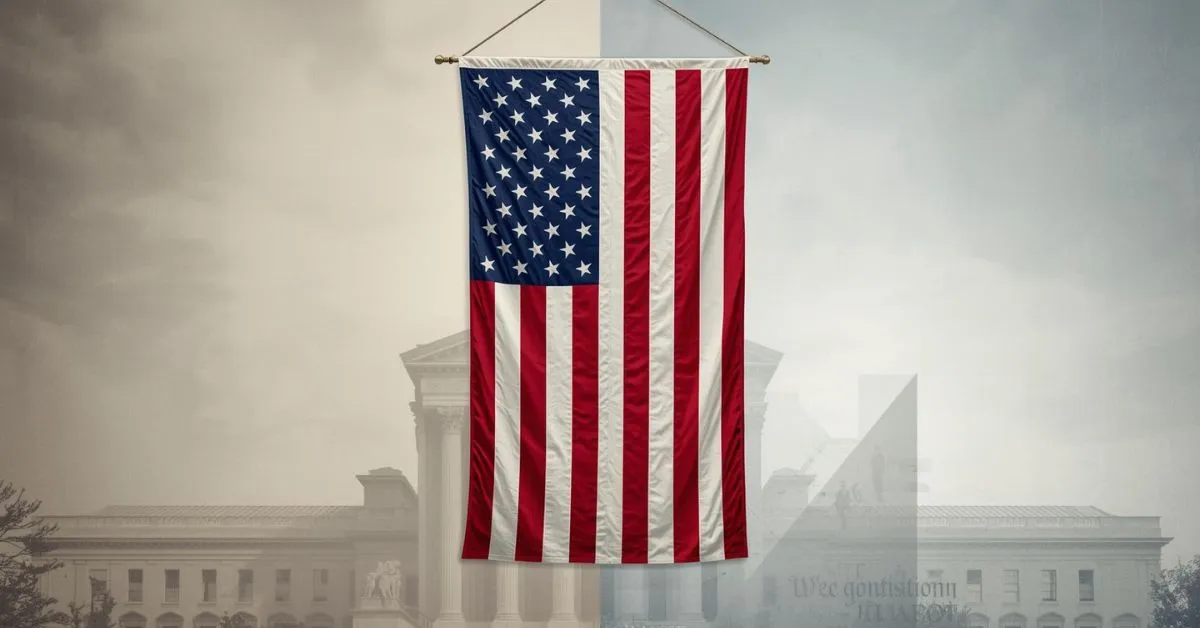
The upside down American flag traditionally means dire distress. The U.S. Flag Code says the flag should never be displayed with the union down except as a signal of extreme danger to life or property. Today, it is also widely used as a form of political protest or symbolic speech.
The upside down American flag is one of the strongest visual symbols in American public life. Some people see it as a legal distress signal. Others see it as a protest symbol. Many see it as both. That is why the image often sparks debate.
In simple terms, the upside down American flag originally signaled serious distress. Over time, it also became a way for people to show that they believe the country is in crisis. That modern use is controversial, but it is not new. Courts and First Amendment sources have recognized flag-based protest for decades.
What does the upside down American flag mean officially?
The official answer comes from 4 U.S. Code § 8, part of the U.S. Flag Code. It says the American flag should never be displayed with the union down except as a signal of dire distress in instances of extreme danger to life or property. In flag terms, the union is the blue field with stars.
So, in its strictest official meaning, an upside down flag is not meant to say “I disagree” or “I am upset.”
It is meant to signal that something is badly wrong. Historically, that idea came from emergency signaling, especially in maritime and military-style contexts, where a reversed national flag could communicate danger. The Free Speech Center notes that the practice was used by ships in distress before it later took on political meaning on land.
What “union down” means
When the flag is upside down, the blue starred corner appears at the bottom rather than at the top.
That reversed display is what the Flag Code calls union down. Because the code treats that position as a distress signal, it gives the inverted flag a special meaning that is different from normal display or half-staff mourning.
Why do people fly the American flag upside down today?
Today, the upside down American flag often signals political distress, social alarm, or moral protest. People use it to say they believe the country, the Constitution, democracy, public lands, civil rights, or public institutions are under threat.
That modern meaning is not identical to the Flag Code’s emergency wording, but it clearly grows out of the same idea: distress.
The Free Speech Center says this protest use has existed for at least 50 years. One major example is Spence v. Washington in 1974, where a college student displayed a U.S. flag upside down with peace symbols attached to protest the Kent State shootings and the Vietnam War. The Supreme Court overturned his conviction and treated the display as protected expressive conduct.
That matters because it shows a key point: the upside down American flag can communicate a message even when people disagree about that message.
In modern public life, people on both the right and the left have used inverted flags to express alarm, anger, or dissent. The Free Speech Center specifically notes right-wing use after the 2020 election and progressive use after the overturning of Roe v. Wade.
Is it illegal to fly the American flag upside down?
Usually, no. For private citizens, flying the American flag upside down is generally not illegal. The Flag Code is widely treated as advisory, not criminally enforceable.
A Congressional Research Service report explains that the Flag Code does not prescribe penalties for non-compliance and functions as voluntary guidance for civilians and civilian groups.
That legal point is important because many people assume “against the Flag Code” means “against the law.” Those are not the same thing here. The code sets out rules of respect and etiquette, but it does not create a general criminal penalty for private citizens who violate those display customs.
What the First Amendment says
The legal analysis becomes even clearer when protest is involved. American courts have repeatedly treated flag-based protest as symbolic speech.
The First Amendment Encyclopedia defines symbolic speech as nonverbal expression, and it notes that it is generally protected unless it creates a specific, direct threat to others or public order.
In Texas v. Johnson in 1989, the Supreme Court struck down a Texas flag desecration law on First Amendment grounds.
In United States v. Eichman in 1990, the Court also struck down the federal Flag Protection Act of 1989, reaffirming that the government could not ban expressive flag desecration simply because it offended people.
So while many Americans see an upside down flag as disrespectful, the legal system often treats it differently when it is part of a political message. In many situations, it is protected expression, not a punishable act.
Upside down flag vs half-staff: not the same thing
A major source of confusion is the difference between an upside down flag and a half-staff flag. These do not mean the same thing.
Half-staff is an official mourning position. The Flag Code defines it as the flag being one-half the distance between the top and bottom of the staff, and it is used to honor deaths or national tragedy in specific circumstances.
An upside down flag, by contrast, is an inversion of the flag itself. It is associated in the Flag Code with dire distress, not mourning. That is why using an upside down flag at a time when people really mean “mourning” can send the wrong message.
| Display style | Main meaning | Official basis | Typical use |
|---|---|---|---|
| Normal display | Respect, patriotism, standard display | U.S. Flag Code customs | Everyday use |
| Half-staff | Mourning and remembrance | U.S. Flag Code position rules | Death of officials, memorial observances |
| Upside down flag | Dire distress; now also protest | U.S. Flag Code distress language | Emergency signaling or political/social protest |
Why the upside down flag is so controversial now
The symbol has become more visible in current political debate. In May 2024, Reuters reported that an upside down American flag had been photographed outside Supreme Court Justice Samuel Alito’s home in January 2021.
Reuters also noted that some Trump supporters displayed upside down flags after the 2020 election. That reporting renewed national debate over whether the symbol reflected distress, protest, political alignment, or something else entirely.
The controversy did not stop there. The Free Speech Center also noted a 2025 Yosemite National Park protest in which an upside down flag appeared on El Capitan during the famous Horsetail Fall “firefall” season, reportedly as a protest against federal cost-cutting and staff reductions. That example shows the symbol is still active in public protest far beyond one party or one event.
This is why context matters so much. The same upside down flag may be read as a distress signal, a protest symbol, a partisan message, or a broad statement of civic alarm depending on where it appears, who uses it, and what is happening around it.
Common mistakes and misunderstandings
1. Thinking it always means the same thing
Officially, it means distress. In practice, it can also mean protest. The meaning depends on context.
2. Confusing it with half-staff
Half-staff is for mourning. Upside down is for distress or protest. They are not interchangeable.
3. Assuming it is automatically illegal
For civilians, Flag Code rules are generally advisory, and expressive uses may be protected by the First Amendment.
4. Assuming it belongs to only one political side
Recent reporting tied it to some post-2020 election protest symbolism, but First Amendment and historical sources also show use in anti-war protest and left-leaning protest contexts.
Real examples of what the upside down American flag can signal
Here are the most common real-world meanings:
A distress signal
This is the original and official meaning in the U.S. Flag Code: extreme danger to life or property.
A protest symbol
People use it to say the country is in danger, rights are under threat, or leadership has failed. Courts have long treated this kind of flag display as expressive conduct.
A controversial public statement
Because the flag is such a powerful national symbol, inverting it can trigger strong emotional reactions even when it is legally protected. That is why disputes over patriotism, respect, protest, and public meaning often surround it.
FAQ
Is flying the American flag upside down disrespectful?
Many people believe it is disrespectful, but officially the Flag Code allows it as a distress signal, and courts have protected some protest uses as expressive conduct.
What does the U.S. Flag Code say about an upside down flag?
It says the flag should never be displayed with the union down except as a signal of dire distress in instances of extreme danger to life or property.
Is it illegal to hang the American flag upside down?
For private citizens, usually no. The Flag Code is generally advisory, and protest-related flag expression can be protected by the First Amendment.
What does “union down” mean?
It means the flag is inverted so the blue field with stars, called the union, appears at the bottom instead of the top.
Is an upside down flag the same as half-staff?
No. Half-staff is a mourning position. An upside down flag signals distress and is also used in protest.
Why do protesters use the American flag upside down?
They use it to show they believe the country is in crisis or that basic rights, institutions, or values are in danger. Courts have treated that kind of display as symbolic speech.
Did the upside down flag appear in recent political controversies?
Yes. Reuters reported in May 2024 on an upside down flag photographed at Justice Samuel Alito’s home in January 2021, which renewed public debate about the symbol’s political meaning.
Has the upside down flag only been used by one political group?
No. First Amendment sources document use in anti-war protest, post-2020 election protest, and later progressive protest contexts, which shows the symbol has been used across different political moments.
Practical takeaway
If you are asking, “What does the upside down American flag mean?” the best answer is this: officially, it signals dire distress; in modern life, it often functions as protest. The U.S. Flag Code gives it its original meaning, while the First Amendment explains why people can still use it as symbolic speech in public debate.
That dual meaning is exactly why the symbol remains so powerful. It combines national identity, civic conflict, free speech, flag etiquette, and public emotion in a single image. If you want to understand it correctly, always look at the context, not just the flag itself.
Click Below To Read About These Posts:
What Does “Everyone Is So Mean 2 Men” Mean? Explanation
What Does Pharaoh Mean? Definition, Origin, and Bible Use
What Does Business Days Mean? Definition, Examples, Weekends

Hi, I’m Evan Lexor, the voice behind Meanpedia.com. I break down English words, slang, and phrases into clear, simple meanings that actually make sense. From modern internet terms to everyday expressions, my goal is straightforward: help you understand English better, faster, and with confidence, one word at a time.