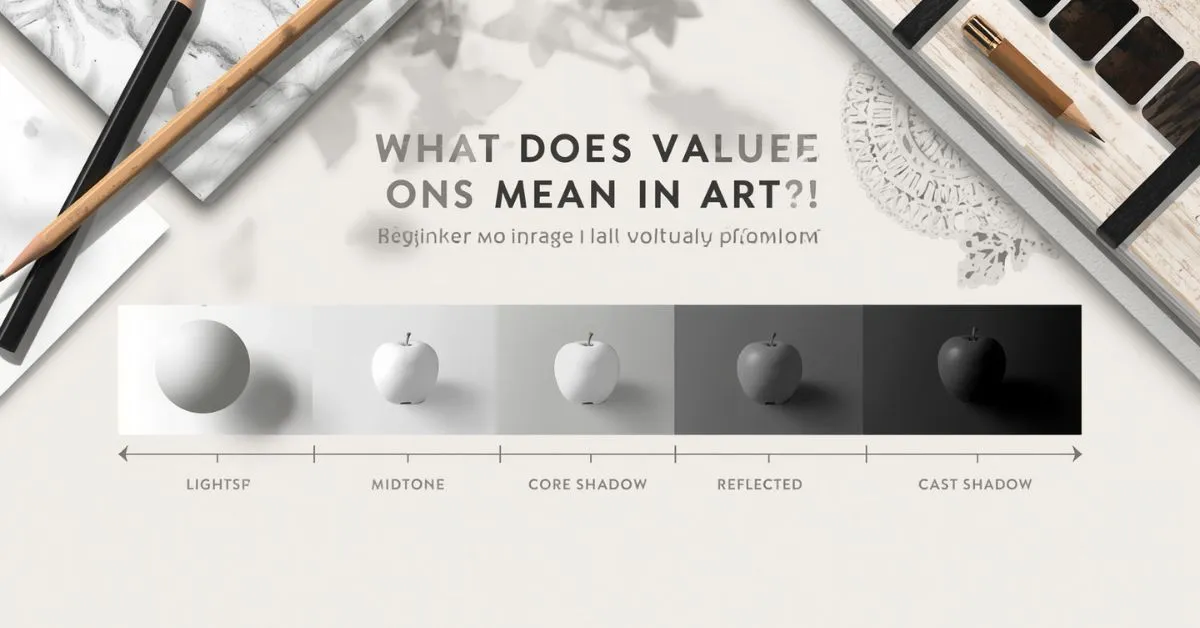
In art, value means how light or dark something appears. It is one of the basic elements of art, and artists use it to create contrast, show form, build depth, guide the viewer’s eye, and shape mood.
In simple terms, value is the range from the lightest highlight to the darkest shadow in a drawing or painting.
If you are learning to draw or paint, value is one of the most important concepts to understand early. Many beginners focus on color first, but strong artwork usually depends more on accurate light and dark relationships than on perfect color choices.
If you work in graphite, charcoal, ink, watercolor, acrylic, or oil painting, value helps flat shapes look solid and believable. It is also a key part of composition, because the lightest and darkest areas often create the main focal point.
What value means in art
The simple definition of value
Value in art is the lightness or darkness of a color, tone, or surface. White is the highest value, black is the lowest value, and everything between them falls somewhere in the middle.
Artists use those shifts in value to describe a light source, create shading, and turn a flat shape into something that looks three-dimensional.
For example, a simple circle can become a sphere when you add a highlight, midtone, core shadow, reflected light, and cast shadow. The outline may stay the same, but the values make the form feel real.
Value is not the same as price or worth
Outside of art, the word “value” often means cost, importance, or worth. In visual art, it usually means only one thing: how light or dark something looks.
That difference matters because students often hear “value” and think of meaning or quality. In drawing and painting, value is about visible tone.
Value exists in black-and-white art and color art
Value is easy to see in grayscale or monochrome work, such as a charcoal sketch or black-and-white photograph.
But value also exists in full color. Every hue has a value. Yellow often appears lighter than navy blue, for instance, even before you mix anything.
This is why an artwork can have beautiful color but still look weak if the values are too close together. Good color theory helps, but strong values often make the bigger difference in readability and realism.
Why value is so important in art
Value creates form and realism
One of the main jobs of value is to show form. Without value, an object can look flat. With careful value shifts, the same object can look round, angular, soft, heavy, shiny, or textured.
That is how artists create the illusion of:
- volume
- light
- surface
- structure
- realism
A face, for example, looks convincing not because every line is drawn, but because the values around the nose, cheeks, eye sockets, lips, and jaw are accurate.
Value creates contrast and focal points
Contrast is the difference between areas. When a very light area sits next to a very dark one, the contrast becomes strong. Strong contrast naturally attracts attention.
That means value is one of the best tools for controlling the viewer’s eye. If you want the viewer to notice the face in a portrait first, or the center of interest in a still life, you often place the strongest value contrast there.
Value creates depth and space
Artists also use value to create depth and space. In landscape painting, nearby objects often have darker darks and clearer value separation, while distant hills and sky masses appear lighter and softer. This helps create atmospheric perspective.
In other words, value helps build the feeling that some parts of the image move forward and others fall back.
Value helps build mood
Value affects emotion too. A painting with mostly dark values can feel dramatic, mysterious, heavy, or intimate. A painting with mostly light values can feel calm, open, soft, or airy.
This is where ideas like high-key and low-key come in:
- High-key art uses mostly light values
- Low-key art uses mostly dark values
Both approaches can be powerful depending on the mood the artist wants.
Value vs hue, tint, tone, shade, and contrast
These terms are connected, but they do not mean the same thing.
| Term | Meaning | Example |
|---|---|---|
| Value | How light or dark something appears | Light gray vs dark gray |
| Hue | The basic color family | Red, blue, yellow |
| Tint | A hue mixed with white | Pink is a tint of red |
| Shade | A hue mixed with black | Maroon is a shade of red |
| Tone | A hue softened or grayed | Muted blue-gray |
| Contrast | The difference between areas | Black beside white |
A quick way to remember the difference
Think of it this way:
- Hue = what color it is
- Value = how light or dark it is
- Tint = lighter version of a hue
- Shade = darker version of a hue
- Tone = softened version of a hue
- Contrast = how different two areas are
This matters because beginners often confuse bright color with light value. A bright red may still be darker than a pale yellow. The eye can be tricked by color, which is why many artists check work in grayscale.
What is a value scale in art?
A value scale is a row of values arranged from light to dark. It may have 3, 5, 7, or 9 steps, or even a full gradual transition.
Artists use value scales to:
- understand tonal range
- practice shading
- judge light and shadow
- compare different passages in a drawing or painting
- simplify complex subjects
A value scale trains your eye to see more than just “light” and “dark.” It helps you notice highlights, light midtones, middle values, dark midtones, and deep shadows.
Why value scales matter
A beginner often draws everything in the middle range. The result looks dull because it lacks a full tonal range. A value scale helps correct that problem. It teaches you how much separation exists between the lightest and darkest parts of a subject.
That skill is useful in:
- still life drawing
- portrait drawing
- landscape painting
- figure drawing
- abstract art
- monochromatic studies
Examples of value in art
A shaded sphere or apple
This is one of the clearest examples of value in action. A plain outline of a sphere looks flat. Once you add:
- a highlight
- a midtone
- a core shadow
- reflected light
- a cast shadow
it begins to look round. The same idea works with an apple, mug, vase, or egg.
A portrait
In portrait art, value creates structure. The bridge of the nose, under the brow, the eye sockets, the cheekbones, the upper lip shadow, and the neck under the chin all rely on value. Good portrait artists understand that the likeness of a face often depends more on value shapes than on small details.
A landscape
In a landscape, value organizes big shapes: sky, mountains, trees, fields, water, and foreground forms. A successful landscape usually has a clear value pattern before it has detailed leaves, grass, or clouds.
Abstract art
Even in abstract art, value matters. Shapes without realistic subject matter still need visual balance. Light and dark areas create rhythm, emphasis, tension, calm, and movement.
Famous artists who used value powerfully
Many great artists are known for their command of value.
Leonardo da Vinci
Leonardo used subtle transitions of light and shadow to model the human face and body. His approach helped forms feel soft, natural, and dimensional.
Caravaggio
Caravaggio is strongly linked with chiaroscuro, a dramatic use of light and dark contrast. His paintings show how value can create focus, drama, and emotional tension.
Rembrandt
Rembrandt used rich shadow areas and carefully placed highlights to create powerful portraits with depth and atmosphere. His value control is one reason his work feels so alive.
These artists show that value is not just a beginner concept. It remains central even at the highest level of painting.
How artists create value in different mediums
Graphite and charcoal
In graphite and charcoal, value comes from pressure, layering, blending, and mark-making. Charcoal usually reaches darker darks faster, while graphite can produce smoother gradual shifts.
Ink
In ink drawing, artists often create value through hatching, cross-hatching, stippling, wash, or brushwork. Because ink can be less forgiving, artists often simplify values into clear groups.
Watercolor
In watercolor, value often builds through transparent layers. Since watercolor relies on preserving the white of the paper, planning light areas early is important.
Acrylic and oil painting
In acrylic and oil painting, artists can block in dark masses, push highlights, and adjust mixtures more flexibly. Many painters begin with a value study or underpainting before refining full color.
Common mistakes beginners make with value
Using only middle values
This is one of the most common problems. When everything stays in the middle range, the work looks flat and uncertain.
Ignoring the light source
If the highlight is on one side and the cast shadow suggests a different light direction, the form breaks apart. Keep the light source consistent.
Focusing on detail before value
Beginners often draw eyelashes, hair strands, or texture too soon. If the big value pattern is wrong, those details will not save the image.
Confusing local color with value
A red apple and a green leaf may be different colors, but their values may be closer than you think. Always compare lightness and darkness, not just hue.
Overblending
Blending can help, but too much blending removes structure and makes forms muddy. Clear value shapes matter more than perfectly smooth shading.
How to practice value and improve fast
Start with a simple value scale
Make a 5-step or 7-step scale from white to black. This is one of the fastest ways to train your eye.
Do 3-value studies
Reduce a subject into just:
- light
- middle
- dark
This teaches simplification, which is essential for composition and strong design.
Squint at your subject
Squinting reduces detail and helps you see big value masses more clearly. Many artists use this trick constantly.
Check photos in grayscale
If you work from reference photos, switch them to black and white. It becomes much easier to compare actual value relationships.
Practice with one light source
Draw simple forms like spheres, cubes, cones, and cylinders under a single lamp. This helps you understand highlight, form shadow, and cast shadow in a clean way.
Try a monochromatic painting
A monochromatic study removes the complexity of many colors and lets you focus on value structure first.
Practical takeaways
If you want to remember the most important points, keep these in mind:
- Value means lightness and darkness
- It is one of the core elements of art
- Value creates form, depth, contrast, and mood
- Good value can make weak color choices look better
- Poor value can make strong color choices fall apart
- A value scale is one of the best beginner exercises
- Great artists from Leonardo da Vinci to Caravaggio and Rembrandt relied on value control
FAQ
What does value mean in art in simple terms?
Value means how light or dark something looks in an artwork. It can describe a color, a shape, or a whole area of a picture.
Is value one of the elements of art?
Yes. Value is widely taught as one of the basic elements of art, along with line, shape, form, color, texture, space, and sometimes more depending on the curriculum.
Why is value more important than color for beginners?
Because value creates structure. If the light and dark pattern is wrong, the artwork often looks flat even if the colors are beautiful.
What is a value scale in art?
A value scale is a series of tones arranged from light to dark. Artists use it to understand tonal range and improve shading.
What is the difference between value and contrast?
Value is the lightness or darkness of an area. Contrast is the difference between one value and another.
What is the difference between value and hue?
Hue is the color family, like red, blue, or green. Value is how light or dark that color appears.
Does value matter in abstract art?
Yes. Even without realistic subject matter, value helps abstract art create balance, focus, rhythm, and emotional impact.
How can I practice value in drawing?
Start with value scales, simple spheres, cubes, and still life setups under one light source. Then move on to 3-value studies and grayscale reference work.
Conclusion
So, what does value mean in art? It means the light-to-dark quality of what you see. That simple idea affects almost everything in drawing and painting, from shading and realism to composition and atmosphere. Once you learn to see value clearly, your artwork becomes stronger, more readable, and more convincing. To keep improving, practice value scales, study light and shadow, and build a habit of checking your work in grayscale before getting lost in small details.
Click Below To Read About These Posts:
What Does It Mean to Stake Crypto? Complete Guide For Beginner
What Does Business Days Mean? Definition, Examples, Weekends
What Does Pharaoh Mean? Definition, Origin, and Bible Use

Hi, I’m Evan Lexor, the voice behind Meanpedia.com. I break down English words, slang, and phrases into clear, simple meanings that actually make sense. From modern internet terms to everyday expressions, my goal is straightforward: help you understand English better, faster, and with confidence, one word at a time.