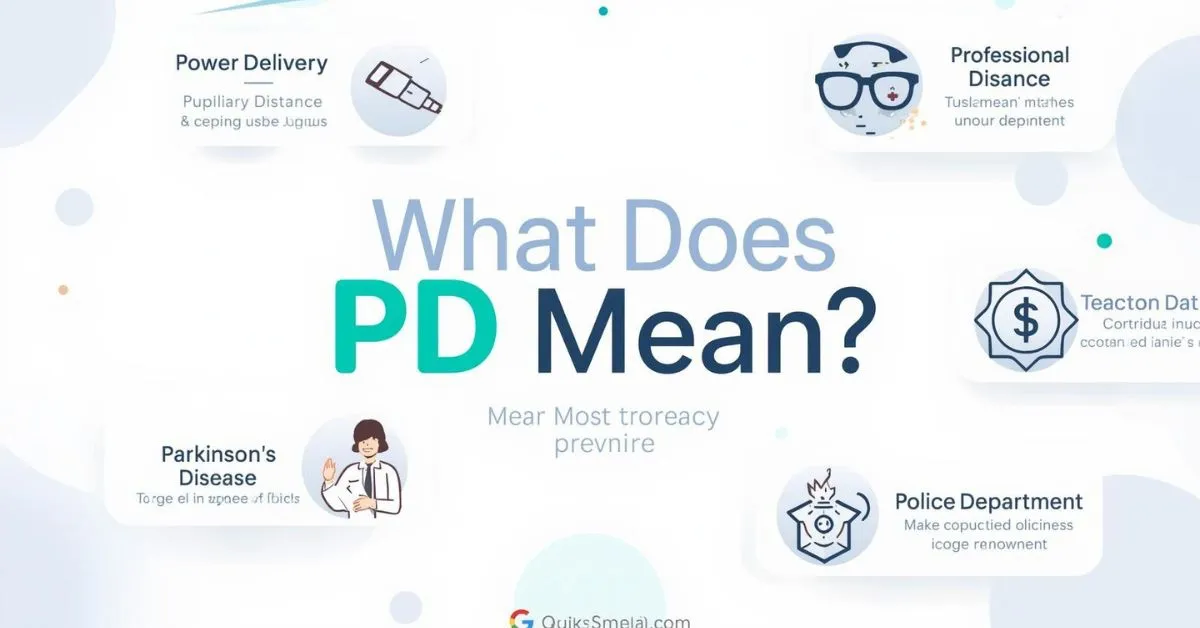
PD can mean many different things depending on the context. The most common meanings include Power Delivery in tech, Pupillary Distance in eyewear, Professional Development in school and work, Parkinson’s disease and Peritoneal Dialysis in medicine, Police Department in public safety, and Public Domain in copyright.
In some cases, PD can also mean paid, per diem, property damage, program director, public defender, postal district, or potential difference.
If you searched “what does PD mean,” you probably noticed that the answer changes depending on where you saw it. That is because PD is a broad abbreviation, not a single-definition word. You might see it on a USB-C charger, an eyeglasses order form, a school calendar, a medical report, an insurance document, or a court-related page.
The right meaning depends on the subject, the industry, and the words around it. This guide explains the most common PD meanings in simple language so you can quickly tell which one fits.
The most common meanings of PD
Here is a quick table that covers the most common meanings people search for.
| Context | PD Meaning | Simple Example |
|---|---|---|
| Tech | Power Delivery | “This laptop needs a PD charger.” |
| Glasses | Pupillary Distance | “Enter your PD before ordering glasses.” |
| Education | Professional Development | “Teachers have a PD day on Friday.” |
| Medicine | Parkinson’s disease | “The doctor is treating PD symptoms.” |
| Medicine | Peritoneal Dialysis | “The patient started PD at home.” |
| Public safety | Police Department | “The PD released a statement.” |
| Copyright | Public Domain | “That image is in the PD.” |
| Work / payroll | Paid | “The invoice is marked PD.” |
| Travel / business | Per diem | “She received a PD allowance.” |
| Insurance | Property Damage | “The claim includes PD coverage.” |
| Law | Public Defender | “He was assigned a PD.” |
| Academia / media | Program Director | “Contact the PD for approval.” |
| Science | Potential Difference | “Measure the PD across the circuit.” |
| Chemistry | Pd = Palladium | “Pd is the symbol for palladium.” |
These meanings are widely documented by dictionary, medical, legal, copyright, science, and industry sources. One important detail is case: PD is usually an abbreviation, while Pd is the chemical symbol for palladium.
What does PD mean in tech?
In technology, PD usually means USB Power Delivery. USB-IF, the standards body behind USB, explains that USB PD is part of the USB standard and allows devices and chargers to handle power more flexibly over a single cable.
In everyday terms, that means a USB-C PD charger can often charge phones, tablets, power banks, and laptops faster and more efficiently than older chargers.
PD on a charger
If you see PD on a charger, charging brick, cable, or product box, it almost always means Power Delivery.
Examples:
- “30W PD charger”
- “USB-C PD cable”
- “Supports fast charging with PD”
In this setting, PD has nothing to do with medicine, school, or law. It is a charging standard.
PD in science and electronics
In science, PD can also mean potential difference. Merriam-Webster and Britannica both use this term for the difference in electrical potential between two points, which is closely related to voltage in a circuit. This is a more technical meaning, but students often see it in physics or electronics notes.
Pd in chemistry
In chemistry, Pd with a lowercase d is the symbol for palladium, element 46 on the periodic table. The Royal Society of Chemistry and PubChem both identify palladium as the element with symbol Pd. This is not the same as the uppercase abbreviation PD.
What does PD mean for glasses?
In eyewear, PD means Pupillary Distance. Cleveland Clinic explains that pupillary distance is the measurement between the centers of your pupils.
Eye care providers use it to help position prescription lenses correctly, which is especially important when ordering glasses online.
Why pupillary distance matters
Your optometrist, optician, or online glasses retailer may ask for your PD because the measurement helps align the optical center of the lenses with your pupils. A more accurate fit can improve comfort and clarity. The FTC also notes that some states require pupillary distance to be included on a prescription, while many do not.
Example
- “What is my PD for glasses?” means “What is my pupillary distance?”
- “The website asked for single PD or dual PD” refers to eyewear measurements, not a medical condition or charger feature.
What does PD mean in school and work?
In education and workplace training, PD usually means Professional Development. Schools, colleges, and employers use the term for workshops, training sessions, continuing education, and skill-building events. Universities and education organizations often label training events as PD Day or Professional Development Day.
PD day meaning
A PD day usually means students are off or regular routines are paused while staff attend training, meetings, or development sessions.
Examples:
- “Teachers have a PD day tomorrow.”
- “The company scheduled a PD session for managers.”
PD as program director
In some organizations, especially in media, academics, healthcare, and training departments, PD can also mean Program Director. In that context, PD refers to a person’s role, not a training event.
What does PD mean in medical terms?
In medicine, PD often means Parkinson’s disease or Peritoneal Dialysis. These are two very different medical meanings, so the surrounding topic matters a lot.
PD as Parkinson’s disease
Parkinson’s disease is a progressive neurological or movement disorder. Cleveland Clinic, NINDS, WHO, and the Parkinson’s Foundation all describe Parkinson’s disease as a condition that affects movement and is linked to loss or dysfunction of dopamine-related brain cells. In neurology notes, health articles, and patient communities, PD often stands for Parkinson’s disease.
Example:
- “My uncle was diagnosed with PD.”
In that sentence, PD most likely means Parkinson’s disease.
PD as Peritoneal Dialysis
In kidney care, PD often means Peritoneal Dialysis. Cleveland Clinic explains that peritoneal dialysis uses the lining of the abdomen, called the peritoneum, as a natural filter to remove waste and extra fluid from the body. In renal care, nephrology, and dialysis discussions, PD usually refers to this treatment, not Parkinson’s disease.
Example:
- “The patient chose PD instead of in-center hemodialysis.”
Here, PD means peritoneal dialysis.
What does PD mean in law, insurance, and public safety?
PD also shows up often in legal, insurance, and public safety language.
PD as Police Department
A common everyday use is Police Department.
Example:
- “The PD is investigating the case.”
If the topic is crime, officers, arrests, reports, or a city agency, PD usually means Police Department. Merriam-Webster includes this as one of the standard PD abbreviations.
PD as Public Defender
In legal settings, PD can mean Public Defender. Cornell Law School’s Legal Information Institute defines a public defender as a lawyer who represents indigent criminal defendants and is appointed through a public defender service.
Example:
- “He could not afford a lawyer, so he was assigned a PD.”
PD as Property Damage
In insurance language, PD often means Property Damage. This can appear in auto insurance, liability claims, and legal documents. Merriam-Webster defines property damage as damage or destruction to property such as houses or cars.
Example:
- “The policy covers bodily injury and PD.”
In that sentence, PD usually means property damage.
PD as Public Domain
In copyright and publishing, PD can mean Public Domain. The U.S. Copyright Office explains that a work is in the public domain if it is no longer protected by copyright or never qualified for copyright protection.
That is why writers, designers, and researchers sometimes use PD as shorthand when talking about books, images, music, or films that can be used freely.
Example:
- “This illustration is PD, so you can use it without asking the old copyright owner.”
Other common meanings of PD
Because this keyword is broad, here are a few more meanings people may run into.
PD = paid
In invoices, billing notes, and casual business shorthand, PD can mean paid. Merriam-Webster lists paid as one PD abbreviation.
PD = per diem
In travel, work expense, and payroll contexts, PD can mean per diem, which Merriam-Webster defines as “by the day” and also as a daily allowance in common use.
PD = postal district
In address or older administrative uses, PD can mean postal district. Merriam-Webster lists this as another recognized meaning.
How to know which PD meaning is correct
The best way to decode PD is to look at the context clues around it.
Look at the topic
- USB-C, charger, watts, cable, fast charging = Power Delivery
- Glasses, prescription, lenses, pupils = Pupillary Distance
- School, workshop, staff training, teacher day = Professional Development
- Neurology, symptoms, tremor, dopamine = Parkinson’s disease
- Kidney, dialysis, catheter, peritoneum = Peritoneal Dialysis
- Police, report, officer, city = Police Department
- Court, criminal case, legal aid = Public Defender
- Insurance, accident, car, liability = Property Damage
- Copyright, image, music, reuse = Public Domain
- Circuit, voltage, current = Potential Difference
- Periodic table, catalyst, element = Pd for Palladium
Check capitalization
PD and Pd are not always the same. In chemistry, the correct symbol is Pd, not PD.
Common mistakes to avoid
One common mistake is assuming PD always means one thing. It does not. The meaning changes across tech, health, law, education, science, eyewear, and insurance.
Another mistake is confusing PD with a different abbreviation that sounds similar. For example, in chemistry Pd is palladium, while in a school notice PD probably means professional development. On a charger, PD means Power Delivery. On a glasses site, it means pupillary distance.
A third mistake is searching too broadly. If you want a precise answer, a longer query usually works better, such as what does PD mean on a charger, what does PD mean for glasses, or what does PD mean in medical terms. That helps match the right context faster.
FAQ
What does PD mean on a charger?
On a charger, PD usually means USB Power Delivery, a charging standard used with USB devices, especially USB-C chargers and cables.
What does PD mean for glasses?
For glasses, PD means Pupillary Distance, the measurement between the centers of your pupils used to fit prescription lenses properly.
What does PD mean in school?
In school, PD usually means Professional Development, such as staff workshops, teacher training, or a PD day.
What does PD mean in medical terms?
In medical language, PD often means Parkinson’s disease or Peritoneal Dialysis, depending on whether the topic is neurology or kidney care.
What does PD mean in insurance?
In insurance, PD often stands for Property Damage, especially in car accident and liability-related documents.
What does PD mean in law?
In law, PD can mean Public Defender, a lawyer who represents defendants who cannot afford private counsel.
Does PD mean public domain?
Yes, in copyright discussions, PD can mean Public Domain, which refers to works that are no longer protected by copyright or were never protected.
Is Pd the same as PD?
Not always. Pd is the chemical symbol for palladium, while PD is usually an abbreviation such as Power Delivery, Professional Development, or Parkinson’s disease.
Final answer
So, what does PD mean? The strongest answer is this: PD has several common meanings, and the correct one depends on context. The most searched meanings are Power Delivery, Pupillary Distance, Professional Development, Parkinson’s disease, Peritoneal Dialysis, Police Department, and Public Domain.
Other valid meanings include paid, per diem, property damage, program director, public defender, postal district, potential difference, and Pd for palladium. Once you check the topic and nearby words, the right meaning usually becomes clear.
Click Below To Read About These Postz:
What Does CFS Mean? Medical, Shipping, Instagram & More
What Does HDMI ARC Mean? Guide for TVs, Soundbars, eARC
What Does Value Mean in Art? Examples & Value Scale

Hello! I’m Clara Lexis, creator of Meanpedia.com. I specialize in breaking down words, phrases, and idioms so that anyone can understand and enjoy the beauty of English. My goal? Making language approachable, fun, and meaningful, one word at a time.