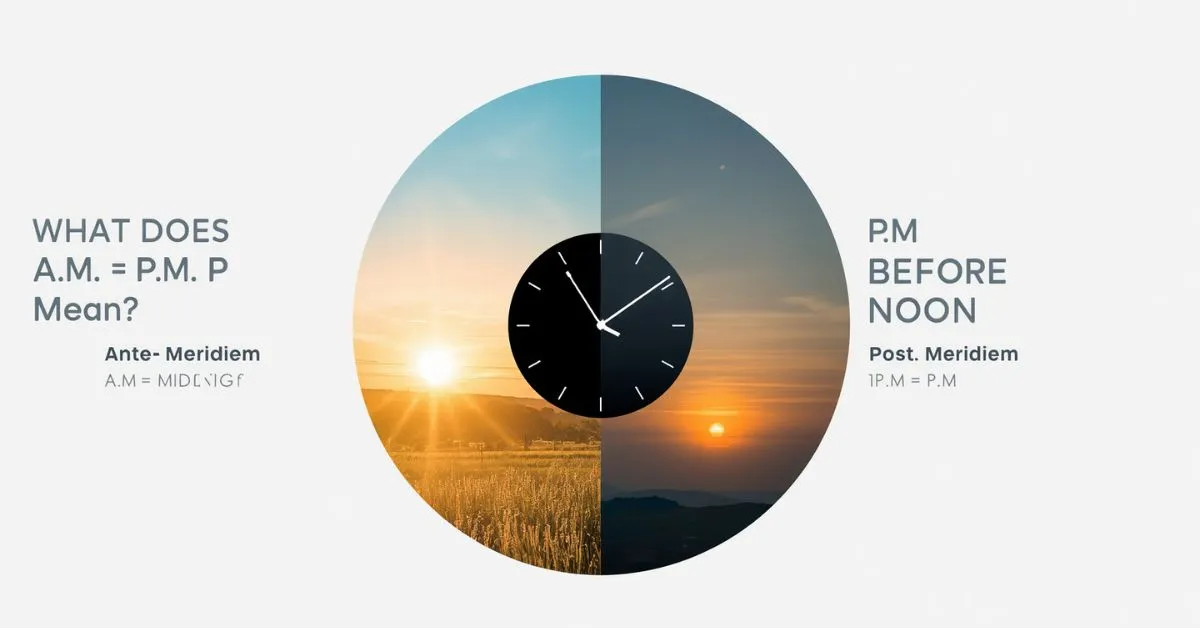
A.M. and P.M. are terms used in the 12-hour clock system to divide the day into two parts. A.M. means ante meridiem, or before noon, and P.M. means post meridiem, or after noon. In simple words, a.m. covers the hours from midnight to before noon, while p.m. covers the hours from noon to before midnight.
If you have ever looked at a digital clock, set an alarm, booked a flight, or checked a meeting time, you have probably seen a.m. and p.m. These two short abbreviations are small, but they are very important. They help people understand whether a time happens in the morning or later in the day.
Many people know the basic idea, but still get confused about 12 a.m., 12 p.m., noon, and midnight. This guide explains everything clearly, with examples, charts, common mistakes, and practical tips.
What Do A.M. and P.M. Stand For?
The full forms are:
- A.M. = ante meridiem
- P.M. = post meridiem
These words come from Latin.
Meaning of ante meridiem
Ante meridiem means before midday or before noon.
So, a.m. refers to the first half of the day, from midnight until just before noon.
Meaning of post meridiem
Post meridiem means after midday or after noon.
So, p.m. refers to the second half of the day, from noon until just before midnight.
This is the simplest answer to the question what does a.m. and p.m. mean.
What Is the Difference Between A.M. and P.M.?
The difference is based on where the time falls in the day.
- A.M. is used for times before noon
- P.M. is used for times after noon
For example:
- 7:00 a.m. = 7 o’clock in the morning
- 7:00 p.m. = 7 o’clock in the evening
The number is the same, but the meaning is completely different because the day is divided into two 12-hour parts.
Quick comparison table
| Term | Full Form | Meaning | Time Range |
|---|---|---|---|
| A.M. | Ante meridiem | Before noon | 12:00 midnight to 11:59 before noon |
| P.M. | Post meridiem | After noon | 12:00 noon to 11:59 at night |
This table helps explain am vs pm meaning in a fast and simple way.
How the 12-Hour Clock Works
The 12-hour clock uses the numbers 1 through 12 twice each day.
That means:
- one cycle is for a.m.
- one cycle is for p.m.
Without a.m. and p.m., it would be hard to know whether 8:00 means morning or night.
First half of the day
The first half starts at 12:00 a.m., which is midnight, and continues until 11:59 a.m.
Examples:
- 1:00 a.m.
- 6:30 a.m.
- 10:45 a.m.
These are all times before noon.
Second half of the day
The second half starts at 12:00 p.m., which is noon, and continues until 11:59 p.m.
Examples:
- 12:30 p.m.
- 3:15 p.m.
- 8:00 p.m.
These are all times after noon.
This system is common in everyday life, especially in countries that use the 12-hour format on phones, alarm clocks, calendars, school schedules, and meeting reminders.
What Does 12 A.M. and 12 P.M. Mean?
This is the part that causes the most confusion.
12 a.m. means midnight
12:00 a.m. is midnight. It marks the start of a new day.
Examples:
- 12:00 a.m. Monday = the very start of Monday
- 12:10 a.m. = ten minutes after midnight
12 p.m. means noon
12:00 p.m. is noon. It is the middle of the day.
Examples:
- 12:00 p.m. = lunchtime
- 12:30 p.m. = half an hour after noon
Best way to avoid confusion
For important writing, many style experts and time references prefer using:
- noon
- midnight
instead of only writing 12 p.m. or 12 a.m.
That makes schedules, event times, deadlines, and invitations much clearer.
For example:
- Better: The deadline is midnight
- Better: The meeting starts at noon
This avoids mistakes in time notation.
Why Do We Use A.M. and P.M.?
We use a.m. and p.m. because the 12-hour clock repeats the numbers 1 to 12 twice every day.
If someone says:
- “Meet me at 6:00”
you still do not know whether they mean:
- 6:00 a.m. in the morning
- 6:00 p.m. in the evening
That is why a.m. and p.m. are useful in:
- work schedules
- travel bookings
- class timetables
- doctor appointments
- alarms
- delivery times
- digital calendars
These terms make timekeeping more accurate in daily life.
A.M. and P.M. Examples in Real Life
Real examples help readers understand the meaning faster.
Daily routine examples
| Time | Meaning |
|---|---|
| 6:00 a.m. | Wake up |
| 8:00 a.m. | School or office starts |
| 12:00 p.m. | Lunch break |
| 2:30 p.m. | Afternoon class |
| 6:00 p.m. | Dinner time |
| 10:00 p.m. | Sleep time |
Travel examples
- A train leaving at 5:45 a.m. leaves early in the morning
- A movie at 9:30 p.m. starts at night
- A flight at 12:15 a.m. leaves shortly after midnight
Alarm examples
If you set your phone alarm for 7:00 p.m. instead of 7:00 a.m., you may miss work or school.
That is why understanding what does am and pm stand for is more practical than many people think.
A.M. and P.M. vs the 24-Hour Clock
The 24-hour clock is another time system. It does not use a.m. or p.m. Instead, it counts from 00:00 to 23:59.
This format is common in:
- hospitals
- military time
- transport systems
- airlines
- train stations
- international schedules
12-hour clock vs 24-hour clock
| 12-Hour Time | 24-Hour Time |
|---|---|
| 12:00 a.m. | 00:00 |
| 1:00 a.m. | 01:00 |
| 6:00 a.m. | 06:00 |
| 12:00 p.m. | 12:00 |
| 1:00 p.m. | 13:00 |
| 5:00 p.m. | 17:00 |
| 9:00 p.m. | 21:00 |
| 11:59 p.m. | 23:59 |
Why the 24-hour clock can be easier
The 24-hour clock removes confusion because each hour appears only once.
For example:
- 7:00 a.m. becomes 07:00
- 7:00 p.m. becomes 19:00
Still, the 12-hour clock remains more common in everyday conversation.
How to Write A.M. and P.M. Correctly
Many people also search for the correct writing style.
You may see these versions:
- a.m. / p.m.
- AM / PM
- am / pm
All are widely understood, but the most important rule is consistency.
Common writing styles
- In formal writing, many style guides use a.m. and p.m.
- In digital interfaces and casual writing, AM and PM are also common
Correct examples
- 8:00 a.m.
- 3:15 p.m.
- 11:30 AM
- 6:45 PM
Incorrect or unnecessary examples
- 8:00 a.m. in the morning
- 9:00 p.m. at night
These repeat the same meaning twice.
A cleaner way is:
- 8:00 a.m.
- 9:00 p.m.
or
- 8:00 in the morning
- 9:00 at night
Not both together.
Common Mistakes to Avoid
A strong article should also show readers what not to do.
Mistake 1: Confusing 12 a.m. and 12 p.m.
This is the biggest one.
- 12 a.m. = midnight
- 12 p.m. = noon
Mistake 2: Leaving out a.m. or p.m.
If a time could be unclear, include the label.
Bad:
- Meeting at 8:00
Better:
- Meeting at 8:00 a.m.
Mistake 3: Mixing 12-hour and 24-hour styles
Do not write something like:
- 18:00 p.m.
That is incorrect because the 24-hour clock does not use p.m.
Mistake 4: Using the wrong time for alarms or bookings
One wrong letter can change the time by 12 hours. This is common with:
- alarms
- calendar reminders
- travel bookings
- online appointments
Easy Tricks to Remember A.M. and P.M.
If you want a simple memory trick, these help:
A.M. reminder
Think:
- A.M. = after midnight
- morning hours happen in a.m.
This is not the literal Latin definition, but it helps many people remember it.
P.M. reminder
Think:
- P.M. = past midday
- afternoon and evening happen in p.m.
Best memory shortcut
Remember these two lines:
- A.M. is before noon
- P.M. is after noon
That is enough for most situations.
Why This Topic Still Matters Today
Even with smartphones, smartwatches, and automatic calendars, people still need to understand basic clock language.
A.m. and p.m. appear in:
- email invites
- office meetings
- train times
- school timetables
- event tickets
- medication schedules
- mobile phone alarms
- world clock apps
They also matter when dealing with time zones, especially in international communication. If someone says a meeting is at 9:00 a.m. EST, you need to understand both the time label and the time zone to join at the correct moment.
So this is not just a school question. It is a real-world skill.
Practical Takeaways
Here are the most important points to remember:
- A.M. means ante meridiem
- P.M. means post meridiem
- A.M. = before noon
- P.M. = after noon
- 12 a.m. = midnight
- 12 p.m. = noon
- The 12-hour clock uses a.m. and p.m.
- The 24-hour clock does not
- Use noon and midnight for extra clarity when needed
FAQ
What does a.m. mean in time?
A.M. means ante meridiem, which means before noon. It covers the hours from midnight to 11:59 before noon.
What does p.m. mean in time?
P.M. means post meridiem, which means after noon. It covers the hours from 12:00 noon to 11:59 at night.
What do a.m. and p.m. stand for?
They stand for the Latin phrases ante meridiem and post meridiem.
Is 12 a.m. midnight?
Yes. 12 a.m. means midnight, which is the start of a new day.
Is 12 p.m. noon?
Yes. 12 p.m. means noon, which is the middle of the day.
What is the difference between a.m. and p.m.?
The difference is simple: a.m. is before noon, and p.m. is after noon.
Why do we use a.m. and p.m.?
We use them in the 12-hour clock system to show whether a time happens in the first half or second half of the day.
How do you avoid confusion between 12 a.m. and 12 p.m.?
The easiest way is to remember:
- 12 a.m. = midnight
- 12 p.m. = noon
In important writing, use midnight and noon instead.
Conclusion
So, what does a.m. and p.m. mean? A.M. means before noon, and P.M. means after noon. The full forms are ante meridiem and post meridiem, and they are used in the 12-hour clock to separate the day into two halves. Once you understand that, reading times on a digital clock, analog clock, calendar, or schedule becomes much easier. If you are writing an important time, use noon and midnight when possible for better clarity.
Click Below To Read About These Articles:
What Does OTE Mean in Sales? Salary, Commission, and Examples
What Does CFS Mean? Medical, Shipping, Instagram & More
What Does HDMI ARC Mean? Guide for TVs, Soundbars, eARC

Hi, I’m Evan Lexor, the voice behind Meanpedia.com. I break down English words, slang, and phrases into clear, simple meanings that actually make sense. From modern internet terms to everyday expressions, my goal is straightforward: help you understand English better, faster, and with confidence, one word at a time.