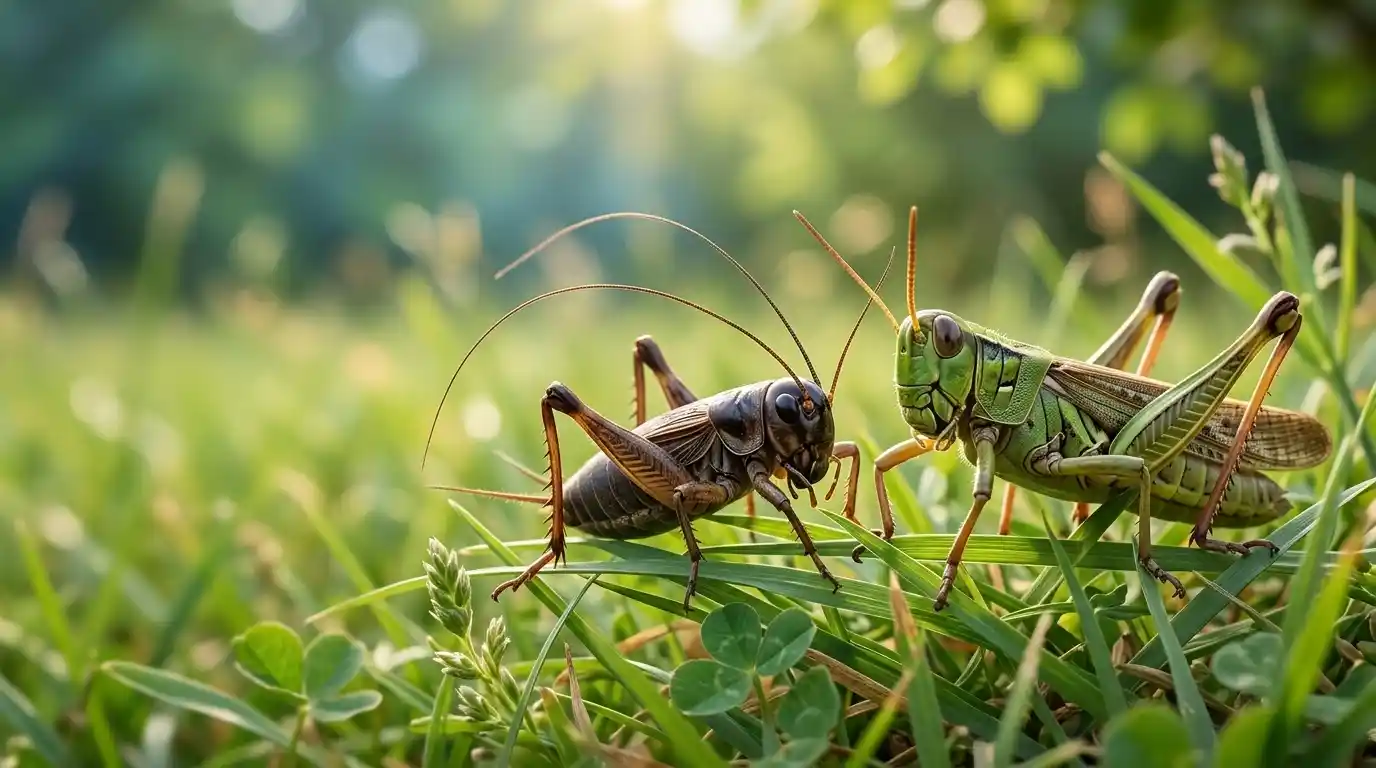
The main difference between a grasshopper and a cricket is their anatomy and behavior. Grasshoppers usually have short antennae, powerful jumping legs, and are active mainly during the day. Crickets typically have long, thin antennae, are more active at night, and produce their familiar chirping sound by rubbing their wings together. Both belong to the insect order Orthoptera.
Key Takeaways
- Grasshoppers generally have short antennae, while crickets have long, thread-like antennae.
- Grasshoppers usually make sounds by rubbing their hind legs against their wings; crickets rub their wings together.
- Grasshoppers are commonly active during the day, while many crickets are most active at night.
- Grasshoppers mainly eat plant material, while many crickets have a more varied diet.
- Both are jumping insects in the order Orthoptera, but they belong to different major groups.
What Is the Difference Between a Grasshopper and a Cricket?
Grasshoppers and crickets are easy to confuse because both have large hind legs, chewing mouthparts, wings, and the ability to jump. They are also closely related members of the order Orthoptera.
However, they are not the same type of insect. Grasshoppers are generally placed in the suborder Caelifera, while true crickets belong to Ensifera. Their antennae, sound-producing structures, hearing organs, activity patterns, and typical diets provide useful ways to tell them apart.
If you only have a few seconds to identify one, look at the antennae first. Short, relatively stout antennae point toward a grasshopper. Very long, thin antennae are a strong clue that you are looking at a cricket.
Grasshopper vs Cricket: Quick Comparison
| Feature | Grasshopper | Cricket |
|---|---|---|
| Major group | Caelifera | Ensifera |
| Antennae | Usually short | Usually long and thin |
| Activity | Mostly daytime | Often evening or nighttime |
| Sound | Often a rasping or buzzing sound | Familiar chirping sound |
| Sound production | Hind leg against wing in many species | Forewings rubbed together |
| Ears | Sides of first abdominal segment | Front legs |
| Diet | Primarily plant material | Often more varied |
| Habitat | Fields, meadows, grasslands, gardens | Grass, leaf litter, burrows, gardens, buildings |
| Jumping | Powerful | Powerful, but generally less specialized |
| Young | Nymph | Nymph |
These are general patterns rather than rules that apply to every species. Orthoptera includes a wide variety of insects with different adaptations.
How to Tell a Grasshopper From a Cricket
Antennae
Antennae are one of the easiest visual clues.
Grasshoppers generally have shorter, stouter antennae, while crickets usually have long, delicate, thread-like antennae that can be as long as or longer than the body. This difference is especially useful when you are trying to identify an insect from a photograph.
There are exceptions among the broader groups, so antenna length should be used alongside other characteristics rather than as an absolute rule.
Body and Legs
Grasshoppers are typically built around powerful hind legs designed for jumping. Their bodies are often relatively elongated, and many species blend into grass, soil, or vegetation.
Crickets can have a more compact appearance and are commonly brown, black, or mottled, although color varies considerably among species.
Both insects have six legs and enlarged hind legs. Their strong jumping ability is one reason people frequently mistake one for the other.
Sound
Their sounds provide another useful clue.
Many grasshoppers produce sound through stridulation, often by moving a specialized part of a hind leg against a wing. Depending on the species, the result may sound like a buzz, rasp, or brief series of clicks. Smithsonian sources describe grasshoppers as using specialized structures on their hind legs and wings to produce these sounds.
Crickets produce their familiar chirping differently. Male crickets generally rub specialized areas of their front wings against each other, creating vibrations that produce the recognizable cricket song. These calls are commonly associated with attracting mates and communicating with other crickets.
So, as a simple rule:
Grasshopper = often rasping or buzzing.
Cricket = often rhythmic chirping.
Ears and Hearing
One of the most surprising differences is where these insects hear.
Crickets have tympanal hearing organs on their front legs, near the tibia. These structures detect vibrations and sounds produced by other crickets.
Grasshoppers have their auditory organs on the sides of the first abdominal segment instead. In other words, neither insect has ears positioned like human ears on the sides of the head.
This difference is particularly useful for understanding how two closely related groups evolved different ways to communicate and detect sound.
Grasshopper vs Cricket: Habitat and Activity
Grasshoppers are commonly associated with open, sunny environments such as grasslands, meadows, fields, farms, and gardens. Many species are most active during daylight hours, when they can move among vegetation and warm themselves.
Crickets are often associated with vegetation, soil, leaf litter, cracks, burrows, and other sheltered locations. Some species also live around homes and other buildings. Many crickets are most active during the evening or at night, which is why their songs are often heard after dark.
This difference can help when you hear an insect before you see it. A loud, repetitive chirp coming from a dark garden at night is more likely to be a cricket than a typical grasshopper.
Still, time of day is not a perfect identification method. Species vary, and some orthopterans are active outside these general patterns.
What Do Grasshoppers and Crickets Eat?
Grasshoppers are primarily plant feeders. Depending on the species, they may consume grasses, leaves, stems, flowers, and other plant material.
Crickets generally have a more flexible diet. Many feed on plant matter and may also consume fungi, decaying organic material, or small insects. North Carolina State University describes true crickets as herbivores and scavengers, while some related cricket groups have more specialized feeding habits.
This broader diet helps explain why crickets can live in such different environments, including natural habitats and human structures.
Are Grasshoppers and Crickets Related?
Yes. Grasshoppers and crickets are related because both belong to the order Orthoptera.
However, they are separated into different major groups. Grasshoppers are generally associated with Caelifera, while true crickets belong to Ensifera. Ensifera also includes other long-horned orthopterans such as katydids and related groups.
This relationship explains why grasshoppers and crickets share characteristics such as:
- Six legs
- Enlarged hind legs
- Chewing mouthparts
- Wings in many species
- Jumping ability
- Sound-based communication in many species
- Incomplete metamorphosis
Their young are called nymphs. Unlike butterflies and moths, they do not pass through a pupal stage.
Grasshopper vs Cricket: Common Misconceptions
One common misconception is that every jumping, chirping insect is a cricket. In reality, Orthoptera contains many different groups, including grasshoppers, crickets, katydids, and other relatives.
Another misconception is that grasshoppers and crickets have completely different lifestyles. In reality, their habitats can overlap. You can find both groups around vegetation, gardens, and grassland.
It is also incorrect to assume that every grasshopper is green or every cricket is black. Color varies significantly between species and can be influenced by camouflage and habitat.
Finally, locusts are not a type of cricket. Locusts are grasshoppers that can exhibit distinctive population-related behavioral and physical changes under particular environmental and population conditions. They remain grasshoppers.
Frequently Asked Questions
Do grasshoppers and crickets make the same sound?
No. Many crickets create their characteristic chirps by rubbing their forewings together. Many grasshoppers instead produce sounds by rubbing specialized structures on their hind legs against their wings. The exact sound varies by species, and not every species uses the same sound-producing behavior.
Which has longer antennae, a grasshopper or cricket?
Crickets generally have much longer and thinner antennae than grasshoppers. Grasshopper antennae are usually shorter and more robust. If you can clearly see the antennae, this is one of the quickest ways to distinguish the two groups.
Where are a cricket’s ears?
A cricket’s hearing organs are located on its front legs, specifically on the tibiae. These tympanal organs detect sound vibrations and help crickets respond to the calls of other individuals.
Is a locust a grasshopper or a cricket?
A locust is a grasshopper, not a cricket. The term refers to grasshopper species that can undergo particular changes in behavior, appearance, and population dynamics associated with high population density and environmental conditions.
Can grasshoppers and crickets fly?
Many grasshoppers can fly, although their flight ability varies by species. Many crickets have wings as well, but some have reduced wings or are poor fliers. Wing structure and flight ability therefore depend on the species rather than simply whether the insect is called a grasshopper or cricket.
Conclusion
The easiest way to understand grasshopper vs cricket is to focus on a few major clues. Grasshoppers generally have short antennae, powerful hind legs, plant-based diets, and greater daytime activity. Crickets usually have long antennae, distinctive nighttime chirps, and hearing organs on their front legs.
Both belong to Orthoptera and share important traits, including jumping legs and incomplete metamorphosis. But their different anatomy, sounds, habitats, and behaviors make them distinct groups of insects. If you see one in your yard, check the antennae first, then consider the sound, activity time, and body shape to make a quick identification.

Hi, I’m Evan Lexor, the voice behind Meanpedia.com. I break down English words, slang, and phrases into clear, simple meanings that actually make sense. From modern internet terms to everyday expressions, my goal is straightforward: help you understand English better, faster, and with confidence, one word at a time.