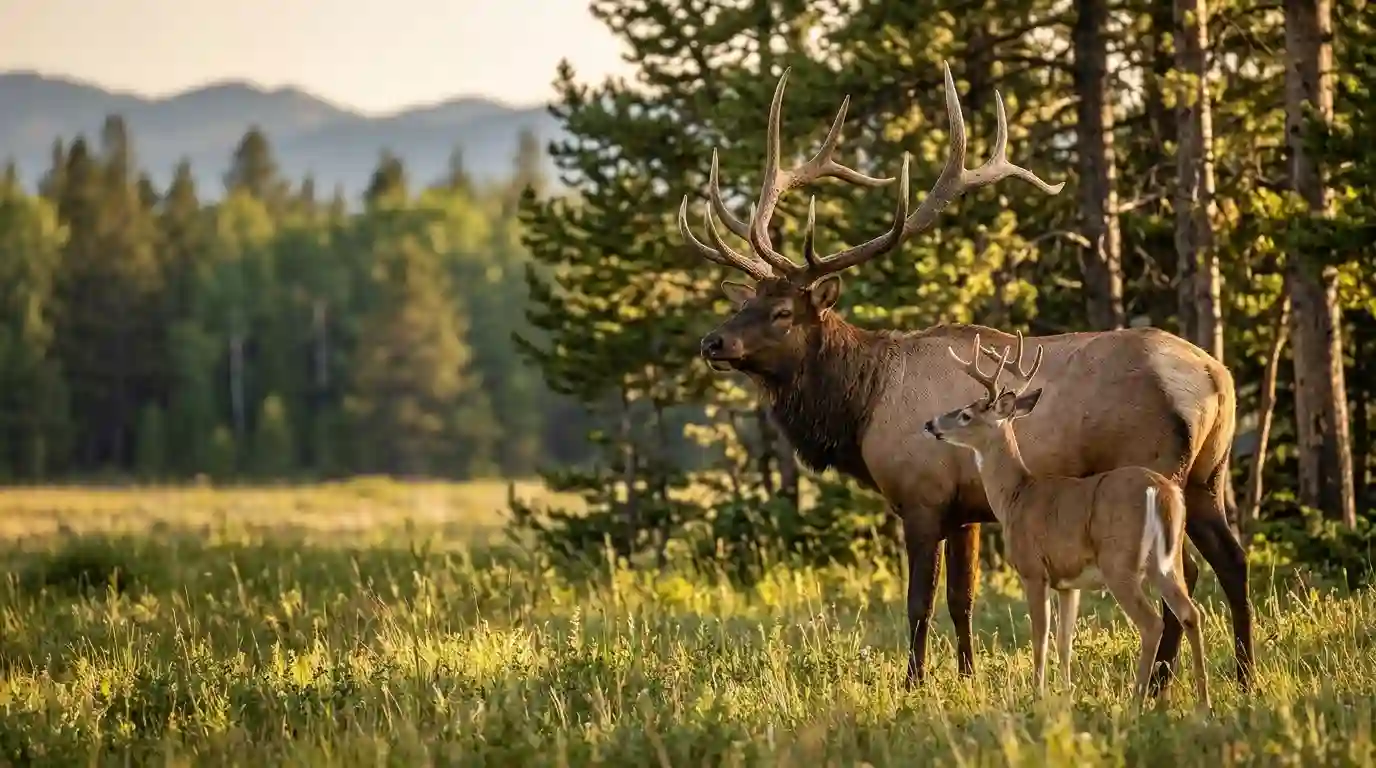
Elk are technically deer because they belong to the Cervidae, or deer, family. However, elk are a distinct species and are much larger than common North American deer such as white-tailed and mule deer. They also differ in body shape, antler structure, coloration, habitat use, diet, and social behavior.
Key Takeaways
- Elk are deer biologically, but they are a separate species from white-tailed and mule deer.
- Elk are generally much larger and taller than common North American deer.
- Bull elk have large, sweeping antlers, while deer antlers are generally smaller and have different branching patterns.
- Elk commonly use open meadows, grasslands, forests, and mountain environments, while deer are highly adaptable to forests, farmland, wetlands, and other habitats.
- Elk often form large herds, while deer social behavior varies by species, season, and sex.
Are Elk Deer?
Yes. This is the first important point in understanding elk vs deer.
The word deer can be used in two ways. Scientifically, deer refers to members of the Cervidae family, which includes elk, white-tailed deer, mule deer, moose, caribou, and other species. In everyday American English, however, people often use “deer” to mean smaller species such as white-tailed deer or mule deer.
That means the statement “all elk are deer, but not all deer are elk” is biologically accurate.
Elk are known scientifically as Cervus canadensis. They are a distinct species within the deer family, not simply a larger version of a white-tailed or mule deer.
Elk vs Deer: Quick Comparison
| Feature | Elk | Common North American Deer |
|---|---|---|
| Family | Cervidae | Cervidae |
| Common species | Elk (Cervus canadensis) | White-tailed or mule deer |
| Size | Much larger | Generally smaller |
| Male | Bull | Buck |
| Female | Cow | Doe |
| Antlers | Large, long, sweeping | Usually smaller and more variable |
| Body | Tall, heavy, long-legged | Smaller and more compact |
| Typical diet | Grasses, forbs, browse | Leaves, twigs, fruits, nuts, forbs |
| Social behavior | Often found in herds | Varies by species and sex |
| Common habitat | Meadows, grasslands, forests, mountains | Forests, farmland, wetlands, shrublands |
The exact measurements vary by species, sex, age, nutrition, and geographic location, so these differences should be used as identification guides rather than rigid rules. For example, Minnesota DNR lists mature male elk at roughly 700–900 pounds and 4½–5 feet at the shoulder, compared with 100–300 pounds for male white-tailed deer.
Size and Body Shape
One of the easiest ways to distinguish an elk from a typical deer is overall size.
Elk
Elk have a large, powerful body with long legs and a relatively tall shoulder. Adult bulls can become particularly massive. At Grand Canyon National Park, for example, bull elk can reach about 700 pounds and may outweigh mule deer by hundreds of pounds.
Elk also have a noticeably large neck and shoulders, especially mature males during the breeding season.
Deer
Common U.S. deer are considerably smaller. White-tailed deer are usually much shorter at the shoulder and lighter in body weight. The National Park Service notes that white-tailed deer are widespread throughout most of the continental United States and are highly adaptable to different habitats.
Simple rule: If you see a deer-sized animal that looks unusually tall, heavy, and long-legged, it may be an elk.
Size alone should not be your only clue, though. Young elk can look surprisingly deer-like, and unusually large deer can create confusion at a distance.
Antlers and Appearance
Antlers provide another useful clue when comparing elk and deer.
Both elk and many deer grow antlers. Antlers are made of bone and are generally grown and shed annually. During growth, they are covered in a soft tissue called velvet, which supplies nutrients to the developing antler.
Elk Antlers
Mature bull elk develop large antlers with substantial main beams and multiple tines. Their antlers typically sweep backward and upward, creating a broad silhouette.
The U.S. Fish & Wildlife Service notes that elk antlers can reach around four feet in length and spread, with individual antlers in large bulls weighing many pounds.
Deer Antlers
Deer antlers are generally smaller, although their exact shape depends on the species.
White-tailed deer commonly have antlers with a main beam and upward-pointing tines. Mule deer have a distinctive tendency toward forked antlers, which can help identify them in the western United States.
Minnesota DNR describes mature white-tailed deer antlers as having tines projecting upward, while mature elk have heavier beams that sweep backward.
Keep in mind that females of most North American deer species do not normally grow antlers, so antlers are primarily useful for identifying males.
Habitat and Range
Elk and deer can occupy some of the same landscapes, but their typical habitat use differs.
Elk are highly adaptable and can live in grasslands, shrublands, forests, mountain environments, and areas where open feeding habitat is close to cover. The U.S. Forest Service describes elk habitat as a mixture of open areas used for feeding and forested areas used for cover.
White-tailed deer are even more broadly distributed across the United States. They can live in forests, farmland, river corridors, wetlands, and suburban environments when sufficient food, water, and cover are available.
Mule deer are particularly associated with the western United States and are well adapted to many dry and rocky landscapes.
So, seeing a large deer-like animal in an open mountain meadow makes elk a strong possibility, while a smaller animal near woodland, farmland, or thick vegetation may be a white-tailed deer.
Diet and Feeding Behavior
Both elk and deer are herbivorous ruminants, but they do not always eat the same plants or feed in the same way.
Elk are often associated with grazing. They commonly consume grasses and forbs but can also browse leaves, stems, shrubs, and other vegetation. Their diet changes with season, weather, snow conditions, and food availability.
Deer, especially white-tailed deer, are commonly described as browsers. Their diets can include leaves, twigs, fruits, nuts, acorns, grasses, and many other plants.
This distinction is useful, but it should not be treated as absolute. Elk can browse, particularly when conditions make grasses less available, and deer can eat grasses and other herbaceous plants.
In areas where elk and deer live together, their feeding strategies can reduce competition during much of the year. Rocky Mountain National Park notes that deer tend to browse while elk often graze, although the two can compete for food when winter conditions become difficult.
Social Behavior and the Rut
Elk are well known for their social behavior. They commonly travel in herds, although adult bulls may become more solitary at certain times.
During the breeding season, called the rut, bull elk compete for access to females and produce a distinctive loud call known as a bugle. This is one of the most recognizable sounds associated with elk.
Deer also have a rut, but the timing and behavior vary by species and location. White-tailed deer, for example, commonly breed in autumn, with rut timing varying across regions.
The sound of a bugling elk can therefore be a useful field clue. If you hear a loud, high-pitched bugle coming from a large herd in elk country, you are almost certainly hearing an elk rather than a typical white-tailed deer.
How to Tell an Elk From a Deer in the Wild
If you encounter one at a distance, look for several characteristics rather than relying on one feature.
1. Check the size.
Elk are much taller and heavier than common white-tailed deer.
2. Look at the body shape.
Elk have long legs, large shoulders, and a substantial neck. Deer look smaller and more compact.
3. Examine the rump.
Elk commonly have a conspicuously pale or yellowish rump area, while white-tailed deer have the familiar white underside of the tail.
4. Look at the antlers.
Large, sweeping antlers on a tall animal strongly suggest a bull elk. Deer antlers are usually smaller and shaped differently.
5. Consider the habitat.
Open meadows, grasslands, mountain valleys, and forest edges are common elk environments, while deer can occur across an extremely broad range of habitats.
6. Listen.
A bull elk’s bugle is a distinctive clue that is not associated with ordinary white-tailed deer behavior.
Elk vs White-Tailed Deer vs Mule Deer
It is useful to remember that “deer” in a U.S. comparison may refer to more than one species.
Elk: The largest of these three, with a tall body, large antlers in males, and a pale rump.
White-tailed deer: Smaller and widespread across the United States. The white underside of the tail is a major identification feature.
Mule deer: Another common western species. They are generally larger than some white-tailed deer but still much smaller than elk, and their large ears and forked antlers can help distinguish them.
All three belong to the deer family, but they are different species with different physical characteristics and ecological adaptations.
Frequently Asked Questions
Are elk considered deer?
Yes. Elk belong to the Cervidae, or deer, family. However, elk are a distinct species rather than the same species as white-tailed deer or mule deer. In everyday American speech, “deer” often refers specifically to those smaller species.
Is an elk bigger than a deer?
Yes, elk are generally much larger than common North American deer. A mature bull elk can weigh several hundred pounds more than a typical white-tailed deer and can stand around five feet at the shoulder in some populations.
Are elk and deer the same species?
No. Elk and species such as white-tailed deer and mule deer are separate species. They are related because they belong to the same biological family, Cervidae.
Can elk and deer live together?
Yes. Elk and deer can occupy the same landscapes and sometimes use the same habitats. Their diets and feeding strategies can differ, allowing them to coexist, although competition can increase when food becomes limited, especially during difficult winters.
Conclusion
The easiest way to understand elk vs deer is to separate biological classification from everyday language. Elk are members of the deer family, so they are technically deer. But elk are a distinct species and are much larger than the white-tailed and mule deer that Americans commonly mean when they simply say “deer.”
When identifying an animal, focus on several clues: size, body shape, antlers, rump coloration, habitat, diet, and behavior. A tall, heavy animal with large sweeping antlers and a pale rump is likely an elk, while smaller animals with species-specific features such as the white tail of a white-tailed deer or the forked antlers of a mule deer point toward other deer species.

Hello! I’m Clara Lexis, creator of Meanpedia.com. I specialize in breaking down words, phrases, and idioms so that anyone can understand and enjoy the beauty of English. My goal? Making language approachable, fun, and meaningful, one word at a time.