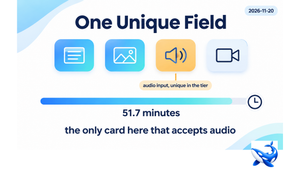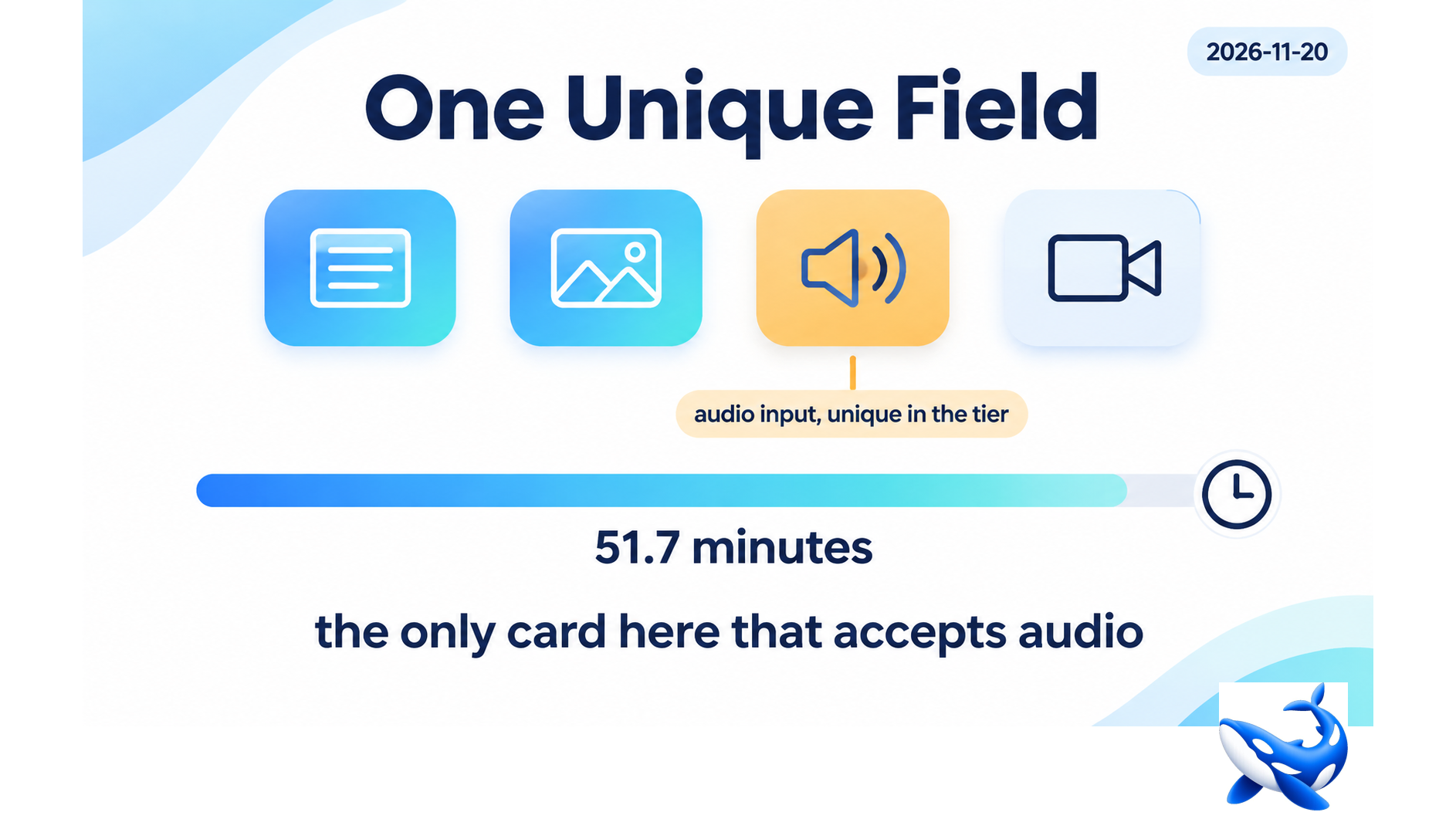
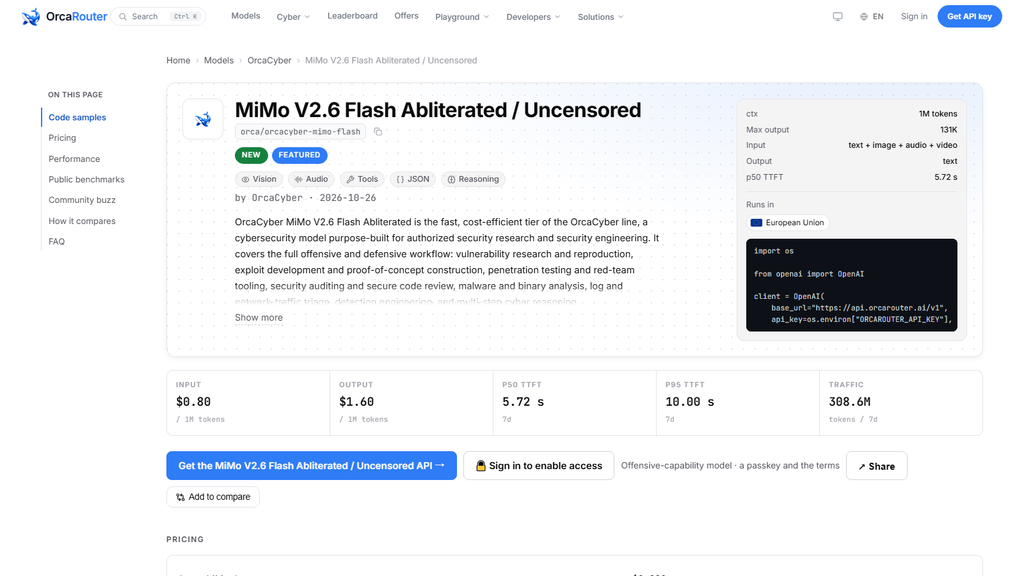
Audio is the one input modality no other card in this tier accepts, and it is published alongside a 1,048,576-token window. OrcaRouter lists the modalities and the parameters on the same card. They are on OrcaCyber MiMo V2.6 Flash capabilities, and together they describe a card with a narrow, specific fit.
Modalities across the tier
| input modalities | cards |
| text, image, video, audio | MiMo V2.6 Flash |
| text, image, video | GLM 5.3 Flash · K3.1 Pro · MiniMax M3.1 Flash · Qwen3.8 Flash Next |
| text, image | Flash 1.0 · Hy4 · Hy4 Flash · OrcaC2 1.0 |
| text | GLM 5.3 · Ultra 1.0 · Zero 1.0 · Zero 1.5 |
Thirteen cards, four modality profiles, and exactly one card in the widest column.
Audio input on a security tier is not a novelty. Phone-call recordings, incident bridge calls, dictation from a site visit, voicemail left with a support desk — all of them carry text that has to be in the pipeline, and every other card here needs a transcription step in front.
That step costs money, adds latency and introduces a place for a silent error. A card that reads audio directly removes it.
The counter-argument is equally simple: a workload with no audio gains nothing from the field. Most pipelines have none, which is consistent with this card’s 0.31 billion tokens of weekly traffic.
The ceiling and the rate together
| card | ceiling | tok/s | fill |
| Hy4 Flash | 65,536 | 182.1 | 6.0 min |
| Hy4 | 65,536 | 135.1 | 8.1 min |
| Zero 1.0 | 128,000 | 240.2 | 8.9 min |
| Zero 1.5 | 128,000 | 195.6 | 10.9 min |
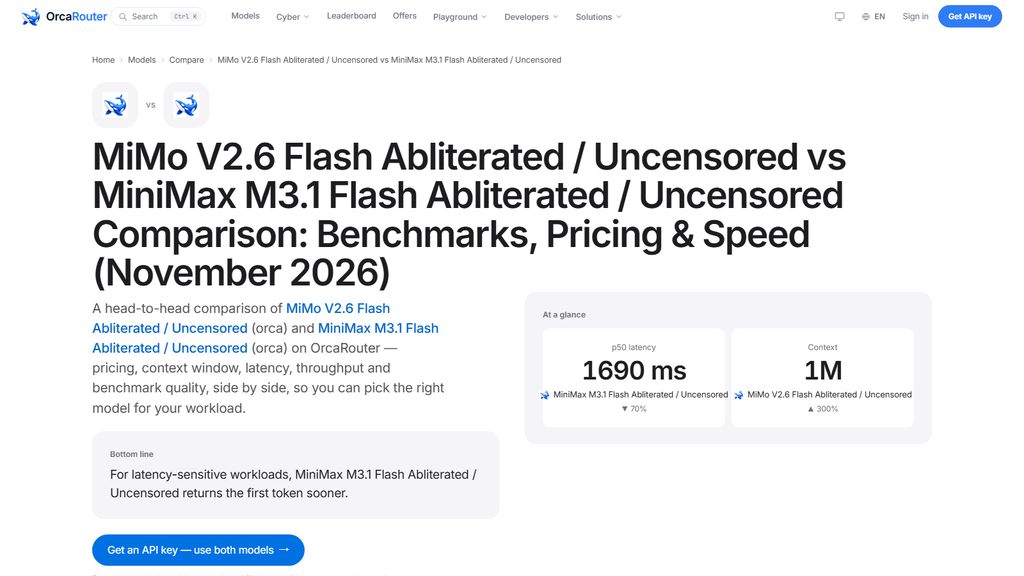
| MiniMax M3.1 Flash | 131,072 | 110.3 | 19.8 min |
| Ultra 1.0 | 131,072 | 109.2 | 20.0 min |
| GLM 5.3 | 128,000 | 91.6 | 23.3 min |
| Qwen3.8 Flash Next | 131,072 | 91.0 | 24.0 min |
| Flash 1.0 | 393,216 | 210.9 | 31.1 min |
| GLM 5.3 Flash | 131,072 | 66.4 | 32.9 min |
| MiMo V2.6 Flash | 131,072 | 51.7 | 51.7 min |
| K3.1 Pro | 943,718 | 81.4 | 193.2 min |
Fifty-one point seven minutes is the longest run of any card with a ceiling under 200,000 tokens. A transcript of a long recording is exactly the kind of job that would produce a large output on this card, and it is the kind of job that would take it an hour.
That tension is worth naming. The card’s unique capability is audio input, and audio input tends toward long transcripts, and long transcripts run into the slowest generation rate in the tier.
A one-hour recording transcribes to roughly 9,000 words, or about 12,000 tokens. At 42.3 tokens a second that is 4.7 minutes of generation, not 52. So the ceiling run is a theoretical maximum rather than a typical audio workload.
At realistic transcript lengths the card is workable. At the ceiling it is not, and the ceiling is what a buyer should size a timeout against.
The published scores
| benchmark | score |
| CyberGym | 95.1 |
| Terminal-Bench 2.1 | 87.6 |
| DeepSWE v1.1 | 67.9 |
| SEC-Bench Pro | 47.5 |
Four rows, and the profile is the mirror image of Qwen3.8 Flash Next’s. This card scores 95.1 on the cyber-specific test — the highest of the three cards publishing CyberGym — and 47.5 on repository-level security repair.
| test | MiMo V2.6 Flash | others publishing it |
| CyberGym | 95.1 | Flash 1.0 88.1 · Hy4 Flash 81.1 · Zero 1.0 98.07 (Level 1 pass@1) |
| Terminal-Bench 2.1 | 87.6 | Flash 1.0 90.6 · GLM 5.3 Flash 84.3 · Hy4 Flash 83.4 |
| SEC-Bench Pro | 47.5 | Flash 1.0 62.8 · Hy4 Flash 57.8 |
| DeepSWE v1.1 | 67.9 | Flash 1.0 74.2 · Hy4 Flash 68.3 · Qwen3.8 Flash Next 58.7 |
On CyberGym this card is second behind Zero 1.0’s differently-versioned row and ahead of both Flash cards. On the other three it is mid-pack or third.
So the published evidence says the card is strong at recognising and reasoning about vulnerabilities and weaker at repairing them across a repository — the same split Qwen3.8 Flash Next shows, at a different price point and with audio input on top.
The narrow-fit case, stated plainly
| what a buyer needs | does this card serve it |
| audio input with no transcription step | yes, uniquely in this tier |
| long input, up to a million tokens | yes |
| long output, up to 131,072 tokens | yes, at 51.7 minutes |
| fast first token | no, 5,757 ms median |
| high throughput | no, 42.3 tokens a second |
| repository-scale repair | weak, SEC-Bench Pro 47.5 |
| a published security score | yes, CyberGym 95.1 |
Three yes, three no, one weak. That table is the card’s whole published case, and it is a niche rather than a general recommendation.
The fit is a pipeline that must ingest audio, works on inputs under a million tokens, and can tolerate a slow first token. For that pipeline this card is the only option in the tier and its price is the band’s.
For every other pipeline the published fields point at a faster sibling on the same row. That is not a criticism of the card; it is what happens when one field is unique and the rest are ordinary.
The parameters, read as a capability list
Twenty supported parameters is joint-second in the tier, and the list is where the card’s other capabilities live.
| field | value |
| supported parameters | 20 |
| input modalities | text, image, audio, video |
| window | 1,048,576 |
| ceiling | 131,072 |
| capabilities | vision, audio, tools, json, reasoning |
| quality score | 8 / 10 |
Five capability tags is the widest list in the tier. Only this card carries `audio`, and four others carry `vision` without it.
A parameter surface of 20 means the API exposes most of what a caller might want to control — sampling, stop conditions, tool definitions, structured output. Eleven parameters, as on GLM 5.3 and K3.1 Pro, is a narrower contract.
So the card is not minimal in the way the post-trained cards are. It is the tier’s broadest API surface on the tier’s slowest engine and cheapest price row.
Whether that breadth is worth 42.3 tokens a second is a workload question. A caller who needs one of the fields nobody else exposes — audio, or a particular parameter — has an answer. A caller who needs none of them is looking at a band card with a fifth of the throughput of its fastest sibling.
Both readings are supported by the same table, and neither requires an inference about what the model is like.
One field rounds out the picture. The card’s quality score is 8 out of 10, which places it with the band cards rather than with the premium group. So the breadth of its API and the uniqueness of its audio input are not accompanied by a quality claim above its price bracket. It is a wide, cheap, slow card with one field nobody else has.
OrcaCyber MiMo V2.6 Flash is the only card in the thirteen-card tier that accepts audio input, and it pairs that with a 1,048,576-token window, a 131,072-token ceiling and a 51.7-minute fill at 42.3 tokens a second.
Its four published rows split the same way Qwen3.8 Flash Next’s do: 95.1 on CyberGym, highest of the three cards publishing it, against 47.5 on SEC-Bench Pro and 67.9 on DeepSWE v1.1. Three yes-and-three-no on a capability checklist makes this a niche card rather than a general one.
Sourcing note: the input modalities, window, ceiling, parameter list, throughput, price rows, cache rate, latency percentiles, error rate, token volume and four benchmark rows are read from the OrcaCyber MiMo V2.6 Flash model API and card page on orcarouter.ai on 2026-11-20, with traffic, latency and throughput being OrcaRouter production telemetry for the seven days to that date. The fill times, transcript arithmetic and capability table are our own; transcript token estimates are illustrative rather than measured. All benchmark scores are vendor-reported and benchmark variants differ between cards. OrcaCyber MiMo V2.6 Flash is published as an abliterated model. No competitor product is named or compared. Checked 2026-11-20.

Hello! I’m Clara Lexis, creator of Meanpedia.com. I specialize in breaking down words, phrases, and idioms so that anyone can understand and enjoy the beauty of English. My goal? Making language approachable, fun, and meaningful, one word at a time.