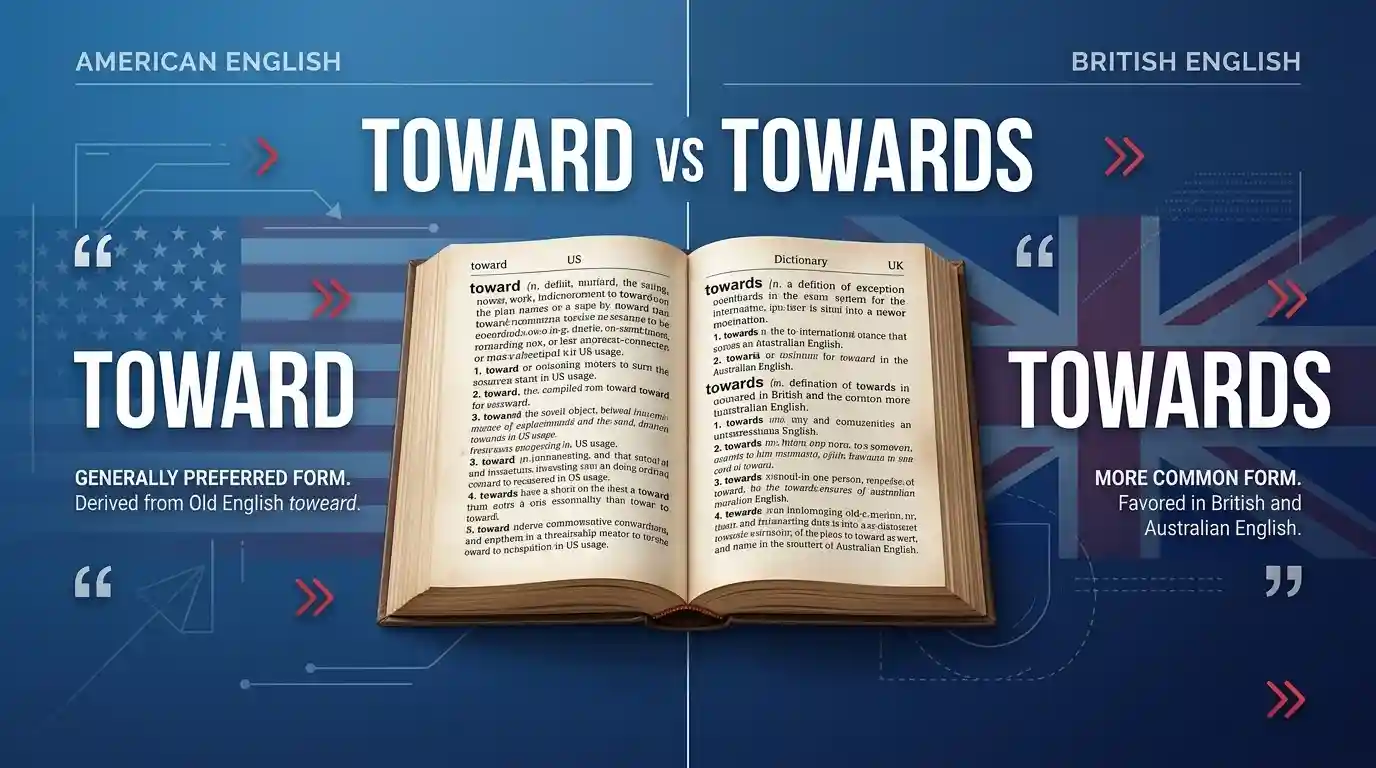
Toward vs towards is a common English usage question that can leave even confident writers wondering which form is correct. The good news is that both words are grammatically acceptable and generally have the same meaning. The main difference comes down to regional preference, with toward more common in American English and towards more common in British English. Let’s explore the difference, meanings, examples, and when to use each form.
Key Takeaways
- Toward and towards are both grammatically correct.
- They generally have the same meaning and function as prepositions.
- Toward is the usual preference in American English.
- Towards is more common in British English.
- For a U.S.-focused website, business, or article, toward is a sensible default.
- The important thing is to use the form consistently with your chosen variety of English.
Toward and Towards at a Glance
The easiest way to understand toward vs towards is to think of them as two regional forms of the same word.
| Feature | Toward | Towards |
|---|---|---|
| Basic meaning | In the direction of | In the direction of |
| Part of speech | Preposition | Preposition |
| American English | More common | Less common |
| British English | Less common | More common |
| Physical direction | Correct | Correct |
| Figurative direction | Correct | Correct |
| Relationship/attitude | Correct | Correct |
| Time or position | Correct | Correct |
| Purpose or contribution | Correct | Correct |
Cambridge lists toward as mainly U.S. and towards as mainly U.K., while also recognizing both forms.
For example:
- She walked toward the door.
- She walked towards the door.
Both sentences are correct. The difference is primarily one of regional usage, not meaning.
What Does “Toward” Mean?
Toward is a preposition that can describe movement, direction, position, relationships, attitudes, time, or progress toward a goal.
Physical Direction
The most common use describes movement in the direction of someone or something.
Examples:
- The dog ran toward its owner.
- She walked toward the station.
- The car moved toward the intersection.
- He turned toward the window.
In each example, toward tells the reader the direction of movement. It does not necessarily mean that the person or object reached the destination.
For example:
The child ran toward the house.
This tells us that the child moved in the direction of the house. It does not necessarily tell us whether the child arrived there.
Cambridge gives toward meanings related to movement, relationships, position, and purpose.
Figurative Direction and Goals
Toward can also describe progress toward an objective.
Examples include:
- We are working toward a solution.
- The company is moving toward a new strategy.
- She is working toward her degree.
- They are moving toward an agreement.
Here, there is no literal physical movement. Instead, toward describes progress or effort directed at a particular result.
The same sentences can use towards without changing their basic meaning:
We are working towards a solution.
Relationship, Attitude, Time, and Purpose
The word can also describe how someone feels or behaves in relation to another person or thing.
For example:
- His attitude toward his coworkers was respectful.
- She was friendly toward her neighbors.
- The company’s policy toward customers has changed.
It can also refer to a point in time or place:
- Toward the end of the day, the office became quieter.
- We arrived toward the back of the theater.
- The weather became colder toward winter.
Another use relates to contributing to or achieving something:
- The payment will go toward the balance.
- This grade counts toward your final average.
- She donated money toward the project.
These meanings are also available with towards.
What Is the Difference Between Toward and Towards?
The main difference is regional preference, not meaning.
The Main Difference Is Regional
In modern English, toward and towards are generally interchangeable.
Compare:
He walked toward the car.
and:
He walked towards the car.
Both mean that he walked in the direction of the car.
Likewise:
We are working toward a better solution.
and:
We are working towards a better solution.
Again, the meaning is essentially the same.
Cambridge’s grammar guidance confirms that both forms can be used, with towards more common in British usage and toward especially associated with U.S. English.
Why American English Usually Uses “Toward”
If your audience is primarily American, toward is generally the better default.
You will commonly see it in U.S. writing such as:
- She moved toward the door.
- We are working toward a solution.
- His attitude toward the issue changed.
- The project is moving toward completion.
- Toward the end of the year, sales increased.
That does not mean towards is wrong in American English. Cambridge’s American Dictionary specifically lists towards as an alternative form.
Why British English Often Uses “Towards”
British English commonly favors towards.
For example:
- She walked towards the station.
- They are working towards an agreement.
- He turned towards me.
- Towards the end of the meeting, everyone became more relaxed.
Cambridge labels towards as mainly U.K. and toward as mainly U.S.
Toward And Towards in American English
For an American audience, toward is usually the safest and most natural choice.
Consider these examples:
| Common U.S. usage | Also grammatical |
|---|---|
| Walk toward the door. | Walk towards the door. |
| Work toward a goal. | Work towards a goal. |
| Move toward the city. | Move towards the city. |
| His attitude toward me changed. | His attitude towards me changed. |
| Toward the end of the year | Towards the end of the year |
So if you are writing an American English blog post, academic paper, business document, or website, using toward throughout will generally make your writing fit U.S. conventions more naturally.
Common Expressions With Toward and Towards
Working Toward or Working Towards?
Both are correct.
For American English:
We are working toward a solution.
For British English:
We are working towards a solution.
The meaning does not change. The difference is mainly regional preference.
Other examples include:
- progress toward/towards a goal
- move toward/towards success
- advance toward/towards an agreement
- work toward/towards completion
Toward the End or Towards the End?
Both forms are correct.
American English commonly uses:
Toward the end of the meeting, the manager answered questions.
British English commonly uses:
Towards the end of the meeting, the manager answered questions.
This construction refers to a point close to the end of a period, event, or activity. Cambridge includes this as one of the meanings of toward(s).
Walk Toward or Walk Towards?
Both are grammatically correct:
She walked toward the store.
She walked towards the store.
If you are writing for American readers, walk toward is generally the preferred version.
The same pattern applies to:
- run toward/towards
- move toward/towards
- drive toward/towards
- head toward/towards
- turn toward/towards
Attitude Toward or Attitude Towards?
Again, both forms work:
His attitude toward his employees was professional.
His attitude towards his employees was professional.
For American English, attitude toward is the more typical choice.
This use is not about physical movement. Here, toward(s) describes a person’s feelings, behavior, or relationship concerning someone or something. Cambridge specifically identifies this relational meaning.
Contribute Toward or Contribute Towards?
Both can be used:
She contributed money toward the project.
She contributed money towards the project.
The phrase describes money, effort, or another contribution being applied to a purpose or goal.
Similarly:
- count toward/towards a grade
- save toward/towards a purchase
- contribute toward/towards a cost
These purpose-related uses are recognized by Cambridge.
Which One Should You Use in Formal Writing?
For American English formal writing, choose toward unless you have a specific reason to preserve another variety of English.
For example:
Preferred for a U.S. audience:
The organization is working toward a long-term solution.
The results point toward a significant change.
Students can earn credits that count toward their degree.
However, don’t treat towards as a spelling mistake. It is an established English form and is especially common in British English.
The most useful rule is simple:
American English → toward
British English → towards
This is a preference, not a rule that makes the other form grammatically invalid.
Common Mistakes to Avoid
Mistake 1: Assuming “towards” Is Wrong
It is not.
If you see:
She walked towards the house.
there is no grammatical error simply because the writer used towards.
Mistake 2: Assuming the Two Words Have Different Meanings
In normal modern usage, adding the s does not create a substantially different meaning.
Move toward the door.
and
Move towards the door.
communicate the same basic idea.
Mistake 3: Mixing English Varieties Without a Reason
Mixing forms is not automatically grammatically wrong, but consistency can make your writing look more polished.
If your article is written primarily in American English, using toward consistently is a straightforward choice.
Mistake 4: Thinking the Word Only Describes Physical Movement
Toward(s) can describe much more than direction.
It can refer to:
- physical movement
- progress
- goals
- attitudes
- relationships
- time
- position
- contributions
Understanding these uses makes the word much easier to use correctly.
Frequently Asked Questions
Is “towards” grammatically correct?
Yes. Towards is grammatically correct. It is a standard preposition and is especially common in British English. American English generally prefers toward, but towards is still an accepted form.
Do Americans use “towards”?
Yes. Americans do use towards, but toward is generally more common in American English. If you are deliberately writing in U.S. English, toward is the natural default.
Does “toward” mean the same as “towards”?
Yes. In most contexts, toward and towards have the same meaning. Both can describe direction, relationships, position, time, purpose, and progress toward a goal.
Is “working toward” correct?
Yes. Working toward is completely correct and is particularly common in American English.
We are working toward a solution.
Working towards is also correct and is more commonly associated with British English.
Should I use “toward” or “towards” for a U.S. audience?
Use toward as your default. It is the form most closely associated with American English. However, towards is not an error, so there is no need to change it simply because it appears in an otherwise correct sentence.
Conclusion
So, toward vs towards is not really a question of right versus wrong. Both are standard English forms, and they generally mean the same thing.
The main distinction is regional usage. American English usually favors toward, while British English commonly favors towards.
If you are creating content for readers in the United States, toward is the best default:
We are moving toward a better solution.
She walked toward the door.
His attitude toward the issue changed.
For British English, towards may sound more natural:
We are moving towards a better solution.
Ultimately, both forms are correct. Choose the version that matches your target variety of English and use it consistently.

Hi, I’m Evan Lexor, the voice behind Meanpedia.com. I break down English words, slang, and phrases into clear, simple meanings that actually make sense. From modern internet terms to everyday expressions, my goal is straightforward: help you understand English better, faster, and with confidence, one word at a time.