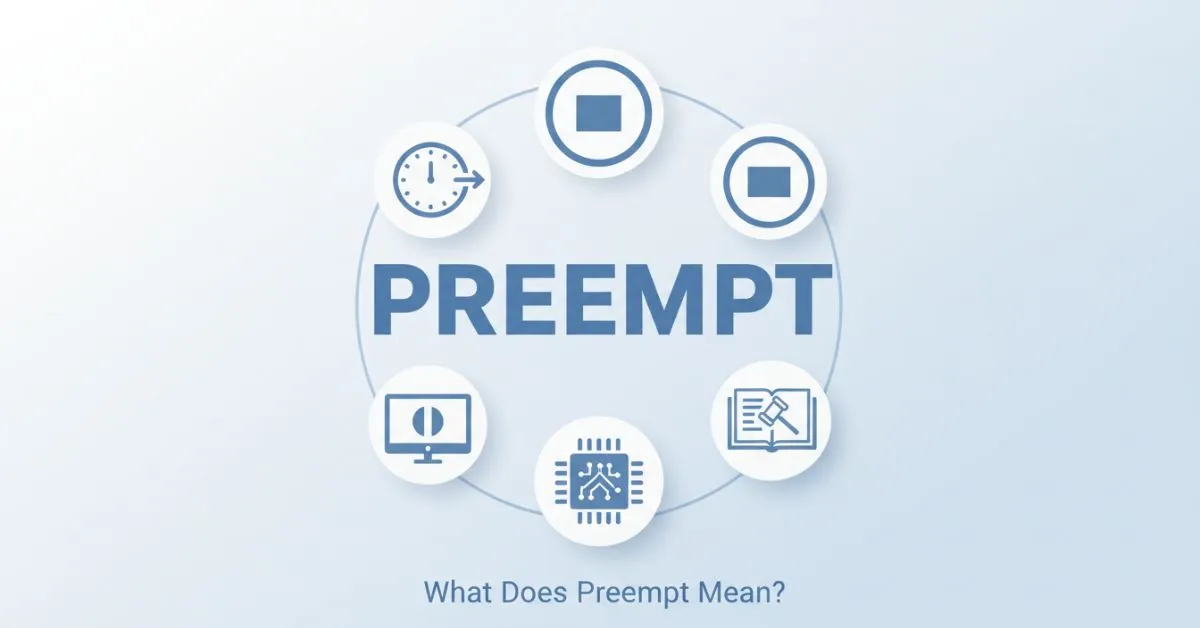
Preempt means to act before something else happens so you can prevent it, replace it, or take priority over it. The word is often used in everyday English, law, television, politics, business, and computing.
If you are wondering what does preempt mean, the short answer is this: it means to move first. In many cases, that early action stops another event, blocks another person’s move, or causes one thing to take the place of another.
That is why you may see the word in phrases like preempt criticism, federal law preempts state law, or breaking news preempted regular programming. Major dictionaries and legal sources all point to that same core idea of acting first in a way that changes what happens next.
What does preempt mean in simple English?
In simple English, preempt means to do something first so another thing does not happen the same way, or does not happen at all.
One explains it as preventing something from happening by taking action first, while Merriam-Webster and Britannica also include meanings such as replacing something that was scheduled or taking priority over it.
A very easy way to remember it is:
Preempt = act first to control the outcome.
That makes the word useful in many settings. A person can preempt criticism with an early apology. A company can preempt a rival by launching first. A television network can preempt a scheduled show with breaking news. In law, a federal rule can preempt a state rule when the two conflict.
Quick answer box
| Term | Simple meaning |
|---|---|
| Preempt | Act first so something else is prevented, replaced, or overridden |
| Preempted | Was prevented, replaced, or cut off by something that happened first |
| Preemptive | Done early to stop or reduce a future action or problem |
| Preemption | The act, process, or legal doctrine of preempting |
This word-family summary reflects how major dictionaries define preempt, preemptive, and preemption, along with how legal sources explain preemption in law.
The main meanings of preempt
1. To prevent something by acting first
This is the most common everyday meaning. When you preempt something, you move early so the other event becomes weaker, unnecessary, or impossible.
Examples:
- She answered the question early to preempt confusion.
- The company cut prices to preempt new competition.
- He apologized first to preempt criticism.
This is the meaning most people want when they search what does preempt mean.
2. To replace or interrupt something that was supposed to happen
In media and broadcasting, preempt means one event takes the place of another because it has higher priority. A live speech, major sports event, election coverage, or breaking news update may preempt regular programming. Merriam-Webster, Britannica, and Collins all include this meaning.
Examples:
- The emergency press conference preempted the evening show.
- Election coverage preempted the regular schedule.
- The live match was preempted by breaking news.
3. To override a lower law with a higher law
In legal writing, preempt has a precise meaning. The Legal Information Institute at Cornell explains that preemption is the doctrine under which a higher authority of law displaces a lower authority when they conflict.
In the United States, this often means federal law preempts state law under the structure of federal supremacy.
Examples:
- Federal law may preempt state law.
- The court found that the federal statute preempted the local rule.
- The issue turned on whether Congress intended to preempt state regulation.
4. To interrupt one task so another can run first
In computing, preemption happens when a running task, thread, or process is interrupted so another one can use the CPU. Microsoft explains that Windows is designed for preemptive multitasking, where the system gives each thread a time slice and suspends the currently running thread when needed. Red Hat similarly explains that preemption occurs when a higher-priority process wants to use the CPU.
That is why tech articles use terms like:
- preemptive multitasking
- preemptive scheduling
- scheduler
- CPU
- context switch
- operating system
Even in computing, the core meaning stays the same: something else takes over first because it has priority.
5. To take something before others can
Older and more formal meanings of preempt include taking, claiming, or purchasing something before other people can. Merriam-Webster and Collins include older senses tied to land and prior rights, and Cornell also explains preemptive right as the right of existing shareholders to buy newly issued stock before it is offered to others.
This meaning is less common in daily conversation, but it still matters because it shows the full history of the word.
How to use preempt in a sentence
A lot of readers do not just want the definition. They also want to know how to use preempt naturally.
Natural sentence patterns
The word often appears with nouns like:
- criticism
- confusion
- debate
- competition
- lawsuits
- regular programming
- state law
- an attack
- a crisis
- a response
Examples:
- She spoke first to preempt further debate.
- The company issued a statement to preempt rumors.
- The network preempted regular programming for the announcement.
- The statute may preempt state law.
- The operating system can preempt a running thread.
These examples match the major real-world uses seen in dictionaries, law, and computing references.
When the word sounds natural
Preempt sounds most natural when:
- timing matters
- one thing happens first
- that first action changes what happens next
- a higher priority event replaces a lower priority one
It is a common fit in formal English, business writing, legal writing, news reporting, politics, and technical writing. It can sound a little formal in casual speech, so many people use prevent in simpler everyday conversation.
That distinction lines up with dictionary usage, where preempt often carries a stronger sense of strategic timing or priority.
Preempt vs related words
Many users search this keyword because they are confused by similar words. This is where a stronger article can beat a basic dictionary page.
| Word | Meaning | Best use case | Example |
|---|---|---|---|
| Preempt | Act first so something is prevented, replaced, or overridden | Timing, priority, strategy | She apologized to preempt criticism. |
| Prevent | Stop something from happening | General everyday use | Locks help prevent theft. |
| Forestall | Prevent by acting in advance | Formal writing | Early talks forestalled a strike. |
| Supersede | Replace because something has greater authority or is newer | Law, policy, official writing | Federal rules supersede conflicting local rules. |
| Preemptive | Done early to stop a later action | Military, business, politics, strategy | They took preemptive action. |
| Preemption | The act or doctrine of preempting | Law, computing, formal writing | The case involved federal preemption. |
This comparison is a simplified usage guide based on dictionary definitions and legal explanations.
The easiest rule to remember
Use preempt when the idea is not only stop, but stop by getting there first.
That is the big difference between preempt and prevent.
Word forms you should know
You may also see related forms of the word:
Preempted
Preempted means something was stopped, replaced, or made ineffective because another thing happened first. Cambridge’s entry for pre-empted keeps the same idea of acting or speaking before someone else so their move becomes unnecessary or less effective.
Example:
- The interview was preempted by a live press briefing.
Preemptive
Preemptive describes an action taken early to stop a later move, attack, problem, or objection. Britannica and Merriam-Webster both define it in that early-action sense.
Example:
- The company made a preemptive announcement before rumors spread.
Preemption
Preemption is the noun form. In law, it refers to one law overriding another. In computing, it refers to interrupting a task so another one can run. Merriam-Webster and Cornell both recognize these meanings.
Example:
- The court’s decision focused on federal preemption.
Pre-empt
Pre-empt is simply a spelling variant, more common in British English. Cambridge lists both spellings.
Common contexts where people see the word preempt
In law
You may read:
- federal law preempts state law
- local regulation is preempted
- express preemption
- implied preemption
- Supremacy Clause
These are legal entities and concepts strongly associated with the word preemption in US legal writing. Cornell’s LII is a good example of this standard legal usage.
In television and news
You may hear:
- this program was preempted
- regular programming has been preempted
- tonight’s episode was preempted by coverage of the event
This use is common in broadcasting and simply means something with greater importance replaced the original schedule.
In computing
You may see:
- preemptive scheduling
- preemptive multitasking
- process priority
- thread scheduling
- CPU time slice
- suspended thread
- context switch
These entities help explain how operating systems manage competing tasks. Microsoft’s documentation and Red Hat’s documentation both describe that kind of preemption.
In business and strategy
People often use preempt when talking about:
- launching first
- answering objections early
- getting ahead of a crisis
- taking initiative before a competitor does
This is a natural extension of the everyday definition and is one of the most common modern uses in business writing.
Common mistakes people make with preempt
Mistake 1: Using preempt when prevent is clearer
Not all prevention is preemption. If timing and first action do not matter, prevent may be the better choice.
- Better: Exercise helps prevent disease.
- Possible but less natural: Exercise helps preempt disease.
Mistake 2: Thinking preempt is only legal language
Law is an important use of the word, but it is not the only one. The word is also common in media, politics, computing, and formal everyday English.
Mistake 3: Missing the priority idea
The word usually carries the sense that one thing happened first and took control of the situation. That is what makes it stronger than a basic synonym like stop.
Practical takeaway
If you want one simple definition to remember, use this:
Preempt means to act first so you prevent, replace, or override something else.
That single line works in most everyday, legal, media, and technical contexts. It also explains why related terms like preemptive action, preemption doctrine, regular programming was preempted, and preemptive multitasking all make sense.
FAQ
What does preempt mean in one sentence?
Preempt means to act first so something else is prevented, replaced, or overridden.
Is preempt the same as prevent?
No. Prevent is broader, while preempt usually adds the idea of acting first or taking priority before something else happens.
What does preempt mean in law?
In law, preempt means a higher law displaces or overrides a lower law when the two conflict. In the US, federal law can preempt state law.
What does preempted mean on TV?
It means a scheduled television program was replaced by something else, such as breaking news, sports, or a live special event.
What does preemptive mean?
Preemptive means done in advance to stop or reduce a later action, attack, problem, or objection.
What is preemption?
Preemption is the noun form of preempt. It can refer to the legal doctrine of one law overriding another or the computing process of interrupting one task so another can run.
Is pre-empt different from preempt?
No. Pre-empt is a spelling variant, more common in British English, but the meaning is the same.
How do you use preempt in a sentence?
A natural example is: “She addressed the issue early to preempt criticism.” That use matches the common meaning of acting first to reduce or stop what comes next.
Conclusion
So, what does preempt mean? It means to move first in a way that stops, replaces, or takes priority over something else. The exact meaning changes slightly by context, but the core idea stays the same.
In everyday English, it often means preventing a problem by acting early, in law, it means a higher law overrides a lower one, in TV, it means one program replaces another and in computing, it means a task is interrupted so a higher-priority task can run. Once you remember that preempt is all about acting first, the word becomes much easier to understand and use correctly.
Click Below To Read About These Posts:
What Does HCl Mean on a Prescription Label?
What Does the Upside Down American Flag Mean?
And What Does Simba Mean? Swahili, Name, and Lion King

Hi, I’m Evan Lexor, the voice behind Meanpedia.com. I break down English words, slang, and phrases into clear, simple meanings that actually make sense. From modern internet terms to everyday expressions, my goal is straightforward: help you understand English better, faster, and with confidence, one word at a time.