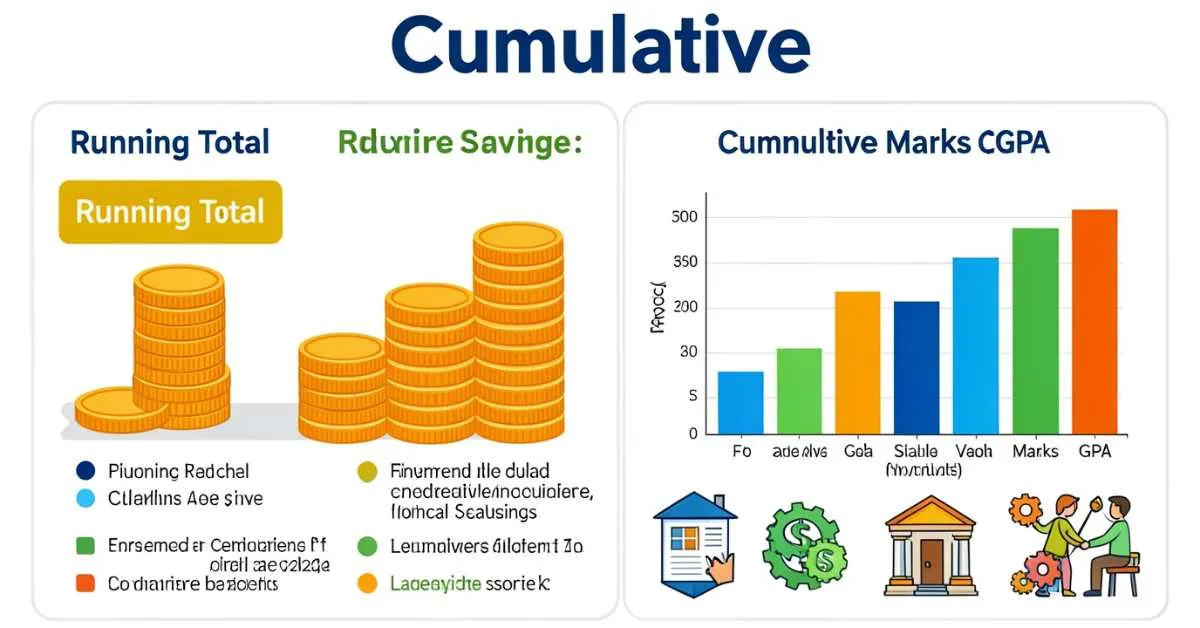
Cumulative means adding all previous amounts together to form a total. It shows the overall progress or total value over time, rather than focusing on a single number.
Have you ever wondered what does cumulative mean in school, math, finance, or daily life? The concept is everywhere. From cumulative marks in school to salary or interest in finance, cumulative shows how things add up over time.
In this article, we will explain what cumulative means in simple words. We will show its definition and give easy examples. You will learn how cumulative is used in math, statistics, school, money, and business.
We will also give real-life examples, tables, FAQs, and show the difference between cumulative and total and cumulative and non-cumulative. By the end, you’ll fully understand what cumulative means and why it matters.
Cumulative Meaning in Simple Words
In simple terms, cumulative means everything so far, added together. Each new value adds to the total of all previous amounts.
Examples:
- Study hours: 1 hour Monday + 2 hours Tuesday + 1 hour Wednesday = 4 hours cumulative study time
- Savings: $50 per week → cumulative savings = $200 after 4 weeks
- Weight loss: 1 kg per week → cumulative loss = 3 kg
Cumulative is different from a one-time value. It shows overall progress rather than isolated numbers.
What Does Cumulative Mean in Math?
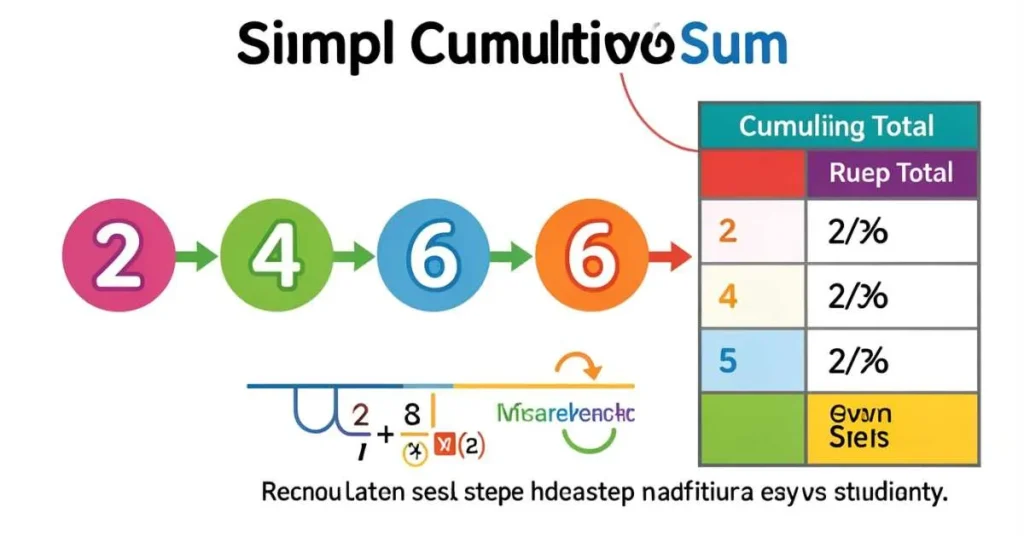
In math, cumulative refers to step-by-step addition.
Example Table – Cumulative Sum:
| Number | Cumulative Total |
|---|---|
| 2 | 2 |
| 4 | 2 + 4 = 6 |
| 6 | 2 + 4 + 6 = 12 |
Cumulative Total Meaning
In math, we use cumulative addition, cumulative data, and charts to see how numbers add up over time.
Many ask, “what does cumulative mean in math?” It simply means each number adds to all previous numbers.
Cumulative amount meaning
Cumulative amount meaning is the total that builds up over time as new amounts keep getting added. It does not show just one payment, score, or value. It shows the running total after each step, which makes it useful in finance, savings, interest, sales, and data tracking.
Cumulative Test Meaning
A cumulative test is an exam that covers both earlier and recent course material instead of only the latest lesson or chapter. In simple terms, it checks how well a student has remembered, understood, and connected what they learned over time.
Education sources describe cumulative exams and assessments as ones that revisit previous material and test knowledge from across the term, not just the most recent unit.
This is what makes a cumulative test different from a regular test. A regular test may focus on one chapter, one topic, or one short unit, while a cumulative test brings older topics back and often combines them with new ones. Because of that, cumulative tests are commonly used in midterms, finals, and larger course assessments where long-term understanding matters more than short-term memorization.
A clear way to define it in one line is this: a cumulative test measures how well a student can retain and use knowledge from multiple parts of a course over time.
What Does Cumulative Mean in Statistics?

In statistics, cumulative data shows how values add over categories or time.
- Cumulative frequency counts the total number of observations up to a point
- Cumulative frequency graphs and cumulative charts visualize overall trends
- Analysts use cumulative results to detect patterns and measure cumulative changes
Example: If 5 students scored ≤50, 10 ≤60, and 15 ≤70, the cumulative frequency shows the total students scoring up to each threshold.
What Does Cumulative Mean in School & Exams?
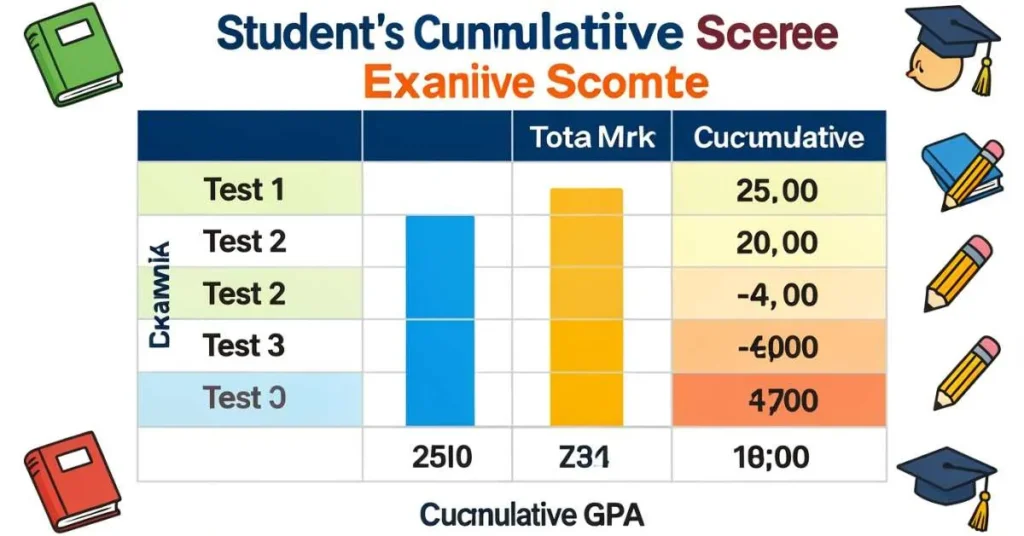
Schools and colleges use cumulative scores, marks, GPA, grades, averages, and percentages to see how well a student is doing overall.
Example Table – Cumulative Marks:
| Exam | Score | Cumulative Total |
|---|---|---|
| Test 1 | 80 | 80 |
| Test 2 | 85 | 165 |
| Test 3 | 90 | 255 |
Cumulative exams test knowledge from the entire course. Students often ask, “what does cumulative mean in school?” or “what does cumulative mean for a test?” The answer: it includes all previous work, encouraging consistent effort over time.
What Does Cumulative Mean in Finance & Business?
In finance, cumulative tracks total earnings or growth over time:
- Cumulative salary = total earnings over months
- Cumulative interest = interest earned including previous interest
- Cumulative profit, cumulative revenue, cumulative growth, cumulative cost track business performance
Example Table – Cumulative Salary:
| Month | Salary | Cumulative Total |
|---|---|---|
| Jan | $3000 | $3000 |
| Feb | $3000 | $6000 |
| Mar | $3000 | $9000 |
People often ask, “what does cumulative mean in salary?” or “what does cumulative mean in accounting?” It shows all previous amounts added together, giving a complete financial picture.
Cumulative vs Total & Non-Cumulative
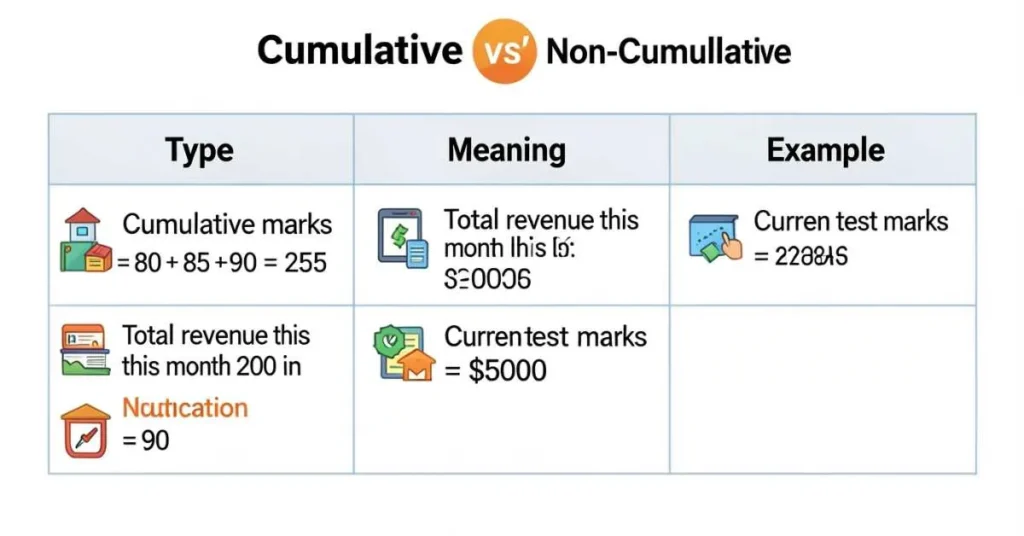
Comparison Table:
| Type | Meaning | Example |
|---|---|---|
| Cumulative | Adds all previous values over time | Cumulative marks = 80 + 85 + 90 = 255 |
| Total | One-time sum | Total revenue this month = $5000 |
| Non-Cumulative | Values stand alone, do not include previous ones | Current test marks = 90 |
Knowing the difference between cumulative and total, and between cumulative and non-cumulative. Helps you avoid mistakes in school, money, or work.
Real-Life Examples of Cumulative
- Savings: $10/day → cumulative savings = $50 after 5 days
- Study hours: 1+2+1 hours → cumulative study = 4 hours
- Weight loss: 1 kg/week → cumulative loss = 3 kg
- Expenses: $20+$15+$10 → cumulative expenses = $45
- Work experience: Each job adds to cumulative experience
These examples show how things add up over time. You can see the total, the increase, and the results in everyday life.
Common Mistakes About Cumulative
- Thinking cumulative is one-time only
- Confusing cumulative totals with averages
- Ignoring cumulative changes in charts or reports
- Forgetting previous contributions in school, work, or finance
Avoiding these mistakes ensures accurate tracking of cumulative totals.
Why Understanding Cumulative Is Important
Understanding cumulative meaning is vital in education, finance, business, and personal growth:
- Education: Tracks cumulative marks, cumulative GPA, cumulative scores
- Finance: Tracks cumulative salary, cumulative revenue, cumulative interest
- Business: Tracks cumulative profit, cumulative growth, cumulative cost
- Personal life: Tracks habits, savings, or skill growth
Cumulative thinking helps you see the whole picture. It shows your progress clearly and helps you make smart choices.
Frequently Asked Questions
1. What does cumulative mean in simple words?
Everything so far, added together.
2. Does cumulative always increase?
Usually yes, but negative values can reduce totals.
3. What is the difference between cumulative and total?
Cumulative shows step-by-step addition, total may be a one-time sum.
4. What does cumulative mean in math?
Each number is added to all previous numbers to calculate cumulative sums.
5. What does cumulative mean in school/exams?
Includes all tests, assignments, and grades so far.
6. What does cumulative mean in finance/salary?
Total earned over time, including cumulative interest or cumulative revenue.
7. What is a cumulative example?
Saving $50 weekly → cumulative savings = $200 after 4 weeks.
Conclusion:
Cumulative means “everything so far, added together.” It applies to school, exams, math, statistics, finance, business, and daily life.
Keeping track of cumulative marks, GPA, money earned, profit, interest, frequency. And data helps you see how much you have grown and how far you have come over time.
Understanding cumulative means every step counts. Each action adds up. You can see your progress over time. By learning cumulative, you can plan better, check your results, and make smart choices in school, work, or life.
Click Below To Read About These Posts:
What Does Alyssa Mean: Origin & Popularity Explained
What Does WTB Mean? Text, Marketplace, and Gaming Guide
What Does Fortnight Mean? Definition, Days, and Examples

Hello! I’m Clara Lexis, creator of Meanpedia.com. I specialize in breaking down words, phrases, and idioms so that anyone can understand and enjoy the beauty of English. My goal? Making language approachable, fun, and meaningful, one word at a time.