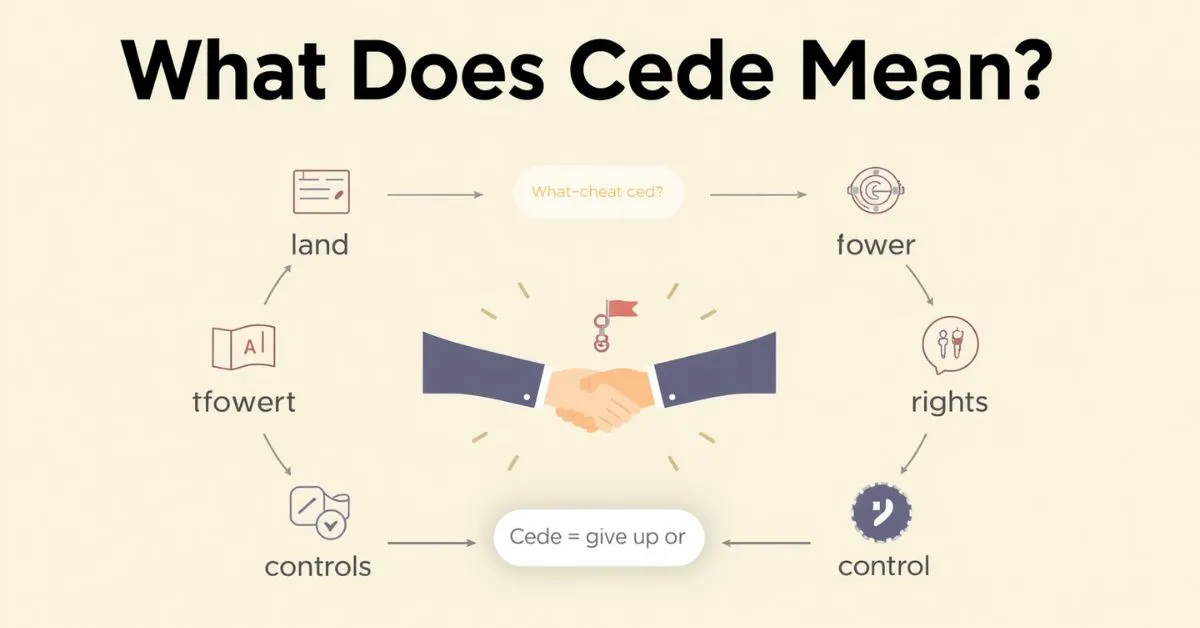
Cede means to give up, surrender, yield, or formally transfer something to someone else. It is often used for important things like land, power, control, rights, authority, or ownership. For example, a country may cede territory after a treaty, or a leader may cede power to someone else.
Quick Answer
| Question | Answer |
|---|---|
| Meaning of cede | To give up or transfer something |
| Pronunciation | Seed |
| Part of speech | Verb |
| Past tense | Ceded |
| Noun form | Cession |
| Common use | Land, power, control, rights, authority |
| Example | The country ceded territory after the treaty. |
Simple meaning:
To cede something means to hand it over, often in a formal or official way.
Cede Meaning in Simple Words
Cede means to give up something important.
It is not usually used for small everyday things. You would not normally say, “I ceded my friend a pencil.” You would say, “I gave my friend a pencil.”
Use cede when the thing being given up is serious or valuable, such as:
- land
- territory
- power
- control
- authority
- rights
- ownership
- responsibility
- claims
- market share
Examples:
- A country can cede land.
- A ruler can cede power.
- A company can cede control.
- A writer can cede rights.
- A business can cede market share.
A good memory trick is:
Cede = give control away.
How to Pronounce Cede
Cede is pronounced “seed.”
It sounds the same as seed, but the meanings are different.
| Word | Pronunciation | Meaning |
|---|---|---|
| Cede | seed | To give up or transfer |
| Seed | seed | A plant seed |
Examples:
- The nation agreed to cede the island.
- She planted a seed in the garden.
If the sentence is about plants, use seed.
If the sentence is about power, land, control, or rights, use cede.
Cede in a Sentence
Here are simple examples of cede in a sentence:
- The king refused to cede power.
- The country agreed to cede territory.
- The company had to cede control to investors.
- The author did not want to cede the rights to her book.
- The team ceded the lead in the final minutes.
- The board refused to cede authority.
- The business ceded market share to a rival.
Each example shows someone giving up control, power, rights, land, or an advantage.
What Does Ceded Mean?
Ceded is the past tense of cede.
It means something was already given up, surrendered, or transferred.
Examples:
- The land was ceded after the war.
- Power was ceded to the new leader.
- The rights were ceded in the contract.
- Control was ceded to the board.
- The territory was ceded under the treaty.
If something was ceded, the first person, group, or country no longer fully controls it.
What Does Ceding Mean?
Ceding means giving up or transferring something.
It is used when the action is happening now or being talked about as a process.
Examples:
- The company is ceding control to investors.
- The government is ceding authority to local leaders.
- The team is ceding ground to its rivals.
- The owner is ceding responsibility to a manager.
What Is Cession?
Cession is the noun form of cede.
It means the act of giving up or formally transferring something.
Examples:
- The cession of territory changed the border.
- The contract included the cession of rights.
- The treaty confirmed the cession of land.
You may see cession in law, history, politics, treaties, and formal agreements.
Is Cede a Formal Word?
Yes. Cede is a formal word.
It is common in:
- history
- politics
- law
- government
- diplomacy
- treaties
- contracts
- business
- news writing
Use cede when the action is serious or official.
Natural phrases include:
- cede power
- cede control
- cede territory
- cede land
- cede rights
- cede authority
- cede ownership
- cede responsibility
- cede market share
Less natural:
- I ceded him my sandwich.
- She ceded me a pen.
Better:
- I gave him my sandwich.
- She gave me a pen.
Common Phrases With Cede
| Phrase | Meaning | Example |
|---|---|---|
| Cede power | Give up authority | The ruler refused to cede power. |
| Cede control | Hand over control | The founder ceded control to the board. |
| Cede territory | Give up land | The country ceded territory after the treaty. |
| Cede rights | Give up legal rights | The artist ceded some rights to the publisher. |
| Cede authority | Transfer official power | The agency ceded authority to local offices. |
| Cede ownership | Give up ownership | The company ceded ownership of the asset. |
| Cede ground | Give up an advantage | The team ceded ground in the second half. |
| Cede market share | Lose business share | The brand ceded market share to a rival. |
Cede vs Concede vs Secede vs Seed
These words look or sound alike, but they do not mean the same thing.
| Word | Meaning | Example |
|---|---|---|
| Cede | To give up or transfer something | The country ceded land. |
| Concede | To admit something or accept defeat | She conceded the argument. |
| Secede | To break away from a larger group | The region tried to secede. |
| Seed | A plant seed | He planted a seed. |
Cede vs Concede
Cede means to give up or transfer something.
Concede means to admit something, accept defeat, or give in.
Examples:
- The country ceded territory.
- The candidate conceded the election.
- He conceded that he was wrong.
- The company ceded control to investors.
Use cede for land, power, control, rights, or authority.
Use concede for arguments, debates, elections, or admissions.
Quick tip:
Cede = transfer.
Concede = admit or accept defeat.
Cede vs Secede
Cede means to give something up.
Secede means to break away from a larger group, country, union, or organization.
Examples:
- The country ceded land.
- The state tried to secede from the union.
Quick tip:
Cede = give up something.
Secede = separate from something.
The word secede starts with se-, which can remind you of separate.
Cede vs Seed
Cede and seed sound the same, but they are different words.
Examples:
- The leader refused to cede power.
- The farmer planted a seed.
Use cede for control, rights, land, or power.
Use seed for plants, food, farming, or growth.
Synonyms for Cede
A synonym is a word with a similar meaning.
Common synonyms for cede include:
- give up
- hand over
- surrender
- yield
- transfer
- relinquish
- grant
- assign
- waive
- forfeit
Best Synonym by Context
| Context | Best Synonym |
|---|---|
| Land or territory | transfer, surrender |
| Power or control | give up, relinquish |
| Legal rights | assign, waive, transfer |
| Authority | yield, hand over |
| Ownership | transfer, give up |
| Market share | lose, yield |
In simple writing, give up or hand over is often best.
In formal writing, relinquish, transfer, or surrender may fit better.
Antonyms of Cede
An antonym is a word with the opposite meaning.
Common antonyms of cede include:
- keep
- retain
- hold
- maintain
- preserve
- claim
- defend
- possess
- control
Examples:
- The king refused to cede power and tried to retain control.
- The company chose to keep ownership.
- The nation defended the land instead of ceding it.
The opposite of ceding something is keeping it or refusing to give it up.
Word Origin of Cede
Cede comes from Latin cedere, meaning to go, yield, withdraw, or give way. It came into English through French.
That root also appears in related words:
| Word | Basic Meaning |
|---|---|
| Cede | Give up or yield |
| Concede | Admit or give in |
| Secede | Break away |
| Recede | Move back |
| Proceed | Move forward |
| Accede | Agree to or take office |
| Succeed | Follow after or achieve success |
Many of these words have a sense of movement, giving way, or going in a direction.
Who Can Cede Something?
Many people or groups can cede something if they give up control, rights, power, or ownership.
| Who or What | What They Can Cede | Example |
|---|---|---|
| Person | rights, control, responsibility | She ceded control of the project. |
| Country | land, territory, sovereignty | The country ceded territory. |
| Government | authority, power, control | The government ceded authority to local leaders. |
| Company | ownership, control, market share | The company ceded market share. |
| Leader | power, influence, authority | The leader refused to cede power. |
This is why cede appears often in history, law, politics, and business.
Is Cede Always Negative?
No. Cede is not always negative.
It depends on the situation.
Negative Example
- The defeated nation had to cede territory.
This sounds negative because the nation lost land.
Neutral Example
- The company ceded certain rights under the agreement.
This is neutral. It simply means the rights were transferred.
Positive or Strategic Example
- The founder ceded control to a trusted team.
This can be positive if it helps the company grow.
Common Mistakes With Cede
| Incorrect | Correct | Why |
|---|---|---|
| The state tried to cede from the union. | The state tried to secede from the union. | Secede means break away. |
| He ceded that he was wrong. | He conceded that he was wrong. | Concede means admit. |
| She planted a cede. | She planted a seed. | Seed is the plant word. |
| I ceded him a pencil. | I gave him a pencil. | Cede is too formal for casual giving. |
| The country conceded land. | The country ceded land. | Cede means transfer land. |
Quick Memory Tricks
- Cede = give control away.
- Concede = admit or accept defeat.
- Secede = separate from a group.
- Seed = plant word.
Another easy trick:
If something important is handed over, use cede.
Mini Quiz
1. Which sentence uses cede correctly?
A. She planted a cede.
B. The country agreed to cede territory.
C. He ceded that he was wrong.
Answer: B. The country agreed to cede territory.
2. Which word means to break away?
A. Cede
B. Concede
C. Secede
Answer: C. Secede.
3. What does ceded mean?
A. Planted
B. Gave up or transferred
C. Won control
Answer: B. Gave up or transferred.
FAQs About Cede
What does cede mean in simple words?
Cede means to give up, surrender, yield, or formally transfer something to someone else.
What is the definition of cede?
The definition of cede is to give up, grant, surrender, or transfer something, often in a formal way.
What does ceded mean?
Ceded means gave up, surrendered, yielded, or transferred.
What does ceding mean?
Ceding means giving up or transferring something.
What is cession?
Cession is the act of ceding something. It means a formal transfer or surrender.
How do you pronounce cede?
Cede is pronounced seed.
What does cede power mean?
To cede power means to give up authority or control.
What does cede territory mean?
To cede territory means to give up or transfer land to another country, government, or authority.
What does ceded land mean?
Ceded land is land that was formally given up or transferred to another country, government, group, or owner.
Is cede the same as concede?
No. Cede means to give up or transfer something. Concede means to admit something or accept defeat.
Is cede the same as secede?
No. Cede means to give something up. Secede means to break away from a larger group.
Is cede a negative word?
Not always. It can be negative, neutral, or strategic. It depends on whether the transfer is forced, agreed, or planned.
What is another word for cede?
Another word for cede is surrender, yield, transfer, relinquish, or hand over.
What is the opposite of cede?
The opposite of cede is keep, retain, hold, claim, defend, or preserve.
Conclusion
Cede means to give up or formally transfer something important, such as land, power, control, rights, authority, ownership, or responsibility.
The key difference is simple:
- Cede means transfer or give up.
- Concede means admit or accept defeat.
- Secede means break away.
- Seed is the plant word.
If you see cede in history, politics, law, business, or news, it usually means someone has handed over something important through an agreement, treaty, pressure, or formal transfer.
Click Below To Read About These Posts:
What Does Preempt Mean? Simple Definition, Uses, and Examples
What Does APR Mean for Credit Cards? Complete Explanation
Flowers That Mean Love: 17 Romantic Blooms and Their Meanings

Hi, I’m Evan Lexor, the voice behind Meanpedia.com. I break down English words, slang, and phrases into clear, simple meanings that actually make sense. From modern internet terms to everyday expressions, my goal is straightforward: help you understand English better, faster, and with confidence, one word at a time.