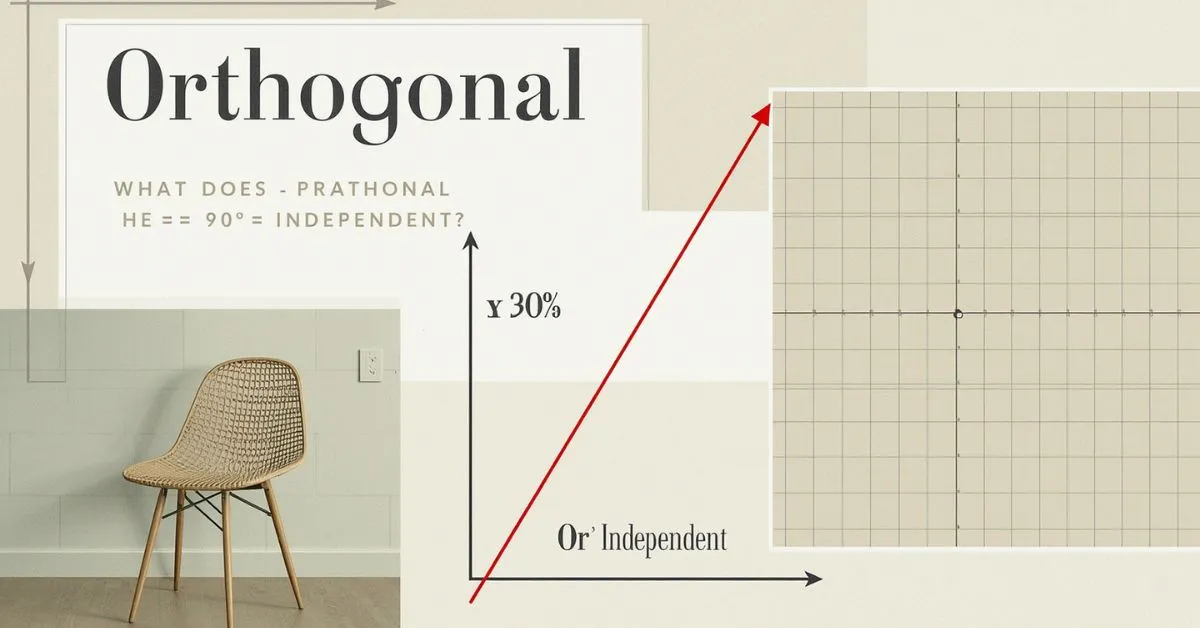
Orthogonal means “at right angles” in geometry, but it can also mean independent, separate, or non-overlapping in fields like statistics, engineering, software, and machine learning.
In math, orthogonal lines or vectors meet at 90 degrees. In broader use, orthogonal ideas affect different things and do not interfere with each other.
If you have searched what does orthogonal mean, you probably want a simple answer first. The short answer is that orthogonal usually means perpendicular or independent, depending on the context. In geometry, it describes lines, axes, planes, or vectors that meet at a right angle.
In statistics, computer science, signal processing, and engineering, it often means two things are separate in effect and do not overlap much. This guide explains the full orthogonal meaning in plain English, shows how the word is used in different subjects, and gives clear examples so you can understand and use it with confidence.
Orthogonal meaning at a glance
Simple definition
Orthogonal means:
- at right angles in geometry and linear algebra
- independent or non-overlapping in statistics, software, engineering, and design
- separate from the main issue in general discussion
Pronunciation
Orthogonal is usually pronounced:
or-THOG-uh-nuhl
One-sentence meaning
A good way to remember it is this:
Orthogonal means either “perpendicular” or “independent in effect,” depending on the subject.
What does orthogonal mean in math?
In math, the word orthogonal has a precise meaning. It usually refers to things that meet at a right angle, also called 90 degrees.
Orthogonal lines in geometry
In Euclidean geometry, two lines are orthogonal when they cross at a right angle.
Common examples include:
- the x-axis and y-axis on a graph
- the corner of a square or rectangle
- a wall meeting the floor
- vertical and horizontal lines
If two lines form a perfect 90-degree angle, they are orthogonal.
Orthogonal vectors in linear algebra
In linear algebra, orthogonal vectors are vectors whose dot product is zero.
That sounds technical, but the idea is simple. If two vectors point in directions that are “at right angles” to each other, they are orthogonal.
For example:
- Vector (1, 0) points along the x-axis
- Vector (0, 1) points along the y-axis
These two vectors are orthogonal because they meet the dot product rule:
(1 × 0) + (0 × 1) = 0
This concept matters in:
- vector spaces
- coordinate systems
- basis vectors
- orthonormal basis
- matrices
- computer graphics
- physics
- machine learning
Orthogonal planes and dimensions
In higher math and geometry, planes and dimensions can also be orthogonal.
For example:
- the width of a box
- the height of a box
- the depth of a box
These three directions are orthogonal to each other. They describe separate dimensions in space.
Orthogonal functions and polynomials
In advanced mathematics, functions can also be orthogonal over a given interval. This happens in areas like:
- calculus
- Fourier analysis
- signal processing
- quantum mechanics
- orthogonal polynomials
Most readers do not need the full formula. The main idea is that these functions behave like separate building blocks in a system.
What does orthogonal mean outside math?
The word orthogonal is common in technical fields because it is useful for describing things that are separate, independent, or non-interfering.
Orthogonal in statistics
In statistics, orthogonal usually means variables, factors, or predictors are arranged so their effects can be measured separately.
You may see this idea in:
- experimental design
- regression
- factor analysis
- analysis of variance
- data modeling
If two variables are orthogonal in a model, they do not overlap in the same linear direction. In simple terms, each one brings its own information.
This is why orthogonality is helpful in data analysis: it makes interpretation cleaner.
Orthogonal in machine learning
In machine learning, orthogonal features or representations can help reduce redundancy.
For example:
- one feature measures size
- another feature measures color
- another feature measures shape
If these features are orthogonal enough, they capture different kinds of information instead of repeating the same pattern.
The word may also appear in discussions of:
- feature selection
- embeddings
- neural networks
- dimensionality reduction
- optimization
- regularization
Orthogonal in engineering
In engineering, orthogonal often means one system, component, or control works independently from another.
Examples:
- changing one setting does not affect another part of the system
- one design decision solves one problem without creating a new one elsewhere
- two controls act on separate outputs
This makes systems easier to build, test, and maintain.
Orthogonal in software and computer science
In software design and computer science, orthogonal usually means features behave independently and combine cleanly.
For example:
- a programming language is called orthogonal when rules are consistent
- one software module can change without breaking another
- one feature can be added without causing side effects in unrelated features
This idea is valuable in:
- software architecture
- programming languages
- interface design
- systems design
- database design
Orthogonal in business, writing, and conversation
People also use orthogonal in a non-technical way.
Example:
“That question is orthogonal to our main discussion.”
In this case, orthogonal means:
- on a different track
- separate from the current issue
- not directly connected
- related in a different direction
It does not always mean irrelevant. It often means important, but not part of the exact point being discussed.
Orthogonal vs perpendicular vs independent
These terms overlap, but they are not always identical. This is where many readers get confused.
| Term | Main meaning | Where it is used most | Is it the same as orthogonal? |
|---|---|---|---|
| Orthogonal | At right angles, or independent in effect | Math, statistics, engineering, software | Sometimes |
| Perpendicular | Meeting at a 90-degree angle | Geometry | Often yes in geometry |
| Independent | Not controlled by another | Statistics, logic, everyday use | Sometimes |
| Uncorrelated | No linear relationship | Statistics | Sometimes related |
| Opposite | Completely different direction or meaning | General language | No |
Is orthogonal the same as perpendicular?
In geometry, yes, often.
If two lines meet at 90 degrees, they are perpendicular and can also be called orthogonal.
But outside geometry, orthogonal has a broader meaning. It can describe ideas, variables, systems, or features that are separate in effect.
Does orthogonal mean independent?
Sometimes. But not always.
In statistics and system design, orthogonal often suggests independence or lack of overlap. Still, it can be more precise than the everyday word independent.
Does orthogonal mean opposite?
No. This is a common mistake.
Two things can be orthogonal without being opposites. Orthogonal means different in direction or effect, not necessarily against each other.
Real examples of orthogonal
Examples make the meaning much easier to understand.
Everyday visual examples
- A floor and a wall are orthogonal
- A door frame has orthogonal edges
- Horizontal and vertical lines on graph paper are orthogonal
- The north-south and east-west directions are orthogonal on a map
Math examples
- The x-axis and y-axis are orthogonal
- Vectors (1, 0) and (0, 1) are orthogonal
- Basis vectors in a coordinate system are often orthogonal
- An orthogonal matrix has rows and columns that are orthogonal unit vectors
Statistics examples
- Two predictors in a model may be designed to be orthogonal
- Experimental factors may be set up to reduce overlap
- Orthogonal contrasts help compare groups clearly
Software and engineering examples
- A user interface setting changes layout but not security behavior
- A software module can be updated without changing payment logic
- One machine control affects speed while another affects temperature
Conversation examples
- “Your comment is orthogonal to the issue we need to solve today.”
- “Brand strategy and server maintenance are orthogonal tasks.”
- “The question is useful, but it is orthogonal to the main argument.”
Why orthogonality matters
Orthogonality is more than just a technical word. It matters because it helps people think clearly about separation.
In math
It helps describe structure, space, vectors, coordinate axes, and transformations.
In statistics
It helps reduce confusion between variables and makes models easier to interpret.
In engineering
It helps create systems where one change does not break something unrelated.
In machine learning and signal processing
It helps separate information into cleaner components.
In communication
It helps explain when a point is different from the main issue without saying the point is wrong.
Common mistakes to avoid
A strong article should also tell readers what not to do.
Mistake 1: Thinking orthogonal always means perpendicular
That is true in geometry, but not in every field. In software or statistics, the word often means independent or separate in effect.
Mistake 2: Using orthogonal as a fancy word for “random”
Orthogonal does not mean random. It usually means structured separation, not total disconnection.
Mistake 3: Confusing orthogonal with opposite
Opposite means two things face against each other. Orthogonal means they move in different directions or affect different dimensions.
Mistake 4: Assuming orthogonal and independent are exactly the same
They are related, but not always identical. In technical use, orthogonal can be narrower and more precise.
Mistake 5: Ignoring context
Context matters. In geometry, think right angle. In system design, think independent behavior. And in conversation, think different line of discussion.
How to tell what orthogonal means from context
A simple context test can help.
If the topic is geometry, graphs, or vectors
Orthogonal probably means:
- perpendicular
- right angle
- 90 degrees
If the topic is statistics, analytics, or machine learning
Orthogonal probably means:
- uncorrelated
- separate effects
- non-overlapping information
If the topic is engineering or software
Orthogonal probably means:
- modular
- independent
- no unwanted side effects
If the topic is a meeting, essay, or discussion
Orthogonal probably means:
- separate from the main point
- on another axis
- not central to the current issue
Quick memory trick
If you want an easy way to remember the orthogonal meaning, use this:
Orthogonal = right angle in math, separate effect in real-world systems.
That one line helps in most situations.
Practical takeaway
So, what does orthogonal mean?
It means two things are either at right angles or separate in effect.
That is why the word appears in:
- geometry
- linear algebra
- vectors
- matrices
- statistics
- regression
- experimental design
- signal processing
- software design
- machine learning
- engineering
- academic writing
- business discussion
Once you understand the core idea of non-overlap, the word becomes much easier to understand everywhere.
FAQ:
1. What does orthogonal mean in simple terms?
In simple terms, orthogonal means at a right angle or independent in effect, depending on the context.
2. What does orthogonal mean in math?
In math, orthogonal usually means lines, vectors, planes, or functions have a right-angle type relationship. For vectors, it often means the dot product is zero.
3. Is orthogonal the same as perpendicular?
Often yes in geometry. But orthogonal is broader and can also describe independent systems, variables, or ideas outside geometry.
4. Does orthogonal mean independent?
Sometimes. In statistics, engineering, and software, orthogonal often means things are separate enough that one does not strongly affect the other.
5. What does orthogonal mean in statistics?
In statistics, orthogonal usually means variables or factors do not overlap in the same linear way, making their effects easier to measure separately.
6. What does orthogonal mean in machine learning?
In machine learning, orthogonal can describe features, representations, or components that capture different information instead of repeating the same signal.
7. Does orthogonal mean opposite?
No. Orthogonal does not mean opposite. It means different in direction or separate in effect.
8. How do you use orthogonal in a sentence?
You can say, “The x-axis and y-axis are orthogonal,” or “That issue is orthogonal to our main discussion.”
Conclusion
The best simple answer to what does orthogonal mean is this: it means perpendicular in math and independent or separate in broader use. In geometry, orthogonal lines meet at 90 degrees, in linear algebra, orthogonal vectors have a dot product of zero, in statistics, engineering, software, and machine learning, orthogonal often describes things that do not overlap or interfere with each other and in everyday language, it can mean a point or issue is on a different track from the main discussion.
If you want to understand technical language faster, this is a useful word to learn because it appears in many fields and always carries the idea of separation by direction or effect.
Click Below To Read About These Posts:
What Does Cede Mean? Simple Definition, Examples and Differences
What Does Broil Mean in Oven? Simple Guide, Uses and Safety Tips
What Does Nympho Mean? Meaning, Slang Use, Better Words

Hi, I’m Evan Lexor, the voice behind Meanpedia.com. I break down English words, slang, and phrases into clear, simple meanings that actually make sense. From modern internet terms to everyday expressions, my goal is straightforward: help you understand English better, faster, and with confidence, one word at a time.