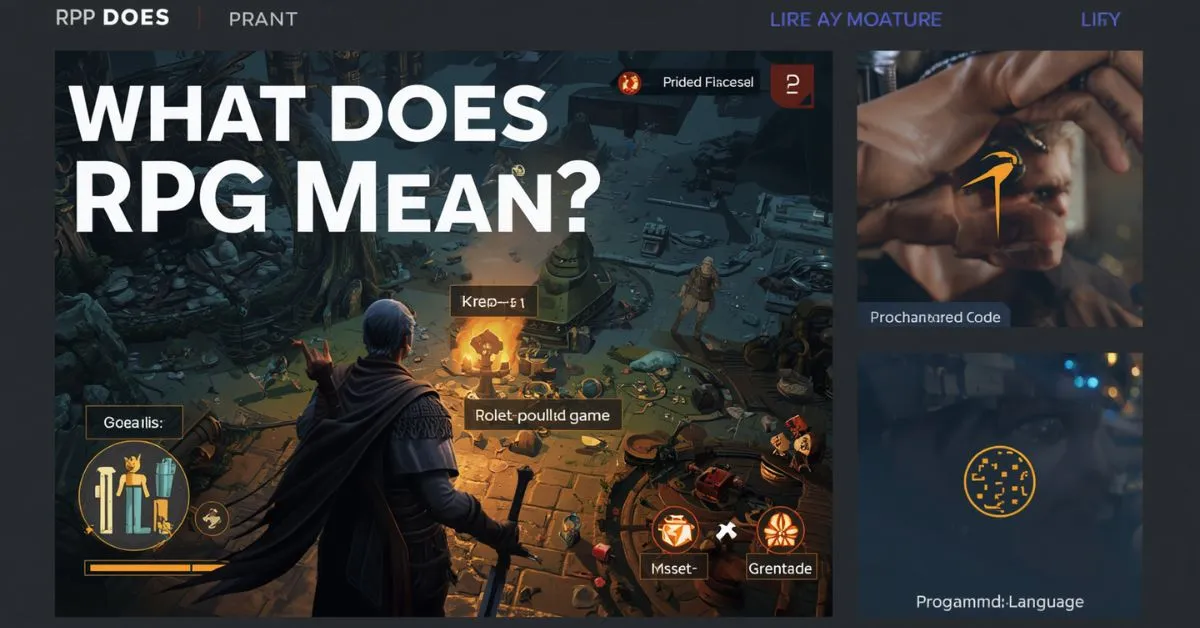
RPG usually means role-playing game. In gaming, it refers to a game where you take the role of a character, follow quests or a story, and improve that character over time. In other contexts, RPG can also mean rocket-propelled grenade or IBM’s RPG programming language.
If you searched this because you saw RPG in a game title, review, Discord chat, or store listing, the answer is usually simple: people almost always mean role-playing game. That is the dominant meaning most readers want. The confusion happens because the same three letters can also mean something very different in news or computing.
This guide is built to clear that up quickly, then go one step further: it explains what makes a game an RPG, how the term is used in real gaming conversations, and how to tell when RPG means something else.
The short answer
In gaming, RPG stands for role-playing game. A role-playing game is a game where you play as a character in an imaginary world and progress through story, quests, abilities, stats, equipment, or other character-building systems.
Strong reference pages consistently describe RPGs around character role, progression, quests, and world interaction.
Quick meaning table
| Context | What RPG means | What it means in simple English |
|---|---|---|
| Gaming | Role-playing game | A game where you play as a character and build that character over time |
| Military/news | Rocket-propelled grenade | A weapon-related meaning seen in conflict or defense coverage |
| IBM/programming | RPG / Report Program Generator | A programming language used in IBM business computing contexts |
That means the safest way to read the term is this: check the context first. If the topic is games, RPG almost certainly means role-playing game.
What does RPG mean in gaming?
In gaming, an RPG is not just “any game where you play a role.” That definition is too loose. In normal usage, people usually mean a game built around character progression and a deeper sense of identity, build, story, or choice.
Most RPGs commonly include several of these features:
- a character or party you control
- stats, skills, or classes
- quests or mission chains
- equipment, inventory, or loot
- leveling or growth over time
- story choices, dialogue choices, or world exploration
TechTarget describes RPGs around players taking on a character role in an imaginary world, with common features such as levels, statistics, combat systems, equipment, character classes, and quests. Britannica also frames role-playing video games around story quests, side quests, and character improvement through experience.
Simple example
If someone says, “I mostly play RPGs,” they usually mean games where they can:
- build a character
- improve abilities
- follow a larger story
- make choices about skills, gear, or playstyle
That is very different from a basic arcade game, sports game, or pure racing game.
What makes a game an RPG?
This is where many weak articles stop too early. Readers do not just want the full form. They also want to know what makes the label fit.
1) Character progression
This is one of the clearest signs. Your character usually becomes stronger over time through levels, experience points, new abilities, better gear, or improved stats. Britannica specifically highlights gaining experience that improves attributes and abilities, while TechTarget points to levels and statistics as common RPG features.
2) Quests, story, and world involvement
RPGs are often built around a story quest, side quests, factions, dialogue, or meaningful interaction with the game world. That does not mean every RPG is story-heavy in the same way, but story and quest structure are very common.
3) Builds, classes, or playstyle choices
Many RPGs let you shape how your character works. That may happen through a class system, a skill tree, magic vs melee choices, party roles, or different equipment paths. TechTarget specifically notes character classes and combat systems as common parts of the genre.
4) Role and identity
At its core, an RPG asks you to step into a character’s role in an imagined world. Cambridge and TechTarget both define the term around controlling or assuming the role of characters within an imaginary setting.
RPG vs games with RPG elements
This is one of the biggest confusion points.
Not every game with levels, loot, or a skill tree is a full RPG. Modern games mix genres all the time.
An action game might include stats and gear. A shooter might include leveling. An open-world adventure might have dialogue choices. That does not automatically make every one of those games a pure RPG.
A better way to think about it:
- Full RPG: character-building and role-based progression are central to the experience
- Game with RPG elements: it borrows some RPG systems, but they are not the main identity of the game
That distinction matters because gamers often use “RPG” loosely. A strong article should explain that clearly instead of pretending the genre has perfectly sharp edges.
Common types of RPGs
The term RPG is broad. These subtypes often appear in related searches and gaming discussions.
JRPG
A JRPG usually refers to a Japanese-style role-playing game tradition. The label often points to certain design patterns, presentation styles, combat formats, or storytelling approaches rather than only the country of origin.
ARPG
An ARPG is an action role-playing game. These games blend RPG progression with more direct, action-based combat.
MMORPG
An MMORPG is a massively multiplayer online role-playing game. It keeps the RPG core but adds a large shared online world with many players. Britannica separately defines MMORPGs as games where very large numbers of players participate in persistent online worlds.
CRPG
A CRPG usually means computer role-playing game. People often use it for classic or systems-heavy digital RPGs.
TTRPG
A TTRPG is a tabletop role-playing game. This is the pen-and-paper side of the genre, where players describe actions and a game master guides the world and outcomes.
Tabletop RPGs and the roots of the term
Many people hear RPG and think only of video games, but the idea is broader than that. The term also belongs to tabletop gaming. Britannica links the wider role-playing game tradition directly to Dungeons & Dragons, which it identifies as the world’s first fantasy role-playing game and a major influence on later electronic RPGs.
That matters because it explains why RPG is not only about screens, graphics, or consoles. The deeper idea is taking on a character role in a fictional world and progressing through play. Digital RPGs inherited much of that structure, then adapted it into quests, party systems, inventory, combat, and character growth.
Does RPG always mean a video game?
No. In gaming, it can refer to both:
- tabletop RPGs
- video game RPGs
Outside gaming, it can mean something else entirely. Cambridge lists both the gaming sense and the weapon-related sense, and Merriam-Webster lists RPG as both a programming-language noun and an abbreviation that includes role-playing game and rocket-propelled grenade.
So the best rule is simple:
If the topic is gaming, RPG almost always means role-playing game.
If the topic is war or conflict, it usually means rocket-propelled grenade.
And if the topic is IBM or legacy business systems, it may mean the programming language.
Other meanings of RPG
Because this keyword is ambiguous, a strong page should clarify the alternate meanings without letting them overpower the gaming intent.
RPG in military or news contexts
In military reporting, RPG commonly means rocket-propelled grenade. That is usually obvious from the surrounding context, such as war coverage, defense reporting, or weapons discussion.
RPG in programming
In IBM and business-computing contexts, RPG refers to a programming language historically associated with Report Program Generator. Merriam-Webster lists RPG as a computer language, and IBM-related references commonly discuss RPG IV in the IBM i environment.
How to tell the meaning instantly
Here is the fastest possible rule:
- “Best RPGs on Steam” = role-playing games
- “Attack carried out with RPGs” = rocket-propelled grenades
- “Maintaining old RPG code on IBM systems” = programming language
When people get confused, the problem is usually not the letters. It is the missing context.
Why the gaming meaning matters most for this keyword
For this search, the most useful answer is the gaming answer first. That is because current reference and explainer results heavily center RPG as role-playing game, then branch into mechanics, genre traits, and alternate meanings.
Cambridge leads with the gaming sense in its main definition, while TechTarget and Britannica expand the gaming concept through quests, character advancement, and genre structure.
That also matches real user behavior. Most people searching this phrase are not looking for IBM programming history or weapons terminology. They are trying to understand what RPG means in a game title, review, recommendation list, or online conversation.
What Most Articles Miss About This Topic
Most articles make one of two mistakes:
They only give the full form
They say “RPG stands for role-playing game” and stop there. That is not enough. Readers also want to know:
- what makes a game an RPG
- whether every game with leveling counts
- how RPG differs from MMORPG, JRPG, or action games with RPG elements
- when RPG means something else
They treat the genre as if it has perfect boundaries
In real gaming language, “RPG” is broad. Some games are clearly RPGs. Some are action games with RPG systems.
And some are open-world adventures with strong progression but mixed genre identity. A better article explains that RPG is both a definition and a practical label people use a little loosely.
They give equal space to all meanings
That weakens intent match. For this keyword, the page should be gaming-first, then briefly clear up the alternate meanings lower on the page. That structure satisfies both the main user intent and the ambiguity without diluting the page.
Quick comparison table: RPG and related terms
| Term | Meaning | Key difference |
|---|---|---|
| RPG | Role-playing game | Broad category focused on character role and progression |
| MMORPG | Massively multiplayer online role-playing game | RPG played in a large shared online world |
| ARPG | Action role-playing game | Stronger emphasis on direct action combat |
| JRPG | Japanese-style role-playing game | Often associated with specific storytelling or design conventions |
| TTRPG | Tabletop role-playing game | Played through group storytelling and guided rules rather than software alone |
FAQ
What does RPG stand for in gaming?
In gaming, RPG stands for role-playing game. It usually means a game where you control a character and improve that character through quests, gear, abilities, stats, or story progression.
What makes a game an RPG?
Usually, it is the combination of character role, progression, and system-based growth. Common signs include levels, quests, classes, combat systems, equipment, and character development over time.
Is every game with a skill tree an RPG?
No. Many games borrow RPG mechanics without being full RPGs. A skill tree alone does not settle the genre label.
What is the difference between RPG and MMORPG?
An RPG can be single-player or multiplayer. An MMORPG is specifically a role-playing game built around a large, persistent online world shared by many players.
Does RPG only mean video games?
No. It can also refer to tabletop role-playing games, and outside gaming it can refer to a weapon-related term or a programming language depending on context.
What does RPG mean outside gaming?
Outside gaming, RPG commonly means rocket-propelled grenade in military/news contexts or a programming language in IBM-related computing contexts.
Conclusion
RPG usually means role-playing game, and for most readers that is the only meaning they need. In gaming, it points to games built around character role, progression, quests, systems, and choice. The other meanings are real, but they are secondary for this query. If you remember one rule, remember this: in game-related content, RPG almost always means role-playing game.
Read Also These Posts:
What Does P.S. Mean in a Letter? Meaning, Placement, and Examples
What Does ESP Mean? Psychic, Car, Education and Explanation
What Does Thee Mean? Definition, Examples, and Usage

Hello! I’m Clara Lexis, creator of Meanpedia.com. I specialize in breaking down words, phrases, and idioms so that anyone can understand and enjoy the beauty of English. My goal? Making language approachable, fun, and meaningful, one word at a time.