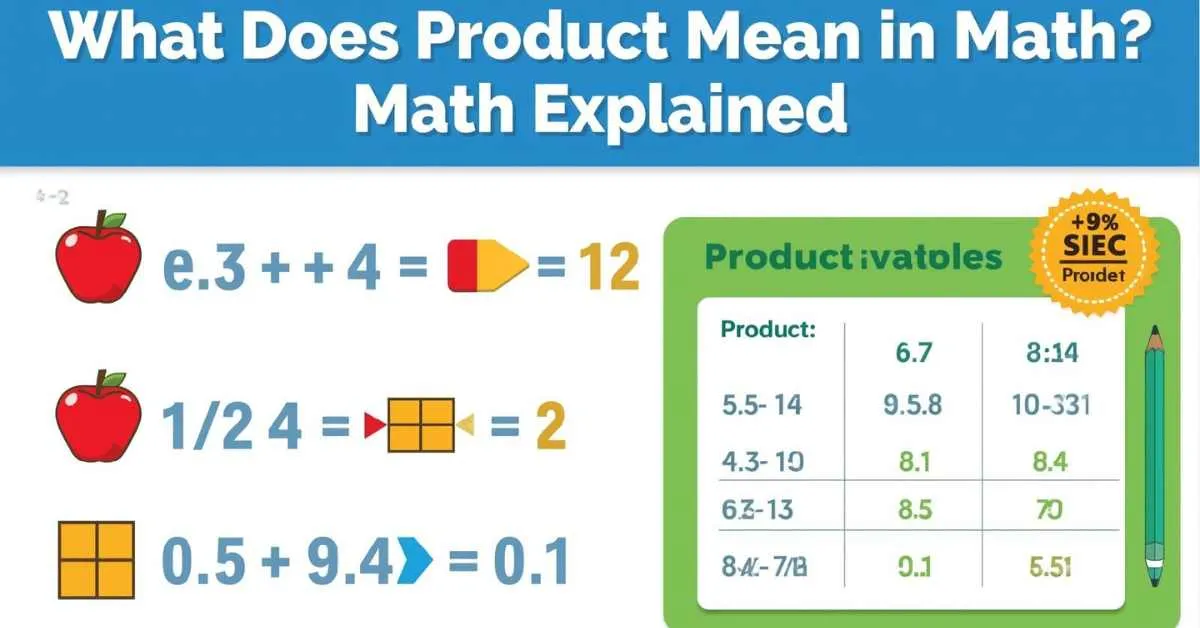
Product Definition Math
“What does product mean in math?” Simply put, a product is the result you get when you multiply two or more numbers.
It’s one of the most fundamental concepts in math. Appearing in arithmetic, algebra, fractions, decimals, and real-life scenarios. Understanding the product is essential for solving performing calculations, and mastering math.
If you’re a beginner, this guide will explain everything from simple examples. And repeated addition to fractions, decimals, and real-life applications.
By the end, you’ll know exactly how to calculate a product, identify factors, and avoid common mistakes, making math simpler, fun, and practical.
What Is a Product in Math? Clear Definition
Product Meaning Maths
In math, a product is the result of multiplication. The numbers being multiplied are called factors, and their combination produces the product.
Example:
- 5 × 7 = 35 → 5 and 7 are factors; 35 is the product.
Products are not limited to whole numbers. They also exist in fractions, decimals, and algebraic expressions. Recognizing the difference between a product, sum, and quotient is vital. While a sum comes from addition and a quotient from division. A product always comes from multiplication.
How Multiplication Produces a Product
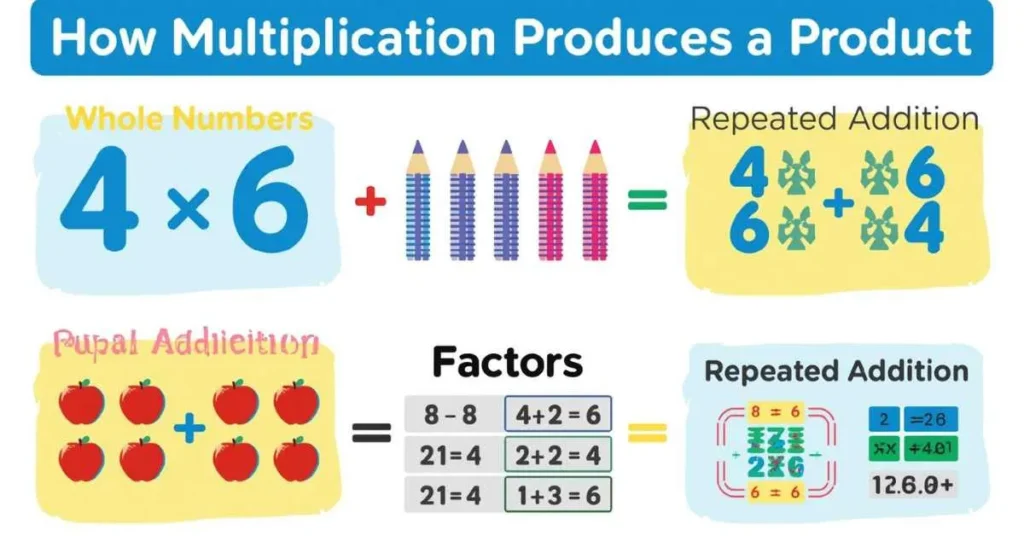
Multiplication is essentially repeated addition, grouping numbers together to find a total.
Example 1 – Whole Numbers:
- 4 × 6 = 24 → 4 groups of 6 give a product of 24.
Example 2 – Visual Representation (Placeholder for Table/Diagram):
GroupsItems per GroupProduct4624
Example 3 – Repeated Addition:
- 6 + 6 + 6 + 6 = 24 → same as 4 × 6
This method helps beginners visualize multiplication and understand how the product is formed.
Product Explained Using Fractions and Decimals
Products also apply to fractions and decimals, making it useful in more advanced calculations.
Fractions:
- ½ × 3 = 1½
- 2/3 × 3/4 = 6/12 = ½
Decimals:
- 0.5 × 0.2 = 0.1
These examples help you solve word problems, measure things, count money, and use math in real life.
Click To Read About: What Does Cumulative Mean? Easy Explanation & Examples
Product in Algebra: Multiplying Variables and Expressions
The concept of a product is critical in algebra. Here, products are results of multiplying variables, constants, or expressions.
Examples:
- 3 × x = 3x
- x × y = xy
- (x + 2) × (x – 3) = x² – x – 6
Knowing the product in algebra helps students solve problems, make expressions simpler, and do harder math more easily.
Product in Everyday Life: Practical Examples
Products appear everywhere in daily life. Understanding them makes calculations faster, easier, and more practical.
Examples:
- Shopping: 6 apples × $2 = $12 → total cost (product)
- Time & Travel: 50 miles/hour × 3 hours = 150 miles → total distance
- Cooking: ¾ cup sugar × 4 batches = 3 cups → total sugar
- School Supplies: 5 desks × 4 pencils = 20 pencils → total items
- Sports: 3 games × 7 goals per game = 21 goals → total scored
Visualizing these products can be made easier using tables or diagrams (placeholder for visuals).
Product vs Sum vs Quotient: Key Differences
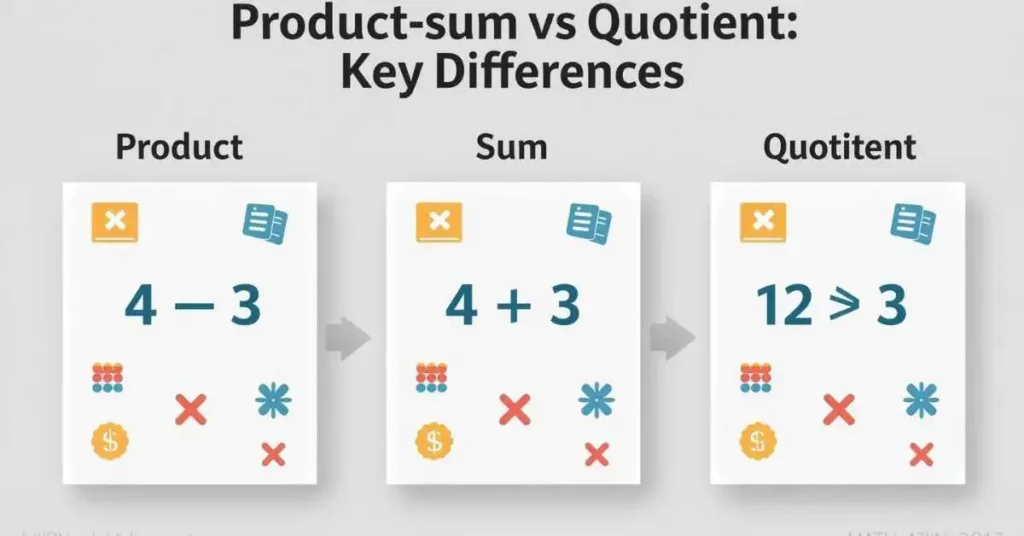
Understanding these differences prevents mistakes:
TermOperationExampleProductMultiplication4 × 6 = 24SumAddition4 + 6 = 10QuotientDivision24 ÷ 6 = 4
Quick tip: Whenever numbers are combined repeatedly, you are finding a product.
Common Mistakes Students Make With Product
- Confusing product with sum → Remember, sum = addition, product = multiplication.
- Misreading word problems → Look for keywords: “each,” “total,” “per.”
- Decimal mistakes → Count decimal places carefully.
- Fraction errors → Multiply numerators and denominators; don’t add them.
- Algebra mistakes → Don’t forget to multiply every term.
Product Meaning in Math for Kids
For kids, a product is the total you get when you multiply groups of numbers.
Example:
- 3 baskets × 4 apples = 12 apples
- 5 toy cars × 3 sets = 15 cars
Tips:
- Think in groups
- Use toys, pencils, or snacks for practice
- Remember: product = result of multiplication
Why It’s Called the Product
The term product comes from Latin producere, meaning “to bring forth”. In math, it’s the result produced by multiplying numbers together.
Example:
- 4 × 5 = 20 → 20 is the product, produced by combining 4 and 5
Knowing where the word ‘product’ comes from helps you remember it and shows how math started long ago.
Interactive Practice Ideas
Try calculating the product in everyday scenarios:
- Count pencils in rows on your desk
- Multiply scores in sports games
- Calculate total cost while shopping
- Use worksheets or online multiplication games
Frequently Asked Questions About “What is product in maths“
1. What does product mean in multiplication? It’s the result of multiplying two or more numbers.
2. Is product the same as an answer?
Answer. Yes, specifically for multiplication.
3. Can products be fractions or decimals?
Answer. Absolutely. Example: ½ × 3 = 1½, 0.5 × 0.2 = 0.1
4. How do I find a product in word problems?
Answer. Identify the factors and multiply them. Look for keywords like “each,” “per,” or “total.”
5. What is the difference between product and sum?
Answer. Product = multiplication; sum = addition.
6. What Does Product Mean?
A product is something made or offered to satisfy a need or want, such as a physical item, digital tool, or service.
Final Thoughts
A product is what you get when you multiply numbers. You can find products with whole numbers, fractions, decimals, and even letters in algebra. It helps to know the difference between a product, a sum, and a quotient. Practice with real-life examples to make math fun and easy.
Kids learning multiplication and students working on algebra need to master the product. It is an important step for all math skills.

Hi, I’m Evan Lexor, the voice behind Meanpedia.com. I break down English words, slang, and phrases into clear, simple meanings that actually make sense. From modern internet terms to everyday expressions, my goal is straightforward: help you understand English better, faster, and with confidence, one word at a time.