A job title is a short name for your work. You see it on your CV / Resume, your LinkedIn profile, and in job applications / forms. It is also stored in office records. Because it shows up in so many places, your job title can shape how people understand your career.
Still, many people feel confused. Does a title tell your real duties? Can two people have the same title and do different work? What if your company uses a “fun” title that nobody knows?
This guide explains job title meaning in a clear way. You will also learn how to pick the best title for your CV/Resume and LinkedIn, how to handle odd company titles, and what to type when a form asks for “job title.”
Quick Answer
A job title is the official name of your position in a company.
It usually tells:
- What kind of work you do (your area, like sales, accounts, design, teaching)
- How senior you are (your level, like junior, senior, manager)
A job title is a label, not the full story. Your daily work is explained by your role and job description.
What a Job Title Tells People
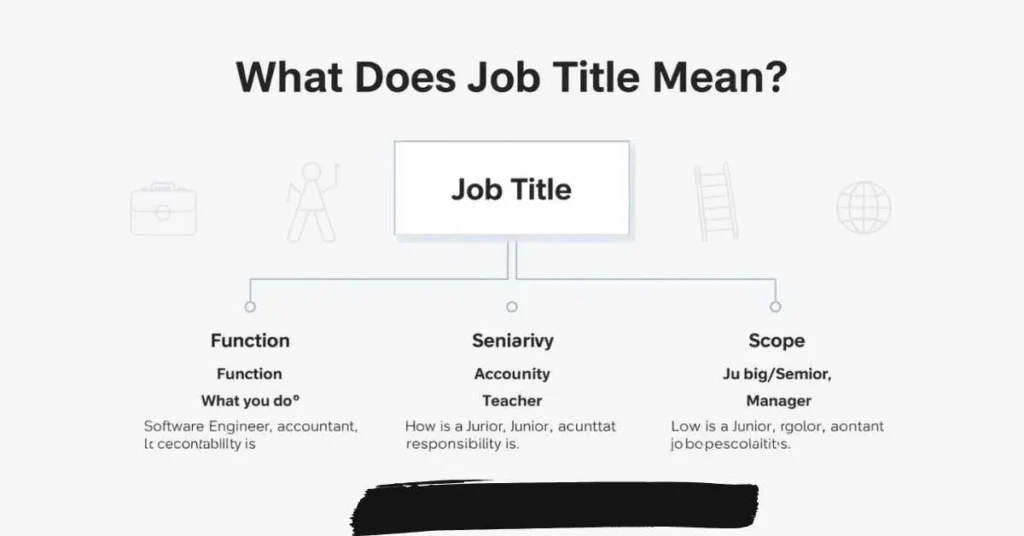
Most job titles are built from a few simple parts. When you learn these parts, you can understand almost any title quickly.
1) Your work area (function)
This is the type of work you do, such as:
- Sales
- Accounts and finance
- Design
- Teaching
- Human resources
- Customer support
- Project work
- Software and technology
2) Your level (seniority)
Many titles include level words, like:
- Intern, Junior, Associate
- Senior, Lead
- Manager, Head, Director
3) Your scope (how big your work is)
Some titles show scope, such as:
- Regional
- Global
- Enterprise
- Project or product focus
A title can give a fast idea of your place in the company. But it does not list your full tasks. That is why titles must be clear and easy to understand.
Where Use Job title?
You will see a job title in these common places:
- CV / Resume
- LinkedIn profile
- Job applications / forms
- Office records
Because titles appear in official and public places, it is smart to keep them accurate and clear.
Job Title vs Job Role vs Job Description (Simple Difference)
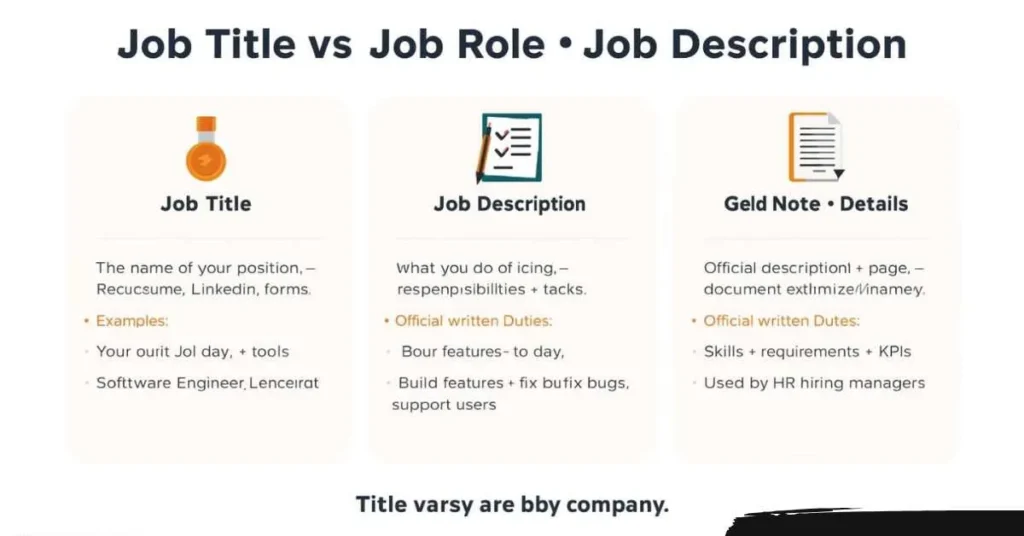
These words sound similar, but not the same.
Job title
This is the name of your position.
Example: Software Engineer or HR Manager.
Job role
This is what you actually do each day.
Two people can share a title but do different tasks.
Job description
This is the written list of duties and skills for the job.
It often includes requirements, tools, goals, and who you report to.
A simple way to remember:
- Title = name
- Role = real work
- Description = details
Job Title Examples (Real and Easy)
Here are common job title examples that most people understand right away:
- Software Engineer
- Accountant
- Sales Executive
- Teacher
- Graphic Designer
- HR Manager
- Customer Support Representative
- Project Manager
These titles work well because they are clear. A person can guess the type of work, even without extra explanation.
Why Job Titles Matter (In Real Life)
A job title may look small, but it can affect big things.
It helps people understand you fast
If you say you are a Teacher, people know the general work. If you say you are a Graphic Designer, they know you work in design.
It helps hiring teams search for you
Many employers use resume-scanning software. It looks for common words, including titles. If your title is too unusual, your CV may not show up for the right role.
It helps with trust and clarity
Clients, managers, and recruiters use titles to set expectations. A clear title reduces confusion during interviews and meetings.
It supports salary research
Pay ranges are often grouped by level and title. Your duties matter most, but the title still shapes first impressions.
Job Title Levels
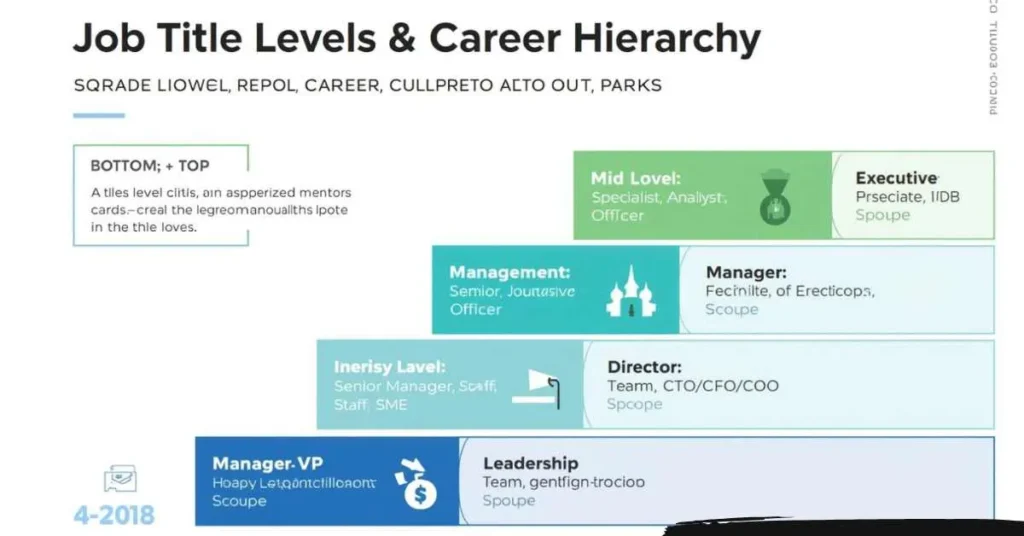
Titles often follow a basic ladder. Not every company uses the same words, but the pattern is similar.
Entry level
- Intern / Trainee
- Junior
- Assistant
Mid level
- Executive (common in many countries)
- Specialist
- Analyst
- Officer
Senior level (expert individual)
- Senior
- Lead
- Principal / Staff (common in tech)
Management
- Manager
- Senior Manager
- Head
- Director
- VP
- C-level (CEO, CTO, CFO)
Important note: Level words can change by company. A “Manager” in one company may have a smaller scope than a “Lead” in another. That is why your responsibilities must match what your title suggests.
Why the Same Job Can Have Different Titles
It is normal to see different titles for similar work. Here are the main reasons.
Company size
In a small company, one person may do many tasks, so titles are broad. In a large company, titles may be narrow and specific.
Industry style
Schools often use titles like Teacher. Tech firms often use Software Engineer. Customer-facing teams may use Customer Support Representative or “Customer Success.”
Location and culture
Some regions use “Executive” for mid-level roles. Other regions may use “Associate” more often.
Branding and creative titles
Some companies use fun titles like “Support Hero.” These can be fine inside the company, but they can confuse people outside.
Creative Titles vs Standard Titles (What You Should Do)
Creative titles can sound cool, but they can cause problems in job search.
The problem with creative titles
- They may be unclear to recruiters
- They may be hard for resume software to match
- They can look less serious in formal industries
The simple fix: use a clear translation
If your official title is creative, keep it honest and add a standard title in brackets.
Examples:
- Customer Happiness Hero (Customer Support Representative)
- Growth Ninja (Sales Executive or Marketing Specialist, depending on your work)
This keeps your profile truthful and easy to understand.
How to Choose the Best Job Title for CV / Resume and LinkedIn Profile
Your title on your CV / Resume and LinkedIn profile should be:
- accurate
- clear to strangers
- easy to search
- supported by your duties
If your official title is already clear
Use it as-is. Titles like Accountant, Project Manager, and HR Manager are easy to understand.
If your official title is unclear
Use this format:
Official Title (Common Title)
Example:
- Support Hero (Customer Support Representative)
If your duties are bigger than your title
Do not “upgrade” your title without proof. Instead, show the truth in bullet points.
Good bullet examples:
- Led weekly planning and delivery for cross-team work
- Managed timelines, risks, and updates for senior leaders
- Trained new team members and reviewed their work
This approach protects your credibility in interviews.
What to Write in the “Job Title” Field (Forms and Applications)
Many people get stuck when a form asks for job title. Use these easy rules.
If you are employed
Use your official title or the clear version:
- Sales Executive
- Software Engineer
- Customer Support Representative
If you are a freelancer
Use:
- Freelance Graphic Designer
- Independent Software Engineer
- Freelance Accountant (only if true)
If you are a student
Use:
- Student
- Teaching Intern (if it was an internship)
- Junior Graphic Designer (Intern) (only if you had that role)
If you are between jobs
Use your last official title with dates on your CV/Resume. On LinkedIn, you can keep your last role and update your headline to show you are open to work.
How to Show Promotions and Multiple Titles (Very Practical)
If you grew inside one company, show that growth clearly. This is a common edge case, and many people do it wrong.
Option A: One company, two titles
Write it like this:
Company Name
Senior Graphic Designer (2025–2026)
Graphic Designer (2023–2025)
Then add bullets under each title that match that time period.
Option B: One title, but bigger duties
Keep your official title, then add a line like:
- Took on team-leading duties while keeping the same title
This is honest and easy to explain in interviews.
When to Ask for a Job Title Change (And How to Ask)
A title change makes sense when your work changed in a real way.
Good reasons to ask
- You took on management work
- Your scope became bigger (team, region, budget)
- Your title is confusing outside the company
- Your title no longer matches your daily duties
A simple message you can use
“I want my job title to match my responsibilities. It will make my role clearer inside the team and in office records. Here are the key duties I handle now, and the results I delivered.”
Bring proof: tasks, projects, results, and team impact.
Common Mistakes That Hurt Your CV (And How to Fix Them)
1) Using a vague title
“Staff” or “Employee” tells nothing. Choose a clear title that matches your work.
2) Inflating your title
If you write “Manager” but you did not manage people or decisions, interview questions will expose it.
3) Leaving out the clear version of a creative title
If your company uses a fun name, add the common name in brackets.
4) Not showing scope
A Project Manager who led a big project should show size and impact, not only tasks.
Copy-and-Paste Job Title Templates
Use these templates to write titles in a clean and professional way.
Template 1: Level + Role
- Senior Software Engineer
- Junior Accountant
- Lead Graphic Designer
2: Role + Area
- Customer Support Representative
- Sales Executive
- Project Manager
3: Role + Scope
- Regional Sales Executive
- Global HR Manager
- Enterprise Project Manager
4: Freelancer format
- Freelance Graphic Designer
- Independent Software Engineer
FAQ (Fast Answers)
What does job title mean in a job application?
It means the name of your position, such as Accountant or Sales Executive.
Is job title the same as designation?
In many places, yes. Both usually mean the official name of your position.
Can two people share the same title but do different work?
Yes. Company size, team structure, and scope can change the duties.
What if my company title is weird?
Use the bracket method:
Official Title (Customer Support Representative)
Does job title matter for office records and checks?
Yes. Official systems and background checks often use the title saved in office records, so keep it accurate.
Key Takeaways
A job title is the official name of your position. You will use it on your CV / Resume, LinkedIn profile, and job applications / forms, and it will appear in office records. Pick a title that is clear, truthful, and supported by your duties. If your company uses a creative title, translate it into a common one so people understand you fast.
Conclusion:
Now you know what a job title means and why it matters. A clear title helps people understand your work, helps hiring teams find you, and keeps your professional story clean.
Next step: open your CV / Resume and your LinkedIn profile right now. Check your job title. If it is unclear, rewrite it using a standard version in brackets. Then update your bullets to show your real impact. If you want, share your current title and 3 main duties, and I will suggest the best clear job title options for your target jobs.
Read Also About: What Does Temu Mean: Quick Facts & Safe Shopping (2026)

Hi, I’m Evan Lexor, the voice behind Meanpedia.com. I break down English words, slang, and phrases into clear, simple meanings that actually make sense. From modern internet terms to everyday expressions, my goal is straightforward: help you understand English better, faster, and with confidence, one word at a time.