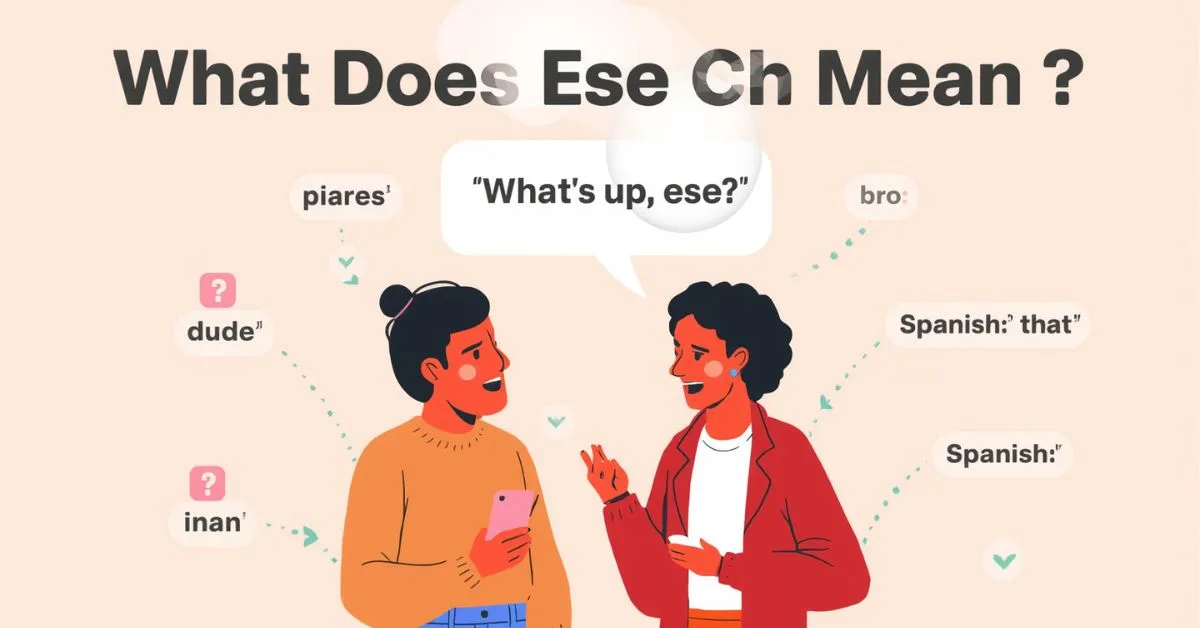
In most slang contexts, ese means something like dude, bro, man, or homie. It is especially associated with Mexican-American and Chicano speech, though usage varies by region and context. In standard Spanish, ese can also simply mean that or that one.
If you heard someone say “What’s up, ese?” in a movie, song, meme, or conversation, the slang meaning is usually the one you want first.
The confusion happens because ese is not just one thing. It can be slang, a normal Spanish word, the name of the letter S in Spanish, or ESE in an abbreviation context.
What does ese mean in slang?
In slang, ese usually means dude, bro, man, guy, buddy, or homie. It is a casual way of referring to or addressing another person.
Language references commonly connect this use to Mexican-Spanish or Chicano slang, and SpanishDictionary notes that it became especially popular in Spanish-speaking regions of the United States.
A few natural examples:
- “What’s up, ese?”
- “That ese was funny.”
- “No way, ese, you really did that?”
In these examples, the word does not have one exact English translation every time. It works more like a tone-based slang label than a strict dictionary equivalent. Depending on context, bro, man, dude, or homie may all fit.
What does ese mean in Spanish?
In standard Spanish, ese is also a normal word meaning that or that one, depending on how it is used in the sentence.
Examples:
- Ese coche = That car
- Eligió ese = He, She chose that one
That is important because sometimes readers assume every use of ese is slang. It is not. In many cases, it is just ordinary Spanish grammar.
Does ese mean bro, friend, or homie?
Usually, yes, but only approximately.
The closest everyday English meanings are:
- bro
- dude
- man
- buddy
- homie
Still, ese does not always land exactly like friend. Sometimes it feels closer to that guy. Sometimes it is just a casual way to address someone . And sometimes it carries a tougher street tone.
So the best simple rule is:
If someone uses ese casually toward another person, think “bro” or “dude” first, not a formal definition like “friend.”
Is ese rude or offensive?
Not automatically. But it is not a neutral word in every setting either.
SpanishDictionary notes that most of the time it just means dude or bro, but also warns that in some parts of California it can be used by certain gangs to self-identify. Dictionary.com also frames it as a slang term tied to Mexican-Spanish/Chicano usage. That means tone, region, and who is saying it all matter.
When it sounds friendly
- used jokingly between friends
- used in a relaxed, informal tone
- used by people who naturally speak that way
When it can sound awkward or rude
- said mockingly
- said with aggression
- copied by someone using it as a stereotype
- dropped into conversation unnaturally just to sound tough or performative
So the safest answer is this:
Ese is usually informal slang, not a bad word by itself. But in the wrong voice or context, it can sound confrontational, forced, or culturally awkward.
How to pronounce ese
In Spanish, ese is pronounced roughly like eh-seh. SpanishDictionary’s pronunciation guide for “¿Qué onda, ese?” gives it as eh-seh.
Some English-language slang explainers also render it as es-ay to help English speakers approximate the sound.
That means you may see different English spelling guides for pronunciation, but the Spanish pronunciation is the better reference point.
Where people usually hear the word ese
People often come across ese in:
- movies and TV dialogue
- rap or hip-hop lyrics
- memes and jokes
- California or Mexican-American slang contexts
- Spanish-learning discussions
- online “what does this word mean?” searches
This matters because pop culture often exaggerates slang. A word can be real and still be overused in movies in a way that does not reflect how every real speaker talks.
Ese meaning by context
| Context | What ese most likely means | Tone |
|---|---|---|
| “What’s up, ese?” | dude / bro / man | friendly, casual |
| “That ese over there” | that guy / dude | informal |
| “Ese coche” | that car | standard Spanish, not slang |
| “Eligió ese” | that one | standard Spanish, not slang |
| “Wind ESE” | east-southeast | abbreviation, not slang |
The context tells you almost everything.
Ese vs güey vs vato vs bro
Many articles explain ese on its own, but readers usually understand it better when they compare it with nearby slang.
| Word | Usual meaning | Notes |
|---|---|---|
| ese | dude / bro / guy | often tied to Chicano or Mexican-American slang contexts |
| güey | dude / guy / idiot, depending on tone | very common Mexican slang, highly tone-dependent |
| vato | guy / dude | slang, often more regionally marked |
| bro | bro / dude | broad English slang, much more universal |
This comparison helps because ese is not just “Spanish for bro.” It has its own cultural feel, and it does not fit every Spanish-speaking context equally well.
SpanishDictionary explicitly notes that the slang use is not commonly used everywhere in Mexico the way many learners assume.
Other meanings of ese
This is where many pages get messy. They mix all meanings together too early. The better way is to answer the slang meaning first, then separate the others clearly.
1) Ese as a normal Spanish demonstrative
As a standard Spanish word, ese can mean that or that one.
2) Ese as the name of the letter S
SpanishDictionary’s guide notes that Ese is also the name of the letter S in the Spanish alphabet. Collins also reflects ese as the name of the letter S.
3) ESE as an abbreviation
In English dictionary and navigation contexts, ESE commonly means east-southeast.
4) -ese as an English suffix
Merriam-Webster explains that -ese can be a suffix in English words related to nationality, language, or a type of writing or diction, as in Chinese, Cantonese, or journalese.
Common mistakes people make
Mistake 1: Thinking ese always means “homie”
It can mean that, but dude, bro, or guy are often just as accurate.
Mistake 2: Assuming it is standard everywhere in Mexico
Some guides present it as broadly Mexican slang, but SpanishDictionary specifically notes the slang use is not commonly used in Mexico in the way many learners imagine and is especially heard in U.S. Spanish-speaking contexts like California.
Mistake 3: Treating it as safe in every situation
It can sound friendly, but it can also sound stereotyped or aggressive depending on who says it and how.
Mistake 4: Forgetting the standard Spanish meaning
Sometimes ese is not slang at all. Sometimes it just means that.
What Most Articles Miss About This Topic
Most articles stop at “ese means bro” and leave readers with only half the answer.
What they usually miss is that ese is a context-heavy word. It can be:
- a slang term of address
- a normal Spanish word meaning that
- the name of the letter S in Spanish
- ESE as east-southeast
- -ese as an English suffix
They also often skip the most useful clarification: just because a word appears in movies or online slang lists does not mean it sounds natural coming from everyone. The word carries tone, region, and cultural context. That is why the real skill is not just knowing the translation. It is knowing when the word fits and when it does not.
FAQ
What does ese mean in slang?
In slang, ese usually means dude, bro, man, or homie.
What does ese mean in Spanish?
In standard Spanish, ese usually means that or that one, depending on the sentence.
Does ese mean friend?
Sometimes loosely, yes, but bro, dude, or guy is often closer in tone than the formal word friend.
Is ese offensive?
Not by itself. It is informal and can sound friendly, but it may also sound aggressive, stereotyped, or awkward depending on context.
What does ESE mean in all caps?
In many English dictionary and compass contexts, ESE means east-southeast.
Is ese used everywhere in Mexico?
Not necessarily. SpanishDictionary notes that the slang use is not commonly used in Mexico the way many learners think and is especially associated with Spanish-speaking regions of the United States, such as California.
Conclusion
If you want the fast answer, here it is: ese usually means dude, bro, man, or homie in slang. But the smarter answer is that context decides everything. In one sentence it can be casual slang. In another, it can just mean that in Spanish.
And in all caps, ESE may simply mean east-southeast. Once you separate those uses, the word becomes much easier to understand correctly.
Read More Posts:
What Does ESP Mean? Psychic, Car, Education and Explanation
What Does Thee Mean? Definition, Examples, and Usage
What Does RPG Mean? Gaming Meaning, Other Uses

Hello! I’m Clara Lexis, creator of Meanpedia.com. I specialize in breaking down words, phrases, and idioms so that anyone can understand and enjoy the beauty of English. My goal? Making language approachable, fun, and meaningful, one word at a time.