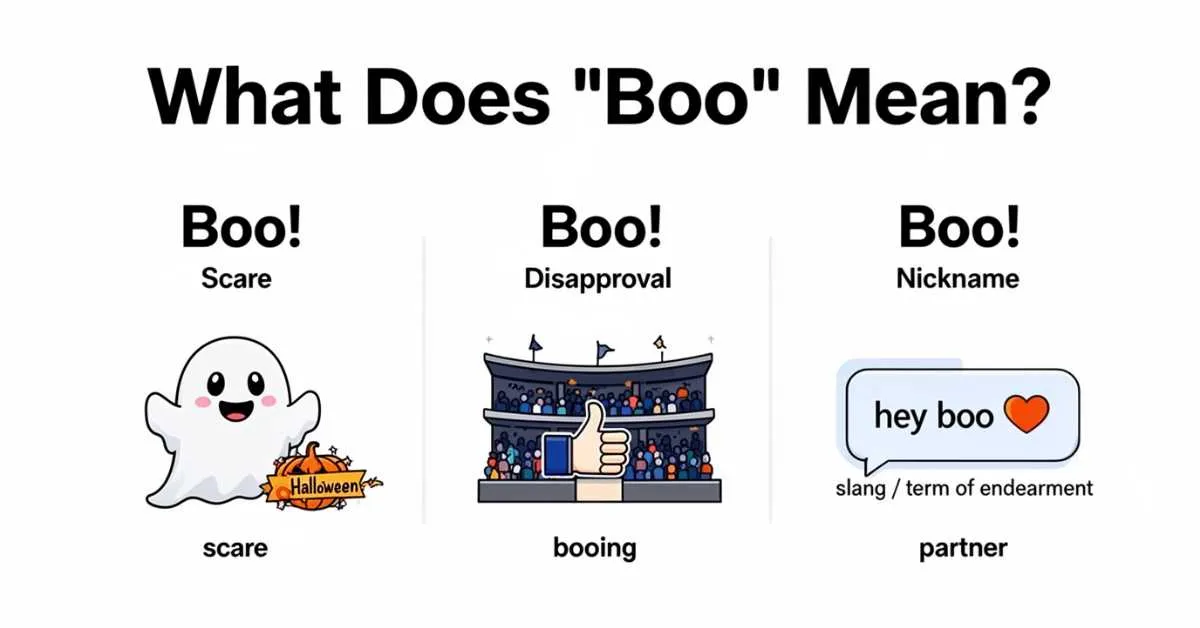
“Boo” has three main meanings. It can be a playful scare sound (like a ghost saying “Boo!”), a loud sign of disapproval (when a crowd is booing or someone gets booed).
Modern slang used as a term of endearment and nickname for someone you care about in a romantic relationship (your boyfriend, girlfriend, or partner), like “Hey boo” or “My boo.”
Ever stared at your phone after someone texted “hey boo” and thought, Wait… are they flirting with me? Or heard people yelling “booo!” at a game and wondered why the same word can sound sweet in a DM but harsh in a crowd?
In this guide, you’ll learn exactly what “boo” means in texting, what it means when people boo, and how to decode tone using punctuation, context, and relationship cues in seconds.
Quick answer
“Boo” has three main meanings. It can be a playful scare sound (“Boo!” like a ghost), a loud sign of disapproval (people booing at games).
Slang for a term of endearment (a sweet nickname for someone in a romantic relationship, like a boyfriend or girlfriend). Context tells you which one fits.
The three meanings of “boo”
When people search boo meaning or what does boo mean, they usually want one clear answer. The truth is simple. “Boo” changes meaning based on the situation.
Meaning A: “Boo!” = scare or surprise
This is the classic jump-scare sound. It is also linked with a ghost in stories and Halloween scenes.
Meaning B: “Boo!” = disapproval
This is what crowds shout when they dislike something. It is common in sports, shows, and speeches.
Meaning C: “Boo” = term of endearment (slang)
This is a sweet nickname. It often means “babe,” “sweetheart,” or “my person.”
Boo meaning in text: “Hey boo” and “My boo”
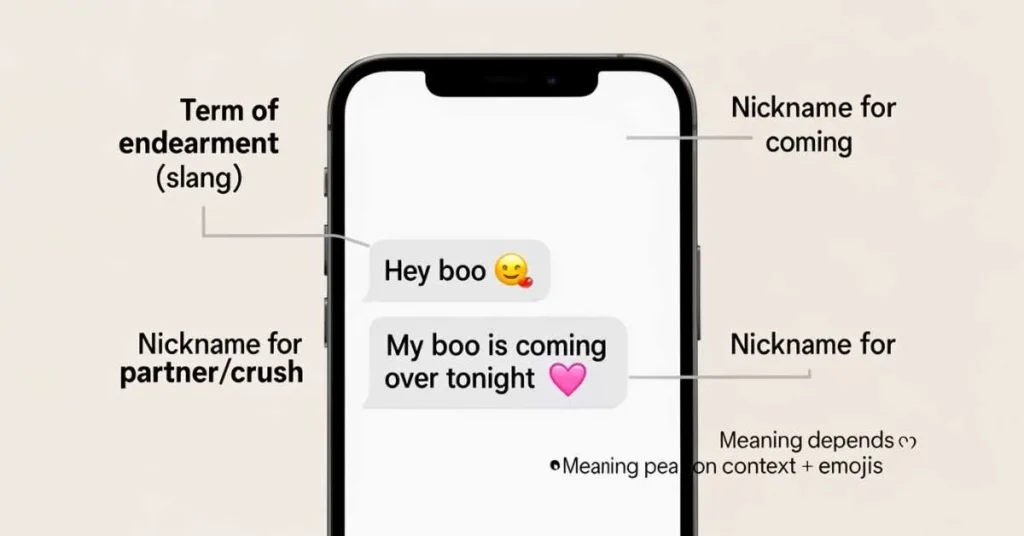
If you searched boo meaning in text or what does boo mean in texting, you are probably seeing “boo” used as slang.
- “Hey boo” usually means “Hey, sweetheart.”
- “My boo” usually means “my partner” or “my crush.”
Examples
- “Hey boo. How was your day?”
- “Miss you, boo.”
- “That’s my boo.”
- “My boo is coming over tonight.”
Pop culture note: “My Boo” helped popularize the phrase
Pop culture strongly influenced this slang term. Many people connect “My Boo” with the famous song by Usher and Alicia Keys. That phrase became a common caption and pet name after it spread in music and media.
Meaning 1: “Boo!” as a scare (the ghost sound)
This “boo” is meant to startle someone. It is often playful.
Why it sounds like a ghost
“Boo” is a type of onomatopoeia. That means the word copies a sound. It is short, loud, and easy to shout. That is why it works in jump scares and ghost stories.
Examples
- “Boo! I scared you.”
- “Don’t shout boo like that.”
- “Boo! Happy Halloween.”
Common Related Things
1.Boo meaning halloween
- On Halloween, “Boo!” is a playful spooky shout used for fun scares, costumes, and haunted-house vibes.
- It’s part of the holiday’s ghost theme, used to create quick surprise without real danger.
2.Boo scare meaning
- “Boo!” is a sudden sound meant to startle someone for a laugh or quick reaction.
- It’s often used in pranks and surprise moments, usually followed by smiling or joking.
3.Boo got you meaning
- “Boo, got you!” means “I tricked you” or “I surprised you,” usually in a harmless, playful way.
- People say it right after a jump-scare to confirm it was a joke, not a real threat.
4.Why do ghosts say boo
- Ghosts “say boo” because it’s an easy, dramatic sound that signals “spooky” instantly.
- The word acts like a sound-effect, so stories and movies use it to show a scare fast.
Meaning 2: “Boo!” as disapproval (booing, booed, boos)
This “boo” is the opposite of cheering. It is used to show dislike or disagreement.
Where you will hear it
- Sports games
- Concerts and theater
- Public speeches
- Reality and talent shows
Grammar forms (helpful for readers and SEO)
- Interjection: “Boo!”
- Verb: “They booed the decision.”
- Noun: “The crowd erupted in boos.”
Examples
- “The fans booed the referee.”
- “He was booed off the stage.”
- “There were boos and a few cheers.”
Booing vs heckling
People ask about this a lot. Booing is usually one simple sound of disapproval. Heckling is more direct and personal. Heckling often includes words, insults, or repeated comments. Booing is shorter and more general.
Meaning 3: “Boo” as slang for a term of endearment
This is the meaning most people see in texting and captions. “Boo” is a term of endearment. It is also a nickname. It often signals affection.
What it usually means
- A partner in a romantic relationship
- A crush or someone you are dating
- A close person you care about
Examples
- “Good morning, boo 😘.”
- “Come here, boo.”
- “I’m proud of you, boo.”
Can “boo” be platonic
Sometimes, yes. Close friends may say, “You got this, boo.” It depends on the friend group and the tone. Romance is still the most common meaning.
How to tell which “boo” it is (fast cheat sheet)
Use these quick checks. They solve confusion fast.
1) Check the setting
- In a text or DM. It is often the slang meaning.
- In a stadium or crowd. It is usually disapproval.
- In a prank or Halloween moment. It is usually the ghost scare sound.
2) Check punctuation
- “Boo!” or “BOO!” often signals a shout.
- “Boooo” often signals disapproval or dramatic teasing.
- “boo” can feel casual and affectionate.
- “boo.” can feel cold or sarcastic.
3) Check the vibe
- Hearts and kisses often mean affection.
- Eye-roll emojis often mean sarcasm.
- “Lol” often signals teasing.
Quick context table
| Context | Likely meaning | Example | Safe reply |
|---|---|---|---|
| Text from someone you like | Term of endearment | “Hey boo 😘” | “Hey 😊 What’s up?” |
| Sports or show crowd | Disapproval | “Boooo!” | “Yeah, that call was rough.” |
| Prank or Halloween | Scare | “BOO!” | “You got me 😂” |
| Snarky tone in chat | Sarcasm | “Ok boo.” | “What do you mean?” |
What to reply when someone calls you “boo”
Your best reply depends on your goal. Do you want to flirt, stay neutral, or set a boundary.
Flirty replies
- “Hey boo 😄.”
- “Hi boo. I missed you.”
- “What are you doing later, boo?”
Neutral replies (when you are unsure)
- “Hey. What’s up?”
- “Haha 😅 What’s going on?”
- “Hi. How can I help?”
Boundary-setting replies (if you do not like it)
- “Please call me by my name.”
- “I’m not into pet names. Thanks for understanding.”
- “Let’s keep it simple. Call me [Name].”
Boo vs bae vs babe vs beau
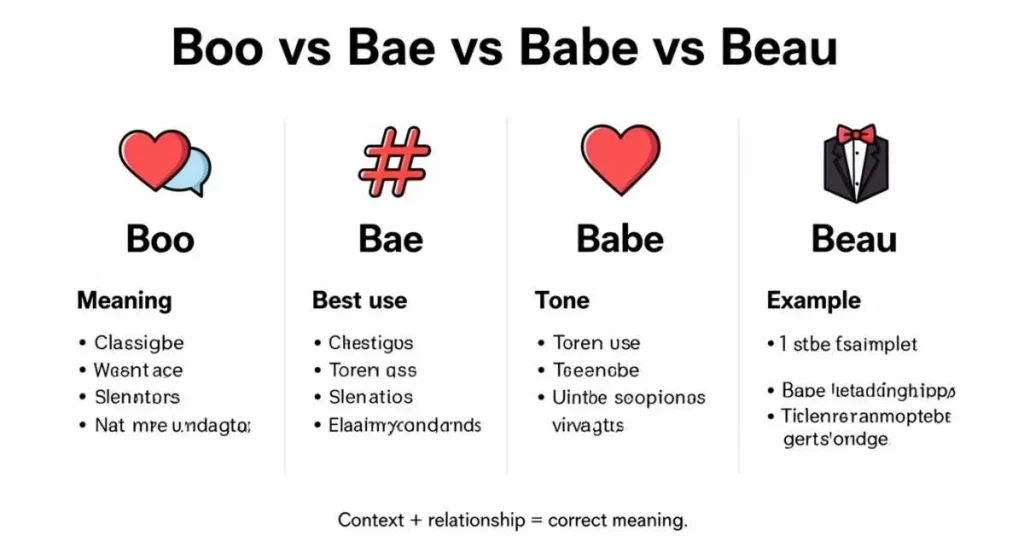
People often compare these. Here is the difference in plain terms.
1.Boo vs bae
- Bae often feels trendier and very relationship-focused.
- Boo can be romantic, but it is also used as friendly hype.
2.Boo vs babe
- Babe is common and widely accepted.
- Boo feels more playful and slangy.
3.Boo vs beau
- Beau is a real word meaning admirer or boyfriend.
- It feels more formal or old-fashioned.
- Boo is the casual slang term people text.
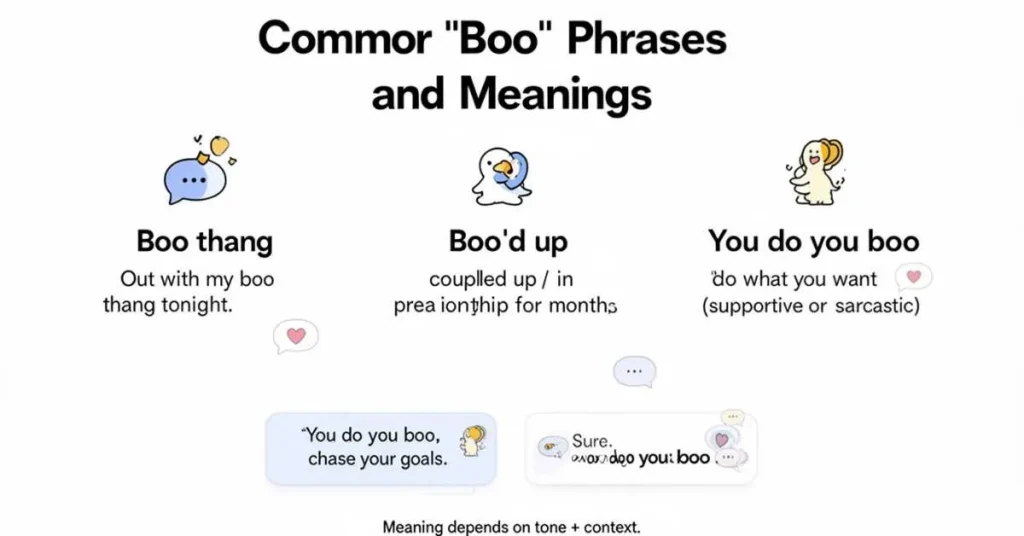
Common phrases: “boo thang,” “boo’d up,” and “you do you boo”
These phrases show up in captions and comments.
Boo thang meaning
“Boo thang” means your person. It can be a partner, date, or crush.
Example: “Going out with my boo thang tonight.”
Boo’d up meaning (or booed up meaning)
“Boo’d up” means taken or coupled up.
Example: “They’ve been boo’d up for months.”
“You do you boo” meaning
This means “Do what you want.”
It can be supportive or sarcastic. Tone matters.
Example (supportive): “You do you boo. Chase your goals.”
Example (sarcastic): “Sure. You do you boo.”
Pronunciation, spelling, and tone
Boo pronunciation
It sounds like “boo” in “boo-hoo.” It uses a long “oo” sound.
Spelling changes the emotion
- “BOO!” feels loud.
- “Boo!” feels playful or dramatic.
- “Boooo” feels like disapproval or big teasing.
- “boo.” can feel annoyed or dismissive.
Origin: Onomatopoeia and why “boo” stuck
Many people search boo origin or boo etymology. You do not need the full history to understand it. A simple view helps.
- The scare “boo” works because it is onomatopoeia. It is a sound-word built for surprise.
- The disapproval “boo” uses that same short sound to send a group message.
- The slang “boo” spread through everyday speech and pop culture. “My Boo” also helped it feel normal in romance talk.
That mix made “boo” last across generations.
When to use “boo” (and when to avoid it)
This section helps you avoid awkward moments.
Use “boo” when
- You are already close.
- You are in a romantic relationship.
- The other person likes pet names.
- The setting is casual.
Avoid “boo” when
- You are at work or in a formal chat.
- You do not know the person well.
- The person seems uncomfortable.
- The message could sound too intimate.
A simple rule works. If you would not say “babe” to them, do not say “boo” yet.
FAQs
What does boo mean from a guy
It depends on the intent, not gender. In texting, it often means a term of endearment. In a crowd, it usually means disapproval.
What does boo mean from a girl
Same answer. Context matters most. Look at emojis, tone, and your relationship.
Is “boo” flirting
Often, yes. “Hey boo” usually reads as flirty or affectionate. It can also be friendly hype in some groups.
What does “my boo” mean
“My boo” usually means a partner or someone you are romantically involved with.
What does “booed” mean
“Booed” means people shouted “boo” to show dislike or disapproval.
Why do crowds boo
Crowds boo to show they do not approve. It is the opposite of cheering.
Is “boo” rude
“Boo” as a nickname is not rude if it is welcome. Booing someone can be rude in personal settings.
What does “never said boo” mean
“Never said boo” means someone stayed silent or did not complain. It is an idiom you may see in older writing.
Final Thoughts
“Boo” has three main meanings: scare, disapproval, and slang affection. In texting, “boo” is often a term of endearment or nickname. In crowds, “booing” means disapproval.
“Booed” is the past tense. Pop culture, including “My Boo” by Usher and Alicia Keys, helped spread the romantic slang use. Punctuation and tone can change everything.
Click For Read About: What Does CYL Mean for Glasses? Cylinder Power, Astigmatism

Hi, I’m Evan Lexor, the voice behind Meanpedia.com. I break down English words, slang, and phrases into clear, simple meanings that actually make sense. From modern internet terms to everyday expressions, my goal is straightforward: help you understand English better, faster, and with confidence, one word at a time.