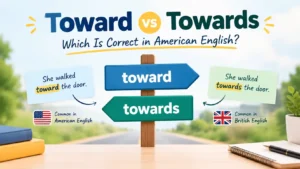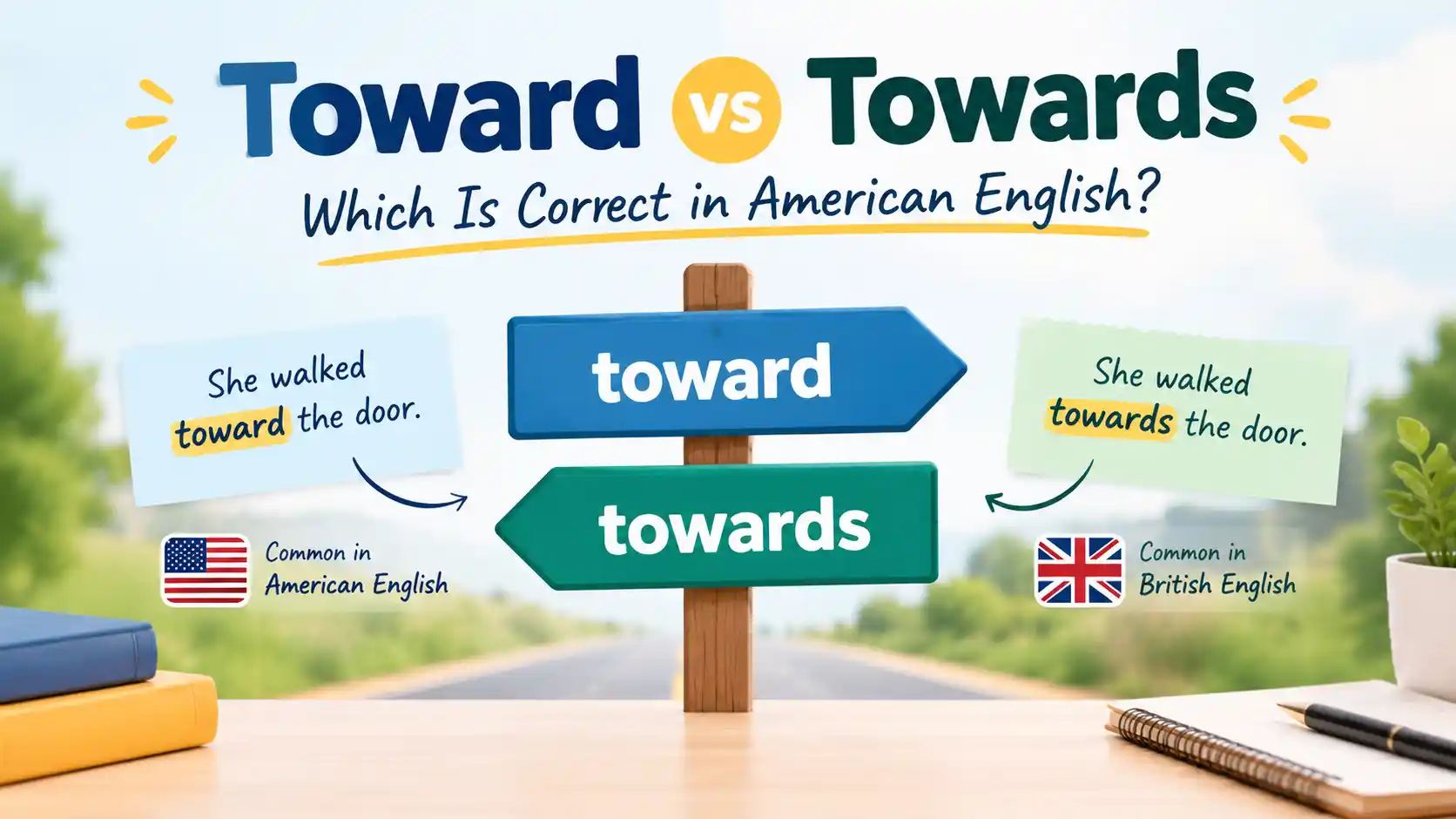
Ever paused while writing and wondered whether it should be “toward” or “towards”? You’re not alone. These two words look almost identical and usually carry the same meaning, yet one may sound more natural depending on where your audience is from. In this guide, we’ll break down toward vs towards with clear examples and explain which form is generally preferred in American English.
Key Takeaways
- Toward and towards are both grammatically correct.
- They generally have the same meaning and function.
- Toward is the more typical choice for American English.
- Towards is especially common in British English.
- Use one form consistently when following a particular regional or editorial style.
- Both forms can describe movement, attitudes, position, time, and purpose.
What Is the Difference Between Toward and Towards?
The difference between toward and towards is mainly a matter of regional usage rather than meaning.
Both words function as prepositions. They can indicate movement in a particular direction:
- She walked toward the door.
- She walked towards the door.
Both sentences mean essentially the same thing.
The same applies when the words are used figuratively. For example:
- The company is moving toward a more sustainable business model.
- The company is moving towards a more sustainable business model.
There is no major grammatical distinction between the two forms. Cambridge identifies toward as mainly U.S. usage and towards as mainly U.K. usage, while also recognizing both forms.
Is Toward or Towards Preferred in American English?
For a U.S. audience, toward is generally the better default.
For example:
The car moved toward the intersection.
We are working toward our goal.
She turned toward the window.
The project is moving toward completion.
American dictionaries recognize towards as well, so using it does not automatically make a sentence incorrect. Cambridge’s American English dictionary lists towards as another form of toward.
However, if you are writing a website, school assignment, business document, or other content specifically for Americans, choosing toward will generally sound more natural and align with common U.S. usage.
For British English, towards is generally more characteristic.
Quick comparison
| Form | American English | British English | Meaning |
|---|---|---|---|
| toward | Common/preferred | Used | Same |
| towards | Used, but less typical | Common/preferred | Same |
The important point is that this is primarily a regional preference, not a difference between correct and incorrect grammar.
How to Use Toward and Towards
Both forms can be used in several different situations.
1. Showing Direction or Movement
The most common use is to show movement in the direction of someone or something.
Examples:
- He walked toward the bus stop.
- The dog ran toward its owner.
- She moved towards the window.
- The plane was heading toward the airport.
The choice of toward or towards does not normally change the meaning.
For American writing, you would typically choose toward:
The children ran toward the playground.
For British-oriented writing, towards may be more natural:
The children ran towards the playground.
2. Describing Attitudes or Relationships
Toward and towards can also describe how someone feels or behaves in relation to another person or thing.
Examples include:
- She has a positive attitude toward her coworkers.
- He showed kindness toward the new employee.
- Their feelings towards the organization changed over time.
- We should be respectful toward others.
Cambridge specifically lists this use for relationships, attitudes, and feelings.
In American English, phrases such as attitude toward, feelings toward, and behavior toward are common.
3. Referring to Position or Time
Both forms can refer to a location that is nearby or a point approaching in time.
For example:
- Our seats were toward the back of the theater.
- The weather became colder toward the end of November.
- Sales usually increase toward the end of the year.
- She became tired towards the evening.
In this use, the word does not necessarily describe actual movement. Instead, it identifies an approximate position or period.
Cambridge gives examples involving locations such as the back of a room and periods such as the end of a year.
4. Showing Purpose or Contribution
Toward can also mean that something contributes to achieving a goal or paying for something.
Examples:
- I put $50 toward the cost of the repair.
- These credits count toward your degree.
- She made a contribution toward the project.
- We are saving money toward a new car.
The towards form can be used in the same situations:
These credits count towards your final grade.
Both forms are established in this construction. Merriam-Webster, for example, records count toward/towards as a phrasal verb meaning that something has value as credit or payment toward something else.
Toward vs Towards: Side-by-Side Examples
| Meaning | American-style example | Alternative example |
|---|---|---|
| Direction | She walked toward me. | She walked towards me. |
| Movement | The car moved toward the bridge. | The car moved towards the bridge. |
| Attitude | His attitude toward work improved. | His attitude towards work improved. |
| Position | We sat toward the back. | We sat towards the back. |
| Time | It happened toward the end of the year. | It happened towards the end of the year. |
| Purpose | She put money toward the purchase. | She put money towards the purchase. |
As these examples show, the final s does not normally create a different meaning.
Is “Towards” Grammatically Correct?
Yes. Towards is grammatically correct.
It is not a misspelling of toward, and you do not need to change every occurrence of towards to toward simply because you are writing in English.
The important consideration is the variety of English and the style you are following.
Cambridge’s grammar guidance states that both towards and toward can be used as prepositions.
So these are both correct:
The child ran toward her mother.
The child ran towards her mother.
If you are writing for an American audience, however, toward is usually the more natural default.
Toward vs Towards in Formal Writing
In formal American writing, toward is often the safer choice because it fits standard U.S. usage.
You might therefore write:
The organization is working toward its long-term objectives.
rather than:
The organization is working towards its long-term objectives.
The second sentence is not grammatically wrong. It simply has a stronger British-English flavor for many readers.
If you are writing for a British publication, an Australian audience, or an international organization that follows British conventions, towards may be the preferred form.
The best approach is to consider your audience and follow the relevant editorial style.
Common Mistakes to Avoid
Mistake 1: Assuming “towards” is wrong
It is not wrong. Both forms are standard.
Mistake 2: Assuming the two words have different meanings
In ordinary usage, toward and towards generally mean the same thing.
Mistake 3: Mixing regional styles without a reason
Using both forms in the same piece is not necessarily a grammar error, but consistent style usually makes writing feel more polished.
For U.S.-focused content, using toward consistently is a simple choice.
Mistake 4: Thinking the choice changes pronunciation completely
The words are closely related in pronunciation. The main visible difference is the final s in towards.
Toward vs Towards: Quick Rule
If you need a simple rule, remember this:
Writing for Americans? Use “toward” as your default.
Writing primarily for British readers? “Towards” is a natural choice.
Not sure? Both are grammatically correct, so choose one and use it consistently.
This rule works for most everyday writing situations because the difference is primarily regional rather than semantic.
Frequently Asked Questions
Is toward or towards correct?
Both toward and towards are correct. They function as prepositions and generally have the same meanings. The main difference is regional preference: toward is more typical of American English, while towards is particularly common in British English.
Is toward American or British English?
Toward is mainly associated with American English, although it is also used elsewhere. Towards is mainly associated with British English. Both forms are recognized in English dictionaries.
Can toward and towards be used interchangeably?
Yes. In most sentences, toward and towards can be substituted for each other without changing the meaning. For example, “She walked toward the door” and “She walked towards the door” communicate the same idea.
Which should I use in U.S. writing?
For American English, toward is the practical default. It is concise and aligns with common U.S. usage. Towards is still understandable and grammatically acceptable, but it may sound more British to some American readers.
Is “towards” too informal for formal writing?
No. Towards is not inherently informal. It is a standard English form. However, if your document follows American English conventions, toward may be the preferred editorial choice.
Does toward mean “in the direction of”?
Yes. One of the main meanings of toward is “in the direction of” or “closer to.” For example, “The child walked toward the door” means the child moved in the direction of the door.
Conclusion
The choice between toward vs towards is much simpler than it may first appear. Both forms are correct, both are prepositions, and both generally express the same ideas.
The main difference is regional preference. For American English, toward is generally the preferred form. In British English, towards is more common.
So if you are writing for a U.S. audience, choose toward as your default:
She walked toward the door.
If you encounter towards, there is no need to assume it is a grammar mistake. It is a valid form used especially in British English.
The most useful rule is to match your audience and remain consistent with your chosen style.

Hello! I’m Clara Lexis, creator of Meanpedia.com. I specialize in breaking down words, phrases, and idioms so that anyone can understand and enjoy the beauty of English. My goal? Making language approachable, fun, and meaningful, one word at a time.