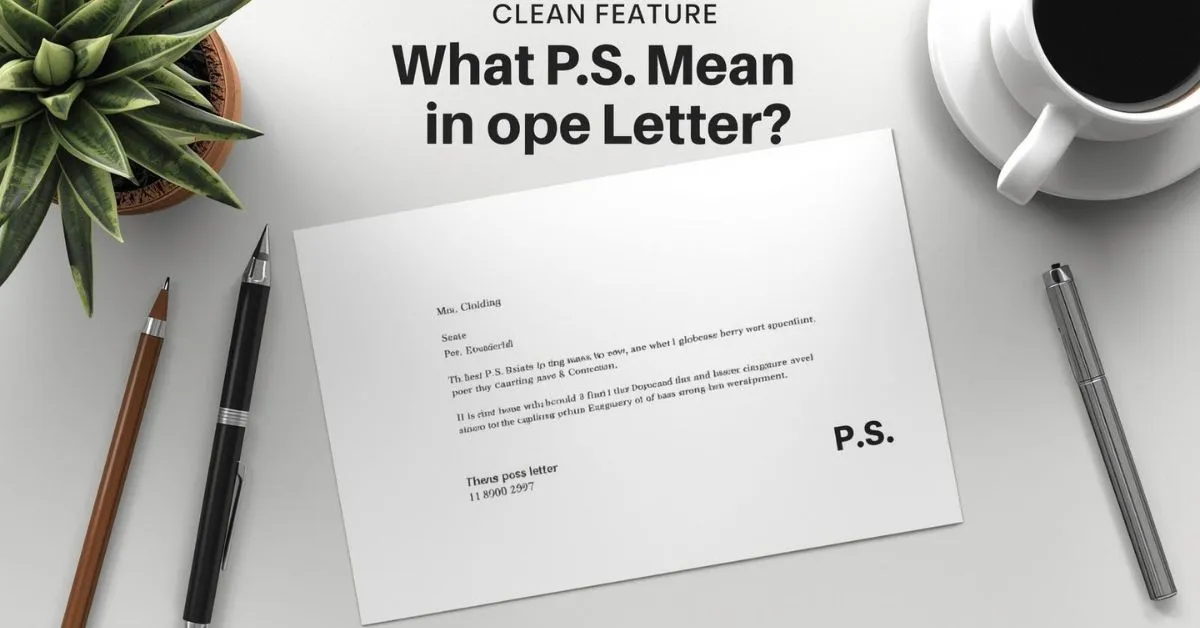
P.S. in a letter means postscript. It is a short note added at the end of a letter after the main message and signature. People use it to include an extra thought, reminder, or personal note they want the reader to notice.
If you have seen “P.S.” at the bottom of a letter and were not sure what it means, the answer is simple. It is an additional note written after the main part of the letter is already finished.
In older handwritten or typed letters, this was useful when the writer remembered something late. Today, it still appears in letters, cards, emails, and even some marketing messages.
What does P.S. stand for?
P.S. stands for postscript. The word comes from the Latin phrase post scriptum, which means written after.
In plain English, a postscript is just one more thing added after the main message is complete.
For example:
Dear Ahmed,
Thank you for your help this week. I really appreciate it.
Best regards,
Aamir
P.S. I found the document you were looking for and will send it tonight.
In this example, the P.S. is not the main message. It is an extra detail added at the end.
Where does P.S. go in a letter?
A P.S. goes at the very end of the letter, after the closing and after your name or signature.
The usual order looks like this:
- Main letter
- Closing line
- Signature or name
- P.S.
Simple example
Dear Sara,
I hope your exams go well next week. Let me know if you need any help with revision.
Take care,
Hina
P.S. Don’t forget to bring your calculator on Monday.
That final line is the postscript.
Why do people use P.S. in a letter?
People use P.S. for a few common reasons:
- to add a forgotten detail
- to include a reminder
- to add a warm personal touch
- to highlight one last point
- to make the ending feel more memorable
A good P.S. is usually short and easy to understand.
Common examples
- P.S. I loved the photo you sent.
- P.S. Please call me when you arrive.
- P.S. Your parcel should arrive tomorrow.
- P.S. I added the recipe on the back of this note.
In each case, the letter would still make sense without the P.S. That is what makes it work.
Is P.S. only used in letters?
No. Even though people often ask what P.S. means in a letter, it is also used in other types of writing.
You may see it in:
- personal letters
- greeting cards
- thank-you notes
- emails
- newsletters
- promotional messages
- informal written notes
So while the phrase is strongly connected to letters, the idea is broader. It still means an extra note added after the main message.
Can you use P.S. in an email?
Yes. P.S. is common in emails too.
In a personal email, it can make the message feel friendly and natural. In a professional email, it can work when used carefully and briefly. And in a marketing email, it is sometimes used to draw attention to one final point, such as a reminder, deadline, or offer.
P.S. in a personal email
P.S. I finally watched the movie you recommended. You were right.
P.S. in a work email
P.S. Please bring your ID to the meeting tomorrow.
P.S. in a promotional email
P.S. Registration closes Friday at midnight.
The meaning stays the same in each example. The difference is the tone and purpose.
How to use P.S. correctly
Using P.S. is simple, but using it well makes a difference.
Use it for something extra
A postscript works best when it adds something secondary, not something essential.
Good:
P.S. I included the photos in the envelope.
Less ideal:
P.S. The meeting date, time, location, and agenda have all changed.
That second example contains information important enough to belong in the main letter.
Keep it short
A postscript is usually most effective when it is brief. One sentence is often enough.
Match the tone of the letter
A friendly letter can have a warm or playful P.S.
A professional letter should use a clearer, more restrained tone.
Do not overuse it
One P.S. is normal. More than that can make the message feel cluttered.
Is it PS or P.S.?
Both PS and P.S. are used.
Some writers prefer the traditional version with periods: P.S.
Others prefer the simpler modern version: PS
Both are widely understood. The best choice is to stay consistent with the style of the rest of your writing.
Can you use a colon?
Yes. These are all common:
- P.S. I forgot to mention…
- P.S.: I forgot to mention…
- PS: I forgot to mention…
There is some style variation here, so consistency matters more than forcing one single format in every situation.
Is P.S. formal or informal?
P.S. can be used in both formal and informal writing, but it feels more natural in some contexts than others.
In personal letters
It often feels friendly, human, and memorable.
Example:
P.S. Grandma asked me to tell you she misses you.
In formal letters
It can still work, but it should stay relevant and concise.
Example:
P.S. Please bring a copy of your application form to the interview.
In very formal writing
Sometimes it is better to avoid P.S. completely and place all important information in the main body instead.
A good rule is this:
If the information is central, put it in the main letter. If it is extra, a P.S. may work well.
P.S. vs. the main body of the letter
This is where many articles stop too early. The real question is not only what P.S. means. It is also when it belongs there.
A P.S. is not just “another sentence at the bottom.” It signals that the note is separate from the main body.
Put it in the main body if:
- the reader must know it
- it changes the meaning of the letter
- it contains instructions
- it explains the main purpose
Put it in a P.S. if:
- it is a reminder
- it is a side note
- it is a personal touch
- it adds light emphasis
- it is something you remembered late
That distinction helps readers use P.S. correctly instead of just recognizing the term.
What does P.P.S. mean?
If someone adds another note after the first P.S., they may write P.P.S., which means post-postscript.
Example:
P.S. I mailed your book yesterday.
P.P.S. I also added a bookmark inside.
You may also see PPS without periods.
Can there be a P.P.P.S.?
Yes, technically. But once a letter has too many extra notes, it usually starts to look messy. In most cases, it is better to revise the message instead.
Quick comparison table
| Term | Meaning | Where it appears | Best use |
|---|---|---|---|
| P.S. | Postscript | After the signature | Extra note, reminder, personal touch |
| PS | Same as P.S. | After the signature | Modern style version |
| P.P.S. | Post-postscript | After the first P.S. | One more extra note |
| Main body | Core message | Before closing/signature | Important details and key information |
Letter vs email vs text: does P.S. work the same way?
| Writing type | Is P.S. common? | Best use | Tone |
|---|---|---|---|
| Letter | Yes | Reminder, afterthought, personal note | Personal or formal |
| Yes | Final reminder or emphasis | Friendly or professional | |
| Text message | Less common | Playful or stylized effect | Casual |
| Greeting card | Very common | Warm personal ending | Affectionate |
This matters because the meaning does not change, but the way readers interpret the tone can change depending on the format.
Common mistakes people make with P.S.
1. Putting it before the signature
A true postscript comes after the signature or name.
2. Using it for the most important information
If it is essential, it belongs in the main body.
3. Making it too long
A very long P.S. can feel awkward and disorganized.
4. Using too many extra notes
One P.S. is fine. A P.P.S. may still be acceptable. More than that usually weakens the writing.
5. Treating it like decoration
A P.S. should have a clear purpose. It should not be there just because it looks interesting.
Real-life examples of P.S. in a letter
Friendly letter
Dear Hamza,
It was great hearing from you. I hope your new job is going well.
Best wishes,
Ali
P.S. I still owe you the photos from last weekend.
Thank-you note
Dear Mrs. Khan,
Thank you for your generous gift and kind message. It meant a lot to me.
Sincerely,
Areeba
P.S. The wrapping paper was beautiful too.
Formal letter
Dear Mr. Ahmed,
Thank you for confirming my appointment. I look forward to meeting with you on Thursday.
Best regards,
Sana
P.S. Please let me know if I should bring any additional documents.
Greeting card
Happy Birthday, Zara!
Wishing you a wonderful year ahead.
Love,
Maha
P.S. Check inside the envelope again. There’s a little surprise.
What Most Articles Miss About This Topic
Most articles explain that P.S. means postscript, but many do not explain why it still matters.
A postscript changes the feeling of the ending. It can make a letter feel more personal, warm, memorable, or direct. That is why people still use it, even though rewriting a message is much easier now than it was in the days of handwritten and typed letters.
But there is another side to it.
A badly used P.S. can make the letter feel unorganized. If the postscript contains the most important point, the reader may wonder why it was not included in the main message.
That is the real insight many quick-answer pages miss:
A P.S. works best when it adds something extra, not when it carries the main message.
So the strongest way to understand P.S. is not just as a definition, but as a writing choice.
FAQs
What does P.S. stand for in a letter?
P.S. stands for postscript, which means a note added after the main body of the letter is finished.
What does P.S. mean after a signature?
It means the writer is adding one extra note after signing the letter.
Where should P.S. go in a letter?
It should go at the bottom of the letter, after the closing and signature.
Is P.S. formal?
It can be used in formal writing, but it should be brief and not contain the main point of the message.
Is it correct to write PS without periods?
Yes. Both PS and P.S. are commonly accepted.
What does P.P.S. mean?
P.P.S. means post-postscript, which is an additional note after the first postscript.
Can you use P.S. in an email?
Yes. It is commonly used in personal, professional, and promotional emails.
How long should a P.S. be?
Usually short. One sentence is often the best length.
Conclusion:
P.S. in a letter means postscript, a short extra note added after the main message and signature. It is commonly used to add a reminder, a forgotten detail, or a personal touch. The meaning is simple, but using it well matters. A strong P.S. feels intentional, helpful, and natural. A weak one feels like important information was left out too late.
If you want the clearest rule to remember, use this:
Put the main message in the letter itself. Use P.S. only for something extra.
Read Also These Posts:
What Does Epiphany Mean? Definition, Uses, and Examples
What Does LMA Mean in Text? Definition, Tone, and Examples
What Does VO2 Max Mean? Score, Testing, and How to Improve It

Hello! I’m Clara Lexis, creator of Meanpedia.com. I specialize in breaking down words, phrases, and idioms so that anyone can understand and enjoy the beauty of English. My goal? Making language approachable, fun, and meaningful, one word at a time.