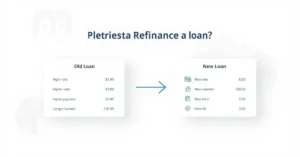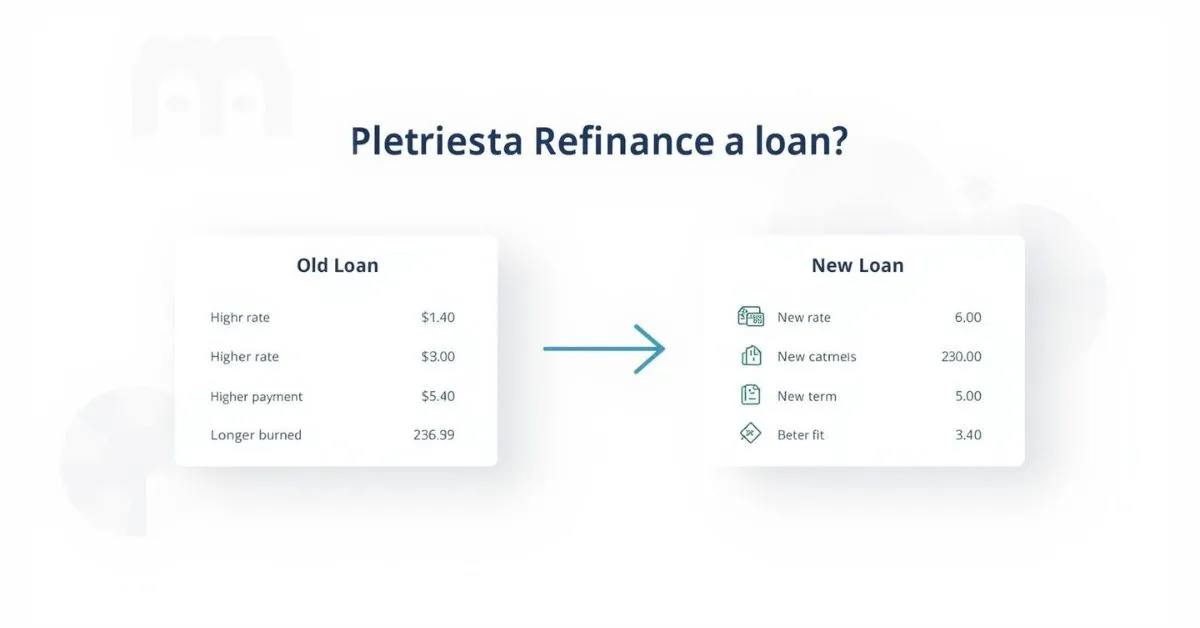
Refinancing a loan means replacing your current loan with a new one. The new loan pays off the old one, and you start making payments under new terms, such as a different interest rate, monthly payment, repayment period, or loan type. In some cases, refinancing can also let you take cash out of home equity.
People usually refinance because they want one or more of these outcomes: a lower interest rate, a lower monthly payment, a shorter payoff timeline, a more stable loan structure, or access to cash.
But a refinance is not automatically a better deal. A lower payment can still cost more over time if the new loan stretches the debt out longer or adds upfront fees.
Refinance meaning in plain English
In plain English, refinancing means starting over with a new loan agreement. Your old loan gets paid off. From that point on, you owe money under the new loan, not the original one. That is why refinancing is more than a simple adjustment. It is a fresh borrowing decision with new pricing, new paperwork, and new tradeoffs.
That distinction matters because many people think refinancing just means “getting a better rate.” Sometimes it does. But sometimes it means trading a lower payment now for more interest later, or moving secured debt onto your home in a way that increases risk.
How refinancing works
The process usually starts with comparing lenders and checking what it would take to fully pay off the current loan.
For a mortgage refinance, the CFPB recommends requesting multiple Loan Estimates so you can compare loan costs and terms side by side. It specifically advises asking at least three lenders for the best comparison.
If you move forward, the lender reviews your application, credit, income, debts, and other factors tied to the loan type. For mortgages, you will usually receive a Loan Estimate early in the process and a Closing Disclosure at least three business days before closing. Those forms are meant to help you compare offers, spot changes, and confirm the final numbers before you sign.
After closing, the new loan pays off the old one. Then your payments begin under the new agreement. If it is a cash-out refinance, the new loan is larger than the payoff amount, and you receive the difference in cash.
Why people refinance a loan
To lower the interest rate
A lower rate can reduce the cost of borrowing. It can also lower the payment if the loan term stays similar. Since credit score is one factor lenders use to price mortgage loans, borrowers with stronger credit often receive more affordable offers than borrowers with weaker credit.
To lower the monthly payment
A refinance can reduce the monthly payment through a lower interest rate, a longer loan term, or both. This is one of the most common reasons people refinance, but it is also where many mistakes happen. A smaller payment does not always mean a cheaper loan overall.
To pay the loan off faster
Some borrowers refinance into a shorter term. That may increase the monthly payment, but it can reduce total interest and help them become debt-free sooner.
To switch loan structure
Some borrowers refinance to move from an adjustable-rate mortgage to a fixed-rate mortgage. That can make payments more stable over time. CFPB guidance explains that an ARM can start lower, but the interest rate and payment may rise later.
To use home equity
A cash-out refinance lets a homeowner replace the old mortgage with a larger one and receive the difference in cash. CFPB and Fannie Mae both note that this can be used for renovations, debt payoff, or other needs, but it also increases the mortgage balance and reduces equity.
Types of refinancing explained
Traditional refinance
A traditional refinance replaces the current loan to improve the rate, payment, or term without turning the deal into a major cash-withdrawal transaction. Consumer-facing mortgage guides often frame this as the standard refinance path when your goal is to make payments more manageable or change the loan structure.
Cash-out refinance
With a cash-out refinance, the new mortgage is larger than what you owe, and you receive the difference in cash. This can be useful, but it can also turn other debts or spending needs into debt secured by your home, which raises the stakes if payments become difficult later.
No-closing-cost refinance
A no-closing-cost refinance does not usually mean the refinance is truly free. CFPB explains that these deals often work by charging a higher interest rate or by rolling costs into the loan balance instead.
Streamline refinance
Some government-backed loans offer streamlined refinance paths. HUD says an FHA streamline refinance involves limited borrower credit documentation and underwriting, while the VA says its IRRRL, often called a streamline refinance, may help lower the payment or move a borrower from an adjustable rate to a fixed rate.
When refinancing makes sense
Refinancing can make sense when the new loan clearly improves your situation. Common examples include getting a lower rate, replacing an ARM with a fixed-rate mortgage, shortening the term to reduce long-run interest, or refinancing after your credit profile improves enough to qualify for better pricing.
It can also make sense if your loan-to-value ratio has improved. CFPB explains that LTV compares the loan amount with the appraised value of the property, and lenders may use it to decide whether to require private mortgage insurance.
In some cases, a refinance with a stronger equity position may improve costs or remove mortgage insurance, depending on the loan and lender rules.
When refinancing can be a bad idea
Refinancing can backfire when the math does not really work in your favor. A lower payment may look good, but if the new loan extends the repayment period too much, you may pay more interest in total. Points, lender credits, fees, and added balance can all change whether the deal is truly beneficial.
It can also be a poor choice if you plan to move soon, if you are paying large upfront costs that take too long to recover, or if you are converting short-term financial pressure into long-term debt secured by your home. That risk is especially important with cash-out refinancing.
For student loans, the biggest danger is different: refinancing federal loans into a private loan can permanently remove federal benefits. Federal Student Aid says borrowers may lose access to income-driven repayment, forgiveness options, and temporary federal relief programs when they refinance federal student loans into private loans.
How much refinancing costs
Refinancing is not just about interest rate. It also involves costs. For mortgage refinances, the Loan Estimate and Closing Disclosure show the key figures you need to compare, including rate, monthly payment, cash to close, fees, points, lender credits, and other charges.
Points, also called discount points, are an upfront fee paid in exchange for a lower rate.
CFPB explains that paying points means you pay more at closing to pay less over time, while lender credits reduce upfront closing costs in exchange for a higher interest rate. That tradeoff is one reason you should compare the full structure of the loan, not just the headline rate.
You should also check for a prepayment penalty on the current loan. FTC and CFPB guidance explain that some loans charge a penalty if you pay off the loan early, which can matter because refinancing usually pays off the original loan in full.
How to think about the break-even point
One of the easiest ways to judge a refinance is to estimate the break-even point.
A simple rule of thumb is:
Break-even point = total upfront refinance costs ÷ estimated monthly savings
So if refinancing costs $3,000 and saves $150 a month, the break-even point is about 20 months. If you expect to keep the loan longer than that, the refinance may be worth a closer look. If not, the savings may never catch up to the cost.
This matters especially when points are involved. CFPB says borrowers usually benefit from discount points only if they keep the mortgage long enough for the monthly savings to outweigh the upfront cost.
What lenders look at before approving a refinance
Lenders do not approve refinances based on rate shopping alone. They look at your financial profile and the loan details.
Credit score and payment history
CFPB says your credit score is one factor that affects the interest rate a lender may offer, and stronger credit often leads to more affordable loans.
Debt-to-income ratio
The CFPB defines debt-to-income ratio, or DTI, as your monthly debt payments divided by gross monthly income. Lenders use DTI to judge whether you can handle the payments on the new loan. Different lenders and loan products may use different limits.
Loan-to-value ratio and equity
For mortgages, LTV compares the amount financed to the appraised value of the property. A lower LTV generally means more equity, and lenders may use it when deciding whether to lend and whether mortgage insurance is required.
Appraisal and loan details
In many refinance situations, the lender may need a current property valuation or other documentation. Government-backed streamline programs can sometimes reduce documentation requirements, but that does not mean there are no costs or no underwriting considerations at all.
How refinancing affects your credit
Refinancing can affect your credit, but usually not in a dramatic or permanent way if the new loan is handled well. CFPB says a mortgage inquiry typically has a small negative effect on credit scores.
It also explains that, in general, loan inquiries for the same type of credit made within a short shopping window are often treated more favorably by common scoring models than widely separated applications.
The bigger long-term effect depends on what happens after refinancing. A better payment structure can help if it makes repayment more manageable. But taking on more debt, missing payments, or using cash-out funds poorly can still harm your financial position even if the refinance looked attractive at first.
Refinance vs consolidation vs modification vs HELOC
| Option | What it means | Best fit | Main caution |
|---|---|---|---|
| Refinance | A new loan replaces the old one. | Better rate, new term, different structure | Lower payment can still mean higher total cost |
| Consolidation | Federal student loan consolidation combines eligible federal loans into a new Direct Consolidation Loan. | Simplifying federal student loan payments | Not the same as private refinancing |
| Loan modification | Changes the terms of the existing mortgage, usually as payment relief, rather than replacing it with a brand-new refinance loan. | Borrowers struggling with current payments | Different purpose from a standard refinance |
| HELOC or home equity loan | Borrows against home equity without replacing the first mortgage. | Accessing equity while keeping the original mortgage | Your home still secures the new debt |
| Cash-out refinance | Replaces the existing mortgage with a larger one and gives cash back. | Tapping equity through one new mortgage | Can reduce equity and increase foreclosure risk |
Mortgage refinance vs auto refinance vs student loan refinance
Mortgage refinancing usually involves the most paperwork and the most detailed comparison of APR, fees, Loan Estimates, and Closing Disclosures. It is also the area where cash-out borrowing, points, lender credits, and LTV usually matter most.
Auto refinancing follows the same basic logic: replace the old loan with a new one to improve rate or payment. But lenders may also look closely at the car’s value and auto loan LTV.
Student loan refinancing is where borrowers need to be especially careful about what they may lose. A private refinance may offer a new rate, but Federal Student Aid warns that federal protections and repayment options may disappear once federal loans are refinanced privately.
What Most Articles Miss About This Topic
Most articles explain refinancing as if the goal is always a lower payment. That is too simple. A refinance can improve the monthly payment while making the long-term cost worse. The right question is not just “Can I pay less each month?” but “What am I paying for that lower payment?”
Another thing many articles skip is the difference between interest rate and APR. CFPB explains that APR includes the interest rate plus other charges, which makes it a better comparison tool than rate alone in many mortgage situations. A loan with a tempting rate can still be the weaker deal after points and fees are counted.
Many articles also underplay how much the right answer depends on the borrower’s goal. Someone trying to stabilize monthly cash flow may accept a longer term.
Someone focused on paying off debt faster may choose a shorter term and a higher payment. The “best” refinance depends on what problem you are actually trying to solve.
FAQ
Is refinancing the same as getting a new loan?
Yes. In a refinance, a new loan pays off the old one and replaces it. After that, you make payments under the new loan terms.
Does refinancing always lower your monthly payment?
No. It often can, but not always. And even when it does, the total cost may still rise if the new term is longer or the upfront costs are high.
What is the difference between interest rate and APR in a refinance?
The interest rate is the cost of borrowing money. APR reflects the interest rate plus other charges tied to the loan, so it often gives a better picture of total borrowing cost.
Does refinancing hurt your credit?
Applying can cause a small temporary effect because of a hard inquiry, but CFPB says inquiries for the same loan type within a short comparison window are generally treated more favorably by common scoring models than widely separated applications.
What is a cash-out refinance?
It is a refinance where the new mortgage is bigger than what you owe, and you receive the difference in cash.
Is refinancing federal student loans risky?
It can be. Federal Student Aid says refinancing federal student loans into private loans may cause you to lose federal protections such as income-driven repayment and forgiveness options.
What should I compare first when shopping refinance offers?
Start with the full deal: APR, fees, points, lender credits, monthly payment, loan term, and how long you expect to keep the loan. For mortgages, compare multiple Loan Estimates, ideally from at least three lenders.
Conclusion
To refinance a loan means to replace your current loan with a new one. That can be helpful, but only when the new loan improves your real position after you account for rate, APR, fees, loan term, risk, and what you may give up. The smartest way to judge a refinance is to compare the full structure of the offer, not just the monthly payment.
Click Below To Read About:
What Does WTB Mean? Text, Marketplace, and Gaming Guide
What Does the Name Lee Mean? Origin, Popularity & More
What Does a No Engine Brake Sign Mean?

Hello! I’m Clara Lexis, creator of Meanpedia.com. I specialize in breaking down words, phrases, and idioms so that anyone can understand and enjoy the beauty of English. My goal? Making language approachable, fun, and meaningful, one word at a time.