Goth and emo are different music-based subcultures with separate histories and musical roots. Goth developed from late-1970s and early-1980s British post-punk, while emo emerged from the mid-1980s Washington, D.C., hardcore punk scene. They can overlap in fashion and mood, but their music, aesthetics, and cultural histories are distinct.
Key Takeaways
- Goth grew from British post-punk and is strongly associated with gothic rock, darkwave, theatrical aesthetics, and gothic literature and imagery.
- Emo originated in Washington, D.C., hardcore punk and became known for emotionally direct, personal songwriting.
- Both may include black clothing, dyed hair, eyeliner, and alternative fashion, which explains much of the confusion.
- Clothing alone does not determine whether someone is goth or emo.
- A person can enjoy both goth and emo music or participate in both scenes.
What Is the Difference Between Goth and Emo?
The simplest way to understand goth vs emo is to start with their musical histories rather than their clothing.
Goth emerged from the British post-punk world around the late 1970s and early 1980s. Bands such as Bauhaus, Siouxsie and the Banshees, Joy Division, and The Cure helped shape the musical environment from which goth developed. The resulting subculture became associated with gothic rock, dark aesthetics, dramatic presentation, and influences from horror and older Gothic artistic traditions.
Emo developed separately in Washington, D.C., during the mid-1980s hardcore punk scene. Early bands such as Rites of Spring and Embrace brought more personal and emotionally expressive songwriting into a scene traditionally associated with hardcore punk. The word emo was initially connected to terms such as “emocore” and “emotional hardcore.”
So, although both scenes can look dark or alternative, goth and emo are not simply two versions of the same subculture.
Goth vs Emo at a Glance
| Category | Goth | Emo |
|---|---|---|
| Main roots | British post-punk | Washington, D.C. hardcore punk |
| Development | Late 1970s–early 1980s | Mid-1980s |
| Music | Gothic rock, darkwave, related styles | Emo, post-hardcore, indie and emo-pop variations |
| Common themes | Darkness, romance, mystery, mortality, atmosphere | Personal emotion, relationships, vulnerability, introspection |
| Fashion associations | Black clothing, dramatic makeup, Victorian or punk influences | Band shirts, fitted clothing, dyed hair, side-swept styles |
| Visual influence | Gothic literature, horror, Victorian and punk aesthetics | Punk, alternative rock, youth culture and later 2000s fashion |
| Key early examples | Bauhaus, Siouxsie and the Banshees, The Cure | Rites of Spring, Embrace |
| Can they overlap? | Yes | Yes |
These categories describe broad traditions, not strict rules. Both scenes have changed considerably over time.
Where Did Goth and Emo Come From?
Origins of Goth
Goth is closely connected to the British post-punk scene. During the late 1970s and early 1980s, certain post-punk artists developed darker, more atmospheric sounds that eventually became associated with gothic rock.
The early goth scene became particularly visible through British clubs and music communities. London’s Batcave, which opened in 1982, became an important meeting place for the emerging scene. The subculture also developed connections with punk, new wave, horror cinema, Gothic literature, and historical fashion.
Musically, goth rock often emphasizes atmosphere, prominent bass, processed guitars, dramatic vocals, and darker or mysterious lyrical themes.
Origins of Emo
Emo has a different history. It began within the Washington, D.C., hardcore punk community during the 1980s.
Rites of Spring is frequently identified as one of the foundational early emo bands. Its music combined the intensity of hardcore with more personal, introspective, and emotionally charged lyrics. AllMusic describes early emo as an artistic outgrowth of hardcore punk, with deeply personal and confessional songwriting.
Over the following decades, emo developed into several different sounds. The genre expanded through 1990s bands such as Sunny Day Real Estate, The Get Up Kids, and Jimmy Eat World and later reached a much larger mainstream audience through 2000s emo and emo-pop.
This history matters because today’s popular image of “emo” does not perfectly represent the original musical movement.
Goth vs Emo Music
Music is one of the clearest ways to distinguish the two.
Goth music is associated with gothic rock and related forms of dark alternative music. The sound can be atmospheric, bass-driven, dramatic, hypnotic, or melancholic. Artists commonly connected with goth include Bauhaus, Siouxsie and the Banshees, and The Cure.
Emo music, by contrast, grew from hardcore punk and later incorporated elements of indie rock, post-hardcore, alternative rock, and pop-punk. Personal lyrics and strong emotional expression are central characteristics of many forms of emo.
For example, someone exploring goth might encounter gothic rock and darkwave, while someone exploring emo might move through early emotional hardcore, 1990s emo, or 2000s emo-pop.
There is some musical crossover, but their historical foundations remain different.
Goth vs Emo Fashion
Fashion is where the confusion becomes especially obvious.
Goth Fashion
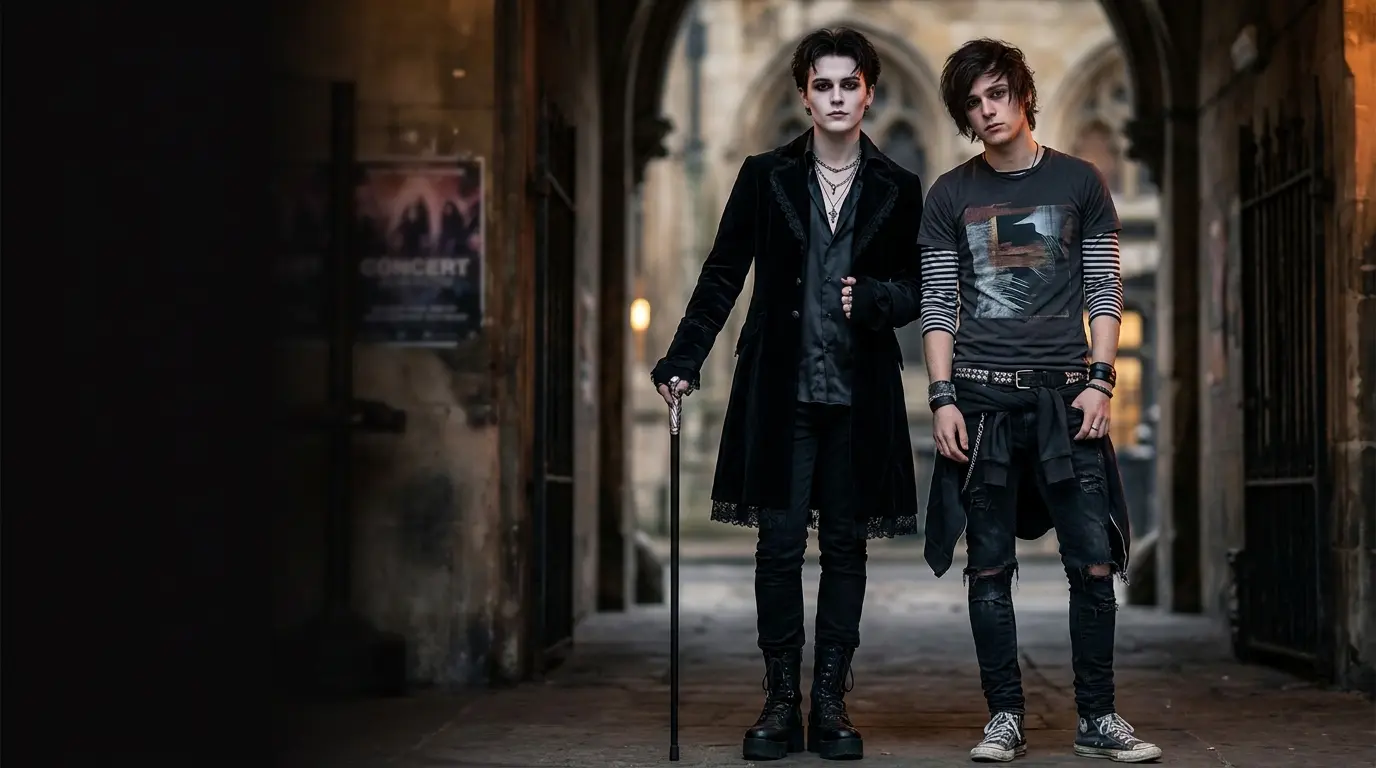
Goth fashion often uses black as a dominant color and can incorporate elements from punk, Victorian, Edwardian, romantic, and theatrical styles. Dark makeup, black hair, dramatic accessories, lace, boots, and historically inspired clothing can all appear within different goth styles.
However, there is no single goth uniform. Modern goth fashion includes many variations, from minimalist black outfits to elaborate romantic, punk, industrial, or Victorian-inspired looks.
Emo Fashion
The popular image of emo fashion became particularly recognizable during the 2000s. Common associations include fitted jeans, band T-shirts, dark colors, dyed hair, and dramatic side-swept hairstyles.
But emo fashion also changed as the music evolved. Early emo musicians were not necessarily dressed like the stereotypical 2000s “emo kid” image. The music existed before that recognizable mainstream fashion aesthetic developed.
That distinction is important: historical subculture and later fashion stereotype are not exactly the same thing.
Goth vs Emo Aesthetic and Themes
Goth aesthetics frequently draw on darkness, mystery, horror, romance, mortality, theatricality, and Gothic artistic traditions. The subculture has longstanding connections with literature, cinema, fashion, and visual art as well as music.
Emo tends to place greater emphasis on direct emotional expression and personal experiences. Lyrics may explore heartbreak, relationships, loneliness, identity, conflict, or other intensely personal subjects.
That does not mean every goth is gloomy or every emo person is sad. Those are stereotypes, not reliable definitions of individuals.
Similarly, wearing black does not automatically make someone goth, and listening to emotional music does not automatically make someone emo.
Why Are Goth and Emo Often Confused?
There are several reasons.
First, both developed from broader punk and alternative music traditions. Second, both have used dark clothing, expressive hairstyles, makeup, and other forms of alternative fashion.
Third, mainstream culture often reduces complicated subcultures to visual stereotypes. A person wearing black clothes and eyeliner may be labeled goth or emo even when their actual musical interests do not fit either scene.
Modern online aesthetics have made the distinction even less obvious because people can mix elements from different subcultures without identifying with a specific historical scene.
The best way to understand the difference is therefore to consider music, history, community, and personal identification, rather than judging someone from an outfit.
Can Someone Be Both Goth and Emo?
Yes.
There is no rule preventing someone from enjoying both scenes. A person might listen to The Cure and Bauhaus while also enjoying Rites of Spring, Sunny Day Real Estate, or later emo bands.
Someone can also combine fashion influences. Alternative fashion is not a set of mutually exclusive categories, and individuals may identify with multiple musical communities.
In fact, some artists and listeners have moved between adjacent alternative scenes over the years. The boundaries between genres are often less rigid in real life than they appear in simplified online comparisons.
Frequently Asked Questions
Are goth and emo the same thing?
No. Goth and emo are distinct music-based subcultures with different origins. Goth developed from British post-punk and became associated with gothic rock, while emo developed from the Washington, D.C., hardcore punk scene and emphasized emotionally expressive, personal songwriting. Their fashion can overlap, which is one reason people often confuse them.
Is emo a type of goth?
No. Emo is not simply a branch of goth. Emo has its own history rooted in hardcore punk, while goth developed from British post-punk and gothic rock. The two can influence or overlap with broader alternative culture, but they are historically separate traditions.
Can you be goth and emo at the same time?
Yes. Someone can enjoy both types of music, participate in both communities, or combine elements of both aesthetics. Subcultural labels describe interests and identities; they do not require someone to follow a single fixed wardrobe or playlist.
What is the easiest way to tell goth and emo apart?
Start with music rather than clothing. Goth is historically connected to gothic rock and post-punk, while emo comes from hardcore punk and later alternative, indie, and pop-punk traditions. Fashion can provide clues, but it is not a reliable way to identify someone’s subculture by itself.
Conclusion
The goth vs emo distinction becomes much clearer when you look beyond black clothing and alternative hairstyles. Goth grew from British post-punk and developed a strong connection with gothic rock, dark atmosphere, theatrical presentation, and Gothic artistic traditions. Emo emerged from 1980s Washington, D.C., hardcore punk and developed around personal, emotionally expressive songwriting.
They overlap in some fashion and cultural spaces, but they are not interchangeable terms. And because both scenes have evolved over decades, no single outfit, hairstyle, or stereotype can define everyone who identifies with either one.

Hello! I’m Clara Lexis, creator of Meanpedia.com. I specialize in breaking down words, phrases, and idioms so that anyone can understand and enjoy the beauty of English. My goal? Making language approachable, fun, and meaningful, one word at a time.