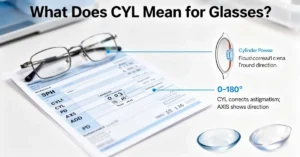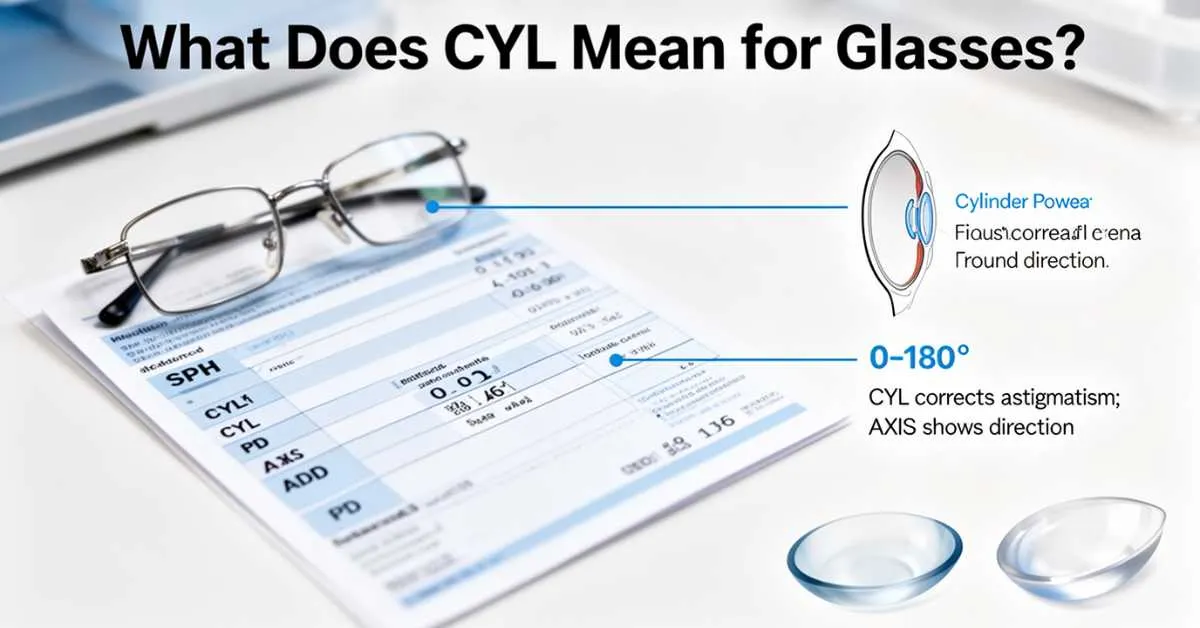
CYL is the cylinder number on your glasses prescription. It shows the lens power used to fix astigmatism.
Astigmatism is a common vision condition where the front of your eye (or the lens inside) is shaped more like an oval than a perfect circle.
Because of this shape, light does not focus in one sharp point on your retina.
That can make vision look blurry, stretched, or shadowy at near or far distance.
Glasses or contacts fix it by adding the right lens power (often shown as CYL and Axis).
You just got your eye test. You look at the paper. Then you see three letters: CYL. It feels like a code. Many people stop right there; especially when they want to buy glasses online. But CYL is not a mystery. It is a simple clue about how your eye focuses light.
If you have astigmatism, your eye is not perfectly round. That can make words look soft. Lights can look messy at night. Letters may look like they have a shadow. CYL tells how much help your lenses need to make that blur go away.
In this guide, you will learn what CYL means, why Axis matters with it, and how it works with SPH. You will also learn what to do if CYL is blank and how CYL works for contact lenses, like toric lenses. By the end, you will read your prescription with ease.
Quick Answer: CYL = Cylinder Power for Astigmatism
CYL on an eye prescription means cylinder power. It tells the lab how much astigmatism correction to build into your corrective lens (your glasses lens). The value is written in diopters and is often in steps like 0.25, 0.50, 0.75, 1.00, etc.
Key point: CYL is not “good” or “bad.” It is simply the amount of correction needed.
What CYL Corrects: Astigmatism
Astigmatism is a common eye condition where the cornea (front surface of your eye) or the lens inside your eye is not perfectly round. That shape can make light focus at more than one point, which can blur vision.
Common signs include:
- blurry or distorted vision
- headaches
- eye strain (often after screens or reading)
Astigmatism often happens along with nearsightedness or farsightedness.
So when people search “is cyl the same as astigmatism”, the best answer is:
- Astigmatism = the condition
- CYL = the lens power used to correct it 100%
Prescription Terms You’ll See With CYL (Fast Glossary)
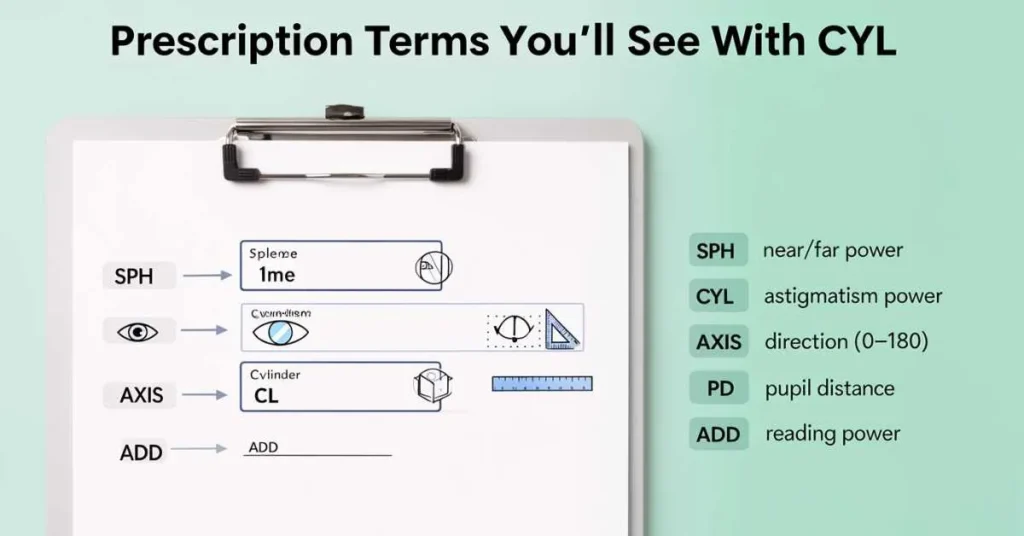
Here are the main terms on most prescriptions:
- SPH (Sphere): the main power for nearsightedness (-) or farsightedness (+), measured in diopters
- CYL (Cylinder): the astigmatism correction power; may be written + or –
- AXIS: where the astigmatism is located and how the cylinder must be positioned; shown from 0 to 180 degrees
- PD (Pupillary Distance): distance between the centers of your pupils (helps align lenses correctly). Some prescriptions include it; many don’t.
- ADD: extra near power for reading (often for bifocals or progressives)
SPH vs CYL vs Axis
This is where most people get confused.
SPH (Sphere) = near/far correction
- Minus SPH (-) usually means nearsightedness.
- Plus SPH (+) usually means farsightedness.
CYL (Cylinder) = astigmatism correction strength
CYL tells how much astigmatism correction you need. If you don’t have meaningful astigmatism correction prescribed, this field may be blank.
Axis = direction of the cylinder correction
Axis tells the angle where CYL must be applied. It’s shown from 0 to 180 degrees. Axis is not “stronger” when it’s higher. It’s only a direction.
Easy way to remember:
- CYL = how much
- Axis = which direction
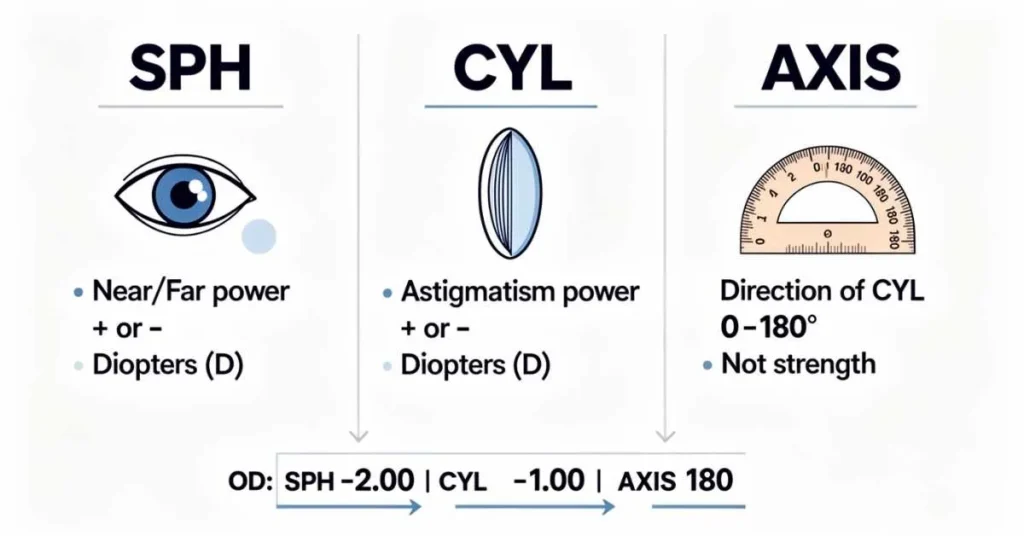
Where to Find CYL on Your Glasses Prescription (OD/OS)
Most prescriptions list:
- OD = right eye
- OS = left eye
- OU = both eyes (sometimes)
It is normal for OD and OS to have different numbers.
What if CYL Is Blank?
A top search is “what if cyl is blank”.
If CYL is blank (or 0.00 / DS / SPH-only), it usually means:
- You do not need astigmatism correction for that eye, or
- It is too small to prescribe right now
Important: When CYL is blank, Axis is usually blank too, because Axis is tied to CYL.
What Does Negative CYL Mean?
People often ask “what does negative cyl mean?”
A negative CYL does not mean your eyes are worse. It often means your prescription is written in minus cylinder format. Some clinics use minus cylinder, some use plus cylinder. Both can represent the same correction when converted properly.
What you should do:
- When ordering glasses, enter the numbers exactly as written.
- If a website only accepts one format, ask your optometrist or the retailer to help convert it.
(Avoid converting it yourself unless you are trained. A small Axis mistake can make the glasses uncomfortable.)
What Does +0.75 CYL Mean?
When someone asks “what does +0.75 cyl mean”, it simply means:
- you have 0.75 diopters of cylinder power written in plus cylinder format.
This is often a mild amount of astigmatism correction. The exact impact depends on your eyes and your Axis.
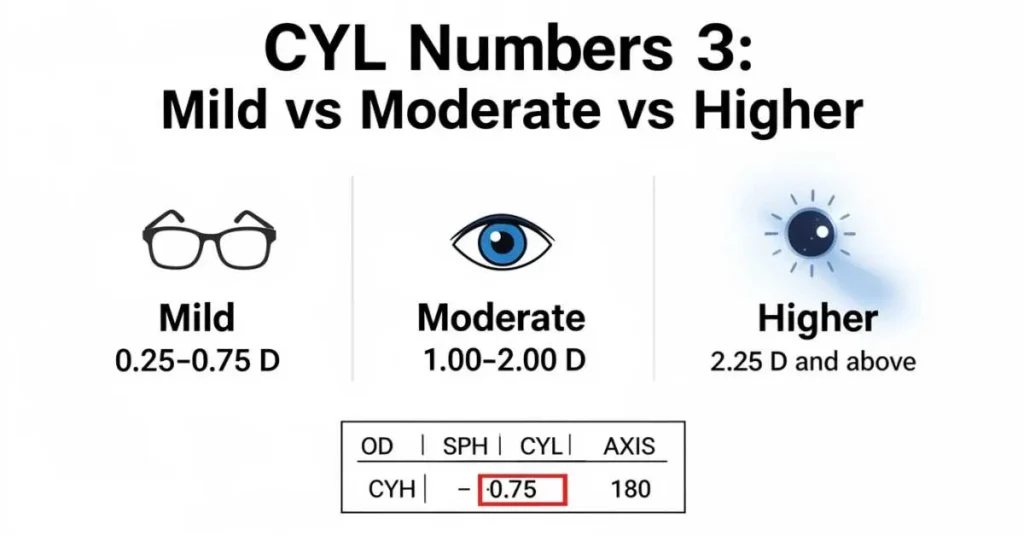
CYL Numbers: Mild vs Moderate vs Higher
Most CYL values move in 0.25 steps. A simple, practical way to understand them:
- 0.25 to 0.75 → Mild correction
- 1.00 to 2.00 → Moderate correction
- 2.25 and above → Higher correction (accuracy matters more)
This is not a “grade” of how good or bad your eyes are. It’s just a way to understand lens strength.
Real Examples (Plain English)
1.Example
OD: SPH -2.00 | CYL -0.75 | Axis 180
Meaning: nearsighted + mild astigmatism correction placed at 180 degrees.
2.Example
OS: SPH +1.00 | CYL -1.25 | Axis 090
Meaning: farsighted + moderate astigmatism correction placed at 90 degrees.
3.Example
OD: SPH 0.00 (Plano) | CYL -1.00 | Axis 170
Meaning: no sphere power needed, but astigmatism correction is needed.
PD (Pupillary Distance): The Hidden Reason Glasses Feel “Off”
PD is the distance between your pupils. It helps the lab place the optical center of each lens in the correct spot. Many prescriptions don’t list PD, but online stores often ask for it.
If PD is wrong, you may feel:
- Eye strain
- Mild blur
- “Not comfortable” vision, especially with higher prescriptions
ADD: What It Means (and When You’ll See It)
ADD is extra near magnification for reading. It’s common with bifocals and progressive lenses. Your prescription may show ADD as a separate number or a near-vision version of SPH/CYL/Axis.
ADD is separate from CYL. You can have ADD with or without astigmatism.
Ordering Glasses Online With CYL (No-Mistake Checklist)
If your prescription has CYL, accuracy matters more. Here’s a simple checklist:
- Match OD and OS
- OD = right, OS = left
- Copy SPH, CYL, Axis exactly
- Don’t round numbers.
- Keep the + or – sign.
- Enter Axis as written. Axis shows direction on a 0–180 scale.
- If CYL is blank
- Select “SPH only” if the site offers it.
- Don’t enter Axis if there is no CYL.
- Add PD
- If the store asks for PD, provide the correct value.
Common signs something is entered wrong:
- Blur that doesn’t clear up
- Headaches or eye strain quickly
- One eye feels clear, the other doesn’t
What Does CYL Mean for Contacts?
A big search variation is “what does cyl mean for contacts”.
On a contact lens prescription, CYL still means cylinder power for astigmatism. But contacts sit directly on the eye, so fitting matters more.
Toric Lens (Made for Astigmatism)
A toric lens is a contact lens designed to correct astigmatism. Unlike regular contact lenses, toric lenses have a special shape. They use different power in different areas. This helps them correct astigmatism and make vision clearer.
Toric lenses specifically astigmatism ke liye hotay hain.
Why Axis Matters Even More in Contacts
Because contact lenses can rotate slightly, toric lenses must stay aligned. That’s why toric prescriptions include Axis (0–180 degrees), and why fitting can take more time.
Can You Use a Glasses Prescription to Buy Contacts?
Usually, no. Contacts need extra fitting details, and the best lens depends on how it sits and stays stable on your eye.
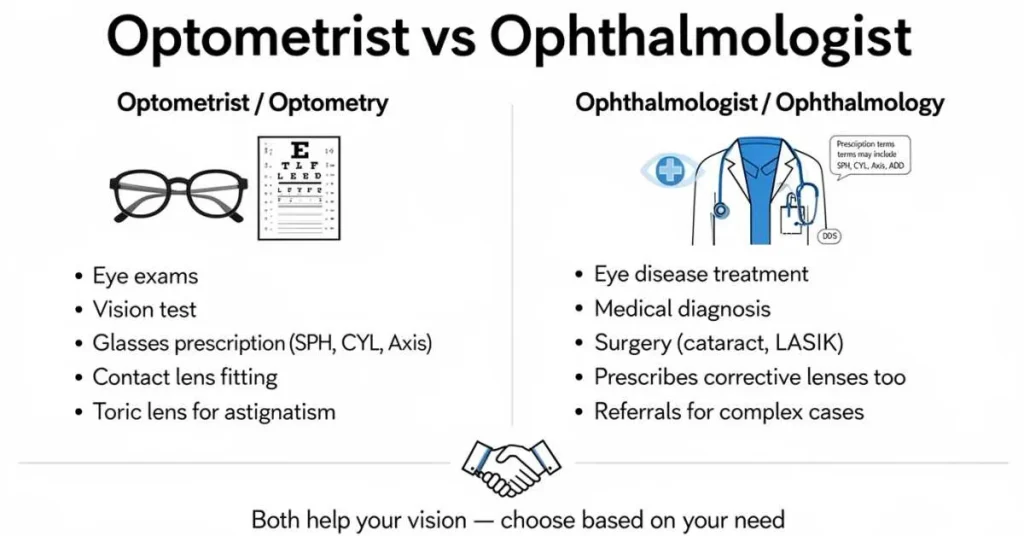
Optometrist vs Ophthalmologist (Who Can Help?)
- Optometrist (Optometry):
Checks your vision. Writes prescriptions for glasses and contact lenses. Fits contact lenses to your eyes. - Ophthalmologist (Ophthalmology):
An eye doctor who treats eye diseases and does eye surgery. They can also write a prescription for glasses or contact lenses.
If your prescription is confusing, call your clinic and ask them to confirm SPH, CYL, Axis, and whether you need PD.
FAQs
What does CYL mean on eye prescription?
CYL means cylinder power used to correct astigmatism.
Is CYL the same as astigmatism?
No. Astigmatism is the condition. CYL is the correction power for it.
What if CYL is blank?
It usually means no astigmatism correction was prescribed for that eye.
What does negative CYL mean?
It often means the prescription is written in minus-cylinder format. It doesn’t automatically mean worse eyes.
What does +0.75 CYL mean?
It means you have 0.75 diopters of cylinder power written in plus-cylinder format (often mild).
What does CYL mean for contacts?
CYL on contacts means cylinder power for astigmatism. Many people need toric lenses for this.
Conclusion:
CYL on your glasses prescription is simply the cylinder power used to sharpen vision when astigmatism is present.
It works hand-in-hand with Axis, which sets the direction of that correction. If CYL is blank, you usually don’t need astigmatism correction in that eye.
When buying glasses online, copy SPH, CYL, and Axis exactly, and don’t forget PD for proper lens alignment.
For contacts, astigmatism often requires a toric lens, so always use a proper contact lens prescription and fitting from an optometrist.
Once you understand CYL, the rest of your prescription becomes much easier; and you can order or update your glasses with confidence.
Read Also This Post: What Does Annexation Mean? Annexation vs Occupation

Hello! I’m Clara Lexis, creator of Meanpedia.com. I specialize in breaking down words, phrases, and idioms so that anyone can understand and enjoy the beauty of English. My goal? Making language approachable, fun, and meaningful, one word at a time.