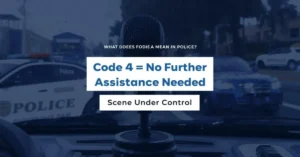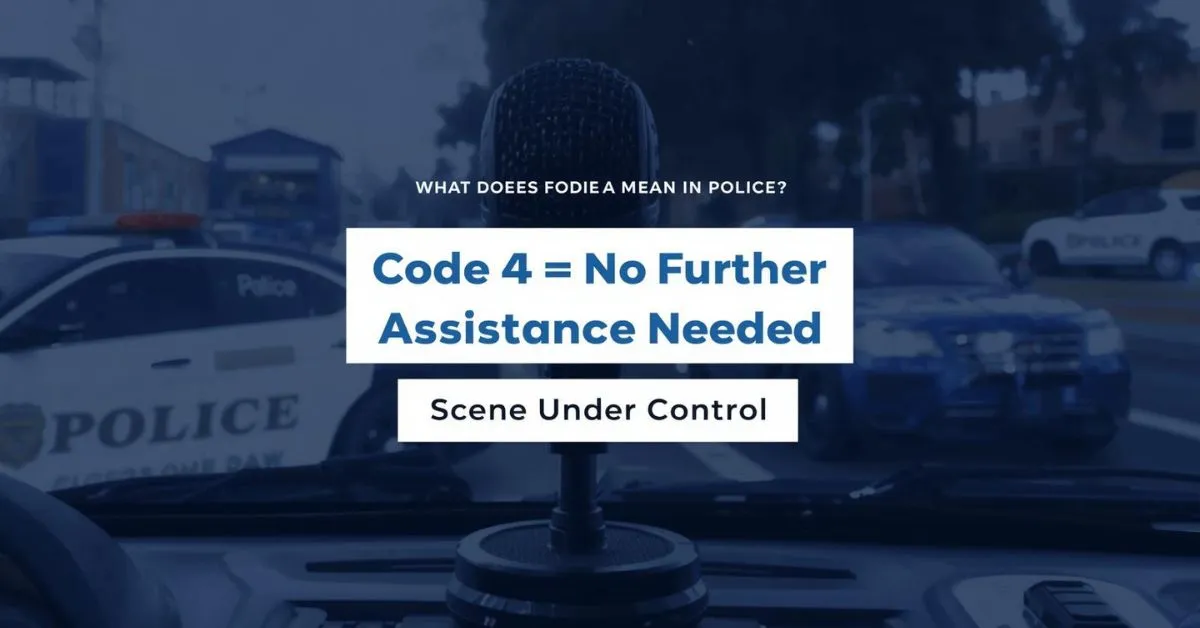
In U.S. police radio use, Code 4 usually means the situation is under control and no further assistance is needed. In some agencies, it also means backup or other responding units can cancel.
The exact wording can vary by department, but the practical meaning is usually the same: the scene has stabilized and extra help is no longer necessary.
If you heard “Code 4” on a police scanner, in bodycam footage, or in a news clip, the plain-English takeaway is usually: everything is under control now. That is the answer most readers want first, and it is the meaning supported by multiple official agency references.
Code 4 meaning in police at a glance
- Most common meaning: No further assistance needed
- Practical meaning: The scene is under control
- What it often tells other units: You do not need to keep responding
- What it does not mean: It is not the same as 10-4
That summary matches official examples from Tucson Police, Alameda Police training material, Lakewood Police policy, and Volusia Sheriff’s code list.
What Code 4 usually means on a police radio
In real dispatch use, Code 4 is usually a status update. It tells dispatch and nearby officers that the situation has settled enough that more help is not needed right now. Tucson Police lists Code 4 as “no further assistance needed.”
Alameda’s dispatcher training manual describes it as “no further assistance needed” with the situation stabilized. Lakewood says it indicates the situation is under control and no further immediate assistance is required.
That is why Code 4 often comes after an officer has asked for help, made a stop, or checked a situation that looked uncertain at first.
Once things are stable, the officer or dispatcher uses Code 4 to lower the response level. In Lakewood’s policy, once Code 4 is broadcast, units still en route return to other duties instead of continuing to the scene.
Code 4 vs 10-4: important difference
A lot of people confuse Code 4 with 10-4, but they are not the same thing.
- Code 4 usually means the scene is under control and more help is not needed
- 10-4 means the message was received and understood
Tucson’s official radio code page lists Code 4 as “no further assistance needed” and 10-4 as “message received; OK; acknowledged.” A Department of Justice bulletin also describes 10-4 as “okay,” “copy,” or “acknowledged.”
So if an officer says 10-4, they are acknowledging communication. If they say Code 4, they are usually describing the condition of the scene.
Does Code 4 mean the same thing everywhere?
Not exactly.
This is one of the biggest reasons people get mixed answers online. Police radio codes are often agency-specific, and the Department of Justice has noted that different jurisdictions do not always use the same codes and signals. That is one reason plain language is encouraged for interagency communication.
Still, the official definitions below point in a very similar direction:
| Agency source | How Code 4 is described | Practical takeaway |
|---|---|---|
| Tucson Police | No further assistance needed | Backup is not needed |
| Alameda Police training manual | No further assistance needed; situation stabilized | Scene is stable |
| Lakewood Police | Situation under control; no further immediate assistance required | Response level can drop |
| Volusia Sheriff | Cancel responding units | Units can stop coming |
The wording changes, but the core idea stays close: the situation is controlled enough that additional response is no longer needed.
What Code 4 sounds like in a real situation
Here is a simple example:
An officer stops a suspicious vehicle late at night. Another unit starts heading over in case backup is needed. After a quick check, the stop turns out to be calm and routine.
The officer radios “Code 4.” That tells dispatch and nearby units the stop is under control and the extra unit can back off if local policy uses the code that way. That example matches the way official agency materials describe Code 4 in practice.
What scanner listeners should assume when they hear Code 4
If you are listening to police radio traffic, the safest interpretation is:
The immediate concern has eased, and no more help is needed right now.
That does not always mean nothing happened. It only means the scene is no longer at the same level of uncertainty or urgency.
A serious event may still have taken place, but the need for extra responding units has dropped. Official agency wording such as “situation stabilized,” “under control,” and “cancel responding units” supports that reading.
Common mistakes people make about Code 4
Thinking it always means exactly “all clear”
“All clear” is close, but it is a little vague. A better explanation is that the scene is controlled and extra assistance is no longer needed.
Assuming every police department uses it identically
That is not true. Official agency materials show small but important differences in wording.
Confusing it with 10-4
This is the biggest mistake. 10-4 is message acknowledgment. Code 4 is usually a scene-status signal.
Assuming Code 4 means the event was minor
Not necessarily. It only means the situation is now stable enough that extra help is not needed.
What Most Articles Miss About This Topic
Most articles stop at “Code 4 means all clear,” but that skips the part readers actually need.
The real value is understanding that Code 4 is not just a definition. It is a radio status signal. It tells dispatch and other units that the response can ease down because the scene has stabilized. That is why one agency says “no further assistance needed,” another says “situation stabilized,” and another says “cancel responding units.” Those are slightly different ways of expressing the same operational outcome.
Another point many articles miss is that radio codes are not fully standardized. The Department of Justice has specifically noted that code meanings can vary across jurisdictions, which is why plain language is encouraged for shared or multi-agency communication. That is also why readers find conflicting definitions online even when the practical meaning is mostly the same.
FAQ
What does Code 4 mean on a police scanner?
Usually, it means the scene is under control and no further assistance is needed. In some agencies, it also means responding units can cancel.
Is Code 4 the same as 10-4?
No. Code 4 usually refers to scene status. 10-4 means a message was received and understood.
Does Code 4 mean all clear?
Often, that is the easiest plain-English way to understand it, but “scene under control” or “no further assistance needed” is more precise.
Do all police departments use Code 4 the same way?
No. Agencies use very similar meanings, but the exact wording can differ.
Why do different websites explain Code 4 differently?
Because police radio codes often vary by department or jurisdiction, and official agencies do not always phrase the code the same way.
Conclusion
If you searched “what does code 4 mean in police,” the clearest answer is this: Code 4 usually means the situation is under control and no further assistance is needed. Depending on the agency, it may also mean responding backup units can cancel. The only important caution is that police radio codes are local, so the exact wording can vary from one department to another.
Click Below To Read About These New Posts:
What Does Fortnight Mean? Definition, Days, and Examples
What Does It Mean to Refinance a Loan? Its Work, When It Helps
What Does Wawa Mean? Store Name, Goose Origin, Other Uses

Hello! I’m Clara Lexis, creator of Meanpedia.com. I specialize in breaking down words, phrases, and idioms so that anyone can understand and enjoy the beauty of English. My goal? Making language approachable, fun, and meaningful, one word at a time.