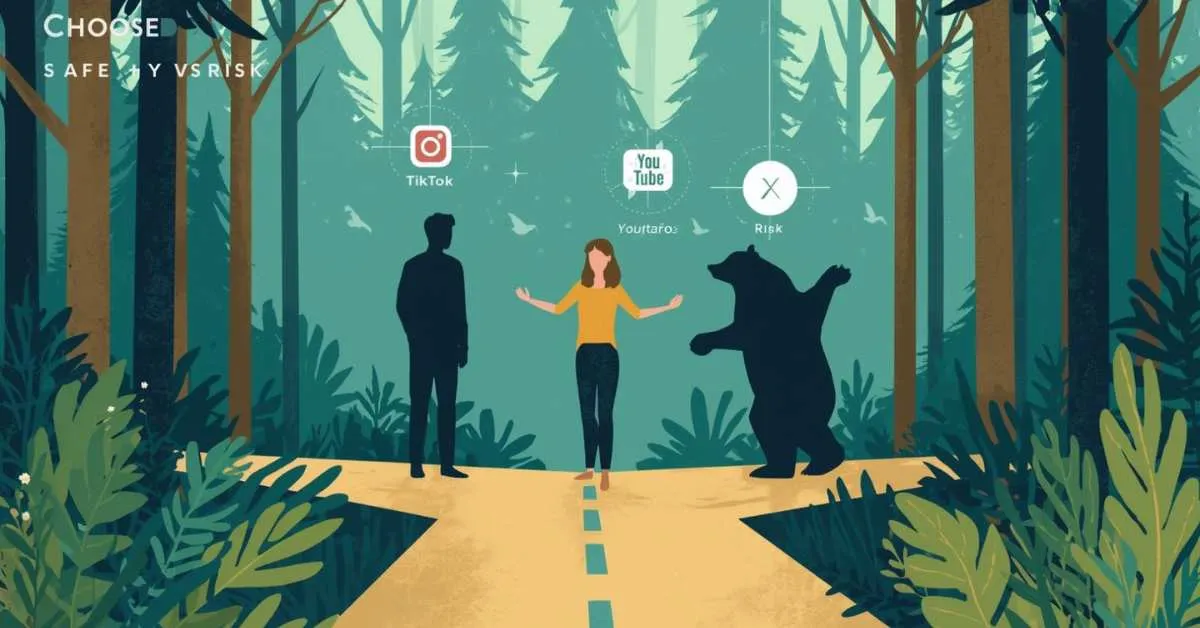
“Would you rather be alone in the woods with a man or a bear?”
This simple question sparked one of the biggest online debates of recent years. Known as “Choose the Bear,” the trend spread rapidly across TikTok, Instagram, YouTube, and X, surprising millions when many women answered: the bear.
At first, the question sounded like a joke. But the discussion quickly became serious. People began talking about safety, trust, risk, and how humans judge danger.
Influencers and comedians like Tana Mongeau and Whitney Cummings shared their thoughts. This made the talk very popular.
Today, the debate is more than a meme. It shows real problems in society, how people feel, and how the internet can make small questions go big all over the world.
What Is “Choose the Bear”? (Quick Definition)
Choose the Bear is a viral internet debate asking:
Would you feel safer alone in the woods with a random man or a bear?
Many women pick the bear. They do not think bears are safe. They feel bears act in a way they can predict. Humans are not so easy to understand.
Why this matters
The answer reveals how people perceive risk emotionally rather than logically. The trend became a symbolic conversation about personal safety and trust.
Where Did the Trend Start?
The debate began as short reaction videos on TikTok. Creators asked friends or strangers the question and recorded genuine responses. The shock value of hearing “the bear” made viewers curious, leading to massive sharing.
How it spread
- TikTok videos gained millions of views.
- Clips were reposted on Instagram Reels and YouTube Shorts.
- Discussions exploded on X through long opinion threads.
- Algorithms boosted engagement because the topic triggered strong reactions.
The scenario’s simplicity made it perfect for virality: anyone could understand it instantly and form an opinion.
Why Many Women Chose the Bear
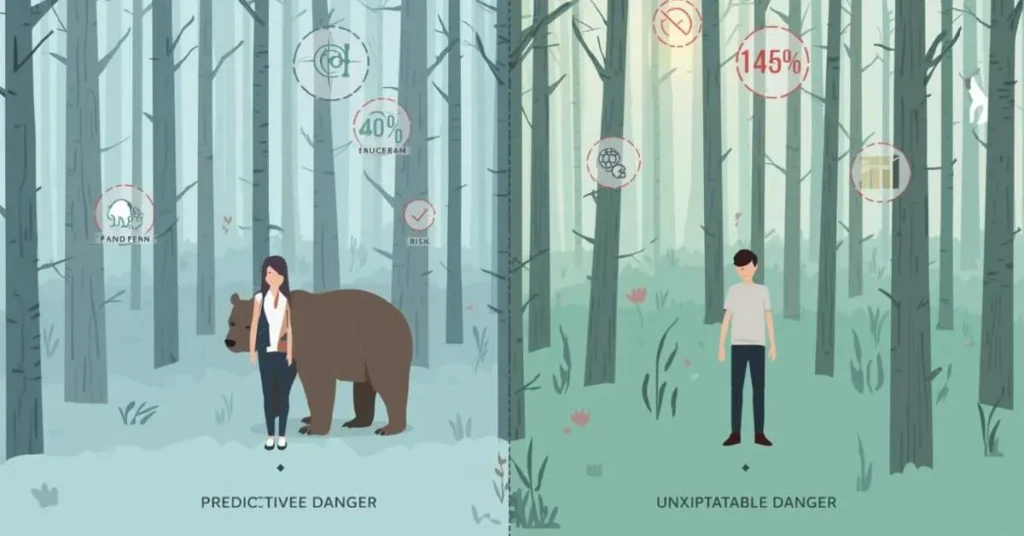
The choice is rarely literal. Instead, it reflects how people evaluate danger.
Key Reasons
1. Predictable Threat
Animals act on instinct. People generally understand when a bear may attack, usually for defense or survival.
2. Uncertainty About Human Intent
A stranger’s motives are unknown. Uncertainty often creates stronger fear than visible danger.
3. Real-World Experiences
Global campaigns like the Me Too movement have made people talk more about safety and harassment.
4. Statistical Context
UN Women says many women around the world face physical or sexual violence. These realities shape emotional risk perception.
👉 The bear becomes a symbol, not a preference for animals, but a statement about predictability and perceived safety.
Why Some Men Felt Offended
The debate also created backlash.
Many men argued that the comparison felt unfair because it appeared to label men as dangerous by default.
Common responses included:
- “Not all men.”
- Concerns about negative stereotypes.
- Discussions about fairness in online narratives.
However, many commentators explained that the trend was not meant to accuse all men. Instead, it highlighted how fear can be shaped by lived experiences and social awareness.
This difference in interpretation is what fueled the debate’s intensity.
The Psychology Behind the Debate (Original Analysis)
The popularity of Choose the Bear can be explained through psychology.
How Humans Judge Risk
| Psychological Concept | Explanation |
|---|---|
| Risk Perception | People react to emotional danger more than statistical danger. |
| Availability Heuristic | News stories and shared experiences make certain risks feel more common. |
| Predictability Bias | Known threats feel safer than unpredictable ones. |
| Social Learning | Collective discussions shape personal fear responses. |
Humans often fear uncertainty more than physical danger. A bear represents a clear rule-based threat, while a stranger represents unknown possibilities.
This psychological contrast is the core reason the debate resonated globally.
The Role of Social Media Algorithms
The debate did not grow naturally alone, algorithms accelerated it.
Platforms prioritize content that:
- sparks emotional reactions,
- encourages comments,
- creates disagreement.

Polarizing questions perform especially well because users feel compelled to respond. The “man vs bear” scenario triggered curiosity, humor, anger, and empathy at the same tim, a perfect formula for viral reach.
Cultural Impact: Why the Debate Matters
The trend evolved into a wider cultural conversation.
Major themes it revealed:
- A growing gender trust gap
- Increased awareness of personal safety discussions
- The power of viral internet culture
- How memes can start serious social dialogue
Choose the Bear is not just for fun. It is now used to talk about safety and how people behave in today’s world.
Expert Perspective: Why This Debate Went Viral
Unlike many short-lived trends, this one lasted because it combined three powerful elements:
- Simplicity – one easy question.
- Emotion – strong personal reactions.
- Symbolism – deeper meaning beneath humor.
When a topic allows people to express identity, fear, or values, engagement increases dramatically. This explains why millions participated even without agreeing.
Quick Comparison: Literal vs Symbolic Meaning
| Interpretation | Meaning |
|---|---|
| Literal | Choosing between a bear or a man |
| Symbolic | Discussing safety and trust |
| Social | Highlighting shared experiences |
| Psychological | Fear of uncertainty |
FAQs About “Choose the Bear”
What does “Choose the Bear” mean?
It refers to a viral debate where people choose between encountering a bear or a man, symbolizing discussions about safety and risk perception.
Is the trend anti-men?
No. Most participants describe it as expressing feelings about safety rather than judging all men.
Why did the debate become viral?
Its emotional nature and simple format encouraged massive engagement on social media platforms.
Is the discussion still relevant?
Yes. It continues appearing in conversations about internet culture and social psychology.
Why does the question feel powerful?
Because it forces people to confront how they emotionally evaluate danger and trust.
Conclusion: More Than Just an Internet Meme
Choose the Bear started as a hypothetical question but evolved into a global cultural discussion. It revealed how people interpret risk, how social experiences shape perception, and how online platforms amplify emotional conversations.
The debate shows that viral trends are not always shallow. Sometimes, a simple question exposes deeper truths about society, psychology, and human trust.
Ultimately, the trend’s lasting impact comes from what it represents, not a choice between humans and animals, but a conversation about safety, perception, and the modern digital world.
Read Also This Post: What Does Apostle Mean? A Complete Guide to Biblical Modern Apostles

Hello! I’m Clara Lexis, creator of Meanpedia.com. I specialize in breaking down words, phrases, and idioms so that anyone can understand and enjoy the beauty of English. My goal? Making language approachable, fun, and meaningful, one word at a time.