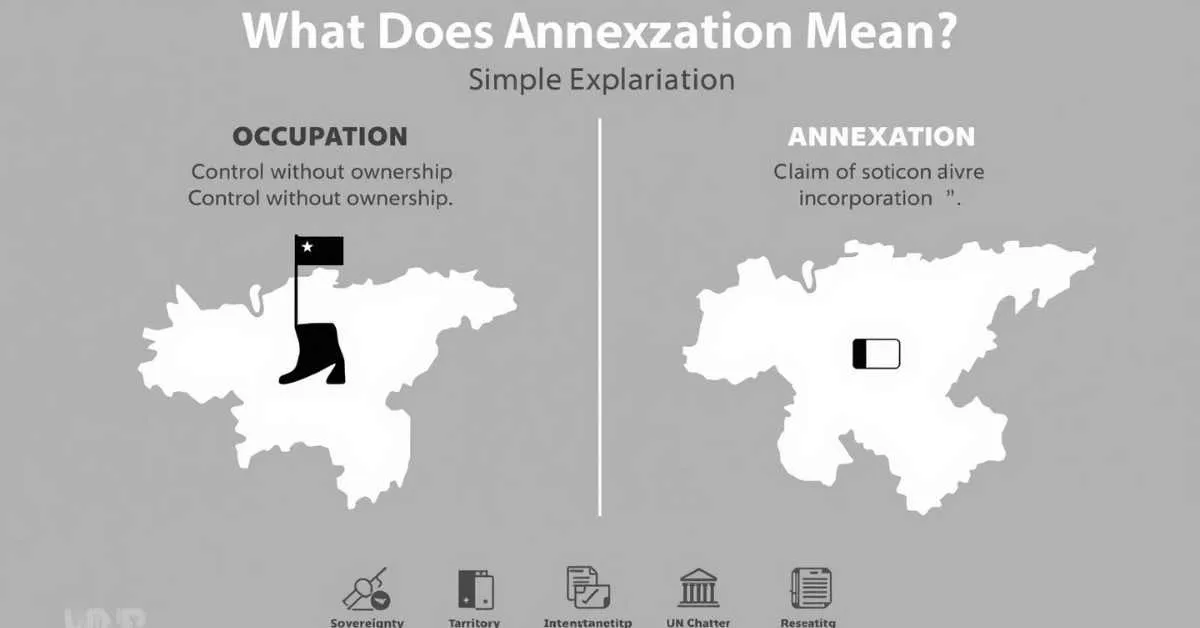
Annexation means a country formally claims a territory as its own and tries to make it part of the state. Now here’s why that one word matters: it can redraw maps, trigger global arguments, and change daily life for the people who live there, often overnight.
You’ll hear “annexation” in breaking news, history documentaries, and political debates, but it’s easy to mix it up with invasion, occupation, or even a simple border change.
The difference is crucial: annexation isn’t just control, it’s a claim of sovereignty and a push to incorporate land through laws, administration, and identity systems.
In this article, you’ll get a clear, plain-English explanation, learn the annexation vs occupation difference, see famous examples from history and modern geopolitics, and understand how international law and the United Nations Charter shape how annexation is judged.
Quick Answer
Annexation is when a country says a piece of land now belongs to it. The land was not part of that country before. The country then tries to make it official by changing laws and running the area.
What Does Annexation Mean?
In plain terms, annexation is a sovereignty claim. A state says: “This land is now part of our country.”
Britannica says annexation is when a country officially claims land that was not part of it before. It also compares this to cession, which is when land is given or transferred by a treaty (an agreement between countries).
The two parts you usually see
Most annexations (attempted or completed) have two layers:
- A formal legal step (de jure claim)
A law, decree, or official announcement that declares the territory “part of” the state. - On-the-ground integration (practical control + administration)
Changes like new courts, police, taxes, ID cards or passports, schools, land papers, and local offices.
Britannica says annexation works in real life when a country controls the land. It also says other countries may need to accept the claim for it to seem more legitimate.
Annexation vs Occupation Difference
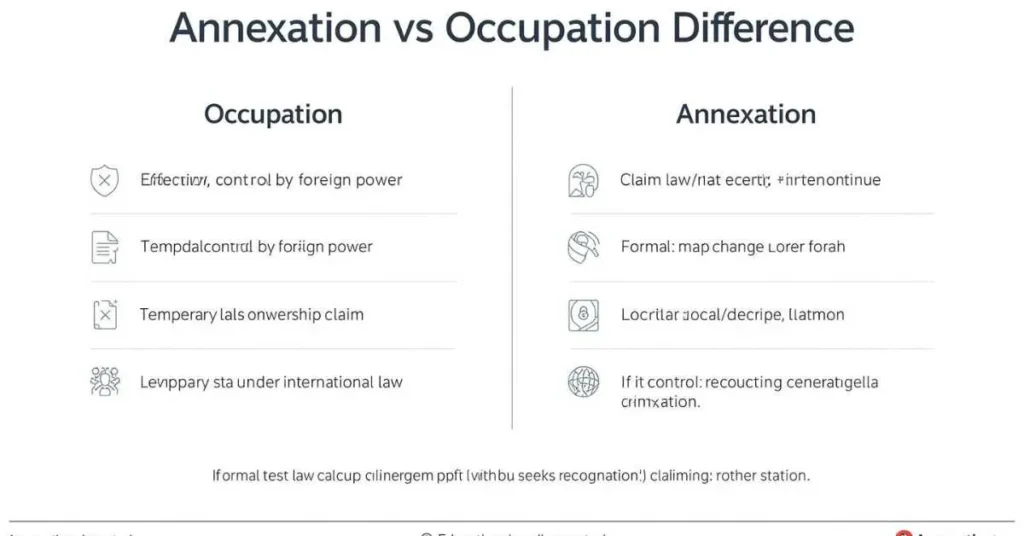
This is the #1 confusion: occupation is control without sovereignty; annexation is a sovereignty claim.
The ICRC says a place is occupied when a country controls land that is not theirs, and the people there did not agree to it.
Comparison table
| Term | What it means | Sovereignty claim? | What usually changes on the ground? |
|---|---|---|---|
| Occupation | Effective control of territory without sovereign title | No | Military/administrative control; laws may be temporarily managed under occupation rules |
| Annexation | Formal claim that territory is now part of the state | Yes | Laws, IDs, courts, taxes, governance are shifted toward the annexing state |
| Cession | Territory transferred by treaty agreement | Yes (by agreement) | Legal transfer with treaty paperwork |
| Secession | A region breaks away from a state | Not by itself | Political separation; may trigger recognition disputes |
Memory trick:
- Occupation = control without title
- Annexation = claim of title (sovereignty) + incorporation attempt
Is Annexation Legal? (UN Charter + International Law)
People often ask: “Is annexation legal?” The legal debate depends on how the territory is acquired and whether force is involved.
UN Charter baseline: no force against territorial integrity
The UN Charter says countries must not threaten or use force against other countries. They must respect other countries’ borders and independence. This rule is often linked to Article 2(4).
Why annexation is usually condemned when tied to force
The ICRC glossary says annexation is when one country takes land from another country and says, “This land is ours now.” It also says this is not allowed under international law, especially when it happens after force or military control.
Recognition matters (but does not erase disputes)
Even if a state passes a law at home, other states may refuse recognition. That can keep the territory’s status disputed for years or decades.
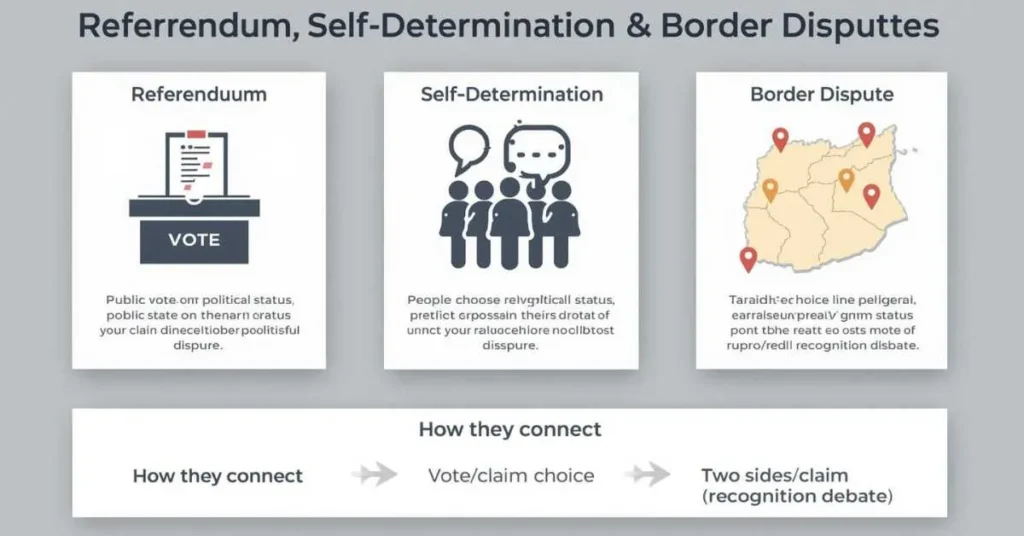
Referendum, Self-Determination, and Border Disputes
These ideas appear a lot in annexation debates:
Referendum
A referendum is a vote by a population on a political question.In annexation disputes, a referendum is sometimes used to show that people agree. But the vote may not count. It depends on who approved it, how it was held, and whether it was fair.
Self-determination
Self-determination is the idea that peoples should be able to decide their political status. In real cases, it often clashes with territorial integrity, so it becomes a legal and political argument rather than a simple “yes/no” rule.
Border dispute
A border dispute can exist without annexation. Annexation raises the stakes because it is an attempt to make a contested border change permanent.
How Annexation Usually Happens (Simple Process)
Annexation is often a sequence, not a single moment:
- Control or influence develops (military presence, political takeover, or breakdown of governance).
- A formal claim is made (law, decree, constitutional step).
- Administration is integrated (IDs, courts, taxes, policing, schools, land registry).
- The world responds (recognition, non-recognition, sanctions, UN votes, diplomatic steps).
De facto annexation is when a state acts like a territory is already part of it; running laws, services, and administration there; even without a formal legal declaration.
It’s a practical takeover through daily governance, not a clear official announcement of sovereignty.
Annexation Meaning in History: Links to Imperialism and Colonialism
If you search “what is annexation in history,” you’ll see it appears often during eras of imperialism and colonialism.
Britannica says imperialism is when a country tries to gain more power. It does this by taking land or controlling other places and people.
Colonialism is related. A colony is a place that a country takes and controls. That country is the home country. The practice is called colonialism. Some experts use wider meanings today, but this simple idea is easy to understand.
Annexation is different. Annexation means a country says, “This land is now part of our country.” It tries to add the land under its own laws and government.
Colonial rule can look different. A country may control a place without making it a full part of the country. Colonial systems can take many forms.
Illegal Annexation Meaning
Illegal annexation means trying to take territory and claim it as your own in a way. That breaks international law, often because it involves force or coercion.
In simple terms, it’s a sovereignty claim without lawful consent or legal basis. So many countries and the United Nations may refuse to recognize it.
Historical Annexation Examples In Simple Words
These examples help you see the pattern: formal step + integration + political consequences.
1) United States – Texas annexation
The U.S. State Department’s Office of the Historian notes a joint resolution passed on March 1, 1845, and Texas was admitted on December 29, 1845.
Annexation can happen through laws and government decisions, not only through war.
2) Hawaii – annexed by the U.S.
The U.S. National Archives notes Hawaii was annexed by a joint resolution on July 7, 1898 (often called the Newlands Resolution).
What this shows: Annexation often uses domestic legal instruments plus administrative takeover.
3) Germany – annexation of Austria (Anschluss)
The U.S. Holocaust Memorial Museum says Germany took over Austria on March 11–13, 1938. This event is called the Anschluss.
This shows something important: sometimes leaders say it is “joining” or “reunification.” But the main point is that one country claims the land and tries to make it part of its own country.
Modern Example: Russia – Annexation of Crimea (Ukraine)
A widely discussed modern case is Russia’s annexation of Crimea, a region internationally recognized as part of Ukraine.
- In March 2014, the UN General Assembly approved Resolution 68/262. It said Ukraine’s borders should stay the same. It also said the Crimea vote was not approved by Ukraine. The UN added that this vote cannot be used to change Crimea’s status.
- The European Union stated it does not and will not recognize the annexation of Crimea and Sevastopol.
Neutral note: In such disputes, different actors use different legal and political arguments. For readers, the main idea is simple. Look at what the UN says, which countries accept it, and how it affects world politics.
How to Read Annexation Headlines
When you see the word in the news, ask:
- Who claims sovereignty? (That’s the annexation signal.)
- Who controls the territory on the ground?
- Was there a formal legal act? (law/decree/constitution change)
- Is there recognition or non-recognition? (UN votes, sanctions, statements)
- Was force involved? (UN Charter principles become central)
Decision Tree: Is It Occupation, Annexation, or Cession?
Use this quick “yes/no” guide:
- Is the territory under a foreign power’s effective control without consent?
- Yes → likely occupation
- No → go next
- Has the state formally declared the territory is now part of its country?
- Yes → likely annexation
- No → go next
- Was the territory transferred by treaty agreement?
- Yes → cession
- No → it may be a border dispute, influence, or another form of control
Common Myths
- Myth: “If you control it, you own it.”
Fix: Control can be occupation; sovereignty is different. - Myth: “Annexation is just invasion.”
Fix: Invasion is an act of force; annexation is a sovereignty claim plus incorporation steps. - Myth: “A referendum settles it.”
Fix: Votes can be disputed; authorization and conditions matter. - Myth: “If some countries recognize it, it’s finished.”
Fix: Recognition can be partial; disputes can last decades.
FAQ:
What does annexation mean in simple words?
It means a country tries to add territory to itself by claiming it is now part of the country.
What is annexation in politics?
It’s a policy move where a state claims territory and tries to incorporate it through laws, governance, and administration.
What is the annexation vs occupation difference?
Occupation means a country controls an area, but it does not own it. The country is in charge there for now, but the land is not officially part of that country.
Is annexation legal under international law?
The UN Charter says countries should not use violence to take another country’s land. If they do, and then claim the land, many people say it is not legal.
What are examples of annexation?
Classic examples often discussed include Texas (1845), Hawaii (1898), and Austria (1938 Anschluss). A modern, widely disputed example is Crimea (2014).
Conclusion:
Annexation is not just “control.” It is a formal claim of sovereignty over territory, backed by legal steps and real-world integration.
Occupation and annexation are not the same. Occupation means a country controls an area, but it does not own it.
It means a country claims the area as its own and tries to make it part of the country.
Today, the United Nations Charter and international law help decide if annexation is accepted. People look at things like force, recognition by other countries, referendums (votes), and self-determination (people choosing their future).
Click For Read More About: What Does It Mean If My Poop Is Black? Melena Guide

Hello! I’m Clara Lexis, creator of Meanpedia.com. I specialize in breaking down words, phrases, and idioms so that anyone can understand and enjoy the beauty of English. My goal? Making language approachable, fun, and meaningful, one word at a time.