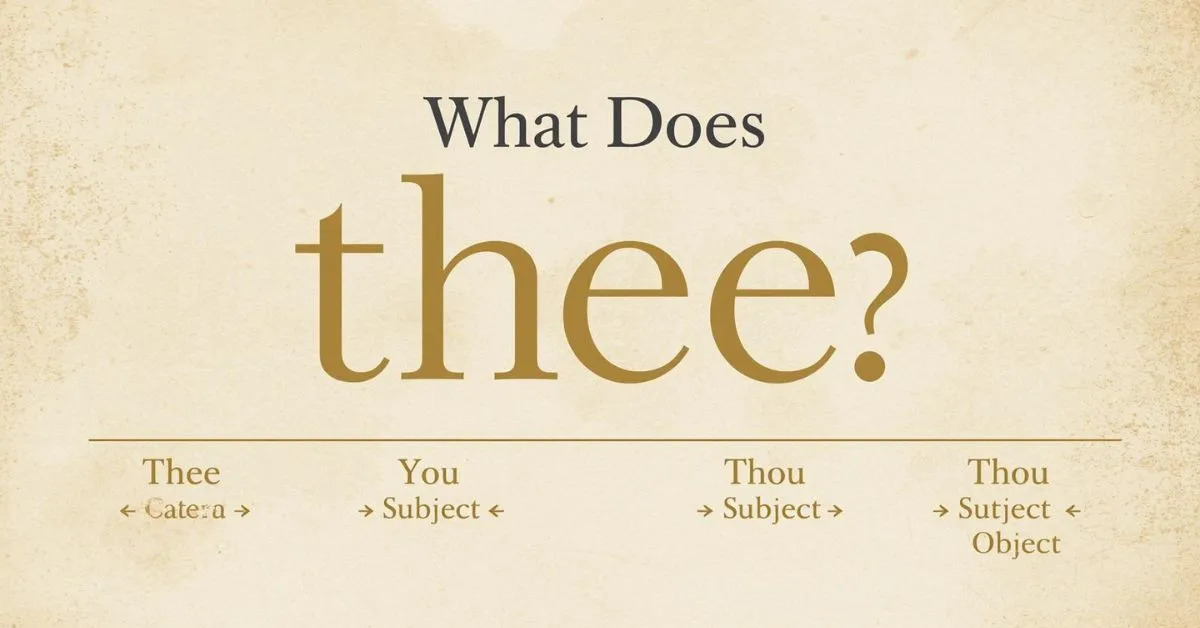
Thee means you, but in older English it is usually the object form of thou. In simple modern English, phrases like “I love thee” or “I thank thee” mean “I love you” and “I thank you.” Standard dictionaries also note that thee is old-fashioned or archaic and is most often seen today in poetry, prayers, literature, hymns, and traditional phrases.
If you want the fast version, this is the easiest way to remember it:
- thee = you
- thou = you as the subject
- thy = your
- thine = yours or sometimes your in older usage
That is the main idea most readers need, but the grammar matters if you want to understand the word correctly in context. Standard dictionary entries describe thee as a pronoun, pronounced /ðiː/, used when speaking to one person, usually as the object of a verb or preposition.
Thee meaning in plain English
In modern English, thee almost always translates to you. The difference is that thee belongs to an older pronoun system where grammar was marked more clearly than it is today. Dictionaries such as Cambridge, Collins, Merriam-Webster, and Oxford Learner’s Dictionaries all describe thee as the object form used for one person.
So these examples are easy to translate:
- I love thee = I love you
- I thank thee = I thank you
- Peace be with thee = Peace be with you
- With this ring, I thee wed = With this ring, I marry you
Is “thee” a subject or an object?
This is the point most pages do not explain clearly enough.
In older English:
- thou is usually the subject
- thee is usually the object
That means:
- Thou art kind = You are kind
- I praise thee = I praise you
Merriam-Webster’s usage note and Cambridge’s entry both reflect this distinction, and Merriam-Webster specifically explains that thee was used in the objective or oblique case while thou was used in the nominative case.
If you want one simple rule, use this:
If the modern sentence would use “you” after a verb or preposition, older English may use “thee.” Cambridge’s grammar guide on personal pronouns also explains the modern difference between subject pronouns and object pronouns, which helps make the older pattern easier to understand.
Thee vs thou vs thy vs thine vs ye
These words are often mixed up, so this is where clear comparison helps most.
| Word | Modern meaning | Main role | Example |
|---|---|---|---|
| thou | you | subject | Thou art welcome. |
| thee | you | object | I thank thee. |
| thy | your | possessive determiner | Thy name is known. |
| thine | yours / sometimes your | possessive form | The choice is thine. |
| ye | you | originally plural subject | Ye cannot serve two masters. |
These distinctions match the current reference entries: thee as object form, thou as subject form, thy and thine as possessive forms, and ye as an older plural form of you used especially as a subject.
Does “thee” mean “you” or “your”?
It means you, not your. That is one of the most common mistakes.
- thee = you
- thy = your
- thine = yours
So:
- I bless thee is correct if you mean I bless you
- thy name is correct if you mean your name
- thee name is incorrect in standard older usage if you mean your name
Where people still see the word “thee”
Most people do not use thee in everyday conversation now. Current dictionaries describe it as old-fashioned, archaic, literary, poetic, religious, or ecclesiastical. That is why it still appears in a few familiar places.
1. Poetry and literature
Many readers first notice thee in poems or classic literature because writers use it to create an elevated, emotional, or old-fashioned tone. Collins and Merriam-Webster both connect the word with poetic or literary language.
2. Prayer, hymns, and religious writing
Merriam-Webster says thee is used especially in ecclesiastical language, and Cambridge’s translated entries also note use when addressing God. That is why you may see phrases like “We thank Thee” or “We praise Thee.”
3. Traditional wedding language
A classic example is “With this ring, I thee wed.” Cambridge uses this exact phrase in its entry, and it remains one of the best-known examples of the word in formal or ceremonial English.
4. Deliberately old-fashioned or dramatic writing
Writers sometimes choose thee for style, not because it is normal modern English. It can make writing sound solemn, romantic, theatrical, or antique.
How to understand “thee” instantly when you see it
The quickest way to decode thee is to replace it with you and check whether the sentence still makes sense.
Examples:
- I miss thee → I miss you
- I give thanks to thee → I give thanks to you
- I shall follow thee → I shall follow you
This works because dictionaries consistently define thee as an old form of you, especially in the object position.
What Most Articles Miss About This Topic
Most articles stop too early. They say “thee means you” and leave it there. That is not wrong, but it misses the part that actually helps readers.
The real key is that thee belongs to an older grammatical system. It is usually the object form, not just a random fancy synonym for you. Once you understand that, phrases like “I love thee” and “to thee” become easy to interpret.
Another thing many pages skip is tone. Today, thee usually sounds poetic, religious, literary, or ceremonial rather than normal. That is why readers often meet it in Shakespeare, hymns, prayers, vows, or intentionally old-fashioned writing.
There is also a small but useful edge case: Merriam-Webster and Dictionary.com both note Quaker usage, including cases where thee can appear outside the standard object-only pattern. That is not the rule most readers need first, but it explains why some historical examples may look unusual.
Is “thee” really Old English?
In everyday conversation, people often say Old English when they really mean old-fashioned English. Oxford Learner’s Dictionaries traces thee back to Old English thē, but the word most readers recognize today usually comes from later literary, religious, and historical English rather than from the earliest stage of English studied by specialists.
For a general reader, the practical takeaway is simple: thee is an old or archaic form of you that survives mainly in traditional or stylized contexts.
Quick reference table
| If you see… | It usually means… | Quick modern translation |
|---|---|---|
| I love thee | thee = object pronoun | I love you |
| I give this to thee | object after preposition/verb | I give this to you |
| Thou art wise | thou = subject pronoun | You are wise |
| Thy voice is gentle | thy = possessive | Your voice is gentle |
| The victory is thine | thine = possessive pronoun | The victory is yours |
This quick-reference pattern matches the dictionary roles given for thee, thou, thy, and thine.
FAQs
What does “thee” mean in Shakespeare?
In Shakespeare, thee usually means you as the object of the sentence. So if a character says something like “I praise thee,” the meaning is simply “I praise you.”
Is “thee” the same as “thou”?
No. Thou is usually the subject form, while thee is usually the object form.
Is “thee” singular or plural?
Current dictionary entries describe thee as used when speaking to one person.
Is “thee” still used today?
Yes, but not much in everyday speech. It mostly survives in poetry, literature, religious language, traditional phrases, and stylized writing.
What does “I love thee” mean?
It simply means I love you.
What is the difference between “thee” and “ye”?
Thee is usually the singular object form, while ye was originally used as a plural subject form of you.
Conclusion:
Thee means you, but in older English it usually appears as the object form of thou. That is why “I thank thee” means “I thank you,” not “I thank your.”
Once you remember that thee = you, thou = subject, and thy/thine = possessive, most old-fashioned phrases become much easier to understand.
Click Here To Read About These Linked Posts:
What Does Epiphany Mean? Definition, Uses, and Examples
What Does HRV Mean? Heart Rate Variability Explained

Hi, I’m Evan Lexor, the voice behind Meanpedia.com. I break down English words, slang, and phrases into clear, simple meanings that actually make sense. From modern internet terms to everyday expressions, my goal is straightforward: help you understand English better, faster, and with confidence, one word at a time.