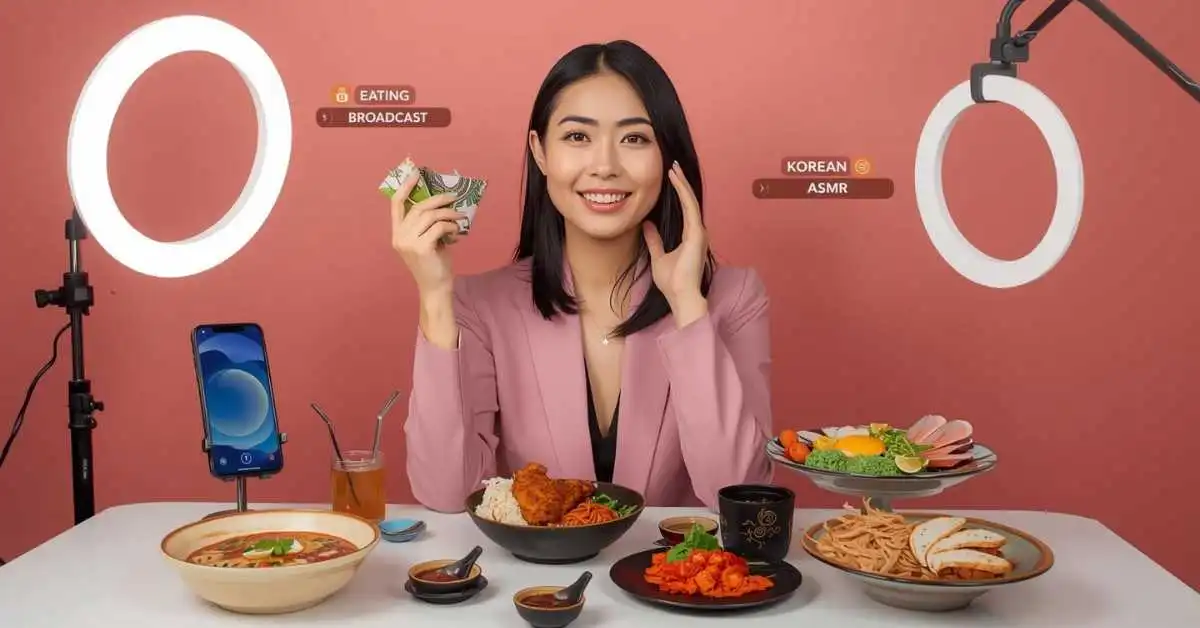
Mukbang means an online eating broadcast. The term comes from South Korea and is commonly explained as a shortened form of the Korean phrase 먹는 방송, meaning “eating broadcast.”
Today, mukbang usually refers to videos or livestreams where a creator eats food on camera while talking, reacting, or interacting with viewers on platforms like YouTube, TikTok, and livestream apps.
If you have seen “mukbang” in a YouTube title, TikTok caption, or social media comment, you are not alone.
Many people know the word is related to food, but they are not sure what it really means. The simple answer is that mukbang is content built around eating on camera. But the full meaning is more interesting than that.
The term has Korean roots, a livestream history, strong ties to digital culture, and several modern styles such as ASMR mukbang, seafood mukbang, spicy noodle mukbang, and talking mukbang.
What does mukbang mean?
Mukbang is a noun used for a video or livestream in which someone eats food for an audience. Many dictionary-style definitions describe it as a video of someone eating large amounts of food, often with commentary or reactions.
In real-world use, though, mukbang can include both very large meals and more ordinary meals, as long as eating is the main focus of the content.
Mukbang meaning in English
In English, mukbang is usually translated as “eating broadcast.” That is the clearest plain-English definition. Some people also call it an online eating show, eating video, or livestream eating content, but “eating broadcast” is the closest direct meaning.
How to pronounce mukbang
Most English speakers say it as mook-bang or muk-bang. You may hear slight differences depending on accent, but both are widely understood online. The Korean spelling is 먹방, and the full Korean phrase commonly linked to the term is 먹는 방송.
Quick answer table
| Question | Quick answer |
|---|---|
| What does mukbang mean? | An online eating broadcast |
| Where did mukbang start? | South Korea |
| What does the word come from? | Korean words related to eating and broadcasting |
| Where is mukbang popular now? | YouTube, TikTok, livestream platforms |
| Is mukbang the same as ASMR? | No, but they often overlap |
The table above works well because it answers the main query fast, then gives the extra details many readers want next.
Where did mukbang come from?
Mukbang began in South Korea and became popular through live online broadcasting. Sources commonly trace its rise to the late 2000s or early 2010s on AfreecaTV, a Korean livestream platform now known globally as SOOP. In those early broadcasts, hosts ate meals while chatting with viewers in real time, which gave the experience a social and interactive feel.
The Korean origin of the word
The word mukbang is commonly explained as a clipped or blended form of Korean words connected to eating and broadcasting. Many sources connect it to meokneun or the verb root meokda for eating, plus bangsong for broadcast. That is why people often say mukbang literally means “eating broadcast.”
Why it grew so fast in Korea
Early mukbang was not just about food. It also gave viewers a sense of company. Academic and media sources have linked mukbang’s appeal to social connection, especially for people eating alone, as well as curiosity, entertainment, and real-time interaction between host and audience.
How mukbang became popular worldwide
Mukbang moved from Korean livestream culture into global internet culture as creators on YouTube, TikTok, Instagram, and Twitch adapted the format for wider audiences.
As that happened, the word itself spread into English-language internet slang and mainstream media. One sign of that expansion was Twitch’s 2016 trial of a social eating category, which showed how recognizable the format had become outside Korea.
Today, people search for phrases like:
- what does mukbang mean on YouTube
- what does mukbang mean on TikTok
- mukbang meaning in English
- what is a mukbang video
- why is mukbang popular
- mukbang vs ASMR
Those searches all point back to the same core idea: watching someone eat on camera as entertainment, companionship, or sensory content.
What is a mukbang video like?
A mukbang video can look very different depending on the creator and platform. Some are calm and conversational. Others are loud, dramatic, or highly edited. Still, most mukbang videos include a few common features:
- food shown clearly on camera
- the creator eating during the video
- talking, storytelling, or reactions
- close-up visuals of texture, steam, sauce, or crunch
- live comments or audience engagement in streams
These details are why mukbang is more than just “a person eating.” It is a specific content format shaped by livestreaming, food presentation, and viewer interest.
Main types of mukbang content
Not all mukbang videos follow the same style. These are the most common forms readers should know.
Talking mukbang
This is the style many YouTube viewers know best. The creator eats while telling stories, discussing daily life, reviewing news, answering questions, or chatting casually with the audience.
ASMR mukbang
ASMR mukbang focuses heavily on sound. Crunching, chewing, slurping, sipping, and crispy textures become a major part of the experience. This style is especially common on YouTube and TikTok.
Seafood mukbang
Seafood mukbang often features crab legs, shrimp, lobster, mussels, or spicy seafood boils. These videos became especially popular because they are visually dramatic and highly sensory.
Spicy noodle mukbang
Spicy noodle mukbang is another huge sub-type. The mix of challenge, heat reaction, and bright visual appeal makes it popular across short-form and long-form video.
Fast food or food review mukbang
Some creators use mukbang as a way to review takeout, fast food, trending snacks, or new menu items while eating them on camera.
Mukbang vs ASMR vs food challenge
A lot of readers confuse these terms, so a direct comparison helps.
| Format | What it means | Main focus | Common platforms |
|---|---|---|---|
| Mukbang | Eating on camera for an audience | Food + personality + viewing experience | YouTube, TikTok, livestream apps |
| ASMR eating | Eating content centered on sound | Crunch, chew, sip, texture sounds | YouTube, TikTok |
| Food challenge | Eating tied to speed, heat, or quantity | Competition or difficulty | YouTube, social media |
| Food review | Tasting and judging food | Opinion and recommendation | YouTube, TikTok, blogs |
Mukbang can include ASMR or a food challenge, but it is not identical to either one. The broad idea of mukbang is still the eating broadcast itself.
Why do people watch mukbang?
This is one of the most searched follow-up questions, and the answer is not one-size-fits-all.
Companionship
Some viewers watch because eating with another person, even through a screen, feels less lonely. This social dining aspect is one of the most discussed reasons in academic writing about mukbang.
Food curiosity
People enjoy seeing huge platters, regional dishes, Korean food, ramen, fried chicken, desserts, seafood boils, or limited-time menu items.
Entertainment
Many mukbang creators build strong audiences through humor, storytelling, reactions, and personality, not just the food itself.
Sensory appeal
For some viewers, the sounds and visuals matter most. Texture, steam, crunch, spice reactions, and close-up bites create a sensory experience that overlaps with ASMR.
Examples of how people use the word mukbang
Seeing the word in context makes the meaning easier to understand.
- “I found a spicy noodle mukbang on YouTube last night.”
- “Her TikTok page is full of seafood mukbang clips.”
- “That is not really a recipe video. It is more of a mukbang.”
- “This creator does ASMR mukbang content with very crunchy foods.”
- “Mukbang started in South Korea before becoming a global trend.”
Common mistakes and things to avoid
This section is important because many weak articles oversimplify the term.
Mistake 1: Thinking mukbang only means eating huge amounts
Large portions are common, but they are not required in every case. The core idea is eating for an audience, not only extreme eating. Dictionaries often stress large quantities, but actual platform use is broader.
Mistake 2: Assuming every food video is mukbang
A cooking tutorial, recipe reel, or restaurant montage is not automatically mukbang. If the main action is cooking or reviewing without eating on camera, it may be food content, but not mukbang.
Mistake 3: Thinking mukbang is only a Korean-language trend
Mukbang began in Korea, but it is now a global internet format used by creators in many countries and languages.
Mistake 4: Confusing mukbang with ASMR
Some mukbang videos are ASMR-heavy, but many are not. A talking mukbang and an ASMR eating video can feel very different.
Is mukbang controversial?
Yes, sometimes. Critics have raised concerns about food waste, exaggerated portion sizes, unhealthy eating habits, and the way extreme mukbang content may shape audience expectations.
Academic work and media coverage have both discussed these concerns, especially around bbinge-style formats.
That said, not every mukbang is extreme. Some are simply casual meal videos, social chats, or food reviews.
A balanced explanation should make that clear. The keyword “what does mukbang mean” needs the basic definition first, but readers also benefit from understanding why the genre sometimes gets mixed reactions.
Practical takeaways
If you want one clean summary, remember these points:
- Mukbang means an eating broadcast.
- It comes from South Korea.
- The Korean spelling is 먹방.
- It is linked to 먹는 방송, often understood as “eating broadcast.”
- It first grew through livestream culture on AfreecaTV / SOOP.
- Today it is common on YouTube, TikTok, Instagram, and Twitch.
- It can include ASMR, food reviews, seafood boils, spicy noodle videos, or live audience interaction.
FAQ
What does mukbang mean in Korean?
Mukbang is commonly linked to the Korean phrase 먹는 방송, meaning “eating broadcast,” and the shorter form 먹방.
What is a mukbang video?
A mukbang video is a video where someone eats food on camera for viewers, often while talking, reacting, reviewing food, or engaging with an audience.
Where did mukbang start?
Mukbang started in South Korea and became popular through livestream platforms such as AfreecaTV, now known as SOOP.
What does mukbang mean on TikTok?
On TikTok, mukbang usually means short eating videos focused on food visuals, satisfying bites, spice reactions, or ASMR-style sounds. The core meaning is still the same: eating content for an audience.
Is mukbang the same as ASMR?
No. Mukbang is the broader eating-broadcast format. ASMR eating is a related style that focuses more on sound and sensory response.
Why do people watch mukbang videos?
People watch for companionship, entertainment, food curiosity, creator personality, and sensory appeal. Research and commentary often point to the social and emotional side of watching someone eat while the viewer also eats or relaxes.
Does mukbang always involve huge amounts of food?
No. Large portions are common in many mukbangs, but the format can also include normal meals, food reviews, and casual eating videos.
Is mukbang healthy?
The format itself is not automatically unhealthy, but extreme mukbang content has drawn criticism over overeating, food waste, and harmful eating habits.
Conclusion
So, what does mukbang mean? In the clearest terms, it means an online eating broadcast. The word comes from Korean internet culture, but the format is now global.
If it appears as a calm meal video, an ASMR seafood feast, a spicy noodle challenge, or a livestream chat over dinner, the main idea stays the same: the audience watches someone eat as part of the content experience.
Read Also This Post: What Does DBA Mean in Business? Name, Uses, LLC, Filing

Hello! I’m Clara Lexis, creator of Meanpedia.com. I specialize in breaking down words, phrases, and idioms so that anyone can understand and enjoy the beauty of English. My goal? Making language approachable, fun, and meaningful, one word at a time.