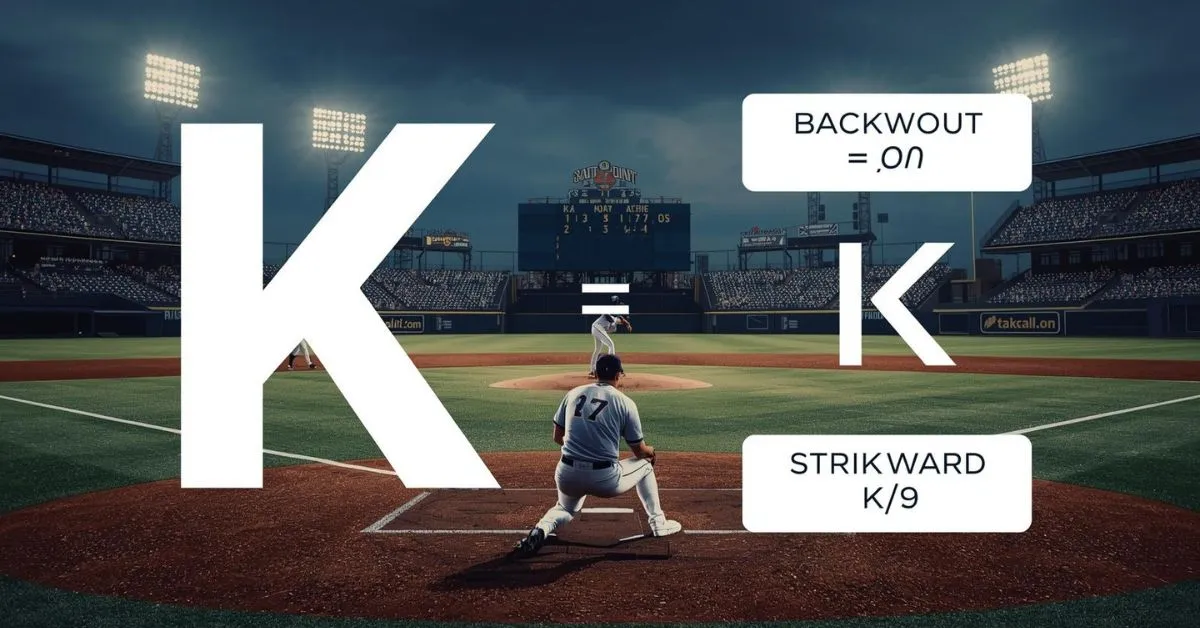
In baseball, K means strikeout. A batter gets a K after three strikes, and in scorekeeping the play is marked with the letter K. A backward K means the batter struck out looking, which means he did not swing at strike three.
MLB’s glossary also lists strikeout as “SO, K,” so you may see either abbreviation depending on the stat page or score display.
If you saw a K on a scoreboard, in a box score, in a stat app, or during a baseball broadcast, it is talking about a strikeout. That is the fast answer. What usually confuses people is everything around it: why baseball uses K instead of S, what a backward K means, whether K is good or bad, and why you sometimes see SO instead.
K in baseball at a glance
| Term | Meaning | Where you might see it |
|---|---|---|
| K | Strikeout | Scorebook, box score, scoreboard, stat pages |
| Backward K | Strikeout looking on a called third strike | Scorebook, broadcasts, fan discussion |
| SO | Strikeout abbreviation used on many stat pages | Official stats, box scores, leaderboards |
| K% | Strikeout rate | Advanced pitching stats |
| K/9 | Strikeouts per nine innings | Pitching analysis |
| K/BB | Strikeout-to-walk ratio | Pitching analysis |
MLB defines a strikeout as a pitcher getting a hitter out with any combination of three swinging or looking strikes, and it specifically notes that K is the scorebook symbol while a backward K marks a third strike on which the batter does not swing. MLB also defines K%, K/9, and K/BB as common pitching stats built around strikeouts.
What does K mean in baseball?
K means strikeout. If a hitter gets three strikes in an at-bat, the result is a strikeout, and scorekeepers record that play with a K. MLB’s official glossary states this directly and also notes that strikeout may appear as SO or K.
This is one of the most common symbols in baseball because strikeouts show up everywhere:
- in a pitcher’s game line
- in a hitter’s box score
- on TV graphics
- in fantasy baseball apps
- in handwritten scorebooks
- on signs fans hold up in stadiums after each strikeout by the home pitcher
What is a backward K in baseball?
A backward K means the batter struck out looking. In simple terms, the batter already had two strikes, did not swing at the next pitch, and the umpire called that pitch strike three. MLB’s glossary makes this distinction explicitly.
That makes the difference easy to remember:
- K = strikeout
- Backward K = strikeout looking
In everyday baseball talk, people often use K as the general symbol for any strikeout. The backward K matters because it tells you how the strikeout happened: the batter was called out without offering at the pitch.
K vs backward K vs SO
This is one of the biggest beginner confusion points, so it helps to separate the terms clearly.
K
A K is the classic baseball symbol for a strikeout in scorekeeping.
Backward K
A backward K means a strikeout looking on a called third strike.
SO
SO is another abbreviation for strikeout. MLB labels the stat as “Strikeout (SO, K)”, which is why some websites, apps, and box scores show SO while scorekeepers and fans often still use K.
Why does K mean strikeout in baseball?
The short answer is history.
MLB says the symbol goes back to the mid-19th century, when baseball writer Henry Chadwick was developing early scorecards. He could not use S for “struck,” because S was already being used for sacrifice, so he chose K instead.
MLB explains that this came from the most memorable sound in the word “struck,” while Britannica and the Baseball Hall of Fame describe Chadwick as one of the key early figures in baseball scoring and statistics.
That old scorekeeping choice never disappeared. It stayed in the scorebook, then spread into box scores, broadcasts, fan culture, and modern baseball stats.
Britannica notes that K has gone far beyond the box score, with fans chanting it in the stadium and displaying K placards to track a pitcher’s strikeouts.
Where people usually see K in baseball
A lot of articles define K but do not explain where readers actually encounter it. That is often the part people need most.
On a scoreboard or TV graphic
If a pitcher has 8 K, that means he has recorded eight strikeouts.
In a batter’s stat line
If a hitter’s line shows 2 K or 2 SO, that means he struck out twice. MLB’s glossary makes clear that strikeouts are tracked as a stat and denoted by SO or K.
In a scorebook
A scorekeeper writes K for a strikeout. If the batter is called out on strike three without swinging, the mark becomes a backward K.
In the stands
Fans often hold up a K sign after each strikeout by the home pitcher, then flip or reverse it for a strikeout looking. Britannica and the Baseball Hall of Fame both describe this long-running stadium tradition.
Is K good or bad in baseball?
It depends on whose stat you are looking at.
For pitchers, K is usually a good thing
A strikeout means the pitcher got an out without the batter putting the ball in play. That is one reason strikeouts are highly valued in pitching analysis and why MLB tracks strikeout-based stats like K%, K/9, and K/BB.
For hitters, K is usually a bad thing
A strikeout means the at-bat ended with an out. For most hitters, that is a negative outcome. Still, one strikeout does not tell you everything about a player.
Some productive hitters strike out a lot but still contribute in other ways. That interpretation point matters because K is not automatically “good” or “bad” on its own; it depends on whether you are evaluating the pitcher or the batter. This is an interpretation point based on how MLB defines strikeouts for both scoring and pitching stats.
Does K apply to both pitchers and hitters?
Yes. The same symbol shows up from two different angles.
- For a pitcher, K tells you how many batters he struck out.
- For a hitter, K tells you how many times he struck out.
That is why context matters so much. If a broadcaster says a starter finished with 10 K, that is praise for the pitcher. If a hitter’s box score shows 3 K, that means he struck out three times.
Can a batter get a K and still reach base?
Yes, sometimes.
MLB notes that the batter is normally out on a strikeout, but on a third strike the catcher does not cleanly hold or that hits the dirt, the batter may try to reach first base if first is open or there are two outs. Even if the batter reaches first safely, the pitcher and batter are still credited with a strikeout.
This is one of the most useful clarifications to include because many short articles skip it.
What do K%, K/9, and K/BB mean?
Once you know K means strikeout, the most common baseball stats built around it become much easier to read.
K%
K% means strikeout rate. MLB defines it as how often a pitcher strikes out hitters, calculated by dividing total strikeouts by total batters faced.
Plain English:
It shows how frequently a pitcher gets strikeouts, not just how many total strikeouts he has.
K/9
K/9 means strikeouts per nine innings. MLB defines it as a pitcher’s strikeouts divided by innings pitched, multiplied by nine.
Plain English:
It estimates how many strikeouts a pitcher averages over nine innings.
K/BB
K/BB means strikeout-to-walk ratio. MLB defines it as strikeouts divided by walks and describes it as an important pitching evaluation tool.
Plain English:
It compares how often a pitcher strikes hitters out versus how often he gives them free passes.
Real examples that make K easier to understand
- “The pitcher had 11 K tonight.”
He struck out 11 batters. - “The batter finished 0-for-4 with 3 K.”
He struck out three times. - “That was a backward K.”
The batter took strike three and was called out looking. - “She has a strong K/9.”
She averages a high number of strikeouts per nine innings pitched.
Common mistakes people make
1) Thinking K only belongs to pitchers
It does not. K can describe a pitcher’s strikeout total or a batter’s strikeout total depending on context.
2) Thinking backward K is just a style choice
It is not. It specifically means the batter struck out looking on a called third strike.
3) Thinking SO and K are different stats
They are two abbreviations for the same result: a strikeout. MLB’s glossary uses Strikeout (SO, K).
4) Thinking every strikeout means the batter swung and missed on pitch three
A strikeout can happen with any combination of swinging and called strikes, and the final strike can be called rather than swung at.
5) Thinking a strikeout always means the batter is definitely off the bases
Usually yes, but not always. On an uncaught third strike in the right situation, the batter may still try to reach first and the play still counts as a strikeout.
What Most Articles Miss About This Topic
Most articles stop at “K means strikeout,” but that is only the first layer.
What readers usually need next is interpretation:
- In a scorebook, K is scoring shorthand.
- In a box score, K or SO is a stat label.
- In a broadcast, K often highlights pitcher dominance. This is an interpretation built from how strikeout totals are displayed and discussed in baseball statistics.
- In the stands, K becomes part of baseball culture, with fans counting strikeouts using signs and sometimes reversing the sign for a batter caught looking.
Another detail many pages skip is that SO matters too. A lot of baseball sites, apps, and official stat pages still show strikeouts as SO, so readers who only learn “K means strikeout” may still feel confused when they see both abbreviations on different pages. MLB’s own glossary solves that clearly by labeling the stat as Strikeout (SO, K).
And finally, many pages skip the dropped-third-strike edge case, even though it is one of the first things that can make a beginner think the rule is inconsistent. MLB’s glossary makes clear that the strikeout still counts even if the batter reaches first safely in that specific situation.
FAQ
What does K stand for in baseball?
K stands for strikeout. MLB’s glossary defines K as the scorebook symbol for a strikeout.
What is a backward K in baseball?
A backward K means the batter struck out looking, which means he did not swing at the third strike.
Why is it K and not S?
MLB says Henry Chadwick could not use S because it was already used for sacrifice, so he used K instead. Britannica and the Baseball Hall of Fame also trace the choice to Chadwick’s early scoring system.
Is SO the same as K in baseball?
Yes. MLB labels the stat as Strikeout (SO, K), so both abbreviations refer to a strikeout.
What does K mean for a pitcher?
For a pitcher, K shows how many batters he struck out.
What does K mean for a batter?
For a batter, K shows how many times he struck out. This follows directly from MLB’s definition of strikeouts as a tracked stat.
What does K/9 mean in baseball?
K/9 means strikeouts per nine innings pitched.
Can a batter strike out and still get on base?
Yes. MLB notes that on an uncaught third strike, the batter may attempt to reach first base in certain situations, and the play still counts as a strikeout.
Final takeaway
If you want the simple answer, here it is: K in baseball means strikeout. A backward K means the batter struck out looking, and SO is another abbreviation for the same stat. Once you know those three pieces, scoreboards, box scores, baseball apps, and stat pages become much easier to understand.
Click Below To Read About:
What Does It Mean to Refinance a Loan? Its Work, When It Helps
Janice Mean Girls: You Mean Janis Ian Complete Explanation
What Does Code 4 Mean in Police? Complete Explanation

Hello! I’m Clara Lexis, creator of Meanpedia.com. I specialize in breaking down words, phrases, and idioms so that anyone can understand and enjoy the beauty of English. My goal? Making language approachable, fun, and meaningful, one word at a time.