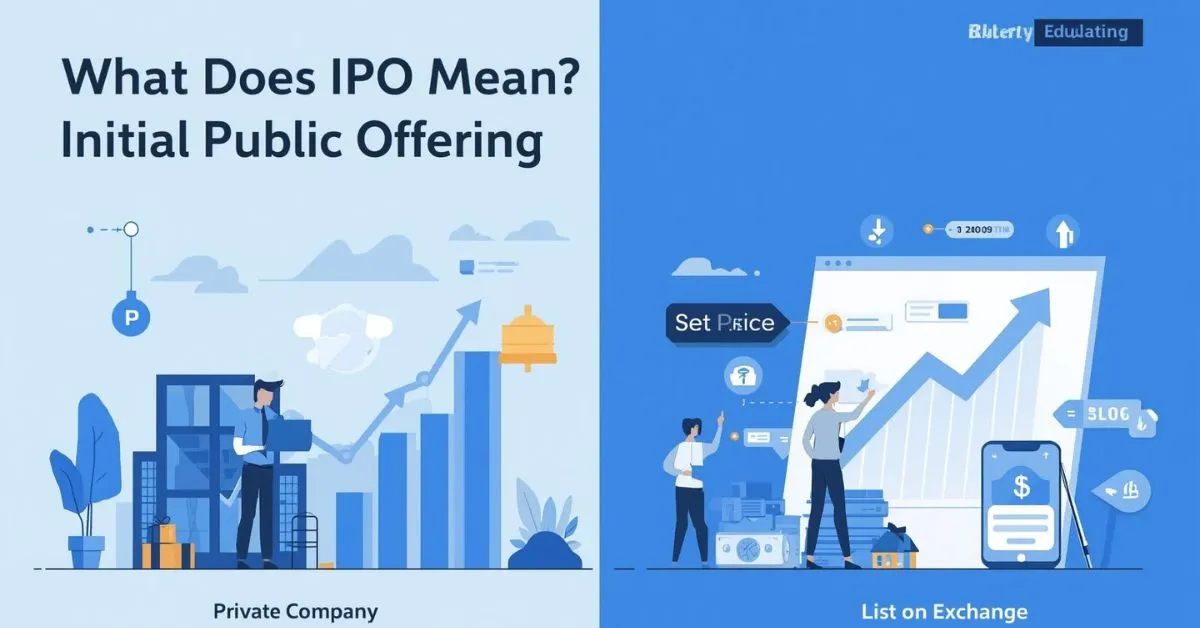
IPO means initial public offering. It is the first time a private company offers its shares to the public in a registered offering, which helps create a public trading market for the stock. In simple terms, an IPO is the moment a business “goes public.”
If you have seen headlines about a company listing on Nasdaq or the New York Stock Exchange, you were probably reading about an IPO.
For businesses, an IPO can raise capital, increase visibility, and give founders, employees, and early investors a path to liquidity. For investors, it can open access to a new stock, but it also brings risk, hype, and price swings.
That is why understanding IPO meaning in plain English matters before you buy or even follow one in the news.
What does IPO mean in simple words?
IPO stands for initial public offering.
- Initial means first
- Public means open to outside investors
- Offering means the company is offering shares for sale
Before an IPO, a company is usually privately owned by founders, employees, venture capital firms, private equity investors, or other early shareholders. After the IPO, its shares can trade publicly, and the company becomes subject to public reporting requirements.
What does IPO mean in the stock market?
In the stock market, IPO meaning is simple: a company that was private becomes a public company by selling stock to investors for the first time. Those shares are then listed on an exchange such as Nasdaq or the NYSE, and the market begins setting the trading price.
What does IPO mean for a company?
For a company, an IPO often means access to a much larger pool of capital, more public visibility, and a liquid market for its shares. It also means more disclosure, more scrutiny, and ongoing SEC reporting obligations.
What does IPO mean for investors?
For investors, an IPO can mean a chance to buy shares in a company early in its public life. But it does not mean guaranteed profits. Investor.gov warns that IPOs can be risky, and regular investors often have difficulty getting shares at the original offering price.
How does an IPO work?
An IPO is not just a company picking a ticker symbol and ringing a bell. It is a formal process involving regulators, exchanges, lawyers, auditors, underwriters, and investors.
In a traditional IPO, a private company raises capital by selling newly issued shares to investment banks called underwriters, which then sell the shares mainly to institutional investors.
Step 1: The company decides to go public
A company usually considers an IPO when it wants money to expand, reduce debt, fund research, make acquisitions, or create a public market for ownership.
This step is strategic because going public changes how the company is governed, valued, and watched by the market.
Step 2: It files a registration statement with the SEC
To launch a registered offering, the company files a registration statement, often on Form S-1. A major part of that filing is the prospectus, which gives investors important information about the company’s business, management, financial statements, use of proceeds, and risk factors.
Step 3: Underwriters help structure and market the deal
The company usually hires one or more investment banks as underwriters. These banks help market the deal, support the offering process, and manage the early trading setup.
SEC materials note that companies may choose the IPO path partly because underwriters help market the offering and manage initial trading volume.
Step 4: The IPO is priced
Nasdaq explains that in a traditional IPO, the IPO price is based on investor demand gathered during the roadshow and then determined by the lead underwriters. That means the offer price is set before public trading starts.
Step 5: Shares begin trading on the exchange
Once the offering is effective and the shares list on Nasdaq or the NYSE, public trading begins. The opening price is shaped by price discovery, meaning the interaction of buy and sell orders in the market.
On the NYSE, the opening process involves a Designated Market Maker, while Nasdaq uses auction mechanisms to establish the opening price.
Why do companies launch an IPO?
The main reason is usually capital raising. A successful IPO can give a company cash to grow faster than it could as a private business. It can also make stock-based compensation more attractive, support acquisitions, and improve visibility in the market.
Another reason is liquidity. Founders, employees, venture capital firms, and early investors may want a clearer path to eventually sell some of their holdings.
Going public creates a public market for those shares, although insider sales are often limited for a period after the offering through lock-up agreements.
Why are IPO shares hard for regular investors to get?
A lot of beginners search “can anyone buy IPO shares?” The real answer is: sometimes, but not always easily. Investor.gov explains that underwriters and the issuing company control the IPO allocation process and have wide latitude in deciding who gets shares.
In popular deals, many shares go to institutional investors, and retail investors may get little or no allocation at the offer price.
That is why many people do not actually buy at the IPO price. Instead, they buy later in the open market after trading begins, often at a very different price.
IPO price vs opening price: what is the difference?
This is one of the most important beginner concepts.
The IPO price is the offer price set before trading starts. The opening price is the price at which the stock actually begins public trading after market demand is matched.
Those two prices can be very different. Nasdaq and NYSE materials both describe this as part of the market’s price discovery process.
Simple example
Imagine a company sets an IPO price at $20 per share. If demand is strong when trading begins, the opening trade might happen at $24. If demand is weak, it could open below $20.
That is why “IPO price” and “first trading price” are not the same thing. This is also why some investors wait for volatility to settle before buying.
IPO vs direct listing vs SPAC vs follow-on offering
Not every public-market debut is the same.
A traditional IPO is the classic route: the company sells shares to the public for the first time with the help of underwriters. A direct listing is another path to public markets.
Nasdaq says direct listings let companies list without a traditional underwritten IPO, and usually without the same lock-up restrictions.
A SPAC is a blank-check company that raises money in its own IPO and later merges with a private operating company. A follow-on registered offering happens after a company is already public and wants to sell more securities in a registered deal.
| Path | What it means | Raises new capital? | Key feature |
|---|---|---|---|
| IPO | First public sale of a private company’s shares | Usually yes | Traditional “going public” route |
| Direct listing | Public listing without a traditional underwritten IPO | Usually no, though capital-raise versions also exist | More market-led pricing |
| SPAC | Blank-check company goes public first, then merges with an operating company | Yes, through the SPAC structure | Alternative route to becoming public |
| Follow-on offering | Registered offering by a company already trading publicly | Yes or sometimes existing shareholder sales | Happens after the IPO stage |
For most beginners, the key idea is simple: IPO means first public offering. If the company is already public, it is no longer an IPO.
Common IPO terms you should know
SEC
The U.S. Securities and Exchange Commission oversees the registration framework for public offerings and ongoing public reporting.
Form S-1
The registration statement often used before a U.S. IPO.
Prospectus
The main offering document that explains the company, the risks, management, finances, and the offering itself.
Underwriters
Investment banks that help structure, market, price, and distribute IPO shares.
Roadshow
The marketing period when company executives and underwriters present the deal to potential investors before pricing. Nasdaq describes IPO pricing as being based on order demand gathered during the roadshow.
Lock-up period
A period after the IPO when insiders and early investors are restricted from selling shares. Nasdaq says lock-ups in IPOs are typically around 90 to 180 days, and often about 180 days.
Institutional investors and retail investors
Institutional investors are large investors such as mutual funds, pension funds, and asset managers. Retail investors are individual investors. In traditional IPOs, institutional investors often get priority allocations.
Nasdaq and NYSE
These are major U.S. stock exchanges where IPO shares may list and begin trading.
Real-world IPO example in simple terms
Let’s say a private software company called BrightApps has strong revenue growth and wants to expand worldwide. Its founders, employees, and venture capital backers own the company privately.
BrightApps hires underwriters, files a Form S-1 with the SEC, prepares a prospectus, markets the deal to investors, sets an offer price, and lists on Nasdaq under a new ticker symbol. On listing day, price discovery begins and the shares start trading publicly.
That full transition is what people mean when they say, “BrightApps had its IPO.” This example reflects the basic process described by the SEC, Nasdaq, and NYSE.
Common mistakes people make about IPOs
Thinking IPO means guaranteed profits
It does not. Investor bulletins warn that IPOs can be risky and speculative, especially when investors buy based on hype rather than business fundamentals.
Confusing the offer price with the market price
The IPO price is set before trading starts, but the market price can move sharply once price discovery begins.
Ignoring the prospectus
The prospectus is where investors find the risk factors, business model, financial statements, and use of proceeds. Skipping it means skipping the most important source document in the deal.
Forgetting the lock-up expiration
When lock-up periods end, more shares may enter the market. That can affect supply and sometimes pressure the stock price.
What should investors check before buying an IPO?
Start with the basics:
- How does the company make money?
- Is revenue growing?
- Is the business profitable or still burning cash?
- What risks are listed in the prospectus?
- Are you getting the offer price or buying after public trading starts?
- When does the lock-up expire?
- Is this a true IPO, a direct listing, a SPAC deal, or a follow-on offering?
These questions help separate a real investment decision from pure excitement.
FAQs
1. What does IPO stand for?
IPO stands for initial public offering, the first time a company offers shares to the public in a registered offering.
2. What does IPO mean in stocks?
In stocks, IPO means a private company is becoming publicly traded by selling shares to outside investors for the first time.
3. Why do companies go public through an IPO?
Companies usually go public to raise capital, increase visibility, and create a public market for their shares.
4. Can regular investors buy IPO shares?
Sometimes, yes. But allocations are controlled by the company and underwriters, so retail investors may not get many shares at the IPO price.
5. Is an IPO the same as a direct listing?
No. A traditional IPO uses underwriters and usually raises new capital. A direct listing is a different path to public markets and usually does not follow the same structure.
6. What is a lock-up period in an IPO?
A lock-up period is a post-IPO period when insiders and early investors are restricted from selling shares. Nasdaq says this is typically around 90 to 180 days.
7. What is the difference between an IPO and a SPAC?
An IPO is a company’s first public stock offering. A SPAC is a blank-check company that raises money first and later merges with a private operating company.
8. Does an IPO mean the company is profitable?
No. IPO only means the company is selling shares to the public for the first time. It does not guarantee profit, safety, or a good valuation
The bottom line
So, what does IPO mean? It means initial public offering: the first time a private company offers shares to the public in a registered sale. For companies, it can unlock capital, visibility, and liquidity.
For investors, it can create opportunity, but it also comes with pricing risk, volatility, and limited access to the best allocations. The smartest way to approach any IPO is to understand the prospectus, the pricing process, the lock-up period, and the type of offering you are actually looking at.
Click Below To Read About:
What Does the Name Cole Mean? Origin, Pronunciation, History
What Does Kyrie Eleison Mean? A Simple and Clear Explanation
What Does Code 4 Mean in Police? Complete Explanation

Hi, I’m Evan Lexor, the voice behind Meanpedia.com. I break down English words, slang, and phrases into clear, simple meanings that actually make sense. From modern internet terms to everyday expressions, my goal is straightforward: help you understand English better, faster, and with confidence, one word at a time.