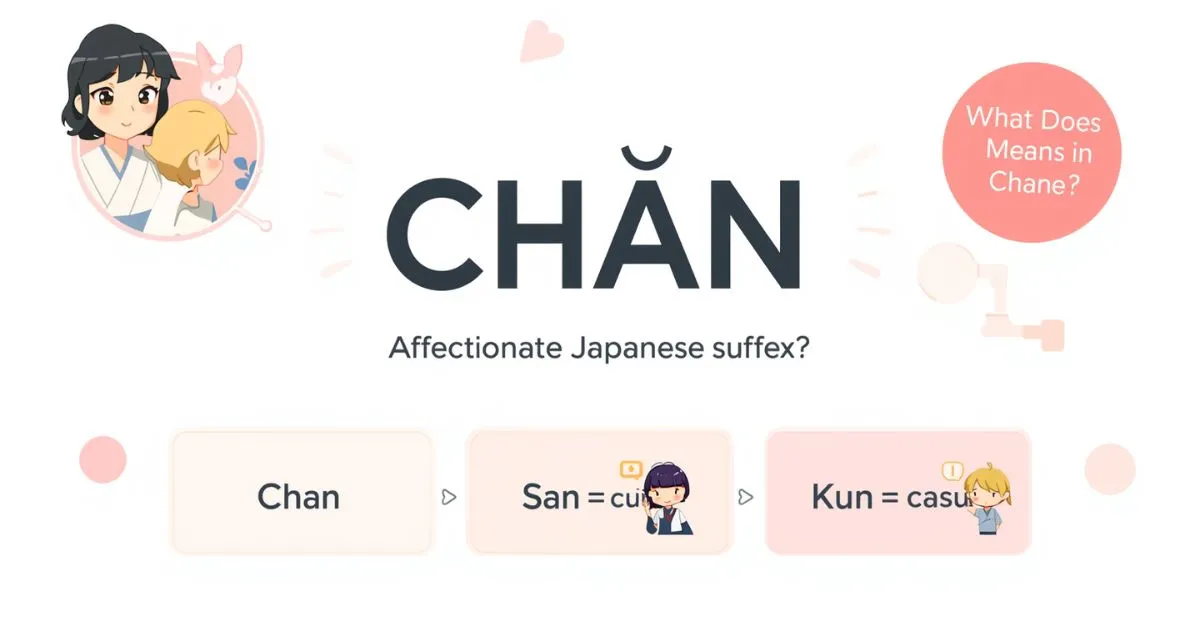
Chan (ちゃん) is a Japanese honorific suffix used to show affection, familiarity, cuteness, or emotional closeness. It is commonly used for children, close friends, babies, pets, lovers, and some family members, and it is most often associated with girls or young women, though it is not limited to them. It is usually too familiar for strangers, bosses, or formal situations.
If you have seen chan after someone’s name in anime, manga, subtitles, or online fandom spaces, that is almost certainly the meaning you are looking for.
It does not simply mean “girl,” and it is not just a random sound added to a name. It is part of the Japanese honorific system, where endings like -san, -kun, and -chan help show respect, familiarity, affection, or social distance.
At a glance
| Term | Meaning / Feel | Typical Use | Safe in Formal Situations? |
|---|---|---|---|
| -chan | affectionate, cute, familiar | children, close friends, pets, loved ones | Usually no |
| -san | polite, neutral, respectful | strangers, coworkers, acquaintances, most adults | Yes |
| -kun | familiar, often junior or boy-oriented | boys, juniors, some school/work settings | Sometimes, depending on hierarchy |
This is the fastest way to understand chan: it is warmer and more intimate than san, and it usually sounds softer and cuter than kun.
When you are not sure what to use, Japanese-learning guides consistently recommend -san as the safer default.
What Does “Chan” Mean After a Name?
When chan comes after a name, it adds a feeling of closeness. In English, the effect can sometimes feel a bit like saying dear, little, sweet, or using a cute nickname, but none of those is a perfect translation. That is why many people get confused when they try to force chan into one exact English word. It works better as a tone marker than as a direct dictionary translation.
For example:
- Mika-chan sounds affectionate and familiar
- Yuki-chan can sound warm, cute, or close
- Obaa-chan is an affectionate way to say grandma
- Ojii-chan is an affectionate way to say grandpa
So the real question is not just “What does chan mean?” The better question is, “What feeling does chan add to this name?” Most of the time, the answer is affection, softness, closeness, or cuteness.
How Chan Is Usually Used
1. For children and babies
This is one of the most common uses. Chan is widely used for small children and babies because it sounds affectionate and gentle.
2. For girls or young women in close relationships
Many teaching sources describe chan as most frequently used for girls and young women, especially where there is familiarity or emotional warmth. That is why many learners first assume it means “girl,” but that is only part of the picture.
3. For close friends, lovers, and family
It can be used between very close friends, romantic partners, and family members. It can also appear in affectionate family terms, especially for grandparents.
4. For pets and cute animals
If someone sees an animal as adorable, using chan can sound natural and affectionate.
5. Occasionally for boys
Although chan is strongly associated with girls and children, it can sometimes be used for boys too, especially when the tone is cute, playful, or nickname-like. It is less common, but it is not wrong in every case.
Does Chan Mean “Girl”?
Not exactly.
This is one of the biggest misunderstandings around the word. Chan is often used with girls, but it does not literally mean “girl.” It is better understood as an affectionate suffix that is commonly used for girls, children, and people or animals seen as cute or dear. If you reduce it to “girl,” you lose the relationship and tone that make the suffix meaningful.
A better explanation is:
- girl is sometimes part of the context
- affection and familiarity are the real core meaning
- social relationship matters more than literal translation
Why Do People Say Chan in Anime?
Anime makes chan especially noticeable because character relationships matter so much. A suffix like -chan quickly tells the audience that the speaker sees someone as close, cute, lovable, childish, or emotionally familiar.
In many English subtitles, that nuance gets flattened, reduced, or dropped, which is why learners often hear the term but do not fully understand what it is doing.
For example, these two names do not feel the same:
- Aiko-san = polite, respectful, neutral
- Aiko-chan = affectionate, softer, more intimate
That difference is exactly why anime fans search this term so often. They can hear that the name ending matters, even if the subtitles do not fully explain it.
Chan vs San vs Kun
Understanding chan gets much easier once you compare it with the two honorifics people confuse it with most.
Chan vs San
San is the polite, neutral, safe default. It works with strangers, acquaintances, coworkers, and most adults. Chan is more intimate and usually more emotionally warm. If you switch from san to chan, you are usually signaling closeness rather than simple politeness.
Chan vs Kun
Kun is commonly used for boys, younger males, juniors, or people lower in workplace or school hierarchy, though usage can vary by context. Chan feels softer, cuter, and more affectionate. In some cases they overlap slightly, but they do not carry the same emotional tone.
Quick comparison examples
- Taro-san = polite
- Taro-kun = familiar, often junior or boy-oriented
- Taro-chan = affectionate, cute, nickname-like
When You Should Not Use Chan
This is where many weaker articles fail the reader.
You generally should not use chan for:
- strangers
- people you just met
- bosses
- teachers in formal settings
- customers
- people you need to address respectfully in business or formal social situations
If you use chan too casually, it can sound childish, overly familiar, or disrespectful. The safest beginner rule is simple: when in doubt, use -san. That guidance appears clearly in beginner honorific resources because it avoids awkward mistakes.
How It Is Written and Pronounced
Chan is written in hiragana as ちゃん. It is a suffix, so it comes after a name rather than standing alone as a separate title.
Teaching sources also commonly note that it is often explained as having roots in children’s baby-talk pronunciation of -san, although it became a normal part of everyday usage.
For SEO and beginner clarity, it helps to show all three forms together:
- chan = romaji
- ちゃん = hiragana
- name example: Yuki-chan / ゆきちゃん
Real-Life Usage Examples
Here are some practical examples that make the meaning easier to feel:
A mother to her daughter:
“Yuna-chan, come here.”
This sounds affectionate and natural for a child.
A close friend to another friend:
“Emi-chan looked so happy today.”
This can sound warm and familiar, especially in a close relationship.
A pet owner to a cat:
“Momo-chan is sleeping again.”
This sounds cute and affectionate.
A coworker to a senior manager:
“Tanaka-chan…”
This would usually sound too familiar and inappropriate in a formal workplace. Tanaka-san would be much safer.
Can You Use Chan for Yourself?
Usually, no. Honorifics are generally not used for yourself in normal adult speech.
But some sources note that people, especially children or people using a childlike or cute affectation, may refer to themselves in the third person with -chan. That is a marked, stylized use, not the standard rule.
What Most Articles Miss About This Topic
Most articles say chan means cute or affectionate, which is true, but incomplete.
What they often miss is that chan is really a relationship signal. It tells you how the speaker is positioning the other person socially and emotionally. That is why the same suffix can sound sweet in one moment, childish in another, and awkward in a formal setting.
The meaning is not only in the word itself. The meaning is in the relationship behind it.
Another thing many articles miss is that the best way to understand chan is not by hunting for a perfect English translation.
Japanese honorifics do not map neatly onto English. Readers learn them faster when they focus on tone, familiarity, and social context instead of trying to force one exact definition.
Does “Chan” Ever Mean Something Else?
Yes, but only in a different context.
If you see Chan with a capital C as part of a full name, it may be a surname, as in Jackie Chan. That is not the same thing as the Japanese suffix -chan. For this keyword, though, the dominant search intent is clearly the Japanese honorific used after names.
FAQ
What does chan mean after a name?
It usually means the speaker is adding a Japanese suffix that shows affection, familiarity, softness, or cuteness.
Is chan respectful?
It can be warm and kind, but it is usually not the best choice for formal respect. San is generally the safer respectful default.
Can chan be used for boys?
Yes, sometimes. It is less common, but it can be used for boys in cute, playful, or nickname-like contexts.
Why do anime characters use chan so much?
Because it quickly signals relationship tone, especially affection, closeness, cuteness, or playful familiarity.
What is the difference between chan and san?
Chan is more affectionate and familiar. San is more neutral, polite, and broadly appropriate.
Does chan mean girlfriend?
No. A romantic partner might use it, but it does not literally mean girlfriend. It is a suffix showing affection or familiarity.
Conclusion
If you wanted the clearest possible answer, here it is: chan is a Japanese suffix used after a name to show affection, closeness, softness, or cuteness. You will hear it often in anime, but it is not just an anime word.
It is part of the real Japanese honorific system, and understanding it becomes much easier once you compare it with san and kun. When you are unsure, stick with -san. When a relationship is genuinely close and informal, -chan can sound warm and natural.
Click Below To Read About:
What Does RPG Mean? Gaming Meaning, Other Uses
What Does Seeing 1111 Mean? Angel Number, Love, and What to Do
What Does Thee Mean? Definition, Examples, and Usage

Hello! I’m Clara Lexis, creator of Meanpedia.com. I specialize in breaking down words, phrases, and idioms so that anyone can understand and enjoy the beauty of English. My goal? Making language approachable, fun, and meaningful, one word at a time.