If you searched for contempt meaning, you may have seen the word in a book, movie, conversation, or legal story and wondered what it really means.
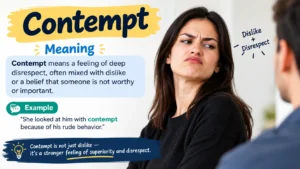
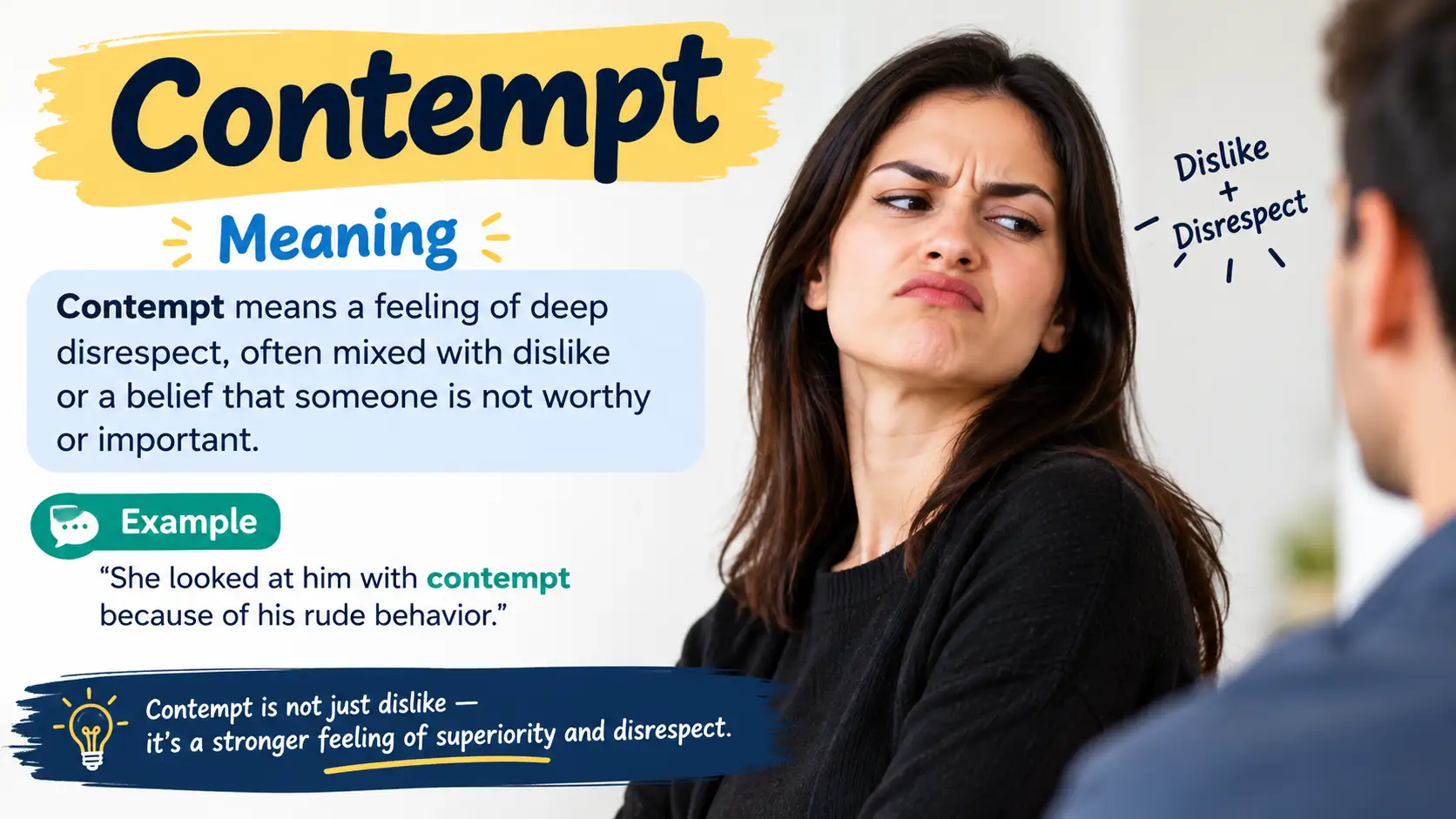
In simple English, contempt means a strong feeling that someone or something is unworthy of respect, often mixed with dislike or a sense of superiority.
For example, if someone treats another person as worthless and looks down on them, they may be showing contempt. The word can also have a legal meaning, especially in the phrase “contempt of court.”
This guide explains the meaning of contempt in plain English, shows how it is used in real sentences, compares it with similar words, and explains its different meanings in everyday and legal contexts.
Quick Answer:
Contempt means a strong feeling of disrespect or dislike toward someone or something you believe is beneath your respect.
In simple terms, contempt is more than just not liking someone. It often involves looking down on them or believing they are not worthy of respect.
For example:
“She looked at his dishonest behavior with contempt.”
This means she strongly disapproved of his behavior and viewed it as deserving no respect.
Contempt can be used as a noun, while contemptuous is the related adjective.
| Word | Simple meaning | Example |
| Contempt | Strong disrespect or dislike | He spoke about the idea with contempt. |
| Contemptuous | Showing contempt | She gave him a contemptuous look. |
| Contemptibly | In a way that deserves contempt | He behaved contemptibly. |
The word is also important in law. Contempt of court refers to behavior that disobeys or disrespects the authority or orders of a court.
Contempt Meaning in Simple English
A simple way to understand contempt is “looking down on someone or something because you believe it is unworthy of respect.”
Imagine someone hears a person make a cruel joke about another person. Instead of simply disagreeing, they may think, “That behavior is beneath respect.” If they show that strong feeling of disrespect, they may be showing contempt.
Contempt can appear through words, facial expressions, tone, or actions.
For example:
“He spoke about his former business partner with contempt.”
This suggests that he did not merely dislike the person. His attitude showed strong disrespect.
The feeling can also be directed toward things, ideas, rules, or behaviors:
“She has contempt for dishonesty.”
Here, the person strongly rejects dishonesty and considers it unworthy of respect.
This distinction matters because contempt is usually stronger than ordinary dislike.
What Does Contempt Mean in a Relationship?
In relationships, contempt describes an attitude in which one person treats the other as inferior, foolish, worthless, or beneath them.
For example:
“His sarcastic comments showed contempt for his partner.”
The problem is not simply that he disagreed with his partner. The attitude behind his words was disrespectful and superior.
Contempt in a relationship can appear as:
- Mocking or insulting someone
- Rolling your eyes at them
- Speaking to them as if they are inconsiderate
- Making cruel jokes at their expense
- Treating their opinions as worthless
- Using sarcasm to humiliate them
- Acting as though you are better than them
A disagreement does not automatically mean contempt. Couples, friends, and family members can disagree while still respecting each other.
The key difference is respect.
A healthy disagreement can sound like:
“I understand your point, but I see it differently.”
Contempt sounds more like:
“That is the inconsiderate thing I have ever heard.”
The second statement attacks the person’s worth or intelligence instead of simply addressing the disagreement.
Contempt Meaning in Law
The legal meaning of contempt is different from its everyday emotional meaning.
In the United States, contempt of court generally involves behavior that disobeys a court order, interferes with court proceedings, or otherwise challenges the authority of the court. The exact rules and consequences can vary depending on the jurisdiction and the type of contempt involved.
For example, a court may deal with contempt when someone knowingly refuses to follow a valid court order.
You may see phrases such as:
“The judge found the defendant in contempt of court.”
This means the court determined that the person engaged in conduct that legally qualified as contempt.
Legal contempt can involve different issues, including failure to follow court orders or disruptive conduct during proceedings. Because legal standards differ by jurisdiction, a person should not assume that every act of disrespect automatically amounts to legal contempt.
| Context | Meaning of contempt |
| Everyday English | Strong disrespect or dislike |
| Relationships | Treating someone as inferior or unworthy of respect |
| Court | Conduct that violates certain court-related legal requirements or authority |
| Literature | A character’s strong scorn or rejection of another person or idea |
Contempt vs Disrespect
Contempt and disrespect are closely related, but they are not exactly the same.
Disrespect means failing to show proper respect. Contempt usually carries a stronger sense of scorn, rejection, or looking down on someone.
For example:
“He showed disrespect by interrupting his teacher.”
The person behaved without proper respect.
Now consider:
“She looked at the dishonest politician with contempt.”
This suggests a much stronger negative judgment. She sees the behavior as deeply unworthy of respect.
In simple terms:
Disrespect = lack of respect.
Contempt = strong disrespect mixed with scorn or a feeling of superiority.
This distinction can help you understand why the word “contempt” often sounds more intense.
Contempt vs Disdain
Disdain is one of the closest synonyms for contempt.
Both words can describe a feeling that someone or something is beneath your respect. However, disdain often emphasizes a feeling of superiority or rejection, while contempt can sound stronger and more openly scornful.
Consider these examples:
“She looked at the cheap imitation with disdain.”
“He treated the dishonest behavior with contempt.”
Both show strong disapproval, but the emotional tone can differ depending on the situation.
In everyday writing, the two words may sometimes be used almost interchangeably.
Contempt vs Hatred
Contempt and hatred are not the same.
Hatred is an intense feeling of dislike or hostility. Contempt is more closely connected to disrespect and the belief that someone or something is beneath consideration or respect.
A person might hate an enemy because of intense anger. A person might feel contempt for someone because they believe that person’s behavior is shameful or unworthy.
For example:
“She hated injustice.”
This focuses on intense dislike.
“She held the corrupt behavior in contempt.”
This focuses more on strong moral rejection and disrespect.
A person can feel both emotions at the same time, but one does not automatically mean the other.
Contempt vs Disgust
Disgust usually describes a strong feeling of revulsion or the desire to avoid something unpleasant.
Contempt is more about judgment and disrespect.
For example:
“The spoiled food filled him with disgust.”
The reaction is mainly physical or emotional revulsion.
“She regarded his dishonest actions with contempt.”
The reaction is based on a judgment that the behavior is beneath respect.
The words can overlap in some situations, but their central ideas are different.
Contempt Synonyms
Several words can be used instead of contempt, depending on the sentence.
Common synonyms include:
- Disdain
- Scorn
- Disrespect
- Derision
- Disapproval
- Condemnation
- Hatred
- Abhorrence
However, these words do not always mean exactly the same thing.
Scorn is especially close to contempt and often suggests open mockery or rejection.
Disdain often suggests looking down on someone or something.
Disrespect is broader and simply means a lack of proper respect.
Derision focuses more on mocking or ridiculing someone.
Choosing the right synonym depends on the exact feeling you want to express.
Contempt Antonyms
An antonym is a word with an opposite or contrasting meaning.
Common opposites of contempt include:
- Respect
- Admiration
- Appreciation
- Esteem
- Approval
- Honor
- Regard
For example:
“She treated her mentor with respect.”
This expresses almost the opposite attitude from contempt.
You can think of the contrast this way:
Contempt → “You are not worthy of my respect.”
Respect → “You are worthy of my consideration and regard.”
This simple contrast makes the meaning easier to remember.
Grammar: How to Use Contempt Correctly
Contempt is usually used as a noun.
Common patterns include:
“Contempt for + person or thing”
“He has contempt for dishonest people.”
“With contempt”
“She looked at the proposal with contempt.”
“Hold someone or something in contempt”
“The community held his actions in contempt.”
“Contempt of court”
“The judge warned him about contempt of court.”
The phrase “contempt for” is especially common when talking about a person’s attitude toward someone or something.
For example:
“Her contempt for cruelty was obvious.”
It would sound unnatural to say “her contempt to cruelty.”
Real-Life Examples of Contempt
Understanding examples can make the word much easier to recognize.
“He spoke with contempt about people who refused to work.”
The speaker showed strong disrespect toward those people.
“She has nothing but contempt for dishonest business practices.”
She strongly disapproves of dishonest practices and considers them unworthy of respect.
“His contempt for the rules eventually caused problems.”
He had such little respect for the rules that his attitude created problems.
“The audience reacted to the cruel joke with contempt.”
The audience strongly disapproved of the joke.
“She looked at the broken promise with contempt.”
She regarded the broken promise as something deserving of strong disrespect.
“The lawyer explained the possible consequences of contempt of court.”
Here, contempt has its legal meaning.
Contemptuous Meaning
Contemptuous is an adjective meaning showing contempt or strong disrespect.
For example:
“He gave her a contemptuous smile.”
This means his smile showed that he looked down on her.
Another example is:
“Her contemptuous tone made the conversation worse.”
Her tone communicated strong disrespect.
The difference is simple:
Contempt = the feeling.
Contemptuous = showing that feeling.
Compare:
“He felt contempt.”
“He was contemptuous toward his opponent.”
The first describes the emotion. The second describes the way the emotion was expressed.
Common Mistakes With the Word Contempt
One common mistake is treating contempt as exactly the same as ordinary dislike.
Saying:
“I dislike this movie.”
is much weaker than:
“I hold this movie in contempt.”
The second sentence communicates strong scorn or disrespect.
Another mistake is confusing contempt with confidence. A confident person may believe strongly in their own abilities without looking down on others. Contempt involves a negative judgment toward another person or thing.
It is also important not to confuse contempt with content. These words sound somewhat similar in some accents, but they have completely different meanings.
Contempt means strong disrespect.
Content can mean satisfied, or it can refer to information contained in something.
For example:
“She felt contempt for his behavior.”
“He was content with his decision.”
Is Contempt Always a Negative Word?
Yes, contempt normally carries a negative meaning.
It describes strong disrespect, scorn, or rejection. However, the object of contempt may sometimes be something most people consider harmful or immoral.
For example:
“She had contempt for cruelty toward animals.”
The word still expresses a negative attitude, but the thing being rejected is itself viewed negatively.
This is why context matters. The emotion described by contempt is negative, but the reason someone feels contempt may be considered morally understandable.
Why Do Writers Use the Word Contempt?
Writers often use contempt because it communicates a stronger emotion than words such as “dislike” or “disapproval.”
In a story, saying:
“He disliked his rival.”
does not tell us much about the intensity of his feelings.
But:
“He regarded his rival with contempt.”
suggests a deeper emotional conflict. The character does not simply dislike the rival. He sees the rival as beneath his respect.
The word can therefore add emotional depth to novels, news writing, essays, speeches, and serious conversations.
How to Remember the Meaning of Contempt
A simple memory trick is:
Contempt = “I look down on you.”
If someone thinks another person is beneath them and unworthy of respect, that attitude can be described as contempt.
Remember these three ideas:
Strong disrespect + looking down + little or no regard = contempt.
For example:
“She treated his opinion with contempt.”
Think: She did not merely disagree. She looked down on it.
This makes the meaning much easier to remember and use correctly.
Frequently Asked Questions
What is the simple meaning of contempt?
Contempt means a strong feeling of disrespect toward someone or something that you believe is unworthy of respect. It can also refer to certain legal violations involving a court’s authority.
What is an example of contempt?
An example is: “She looked at his dishonest behavior with contempt.” This means she strongly disapproved of the behavior and considered it unworthy of respect.
Is contempt stronger than disrespect?
Usually, yes. Disrespect means failing to show respect, while contempt often adds strong scorn, rejection, or a feeling that someone or something is beneath respect.
What is the difference between contempt and hatred?
Hatred is intense dislike or hostility. Contempt is more focused on disrespect and looking down on someone or something. A person can feel both at the same time.
What does contempt mean in a relationship?
In a relationship, contempt means treating a partner with strong disrespect or as if they are inferior or unworthy. Mocking, insulting, humiliating, or constantly talking down to someone can express contempt.
What does contempt of court mean?
Contempt of court is a legal term for certain conduct that disobeys a court order, disrupts court proceedings, or improperly challenges the authority of a court. The exact rules depend on the jurisdiction and circumstances.
Conclusion
The simplest way to remember contempt meaning is strong disrespect combined with a sense that someone or something is beneath respect. It is stronger than ordinary dislike and often overlaps with words such as scorn and disdain.
In relationships and everyday conversations, contempt can describe a deeply disrespectful attitude. In legal settings, particularly in the phrase “contempt of court,” it has a specific meaning connected to the authority and functioning of the court.
When you see the word in a sentence, look at the surrounding context. Ask whether the person is simply unhappy or whether they are showing strong scorn and looking down on someone or something. That distinction will help you understand and use contempt correctly.

Hi, I’m Evan Lexor, the voice behind Meanpedia.com. I break down English words, slang, and phrases into clear, simple meanings that actually make sense. From modern internet terms to everyday expressions, my goal is straightforward: help you understand English better, faster, and with confidence, one word at a time.