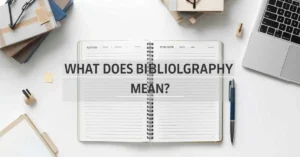
A bibliography means a list of sources used or consulted in a piece of writing, research, or academic work. It usually appears at the end of an essay, report, thesis, dissertation, or school project and includes details like the author, title, publisher, publication date, and sometimes a URL, DOI, or ISBN.
If you have ever written a research paper, essay, assignment, or project, you have probably seen the word bibliography. Many students think it sounds difficult, but the idea is simple. A bibliography is just a clear record of the books, journal articles, websites, reports, newspapers, and other sources used during research.
It helps readers see where the information came from, check the original source, and trust the work more. In academic writing, a bibliography also helps prevent plagiarism and supports proper citation practice.
What Does Bibliography Mean in Simple Words?
In simple words, a bibliography is a list of the sources you used to gather information.
These sources can include:
- books
- websites
- journal articles
- magazines
- newspapers
- reports
- interviews
- videos
- dissertations
- conference papers
The main purpose of a bibliography is to show the reader where your facts, ideas, and background information came from.
Simple definition
A bibliography is a page at the end of writing that lists the sources used or consulted for the topic.
Bibliography meaning in writing
In writing, bibliography means documentation of research. It shows that your work is based on real sources, not guesses. This is why bibliographies are common in academic writing, research papers, school assignments, essays, books, and university projects.
Why Is a Bibliography Important?
A bibliography is not just a formal requirement. It has real value for writers, teachers, students, researchers, and readers.
It gives credit to original authors
When you use information from a book, website, journal, or report, you should acknowledge the source. A bibliography gives credit to the original author, editor, researcher, or publisher.
It helps avoid plagiarism
Plagiarism happens when someone uses another person’s words or ideas without proper credit. A bibliography helps show that the source material has been acknowledged properly.
It makes your work more trustworthy
A paper with a proper bibliography looks more reliable. Readers can see that the information came from published material, academic databases, journals, or trusted websites.
It helps readers find the source again
A good bibliography allows someone to go back to the original book, article, journal, website, or database record and verify the information.
Where Does a Bibliography Go?
A bibliography usually goes at the end of the document.
It is often placed after:
- the main body
- the conclusion
- appendices, in some cases
In most essays, reports, or assignments, the bibliography is one of the last pages. In books and academic texts, it may appear near the end, along with footnotes, endnotes, or an index.
What Information Is Included in a Bibliography?
The exact format depends on the citation style, but most bibliography entries include key publication details.
Common details in a bibliography
A bibliography entry may include:
- author name
- title of the source
- editor name, if relevant
- publisher
- place of publication in some styles
- publication year
- journal title
- volume and issue number
- page range
- URL
- DOI
- access date for online sources
- ISBN for books in some cases
Common types of sources listed
A bibliography may contain:
- books
- e-books
- journal articles
- web pages
- newspaper articles
- encyclopedias
- government reports
- theses and dissertations
- conference proceedings
- videos and documentaries
Bibliography vs References vs Works Cited
These terms are related, but they are not always the same. This is one of the most searched parts of the topic.
Quick comparison table
| Term | Meaning | Common Use |
|---|---|---|
| Bibliography | A list of sources used or consulted | General academic writing, Chicago style |
| References | A list of sources directly cited in the text | APA style |
| Works Cited | A list of sources quoted or cited in the text | MLA style |
Bibliography
A bibliography can be broader. It may include sources you read for background, even if you did not directly quote them.
Reference list
A reference list usually includes only the sources directly cited in the paper. This is common in APA style.
Works Cited
A Works Cited page is most common in MLA format. It lists the works directly cited in the text.
Why the difference matters
Teachers, universities, publishers, and style guides may ask for different things. That is why it is important to follow the correct style guide, such as MLA, APA, or Chicago Manual of Style.
Types of Bibliography
A bibliography is not always the same. There are different forms depending on the assignment or research method.
Standard bibliography
This is the basic list of sources used in a project, essay, or report.
Annotated bibliography
An annotated bibliography includes a short note under each source. The annotation explains what the source is about, whether it is useful, and how it supports the topic.
Example:
Khan, Aisha. Modern Water Management. Oxford University Press, 2022.
This book explains water systems, policy, and urban planning. It is useful for environmental research because it gives current case studies and clear data.
Working bibliography
A working bibliography is a list of sources collected during the research process. It may change as you continue reading and refining your topic.
Enumerative bibliography
This type mainly lists sources in a structured way, often for record-keeping or subject grouping.
How to Write a Bibliography Step by Step
Writing a bibliography becomes much easier when you do it in order.
1. Record each source while researching
Do not wait until the end. As soon as you use a source, save the full details.
For a book, record:
- author
- title
- publisher
- publication year
- edition, if needed
- ISBN, if useful
For a website, record:
- page title
- website name
- author, if available
- date published
- URL
- access date, if required
And for a journal article, record:
- author
- article title
- journal title
- volume
- issue
- year
- page numbers
- DOI
2. Choose the right citation style
The most common styles are:
- MLA for literature and humanities
- APA for education, psychology, and social sciences
- Chicago for history and many research-heavy subjects
Each style has different rules for punctuation, italics, dates, names, and order.
3. Put entries in alphabetical order
Most bibliographies are arranged alphabetically by the author’s last name. If there is no author, the title is usually used instead.
4. Format every entry consistently
Keep the format the same for every source. Consistency matters in academic writing.
5. Check for missing details
Make sure every entry has the needed information. Broken links, missing dates, and incomplete titles reduce quality.
Bibliography Examples
Examples make the meaning much clearer.
Book example
Smith, John. The History of Science. Oxford University Press, 2022.
Website example
Brown, Lisa. “How Volcanoes Form.” National Geographic Education, 15 June 2023, www.example.com.
Journal article example
Ahmed, Sara. “Climate Change and Coastal Cities.” Journal of Urban Studies, vol. 12, no. 3, 2024, pp. 45-60. doi:10.1234/example.
Newspaper article example
Ali, Hamza. “Cities Face Rising Heat Risks.” The Daily News, 3 March 2025, pp. A4-A5.
These are sample models. The exact structure changes based on the style guide.
Bibliography Format in MLA, APA, and Chicago
The word bibliography is often used generally, but formatting rules depend on style.
MLA format
MLA usually uses the label Works Cited.
Example:
Lee, Harper. To Kill a Mockingbird. J. B. Lippincott & Co., 1960.
APA style
APA usually uses the label References.
Example:
Lee, H. (1960). To kill a mockingbird. J. B. Lippincott & Co.
Chicago style
Chicago style often uses Notes and Bibliography.
Example:
Lee, Harper. To Kill a Mockingbird. Philadelphia: J. B. Lippincott & Co., 1960.
Style comparison table
| Style | Common Label | Common Fields |
|---|---|---|
| MLA | Works Cited | Author, title, publisher, year |
| APA | References | Author, year, title, publisher |
| Chicago | Bibliography | Author, title, place, publisher, year |
Bibliography in an Essay, Project, or Research Paper
Searchers often want to know how the term applies in real writing situations.
Bibliography in an essay
In an essay, a bibliography shows where facts, quotes, definitions, and ideas came from.
Bibliography in a school project
In a school project, the bibliography lists all books, websites, encyclopedias, and articles used to prepare the project.
Bibliography in research
In research, the bibliography supports transparency. It helps professors, supervisors, librarians, and other researchers check the source base behind a paper, thesis, or dissertation.
Common Mistakes to Avoid
A bibliography can lose quality because of small errors.
Mixing styles
Do not combine MLA, APA, and Chicago in one bibliography unless told to do so.
Missing source details
An entry without the author, title, publication date, or publisher may be incomplete and less useful.
Using weak or unreliable sources
A bibliography should rely on strong sources where possible, such as journals, books, university material, government publications, and reputable publishers.
Wrong alphabetical order
Most bibliography pages should be alphabetized correctly.
Listing sources not actually used
Only include sources you used, cited, or genuinely consulted for the topic.
Practical Tips for a Better Bibliography
These simple tips help students and writers create a stronger final page.
Keep a source list from day one
This saves time and prevents missing details later.
Use a citation tool carefully
A citation generator can help, but always review the final entry manually.
Check the official style guide
Your school, department, publisher, or journal may have a preferred citation style.
Double-check names and titles
Small errors in the author name, article title, journal title, or year can make a bibliography look careless.
Use quality sources
The better the source quality, the stronger your work looks.
What Should a Good Bibliography Include?
A strong bibliography should be:
- accurate
- complete
- consistent
- easy to read
- properly formatted
- based on credible sources
It should also match the level of the assignment. A short school project may use a few simple sources, while a thesis or dissertation may include books, peer-reviewed journal articles, archives, reports, footnotes, endnotes, and digital sources from research databases.
FAQ Section
What does bibliography mean in simple words?
A bibliography means a list of the books, articles, websites, and other sources used in a paper, project, or piece of research.
Is a bibliography the same as references?
Not always. A bibliography may include sources used or consulted, while references usually include only the sources directly cited in the text.
What does bibliography mean in a project?
In a project, bibliography means the page where you list all the sources used to collect information for that project.
Where do you put a bibliography?
A bibliography is usually placed at the end of an essay, report, assignment, dissertation, or research paper.
What is an annotated bibliography?
An annotated bibliography is a bibliography that includes a short explanation under each source describing what it covers and why it is useful.
What should be included in a bibliography?
A bibliography often includes the author, title, publisher, year, and for digital sources, a URL or DOI when needed.
Why is a bibliography important?
A bibliography is important because it gives credit to sources, helps avoid plagiarism, and makes the writing more trustworthy.
Can websites be included in a bibliography?
Yes. Websites can be included in a bibliography as long as they are relevant and formatted according to the required citation style.
Final Thoughts
So, what does bibliography mean? It means a list of the sources used or consulted in a piece of writing, research, or academic work. It is an important part of essays, school projects, reports, research papers, theses, and dissertations because it gives credit, supports trust, and helps readers find the original material.
A clear bibliography also improves the overall quality of your writing. When it is accurate, consistent, and based on reliable sources, it shows strong research habits and good academic practice. For the best result, track every source early, choose the correct citation style, and review the final page carefully before submitting your work.
Click To Read About: What Does Amore Mean? Italian Meaning, Use, and Examples

Hi, I’m Evan Lexor, the voice behind Meanpedia.com. I break down English words, slang, and phrases into clear, simple meanings that actually make sense. From modern internet terms to everyday expressions, my goal is straightforward: help you understand English better, faster, and with confidence, one word at a time.