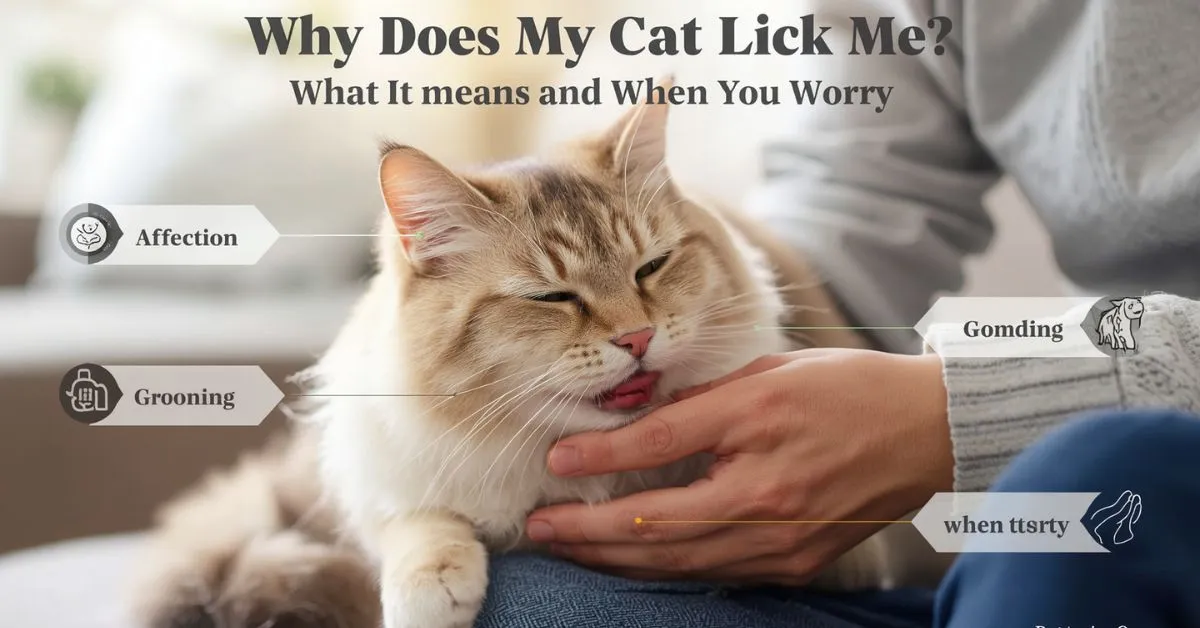
If your cat licks you, it usually means trust, social bonding, grooming behavior, curiosity about your scent, or a bid for attention. In some cats, licking can also be a self-soothing behavior linked to stress.
If the licking becomes sudden, frequent, obsessive, or comes with other changes such as hiding, bald spots, skin irritation, or biting, it is worth checking with your vet.
Most cats are not licking you for just one reason. That is where many articles oversimplify the topic. A few gentle licks while your cat is relaxed on your lap often mean affection or social grooming. Repeated licking during petting can mean your cat is becoming overstimulated.
A sudden increase in licking can point to stress, pain, nausea, or another medical issue. The real meaning depends on context, body language, and change over time.
The most common reasons cats lick people
1. Affection and bonding
One of the most common reasons is simple affection. Cats that feel close to each other often groom one another, a behavior called allogrooming. Veterinary and animal-behavior sources explain that some cats extend this same social grooming behavior to people they trust.
If your cat licks you while purring, leaning into you, slow blinking, or settling beside you, affection is the most likely explanation. In that moment, your cat is not just licking randomly. It is treating you like a safe member of its social group.
2. Grooming you like family
Cats are built to groom. Their tongues are covered with backward-facing papillae made of keratin, which is why their licks feel rough and sandpaper-like. Those papillae help remove dirt and loose fur during grooming. When your cat licks your skin or hair, it may be using a normal grooming behavior on you.
This is one reason hair, eyebrows, and hands are common targets. Hair feels more like fur, and hands carry strong scent and “day-to-day life” smells that your cat recognizes. VCA and Purina both note that shampoos, lotions, perspiration, and food traces can also make these areas especially interesting.
3. Sharing scent and marking you as “safe”
Licking can also help cats reinforce a shared social scent. Blue Cross and Cats Protection explain that cats groom social companions partly to create a familiar group odor, which helps them recognize who belongs in their trusted circle. When your cat licks you, it may be blending your scent with its own social world.
That does not mean your cat sees you as “property” in a dramatic sense. It more likely means you smell like part of home.
4. Attention-seeking
Cats quickly learn which behaviors get a response. VCA notes that when a cat licks and the person talks, pets, laughs, or even pushes the cat away, the cat still receives attention. That can reinforce the habit over time.
This is especially likely if your cat licks you at predictable times, such as before meals, when you are working, or when you stop petting them. In that situation, licking may mean, “Notice me” more than “I love you.”
5. Self-soothing or stress relief
Purina, VCA, PetMD, and Blue Cross all note that licking can sometimes be connected to stress or anxiety. Cats often self-groom to regulate themselves, and in some cases the licking gets redirected toward people, objects, or repetitive routines.
Stress-linked licking is more likely when the behavior becomes frequent, repetitive, or tied to changes in the home, such as visitors, moving furniture, schedule changes, conflict with another pet, or increased noise.
6. Pain, nausea, or another medical issue
PetMD and VCA both warn that excessive or newly increased licking can be associated with medical issues, including pain, discomfort, or nausea. If your cat suddenly starts licking you, itself, or nearby objects much more than usual, do not assume it is only a behavior quirk.
This matters most when the licking is new, persistent, intense, or paired with other changes, such as reduced appetite, hiding, clinginess, aggression, overgrooming, skin irritation, or stiffness.
Is it normal when a cat licks you?
Usually, yes. Occasional licking is normal for many cats, especially during cuddling, quiet bonding, or grooming-like interactions. Purina says there is generally no reason to worry if your cat licks you now and then.
It becomes more concerning when the behavior is excessive, sudden, or clearly tied to distress. Blue Cross specifically flags frequent licking along with bald patches, scabs, or red skin as reasons to speak to a vet.
How to tell what your cat means in the moment
Here is the fastest way to interpret the behavior:
| What you see | Most likely meaning | What to watch next | Best response |
|---|---|---|---|
| A few gentle licks during cuddling | Affection or bonding | Purring, soft eyes, relaxed body | Enjoy it or gently redirect if you prefer |
| Licking your hair or hands | Grooming or scent curiosity | Calm posture, normal mood | Fine if occasional |
| Licking right before food or attention | Attention-seeking | Meowing, following, staring | Reward calm behavior instead of the licking |
| Licking during petting, then tensing up | Overstimulation | Tail flicking, body stiffness, ears flattening | Stop petting and give space |
| Sudden increase in licking | Stress or medical issue | Hiding, clinginess, skin changes, appetite change | Monitor closely and call your vet if it continues |
| Constant repetitive licking | Possible compulsive or medical problem | Bald spots, red skin, raw areas | Vet visit recommended |
This pattern-based approach matches the behavior guidance across VCA, PetMD, Blue Cross, and Purina more closely than the simplistic “licking means love” answer.
What body language should you watch next?
Body language changes the meaning. Blue Cross advises watching for signs that your cat wants to be left alone, including flattened ears, repeated lip licking, and tail swishing or flicking. If you ignore those signals, licking may be followed by scratching or biting.
Pain can also show up in body posture. Blue Cross lists signs such as a lowered head, hunched posture, stiffness, narrowed eyes, flattened ears, and body tension as possible pain cues.
If licking happens alongside those signs, treat it as a possible comfort or distress behavior rather than affection.
Why does my cat lick my hands?
Hands often smell the most like food, other animals, soap, lotion, or everyday activity. VCA specifically notes that leftover food smells, lotions, shampoos, and salts or sugars from perspiration can attract a cat to lick a person’s skin.
If your cat mainly licks your hands after cooking, eating, cleaning, or applying skincare products, scent and taste interest are the most likely reasons.
Why does my cat lick my face?
Face licking is usually another version of grooming or bonding. Some cats lick faces because they are close to the owner’s scent, skin, and hairline during cuddling.
PetMD notes that the reasons are generally the same as for other kinds of human licking: affection, attention, anxiety, or medical discomfort if it becomes excessive.
That said, it is better not to encourage face licking. CDC guidance notes that dog or cat saliva can make people sick if it gets into an open wound or sore, and people with weakened immune systems are at greater risk.
Why does my cat lick my hair?
Hair is one of the most grooming-like parts of the human body. To a cat, it is the closest match to fur.
Shampoo scents and product residue may also make it more interesting. This is why hair licking is often less mysterious than it seems.
Why does my cat lick me and then bite me?
This is one of the most common follow-up questions, and it usually points to overstimulation, playful excitement, or a warning that the interaction should stop.
PetMD says licking can turn to biting when a cat becomes overstimulated, unhappy with the interaction, or in pain. Cats Protection also notes that licking followed by biting often means the cat is overexcited or playful and needs the interaction redirected or paused.
The key is the rest of the body. If your cat is loose and playful, it may be mild play. If the tail is twitching, the body is stiff, or the ears are flattening, the bite is a warning.
Why is my cat suddenly licking me more than usual?
A sudden increase matters more than the licking itself. PetMD, VCA, and Cats Protection all caution that new or excessive licking can be linked to stress, medical problems, or discomfort.
Ask yourself:
- Did anything in the home change recently?
- Is your cat also overgrooming?
- Is there skin redness, hair loss, or sores?
- Has your cat become clingier, more withdrawn, or more irritable?
- Has appetite, mobility, or sleep changed?
If the answer to any of those is yes, a vet visit is the safest next step.
Should you let your cat lick you?
For most healthy adults, a few licks on unbroken skin are not a major problem. Purina says it is usually safe to let your cat lick you occasionally, but advises keeping cats away from broken skin and, if possible, your face.
CDC says germs from dog or cat saliva can cause illness if the saliva gets into an open wound or sore, and the risk is higher for people with weakened immune systems.
So the practical rule is simple:
- occasional licking on intact skin: usually fine
- open cuts, sores, or compromised immunity: avoid it
- repeated face licking: better discouraged
How to gently stop a cat from licking you
Do not punish the behavior. PetMD specifically advises against scolding, squirting water, or using bitter sprays, because punishment can damage your bond and may make an anxious cat more anxious.
Instead:
- calmly move your hand, arm, or face away
- reward your cat when it interacts without licking
- redirect to a toy, food puzzle, or short play session
- provide more enrichment, including rotating toys and vertical spaces like cat trees or perches
- stop petting at the first signs of overstimulation
PetMD also recommends regular interaction and environmental enrichment, including novelty in toys and vertical spaces, when licking has become a repeated habit.
What Most Articles Miss About This Topic
Most articles treat cat licking like a fixed message, as if every lick means love. That is too simple.
The more accurate answer is that licking is a multi-purpose social and self-regulating behavior. It may mean affection, grooming, group-scent sharing, curiosity, attention-seeking, self-soothing, or discomfort. That is why the same cat can lick you for different reasons in different moments.
Another missed point is that sudden change matters most. A cat that has always given a few gentle licks during cuddles is very different from a cat that suddenly starts licking you repeatedly, licking objects, or overgrooming itself. The second pattern deserves more scrutiny.
The last thing many articles skip is the importance of reading the sequence. A lick followed by a bite is often not a contradiction. It is usually a progression: bonding or stimulation first, then overarousal, then a warning. If you learn that sequence, your cat’s behavior becomes much easier to understand.
FAQ
Does a cat licking you mean love?
Often, yes. Licking is commonly tied to affection, trust, and social grooming, but it can also be attention-seeking, scent sharing, or stress-related depending on the context.
Why does my cat only lick me and not other people?
The simplest explanation is that your cat has a stronger bond with you, is more interested in your scent, or has learned that you respond to the behavior. Veterinary and behavior sources support bonding, scent, and reinforcement as common reasons.
Why does my cat lick me while purring?
That combination usually points to comfort, trust, and affiliative behavior, especially if the body is relaxed and the interaction is calm.
Why does my cat lick me during petting?
It may be social grooming, but if it turns into tail flicking, lip licking, flattened ears, or biting, your cat may be getting overstimulated and wants the petting to stop.
When should I call the vet about licking?
Call your vet if the licking is new, excessive, obsessive, or comes with bald spots, red skin, scabs, hiding, clinginess, reduced appetite, stiffness, aggression, or other behavior changes.
Conclusion
If your cat licks you, the most likely meaning is trust, grooming, bonding, or curiosity about your scent. In many cases, it is normal and even affectionate. But the best way to read the behavior is not to ask what licking means in general.
It is to ask when it happens, what body language comes with it, and whether the pattern has changed. That is what separates a sweet cat habit from a signal that your cat may need more space, more enrichment, or a vet visit.
Click Below To Read About:
What Does RPG Mean? Gaming Meaning, Other Uses
What Does Elphaba Mean in Wicked? Name Origin Explained
Mean Platelet Volume (MPV): What It Means on a Blood Test

Hi, I’m Evan Lexor, the voice behind Meanpedia.com. I break down English words, slang, and phrases into clear, simple meanings that actually make sense. From modern internet terms to everyday expressions, my goal is straightforward: help you understand English better, faster, and with confidence, one word at a time.