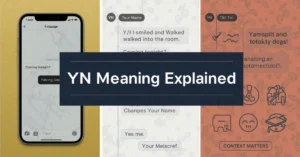
YN usually means “your name,” especially in fanfiction and reader-insert stories. You may also see it written as Y/N. In some contexts, though, Y/N can mean “yes/no,” and on social media, YN can sometimes carry a different slang meaning, so the right answer depends on where you saw it.
If you searched “what is yn mean,” the answer most people want is simple: YN usually means “your name.” That is the common fandom meaning, especially in reader-insert stories where the writer wants the reader to imagine themselves inside the scene.
At the same time, this term is easy to misunderstand because context changes the meaning. In a story, it usually means your name.
In a prompt or question, it may mean yes/no. On some social platforms, YN can also show up as a separate slang term unrelated to fanfiction.
Quick answer by context
The easiest way to understand YN is to look at where it appears. The main meanings documented across the strongest reference and explainer pages are shown below.
| Where you see it | Most likely meaning | Example |
|---|---|---|
| Fanfiction, imagines, reader-insert stories | Your name | “Y/N opened the door and froze.” |
| Forms, prompts, quick replies | Yes/No | “Are you coming? Y/N” |
| Some TikTok or slang-heavy comment sections | A different slang meaning | Meaning depends on the surrounding words and community |
What does YN mean in fanfiction?
In fanfiction, YN or Y/N usually means “your name.” It works as a placeholder that lets the reader mentally insert their own name into the story. That is why it is strongly associated with reader-insert or self-insert fiction.
Fanlore describes Y/N as a fanfiction convention used in reader-focused stories, and Wiktionary lists it as fandom slang for the reader’s name in self-insert fanfiction.
For example, if a story says:
“Y/N walked into the room and everyone went quiet.”
you are meant to read it as:
“Aamir walked into the room and everyone went quiet.”
The letters are not the character’s permanent name. They are simply a stand-in for the reader.
Why writers use Y/N instead of a real name
Writers use Y/N to make a story feel more personal. Instead of reading about a named character, the reader imagines themselves in the scene. That is one reason reader-insert fiction became so popular in fandom spaces such as Wattpad, Tumblr, and similar communities.
CyberDefinitions and Fanlore both connect Y/N with fanfiction and reader-focused storytelling, and CyberDefinitions specifically notes its popularity on apps such as Wattpad and TikTok.
This also explains why people often see Y/N in:
- character x reader stories
- imagines
- POV-style story posts
- fandom scenarios
- social posts designed to feel interactive
What does YN mean in text?
In plain text messages, YN does not always mean the same thing. If the message looks like a story, fantasy scenario, or roleplay post, it probably still means your name. But if it looks like a short question or response prompt, it may mean yes/no instead. CyberDefinitions lists both meanings and treats context as the deciding factor.
Here is the easiest rule:
- Story-style message = probably your name
- Choice or prompt = probably yes/no
- Slang-heavy social post = check the wider context first
That simple distinction will solve most confusion.
Does Y/N mean yes or no?
Yes. Y/N can also stand for yes/no, especially in questions, forms, or quick reply formats. Wiktionary lists yes/no as a computing-style initialism, and CyberDefinitions also includes yes/no as a common meaning.
Examples:
- “Do you want fries? Y/N”
- “Attending the event: Y/N”
In this kind of sentence, Y/N is not personal or fictional. It is simply asking for one of two answers.
YN vs Y/N: is there a difference?
Most of the time, YN and Y/N are treated the same when people are talking about fanfiction. The slash version is more explicit, while the no-slash version is often just easier to type or cleaner to show on mobile.
FamiSafe’s current explainer says both forms mean “your name” in fanfiction contexts, and that the main difference is presentation rather than meaning.
That matters because many users search YN, but the form they originally saw may actually have been Y/N.
What does YN mean on TikTok and social media?
On TikTok, Instagram, and similar platforms, YN often still keeps its “your name” meaning when the post is written like a scenario, POV caption, or reader-insert joke.
CyberDefinitions explicitly notes that “your name” is a common definition across platforms such as Snapchat, WhatsApp, Facebook, Twitter, Instagram, and TikTok.
However, social media also creates extra ambiguity. FamiSafe’s 2026 explainer notes that YN may appear in a separate slang sense on TikTok and other platforms, and that the meaning depends on context. That is why social posts should never be decoded by letters alone.
Example of the fanfiction-style social use
“POV: Y/N finally notices you in the hallway.”
That usually means the post is inviting the viewer to imagine themselves in the scenario.
Example of the prompt-style use
“Movie night tonight? Y/N”
That usually means yes or no.
How to tell what YN means in five seconds
If you want a fast way to decode it, use this:
1. Is it inside a story?
If yes, it most likely means your name.
2. Is someone asking for a choice?
If yes, it probably means yes/no.
3. Is it in a slang-heavy comment section?
If yes, pause and read the surrounding words before deciding. Social slang can shift by platform, group, and tone.
That one habit will help you avoid most mistakes.
YN vs related fandom terms
People who see Y/N often run into other fandom or internet terms at the same time. These are not synonyms, but they appear in similar spaces.
| Term | What it usually means | How it differs from Y/N |
|---|---|---|
| Y/N | Your name | Placeholder for the reader |
| POV | Point of view | Describes the angle of the scene or post |
| OC | Original character | A created character, not the reader |
| Reader-insert | A story style | The reader is placed into the story, often using Y/N |
Fanlore’s reader-insert reference helps explain why Y/N is part of a broader storytelling style rather than just a random slang abbreviation.
Common mistakes people make with YN
Assuming it always means one thing
This is the biggest mistake. YN is common, but it is not fixed to one meaning everywhere.
Thinking Y/N is a real character name
In fanfiction, it is usually just a placeholder for the reader.
Ignoring the slash
A lot of people search YN, but the version in the original content may be Y/N.
Forgetting that platform matters
TikTok comments, Wattpad stories, and text prompts do not always use the term the same way.
FAQ
What does YN mean in fanfiction?
In fanfiction, YN usually means your name. It is a placeholder used in reader-insert stories so the reader can imagine themselves in the scene.
What does Y/N mean in text?
It can mean your name or yes/no, depending on the sentence. Story-style content usually points to your name, while a direct prompt usually points to yes/no.
Is YN the same as Y/N?
Usually yes, especially in fandom spaces. The slash version is just a more explicit written form.
What does YN mean on Wattpad?
On Wattpad, Y/N commonly means your name in reader-insert stories and imagines.
Does YN always mean your name?
No. It often does in fanfiction, but in other contexts it may mean yes/no or something else entirely.
Why do people use Y/N in stories?
They use it to make the story feel more personal and immersive by letting the reader imagine themselves as part of the plot.
Final takeaway
If you only remember one thing, remember this: YN usually means “your name,” especially in fanfiction and reader-insert content. But if the phrase looks like a prompt, Y/N may mean yes/no instead. And on social media, context matters even more. Read the sentence around it, and the right meaning is usually clear.
Click Below To Read About These Posts:
What Does IPO Mean? Initial Public Offering Explained
What Does Paranoidd Mean? Simple Definition, Examples, Use
What Does HTML Mean? Full Form, Example, and Simple Guide

Hi, I’m Evan Lexor, the voice behind Meanpedia.com. I break down English words, slang, and phrases into clear, simple meanings that actually make sense. From modern internet terms to everyday expressions, my goal is straightforward: help you understand English better, faster, and with confidence, one word at a time.