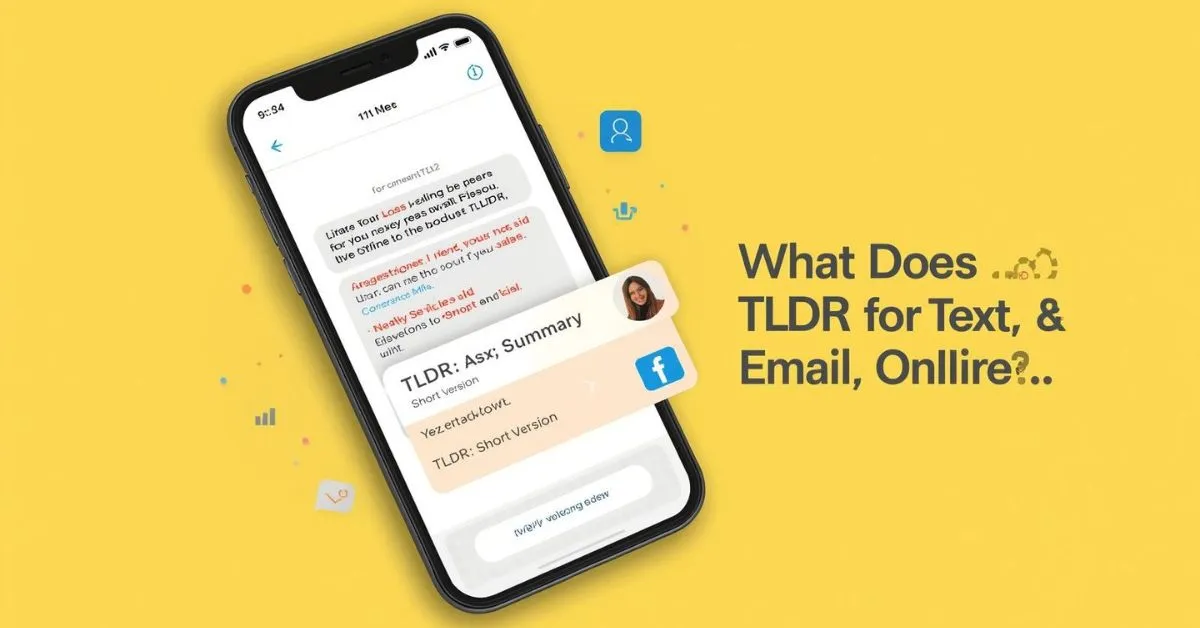
TLDR means “too long; didn’t read.” It is a common internet abbreviation people use in texts, social media, forums, chats, and sometimes email. Today, it also often means “here’s the short version” or “quick summary.”
- Full form: Too long; didn’t read
- Main use: To describe something long or give a short summary
- Tone: Usually informal
- Can it sound rude? Yes, sometimes
- Best use: When sharing a quick summary, not dismissing someone
The direct meaning of TLDR is “too long; didn’t read.” It started as internet shorthand for reacting to long writing. Over time, people also began using TLDR as a label before a short summary.
So today, TLDR has two common meanings:
- Too long; didn’t read
- Here is the short version
That second meaning is now very common in text messages, online posts, Slack messages, and long emails.
What Does TLDR Stand For?
TLDR stands for “too long; didn’t read.”
You may see it written in different ways:
- TLDR
- TL;DR
- tldr
- tl;dr
All of these mean the same thing. Some people use the semicolon, and some do not.
What Does TLDR Mean in Text?
In text messages, TLDR usually means a quick summary.
For example:
- TLDR: I’ll be there at 8 instead of 7.
- TLDR: The trip is still on, but the hotel changed.
- Can you give me the TLDR?
In texting, the tone is often casual and practical. People use it to save time and get to the main point fast.
What Does TLDR Mean on Social Media?
On social media, TLDR can mean either a summary or a reaction to a long post.
You might see:
- TLDR: The update fixed the problem, but battery life is still bad.
- TLDR: She liked the movie, but not the ending.
You may also see someone comment “tldr” under a long post. In that case, it usually means:
- this is too long
- I did not read all of it
- give me the short version
That use can sound dismissive, depending on tone and context.
What Does TLDR Mean in Email?
In email, TLDR usually means “brief summary.” It is often placed near the top or bottom of a long email to help the reader quickly understand the main point.
Example:
TLDR: The launch moved to Friday, and the design team needs final approval by Wednesday.
This can be useful in workplace communication, team updates, project notes, and long internal emails.
But there is one important warning: in formal email, especially with clients, senior leadership, teachers, or new contacts, “summary” or “key takeaway” is often safer than TLDR.
Is TLDR Rude?
TLDR is not always rude, but it can be.
It depends on how you use it.
When TLDR feels helpful
It usually sounds fine when you use it before a summary.
Example:
TLDR: We are still meeting tomorrow, but the time changed to 3 PM.
This use is helpful because it makes long information easier to scan.
When TLDR feels rude
It can sound rude when it is used as a blunt reply.
Example:
tldr
That one-word response may sound like:
- I do not want to read this
- this is too long
- say it faster
- this is not worth my time
So yes, TLDR can be rude if it is used to dismiss what someone wrote.
TLDR Meaning by Context
| Context | What TLDR Usually Means | Tone |
|---|---|---|
| Text message | Quick summary | Casual |
| Social media post | Summary or reaction to long content | Neutral to dismissive |
| Comment section | Too long; didn’t read | Often blunt |
| Slack or team chat | Main point in short form | Efficient |
| Long email | Brief overview | Helpful if informal |
| Formal communication | Often better replaced with “summary” | More professional |
Why TLDR Has Two Meanings
This is where many weak articles stop too early.
At first, TLDR was mostly a reaction. It meant something was so long that the reader skipped it.
Later, people started using it in a smarter way. Instead of only criticizing long content, they began writing “TLDR:” before a short summary. That made the term more useful and less negative.
So now, the same abbreviation can mean:
- I did not read all of this
- Here is the short version
That is why context matters so much.
How to Use TLDR Correctly
The safest way to use TLDR is to make communication easier.
Good uses of TLDR
- before a short summary of a long message
- in casual chats
- in team conversations where informal language is normal
- in long posts where readers need the main point fast
Less safe uses of TLDR
- as a one-word reply to someone’s effort
- in emotional or sensitive conversations
- in formal writing
- with people who may not know the term
Real Examples of TLDR
Here are some realistic examples that show how it works.
Example 1: Text message
TLDR: I can come, but I’ll be about 20 minutes late.
Example 2: Social media post
TLDR: Great camera, solid battery, but the app still needs work.
Example 3: Work chat
TLDR: The client approved the draft, and we only need minor edits.
Example 4: Asking for the short version
I missed the meeting. Can you give me the TLDR?
Example 5: Rude use
tldr
That last one is short, but it often feels cold or dismissive.
When to Use TLDR
Use TLDR when:
- you want to summarize a long explanation
- you are talking in a casual setting
- your readers know online slang
- you want your message to be easier to scan
It works well in:
- text messages
- group chats
- Slack
- comment threads
- social media captions
- long informal emails
When Not to Use TLDR
Avoid TLDR when:
- the message is formal
- the topic is sensitive
- the other person may take it the wrong way
- you are replying to something serious or emotional
- you are writing to a client, teacher, manager, or official contact
In those cases, better options include:
- Summary
- In short
- Main point
- Key takeaway
- Brief overview
TLDR vs Summary
A lot of people think TLDR and summary mean exactly the same thing. They are close, but not identical.
TLDR
- informal
- internet-style
- very short
- often used in chats, posts, and messages
Summary
- more neutral
- works in formal and informal writing
- broader term
- safer in professional settings
So if you want something more polished, use summary. If you want something fast and casual, TLDR often works well.
TLDR vs Other Common Terms
TLDR belongs to a group of internet abbreviations people use in quick communication.
Related terms include:
- FYI = for your information
- TMI = too much information
- ICYMI = in case you missed it
- IMO = in my opinion
- TBH = to be honest
These are related in style, but they do not mean the same thing as TLDR.
Common Mistakes to Avoid
1. Thinking TLDR always means something rude
It does not. In many cases, it simply introduces a useful short summary.
2. Using TLDR in formal writing
It may sound too casual in professional or academic settings.
3. Replying with only “tldr”
That is the version most likely to sound rude.
4. Using it with the wrong audience
Not everyone knows internet abbreviations, especially in formal or mixed-age settings.
5. Overusing it
If every long message starts with TLDR, it can feel repetitive and lazy.
FAQs
What does TLDR mean in simple words?
It means “too long; didn’t read” or “short summary.”
What does TLDR mean in text slang?
In text slang, it usually means a quick version of a longer message.
Is TLDR rude in a text?
It can be rude if you send it as a blunt reply. It is usually fine if you use it to introduce a summary.
Can TLDR be used in emails?
Yes, but mostly in informal emails. In formal emails, words like summary or key takeaway are usually better.
Is TLDR a slang term or abbreviation?
It is both an internet abbreviation and a slang-style term used in casual digital communication.
What is the difference between TLDR and summary?
TLDR is informal and very short. Summary is more neutral and works in formal writing too.
Do you need the semicolon in TL;DR?
No. Both TLDR and TL;DR are commonly used.
How do you pronounce TLDR?
Most people say the letters one by one: T-L-D-R.
Final Thoughts
So, what does TLDR mean? Most directly, it means “too long; didn’t read.” But in modern everyday use, it also commonly means “here’s the short version.”
That is the key point most people need to know.
If you use TLDR to help people understand something faster, it usually works well. If you use it to brush off someone’s message, it can sound rude. The meaning stays the same, but the tone changes with context.
Click Here To Read About: What Does Rabe Mean?

Hi, I’m Evan Lexor, the voice behind Meanpedia.com. I break down English words, slang, and phrases into clear, simple meanings that actually make sense. From modern internet terms to everyday expressions, my goal is straightforward: help you understand English better, faster, and with confidence, one word at a time.