Refraction means the bending of light or another wave when it moves from one medium to another and changes speed. In everyday life, that is why a straw looks bent in water, why lenses can focus light, and why eye doctors use the word refraction when checking your glasses or contact lens prescription.
If you searched this term, you probably want a plain-English answer first, not a long textbook explanation. The simple idea is that light travels differently through air, water, glass, plastic, and the structures inside the eye.
When the speed changes, the path changes too. That one idea explains a lot: magnifying glasses, camera lenses, rainbows, mirages, and even the “Which is better, 1 or 2?” part of an eye exam.
Refraction in simple words
In simple words, refraction is light bending because it enters a different material.
You can remember it like this:
New material → new speed → new direction
That is the core meaning. If light goes from air into water or from air into glass, it does not keep moving in exactly the same way. Its speed changes, so its direction changes too. That change in direction is called refraction.
What does refraction mean in physics?
In physics, refraction is the change in direction of a wave as it passes from one medium into another because its speed changes. This idea applies most often to light, but it can also apply to other waves, including sound waves in some situations.
A medium is simply the material a wave moves through. For light, common examples include:
- air
- water
- glass
- plastic
- the cornea and lens of the eye
Physicists also use the term refractive index, which describes how strongly a material bends light. Britannica explains it as a measure tied to how light travels more slowly in a substance than in a vacuum. In short, the higher the refractive effect of a material, the more strongly light can bend when entering it.
How refraction works step by step
You do not need heavy math to understand refraction, but a few simple terms help.
When a ray of light reaches a new surface, it is called the incident ray. Scientists measure its approach using the angle of incidence, which is the angle between the incoming ray and an imaginary line called the normal.
The normal is just a line drawn perpendicular to the surface. After the light enters the new medium, the new path is described by the angle of refraction.
A useful rule is this:
- when light moves into a denser optical medium, it bends toward the normal
- when it moves into a less dense optical medium, it bends away from the normal
That is why water, glass, and lenses can redirect light in predictable ways. This same principle also supports tools and concepts such as prisms, optical lenses, and Snell’s law, even if most readers never need the formula itself.
Everyday examples of refraction
One reason this topic ranks so often is that people see refraction without realizing it.
A straw in water
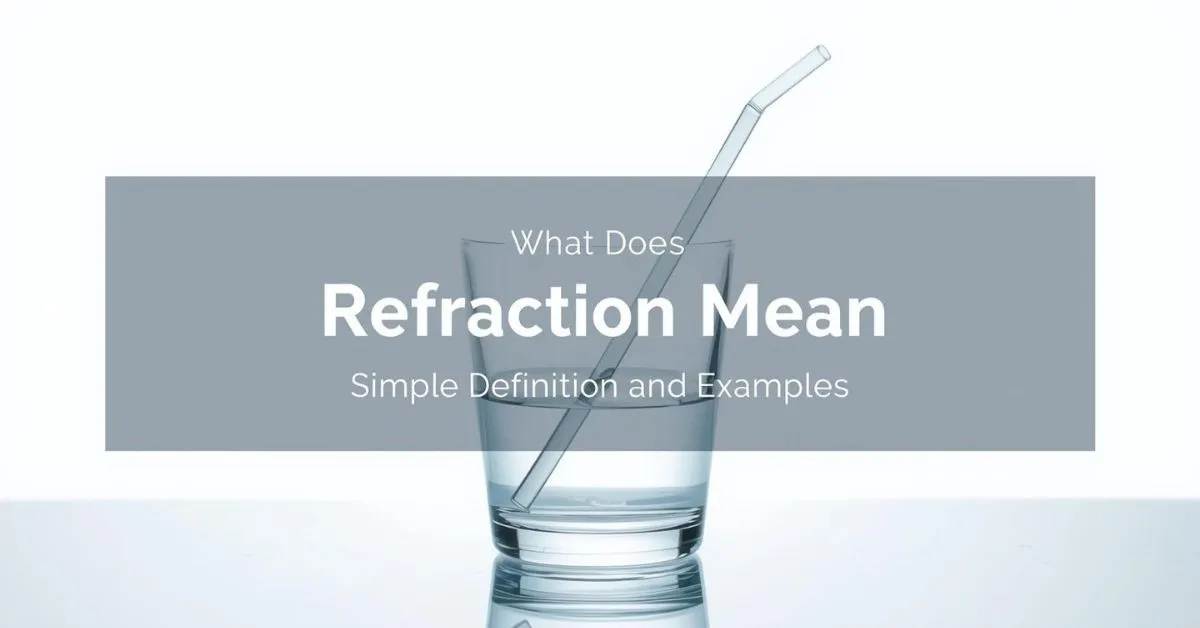
This is the classic example. A straw in a glass looks bent where it enters the water. The straw is still straight. What changes is the path of the light traveling from the underwater part to your eyes.
Lenses in glasses, cameras, and magnifiers
A lens works by refracting light. Eyeglasses and contact lenses help focus light more accurately on the retina. Camera lenses direct light onto an image sensor. Magnifying glasses enlarge objects by controlling how light bends through curved glass or plastic.
Rainbows
A rainbow is not caused by refraction alone, but refraction is a major part of it. Light enters a water droplet, bends, reflects inside the droplet, and bends again as it exits. That process helps separate colors and create the familiar rainbow arc.
Mirages
Mirages happen when light bends through layers of air with different temperatures and densities. That can make the road ahead look wet or make distant objects appear shifted. In other words, a mirage is not imagination. It is an optical effect caused by refraction in the atmosphere.
What does refraction mean in an eye exam?
In eye care, refraction means an eye test used to measure the prescription for eyeglasses or contact lenses. That is why the word appears on clinic forms, vision reports, and exam summaries. MedlinePlus describes a refraction as an eye exam that measures a person’s prescription, and it notes that people needing glasses or contacts often have this test as part of a broader eye exam.
This meaning is not separate from the science meaning. It comes from the same principle. The cornea and lens of the eye bend, or refract, incoming light so it can focus on the retina. If light does not focus correctly, vision becomes blurry. MedlinePlus explains that refractive errors happen when the shape of the eye prevents light from focusing correctly on the retina.
During the test, the eye doctor changes lens strengths to find which option gives the clearest vision. That is the familiar “Which is clearer, 1 or 2?” part of an exam. The goal is to determine the lens power needed to improve focus.
Common refractive errors linked to eye refraction
The eye-exam meaning becomes much easier to understand once you know what doctors are checking for.
Myopia means nearsightedness. Distant objects look blurry because light focuses in the wrong place relative to the retina. Hyperopia means farsightedness. Near vision may be harder, and MedlinePlus notes that presbyopia, which often comes with age, is related but not the same thing as hyperopia.
Astigmatism happens when the eye does not focus light evenly. Presbyopia affects near focusing as people get older. All of these fall under the broader category of refractive errors.
So, when an optometrist talks about refraction, they usually mean measuring how your eye focuses light and what prescription will correct the blur.
Refraction vs reflection, dispersion, and diffraction
These terms are often confused, so a quick comparison helps.
| Term | What it means | Simple example |
|---|---|---|
| Refraction | Light bends as it enters a different medium | A straw looks bent in water |
| Reflection | Light bounces off a surface | Seeing yourself in a mirror |
| Dispersion | Different wavelengths separate as they refract by different amounts | White light splitting into colors through a prism |
| Diffraction | Waves spread around edges or through openings | Light spreading after a narrow slit |
Refraction and reflection are the two people mix up most often. Reflection is about bouncing. Refraction is about bending through a new material.
Dispersion is related to refraction, because different colors can bend by different amounts. Diffraction is different again, because it involves spreading around edges or openings rather than entering a new medium and changing speed.
Atmospheric refraction and other important uses
Refraction does not only happen in water, glass, or the eye. It also happens in the atmosphere. Britannica defines atmospheric refraction as a change in the direction of electromagnetic radiation or sound as it travels through the atmosphere because of changes in air density.
This is one reason the apparent position of an object can look slightly shifted and why some atmospheric optical effects are possible.
This broader idea helps explain why refraction matters in:
- astronomy and sky observation
- weather-related optical effects
- photography and lenses
- microscopes and telescopes
- clinical eye care and vision correction
That wider usefulness is part of why the term appears in both science education and medical contexts.
When people use the word refraction
People usually use the word refraction in one of two ways.
The first is the standard science meaning: the bending of light or another wave between mediums. The second is the eye-care meaning: the part of an eye exam that helps determine a prescription.
So if someone says, “We studied refraction in physics,” they mean the optical principle. If someone says, “I had a refraction at the eye doctor,” they mean the prescription-measuring test. Both uses are correct, and both come from the same underlying idea of how light bends.
Common mistakes to avoid
A common mistake is using refraction when you really mean reflection. If light bounces off a mirror, that is reflection. If light bends going through water or glass, that is refraction.
Another mistake is thinking refraction only applies to light in water. In fact, the principle applies more broadly to waves, and it can happen in glass, plastic, the atmosphere, and the structures of the eye.
A third mistake is treating the eye-test meaning as unrelated to physics. It is directly connected. The whole point of a refraction test is to measure how the eye bends light and how lenses can improve the focus on the retina.
FAQ
What does refraction mean in one sentence?
Refraction means the bending of light or another wave when it passes into a different medium and changes speed.
What does refraction mean in simple words?
In simple words, it means light bends when it goes from one material to another, such as from air into water or glass.
Why does a straw look bent in water?
It looks bent because light from the part under water changes direction as it moves from water into air before reaching your eyes.
What does refraction mean in an eye test?
It means a vision test that measures your eyeglass or contact lens prescription by checking how your eyes focus light.
Is refraction the same as refractive error?
No. Refraction is the bending of light or the eye test that measures vision. A refractive error is a vision problem that happens when the eye does not focus light correctly on the retina.
Is refraction the same as reflection?
No. Reflection is light bouncing off a surface, while refraction is light bending as it enters a different medium.
Does refraction only happen with light?
No. In physics, refraction can apply to other waves too, including sound in some conditions.
What is atmospheric refraction?
Atmospheric refraction is the bending of electromagnetic radiation or sound as it travels through layers of air with different densities.
Final takeaway
Refraction means light or another wave bends when it enters a different medium and changes speed. That is the main meaning. In eye care, refraction also means the test that measures how your eyes focus light so a doctor can determine the right prescription for glasses or contacts.
Once you understand that one idea, the term becomes much easier to recognize in science, photography, weather effects, prisms, rainbows, and eye exams. It is a technical word, but the core meaning is simple: light changes direction because the material changes the way it travels.
Click Here To Read About This Post: What Does PMO Mean in Roblox Chat?

Hi, I’m Evan Lexor, the voice behind Meanpedia.com. I break down English words, slang, and phrases into clear, simple meanings that actually make sense. From modern internet terms to everyday expressions, my goal is straightforward: help you understand English better, faster, and with confidence, one word at a time.