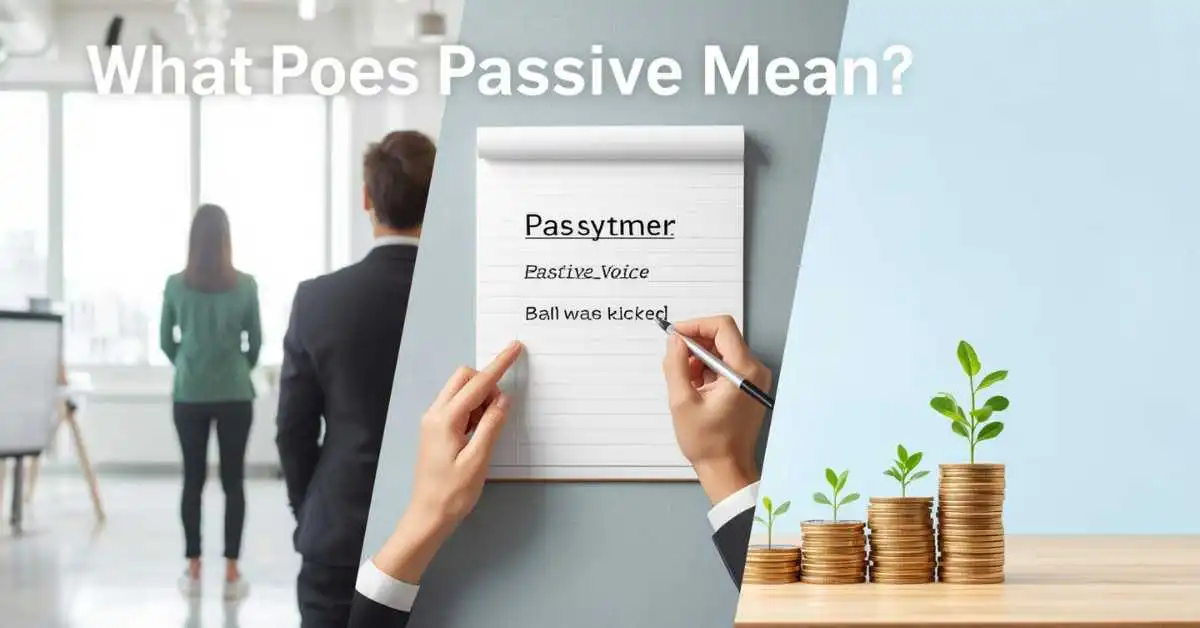
Passive means not taking direct action, not showing strong resistance, or receiving action instead of doing it. In everyday English, a passive person often lets things happen. In grammar, the subject receives the action. And in finance, passive usually means low ongoing effort, such as passive income or passive investing.
The word passive is common, but its meaning changes with context. People use it to describe behavior, communication style, sentence structure, investing, and even technical subjects like chemistry and electronics.
The core idea stays the same: something passive usually does not lead, push, or act directly. Instead, it receives, allows, or responds. That is why this keyword needs more than a one-line definition. A strong article must explain the main meaning first, then show how the word works in real life, grammar, and finance.
Passive meaning at a glance
| Item | Meaning |
|---|---|
| Pronunciation | /ˈpæsɪv/ |
| Part of speech | Adjective; also a noun in grammar as the passive |
| Core meaning | Not acting directly, or being acted upon |
| Opposite | Active |
| Common related words | passively, passivity, passiveness |
| Common contexts | behavior, communication, grammar, passive income, passive investing |
| Word origin | From Latin passīvus, linked to “to undergo” or “to suffer” |
Britannica gives the pronunciation /ˈpæsɪv/ and defines passive as allowing things to happen or accepting what others do without trying to change it. Cambridge also uses passive for grammar and everyday behavior, and Collins lists the related forms passively, passivity, and passiveness. Oxford and Collins trace the word back to Latin passīvus, from a root meaning to undergo.
What does passive mean in everyday English?
In everyday English, passive usually describes a person, attitude, role, or response that is not active, forceful, or leading. A passive person often waits, accepts, or follows instead of directing what happens.
That does not always mean weak, but it often suggests low initiative, little resistance, or a quiet, non-dominant role. Merriam-Webster includes meanings such as being acted upon by an outside force, being receptive to outside influence, or tending not to take an active or dominant part.
Passive meaning in a person
If someone asks, what does passive mean in a person, the usual answer is simple: it describes someone who lets things happen rather than trying to control or change them. Britannica says a passive person accepts what others do or decide without trying to change it. Collins gives a similar meaning and uses examples like a passive attitude.
Examples:
- He stayed passive during the argument and said very little.
- She took a passive role in the project and let others decide.
- His passive attitude made it hard for him to set boundaries.
In this sense, close synonyms can include inactive, submissive, receptive, or inert, depending on context. Merriam-Webster’s thesaurus notes that passive often suggests immobility or a lack of expected response, and Collins lists synonyms such as submissive, resigned, compliant, and receptive.
Passive meaning in communication
In communication, passive means not clearly saying what you think, want, need, or feel. The University of Toledo describes passive communication as a style where a person avoids expressing opinions, needs, or values and often puts other people’s priorities first.
A passive communicator may:
- say “it’s fine” when it is not fine
- avoid disagreement to keep the peace
- struggle to say no
- expect other people to guess how they feel
This is why people also search what does passive mean in a relationship. In relationships, passive behavior can lead to silence, unclear boundaries, frustration, and resentment because one person is not expressing their real needs directly.
Passive vs assertive vs aggressive vs passive-aggressive
Many users do not only want the definition of passive. They want to know how it compares with similar communication styles.
| Style | Main pattern | Example |
|---|---|---|
| Passive | Hides needs to avoid conflict | “Whatever you want is okay.” |
| Assertive | Speaks clearly and respectfully | “I understand, but this does not work for me.” |
| Aggressive | Pushes own needs over others | “We are doing it my way.” |
| Passive-aggressive | Shows anger indirectly | “I’m fine,” followed by sarcasm or cold behavior |
This distinction matters because passive and passive-aggressive are not the same. Passive avoids direct expression.
Passive-aggressive still avoids direct expression, but it shows resentment indirectly through tone, delay, sarcasm, or mixed signals.
What does passive mean in grammar?
In grammar, passive usually means passive voice. Cambridge explains that the passive form is used when the grammatical subject is the person or thing that experiences the effect of an action rather than the person or thing that causes it.
Purdue OWL explains it similarly: in passive voice, the subject is acted upon and receives the action expressed by the verb.
How passive voice works
The most common structure is:
form of “be” + past participle
Example:
- Active: The dog chased the cat.
- Passive: The cat was chased by the dog.
Cambridge and Collins both show this pattern, and Collins notes that passive verbs are formed with a form of be plus the past participle of the main verb.
Active vs passive voice examples
| Active voice | Passive voice |
|---|---|
| The chef cooked the meal. | The meal was cooked by the chef. |
| Someone broke the window. | The window was broken. |
| The team finished the report. | The report was finished by the team. |
If you search what does passive mean in grammar, this is the key idea: in active voice, the subject does the action; in passive voice, the subject receives the action.
Is passive voice bad?
No. Passive voice is not always wrong. Purdue OWL explains that writers choose passive voice when the doer is unknown, obvious, unimportant, or when the writer wants to focus on the result instead of the actor. The problem is not passive voice itself. The problem is overusing it and making writing wordy or unclear.
Good use of passive:
- The window was broken during the storm.
Bad overuse: - It was decided that a review would be conducted by the team.
So the best rule is simple: use passive voice on purpose, not by accident.
What does passive mean in finance?
In finance, passive usually means low ongoing involvement. The two most common phrases are passive income and passive investing.
Passive income meaning
Investopedia defines passive income as money earned with relatively minimal effort or ongoing active participation. It also notes that tax rules can treat passive income differently and that ideas like material participation may matter in tax contexts.
Examples of passive income often include:
- rental income
- dividend income
- royalties
- digital products that continue to sell
- interest from some investments
Still, “passive” does not mean “zero work.” Many passive income streams need time, money, setup, or maintenance before they become low-effort.
Passive investing meaning
Passive investing is an investment strategy focused on long-term returns while minimizing trading, market timing, and management costs. Investopedia explains that it is often done through index funds or ETFs and is built around a buy-and-hold approach rather than active stock picking.
So if someone asks, what does passive mean in investing, the simplest answer is: it means investing in a way that requires less ongoing decision-making and less active management.
Other meanings of passive
A stronger article on this keyword should also cover the technical senses, because major dictionary entries do.
Passive in chemistry
Dictionary.com notes that in chemistry, passive can mean inactive under conditions where something might normally react. Vocabulary.com also points out that in chemistry a passive substance does not react.
Passive in electronics and engineering
Collins includes an electronics meaning where passive describes something that contains no source of power and cannot amplify a signal, such as a passive network or a passive communications satellite.
Passive as a noun
In grammar, the passive can also be a noun. Cambridge’s learner dictionaries use the passive to mean the passive form of a verb.
Word origin, forms, and related terms
The word passive entered English in the late Middle English period and comes from Latin passīvus, through French, with a root idea connected to undergoing or suffering rather than acting.
Common derived forms include passively as an adverb and passivity or passiveness as nouns. Related terms include passive voice, passive role, passive attitude, passive resistance, passive income, and passive investing.
Common mistakes people make with the word passive
1. Thinking passive always means weak
Not always. In some contexts, it means calm, non-active, or receiving action. In others, it may suggest low initiative or submissiveness. Context decides the tone.
2. Confusing passive with passive-aggressive
Passive avoids direct expression. Passive-aggressive hides anger behind indirect behavior. They overlap, but they are not identical.
3. Thinking passive voice is always bad writing
It is not. Passive voice is useful when the focus should be on the result or when the actor is unknown or unimportant.
4. Assuming passive income means effortless money
Most passive income sources need setup, assets, skill, or ongoing maintenance. “Passive” usually means less active work over time, not no work at all.
Practical takeaway
If you want one easy way to remember the meaning, use this:
- In daily life, passive means not taking the lead.
- In communication, passive means not expressing needs directly.
- In grammar, passive means the subject receives the action.
- In finance, passive means low ongoing effort or management.
That simple framework covers the dominant meanings behind most searches for what does passive mean.
FAQ
What does passive mean in simple words?
Passive means not taking direct action, or being affected by action instead of causing it.
What does passive mean in a person?
It usually means a person lets things happen, avoids taking charge, or does not push back strongly.
What does passive mean in communication?
It means avoiding direct expression of needs, feelings, opinions, or boundaries.
What does passive mean in a relationship?
It usually means one partner avoids speaking up, setting boundaries, or sharing needs clearly.
What does passive mean in grammar?
It means the grammatical subject receives the action, as in “The ball was kicked.”
What is the opposite of passive?
The usual opposite is active. In communication, assertive is also an important contrast.
What does passive-aggressive mean?
It means expressing anger or resistance indirectly rather than openly.
What does passive mean in finance?
It usually means income or investing that requires less day-to-day effort or management.
Conclusion
So, what does passive mean? In the broadest sense, it means not acting directly, not resisting strongly, or being acted upon instead of doing the action. The exact meaning changes by context, but the core idea stays the same. In a person, it often means quiet or non-assertive.
In grammar, it means the subject receives the action. And in finance, it points to income or investing with less ongoing involvement.
Read Also About: What Does a Red Porch Light Mean? Heart Month, Firefighters & More

Hi, I’m Evan Lexor, the voice behind Meanpedia.com. I break down English words, slang, and phrases into clear, simple meanings that actually make sense. From modern internet terms to everyday expressions, my goal is straightforward: help you understand English better, faster, and with confidence, one word at a time.