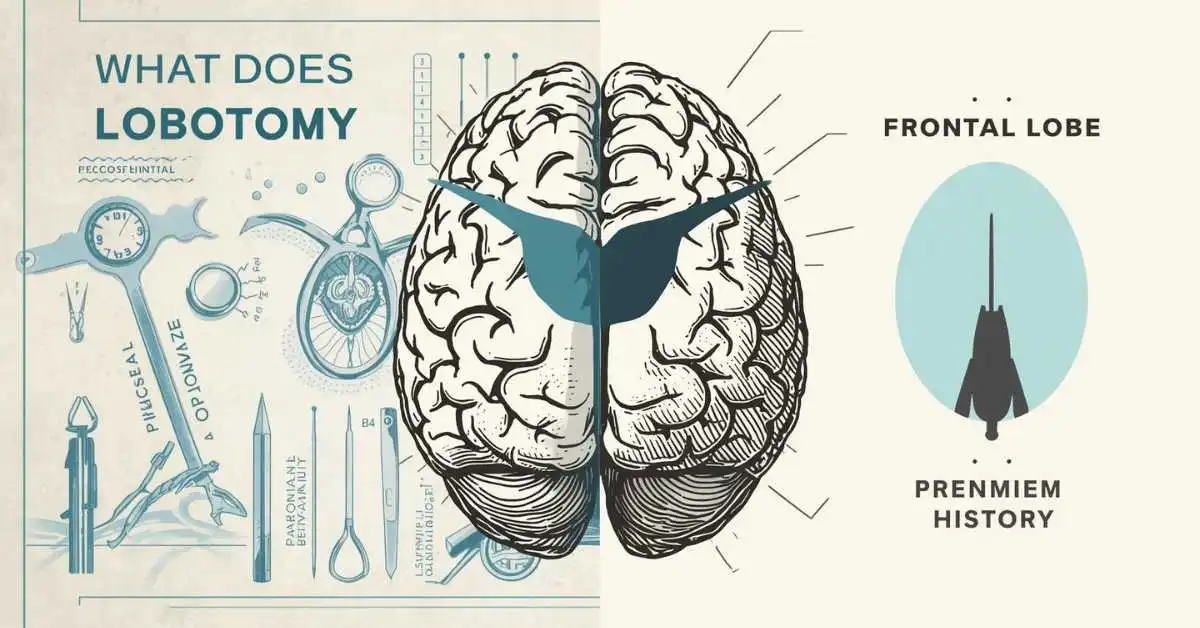
Lobotomy means a historical type of brain surgery in which nerve connections in the frontal part of the brain were cut or damaged, mainly to treat severe mental illness. It is also called leucotomy or leukotomy.
Today, the procedure is largely abandoned because it caused major side effects and serious ethical concerns.
If you searched what does lobotomy mean, you probably want a quick, clear answer first. After that, most readers want to know what a lobotomy actually was, why it was used, how it worked, and why the word still appears in history, medicine, and everyday speech.
This guide explains the term in simple English while naturally covering the important entities around the topic, including psychosurgery, prefrontal lobotomy, transorbital lobotomy, António Egas Moniz, Walter Freeman, and modern alternatives such as cingulotomy, capsulotomy, and deep brain stimulation.
Quick facts about lobotomy
| Term | Quick meaning |
|---|---|
| Lobotomy | Old brain surgery used in psychiatry |
| Leucotomy / Leukotomy | Another name for lobotomy |
| Prefrontal lobotomy | A lobotomy targeting the prefrontal region |
| Frontal lobotomy | Another common historical name |
| Transorbital lobotomy | A later method done through the eye socket area |
| Lobotomize / lobotomized | Can mean the literal surgery, or figuratively to dull someone mentally or emotionally |
| Lobectomy | A different surgery that removes a lobe from an organ |
The meanings above reflect dictionary and medical-reference usage and help readers quickly separate the main term from related terms that are often confused.
What does lobotomy mean in simple terms?
In simple terms, a lobotomy was a medical operation that cut brain connections, especially in the frontal lobes or prefrontal cortex, to change behavior or reduce severe psychiatric symptoms.
Historical references describe it as a radical treatment once used for serious mental disorders when far fewer effective treatments existed.
Pronunciation and basic definition
In Cambridge Dictionary, lobotomy is pronounced UK /ləˈbɒt.ə.mi/ and US /ləˈbɑː.t̬ə.mi/. The dictionary defines it as a medical operation in or near the front part of the brain that was used in the past for severe mental problems.
What does the word literally mean?
The word combines lobe, meaning a rounded part of an organ, with -tomy, a suffix used for cutting or incision.
That literal word structure helps explain why the term sounds clinical and surgical. In practice, the historical procedure focused on disrupting nerve pathways connected with the frontal areas of the brain.
Is lobotomy the same as leucotomy?
Yes. Leucotomy or leukotomy is another name for lobotomy, especially in older British and medical usage. Many historical sources refer to prefrontal leucotomy, while modern readers are usually more familiar with the word lobotomy.
What was a lobotomy in medicine?
In medicine, lobotomy was a form of psychosurgery, meaning brain surgery used to treat psychiatric illness. The procedure aimed to sever white matter pathways between the frontal lobes and deeper brain structures, including the thalamus, in the belief that this would reduce severe symptoms such as agitation, distress, or disordered thinking.
Which conditions was it used for?
Historical sources show that lobotomy was used for serious psychiatric conditions such as schizophrenia, severe depression, and other severe mental disorders, and it was promoted during a period when mental hospitals were crowded and treatment choices were limited.
Britannica also notes its use as a radical measure for illnesses including schizophrenia and bipolar disorder.
Why did doctors think it might help?
Doctors at the time believed certain mental symptoms came from abnormal brain circuits. By cutting those circuits, they hoped patients would become calmer or more manageable. Some patients did become less distressed or less agitated, but many also lost spontaneity, initiative, emotional range, or independent function.
That gap between symptom control and real well-being became one of the biggest reasons the procedure is judged so harshly today.
History of lobotomy: who created it and how it spread
The modern history of lobotomy begins with Portuguese neurologist António Egas Moniz, who introduced prefrontal leucotomy in the mid-1930s with the help of surgeon Pedro Almeida Lima.
Britannica notes that Moniz, unable to perform the surgery himself because of gout, enlisted Almeida Lima to help carry out the procedure.
António Egas Moniz and Almeida Lima
Moniz is often called a founder of modern psychosurgery. Britannica and Nobel sources say he introduced prefrontal leucotomy, later known as lobotomy, as a radical therapy for certain psychoses.
He later shared the 1949 Nobel Prize in Physiology or Medicine for work connected with the development of prefrontal leucotomy.
Walter Freeman and James W. Watts
In the United States, Walter Freeman and neurosurgeon James W. Watts helped spread the operation.
Freeman later became especially associated with the transorbital lobotomy, a faster and cheaper version that became one of the most infamous symbols of twentieth-century psychiatry.
Transorbital lobotomy
Britannica describes the transorbital lobotomy as a method in which a picklike instrument was passed through the back of the eye socket area to reach the frontal lobe and sever connections there.
This method made the procedure easier to perform, but it also made public concern about the operation even stronger.
How did a lobotomy work?
Early lobotomies involved drilling openings in the skull and then cutting or destroying tissue in the prefrontal cortex or nearby white matter pathways.
Britannica notes that Moniz’s early procedure involved drilling holes and injecting alcohol into the prefrontal region, while later techniques used instruments designed to separate white matter fibres.
Brain areas involved
The main brain areas linked with lobotomy were the frontal lobes, especially the prefrontal lobe or prefrontal cortex, plus the pathways connecting those areas to deeper structures such as the thalamus.
This is why dictionary-style medical definitions often describe lobotomy as severing nerve fibres that connect the frontal lobes to the thalamus.
What doctors hoped would happen
The hoped-for result was not a cure in the modern sense. Instead, doctors often aimed for reduced agitation, reduced psychosis, and more manageable behavior.
That older standard of “success” is one reason the procedure is now viewed with strong ethical concern, because calmer behavior did not always mean better life quality or true recovery.
Why is lobotomy controversial?
Lobotomy is controversial because it often caused lasting harm. Historical and modern reviews connect it with serious personality changes, emotional blunting, cognitive decline, seizures, and loss of independence.
Even supporters eventually had to confront the fact that many patients paid a severe price for any reduction in symptoms.
Medical ethics and informed consent
The topic is also central to medical ethics. Recent reviews highlight concerns about weak evidence, poor follow-up, vulnerable patients, and inadequate informed consent by modern standards.
The history of lobotomy is now often taught as a warning about what can happen when urgency, institutional pressure, and limited science shape treatment decisions.
Why did lobotomy decline?
Lobotomy declined sharply in the 1950s as psychiatry changed. A key reason was the arrival of antipsychotic drugs, especially chlorpromazine, alongside growing criticism of the procedure’s harms and stronger ethical standards in medicine.
Recent NIH and Britannica-linked sources both point to better drug treatment and growing awareness of severe side effects as major reasons the procedure fell out of favor.
What replaced lobotomy?
Lobotomy was not replaced by one single treatment. Instead, psychiatry moved toward medication, psychotherapy, electroconvulsive therapy in selected cases, and far more targeted forms of neurosurgery.
Reviews of modern psychosurgery describe procedures such as cingulotomy, capsulotomy, subcaudate tractotomy, and limbic leucotomy for carefully selected treatment-refractory cases, along with newer neuromodulation approaches such as deep brain stimulation.
Modern psychosurgery is not the same as lobotomy
That difference matters. Modern psychiatric neurosurgery uses stereotactic and image-guided techniques to target specific circuits with far more precision.
Sources discussing current practice note the use of precise lesioning procedures and reversible neuromodulation like deep brain stimulation, especially for severe, treatment-resistant conditions such as obsessive-compulsive disorder and major depression in carefully selected patients.
Lobotomy meaning in slang and modern speech
Today, the word does not always refer to literal surgery. Merriam-Webster defines lobotomize both as performing a lobotomy and, figuratively, as depriving someone of sensitivity, intelligence, or vitality.
That is why modern readers may see phrases like “the rewrite felt lobotomized” or “the show lobotomized the character,” where the term means emotionally flattened, mentally dulled, or stripped of spark.
What does lobotomized mean?
Lobotomized can mean a person literally underwent a lobotomy, but in casual speech it more often suggests someone seems mentally dulled, emotionally blank, or drained of personality.
Because the word comes from a painful medical history, it carries more weight than many casual slang terms.
Lobotomy vs lobectomy: a common confusion
A lobotomy is not the same as a lobectomy. A lobotomy historically meant cutting brain connections for psychiatric reasons.
A lobectomy means removing a lobe from an organ, especially a lung, and it is still a modern surgical term. Mixing these words weakens accuracy and can confuse readers and search engines alike.
Common mistakes to avoid when explaining lobotomy
One common mistake is saying lobotomy is a normal treatment still used in the same way today. It is not. Another mistake is treating lobotomy, leucotomy, and lobectomy as the same word.
A third mistake is describing the procedure only as a “success” because some patients became calmer, without mentioning the serious side effects and ethical problems that later defined its reputation.
FAQ
Is lobotomy the same as leucotomy?
Yes. Leucotomy or leukotomy is another historical name for lobotomy, especially in older medical usage.
What part of the brain did a lobotomy affect?
It mainly affected the frontal lobes, especially the prefrontal cortex, and the pathways connecting those areas to deeper structures such as the thalamus.
Who invented the lobotomy?
The procedure is generally traced to António Egas Moniz, who introduced prefrontal leucotomy with help from Pedro Almeida Lima in the 1930s.
Why were lobotomies done?
They were done because doctors hoped cutting certain brain circuits would reduce severe psychiatric symptoms at a time when effective treatments were limited.
Are lobotomies still done today?
Classic lobotomies are largely abandoned. Modern psychiatric neurosurgery, when used at all, is much more targeted and carefully controlled than the old procedure.
What does lobotomize mean in modern English?
It can mean performing a literal lobotomy, but it is also used figuratively to mean dulling someone’s emotional or mental vitality.
What is the difference between transorbital lobotomy and prefrontal lobotomy?
Prefrontal lobotomy is the broader historical procedure aimed at the frontal region of the brain. Transorbital lobotomy was a later technique that approached the frontal lobe through the eye socket area.
Did lobotomy disappear because of new medicine?
New psychiatric drugs, especially chlorpromazine, were a major reason, but the decline also came from public criticism, ethical concern, and recognition of serious long-term harm.
Practical takeaway
So, what does lobotomy mean? It means a now-discredited form of psychosurgery that cut brain pathways in the frontal region to treat severe mental illness. It is strongly linked with António Egas Moniz, Almeida Lima, Walter Freeman, the prefrontal cortex, frontal lobes, and the history of psychiatric medicine.
Today, the word survives mainly in medical history and in figurative language such as lobotomize or lobotomized, while modern psychiatry relies on safer and far more precise treatments.
Read Also This Post: What Does Hashtag Mean? Examples and Uses

Hello! I’m Clara Lexis, creator of Meanpedia.com. I specialize in breaking down words, phrases, and idioms so that anyone can understand and enjoy the beauty of English. My goal? Making language approachable, fun, and meaningful, one word at a time.