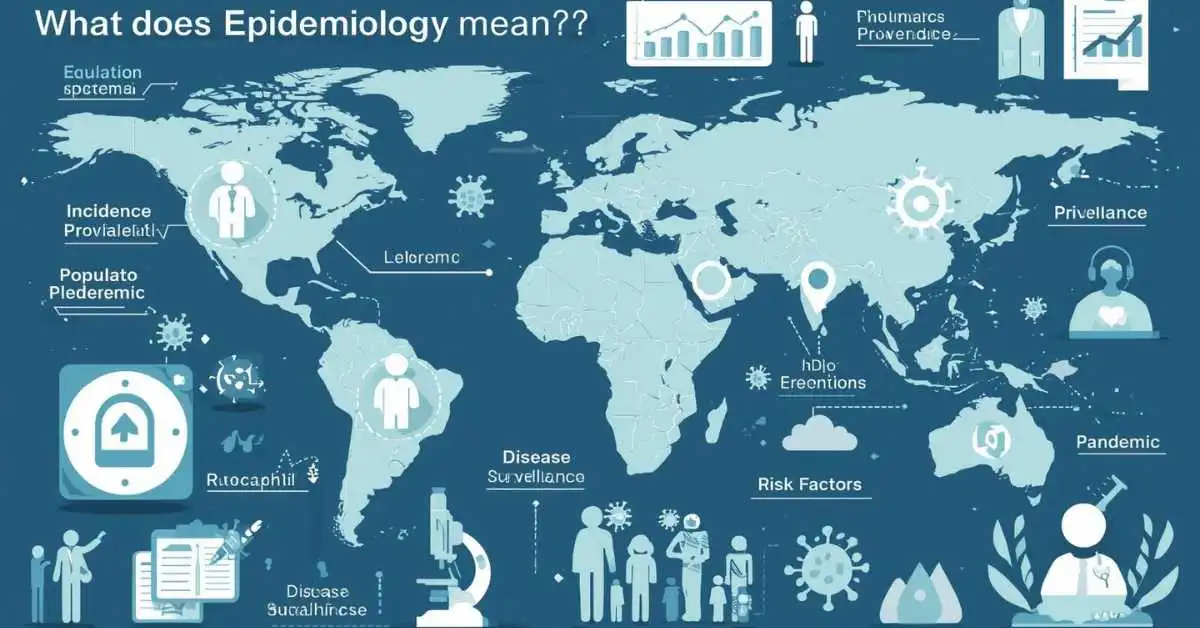
Epidemiology means the study of how disease and other health problems affect groups of people. It looks at patterns, causes, risk factors, and ways to prevent or control illness in a population.
In simple words, epidemiology helps public health experts understand who gets sick, where, when, why, and what can be done about it.
Epidemiology is often called the core science of public health because it helps communities move from guesswork to evidence. Instead of focusing on one patient at a time, it studies populations, communities, and patterns of health events.
That is why epidemiology is used in outbreak investigation, disease surveillance, screening, vaccination planning, chronic disease prevention, environmental health, occupational health, and maternal-child health.
What does epidemiology mean in simple words?
In simple words, epidemiology means studying how health problems spread or appear in groups of people and what influences them. The field asks practical questions such as:
- Who is affected?
- Where is the problem happening?
- When did it start?
- What exposures or risk factors may be involved?
- How can the problem be controlled or prevented?
That simple idea sits at the center of the CDC definition, the NIH explanation, and standard medical dictionaries.
Epidemiology definition
A standard public health definition says epidemiology is the study of the distribution and determinants of health-related states or events in specified populations, plus the application of that knowledge to control health problems.
NIH describes it as the branch of medical science that investigates the factors that determine the presence or absence of diseases and disorders. The NCI Dictionary gives an even simpler version: it is the study of the patterns, causes, and control of disease in groups of people.
What “distribution” means
In epidemiology, distribution means the pattern of disease by person, place, and time.
Epidemiologists want to know which age groups are affected, whether the disease is more common in one city or country, and whether it rises at a certain season or after a certain exposure. This is the descriptive side of epidemiology.
What “determinants” mean
Determinants are the causes, drivers, or risk factors linked with disease or health events.
These may include smoking, air pollution, contaminated water, diet, workplace hazards, lack of vaccination, age, genetics, or social conditions. This is the analytic side of epidemiology, where researchers test ideas about why disease occurs.
How do you pronounce epidemiology?
Epidemiology is pronounced EH-pih-dee-mee-AH-loh-jee. You may also see related forms such as epidemiologic, epidemiological, and epidemiologist.
Where the word epidemiology comes from
The CDC explains that the word comes from Greek roots: epi meaning “upon,” demos meaning “people,” and logos meaning “study.” That origin helps explain why epidemiology is about what happens to populations rather than to only one person at a time.
Why epidemiology matters in public health
Epidemiology matters because it gives public health agencies a way to measure disease, compare groups, detect unusual events, and choose the best response.
It helps experts understand how many people have a condition, whether the numbers are changing, and how the problem affects society and the economy. Public health then uses those findings to build policies, programs, and interventions that improve community health.
A clinician treats an individual patient. An epidemiologist studies the health of the community. If a patient arrives with diarrheal disease, the clinician focuses on diagnosis and treatment.
The epidemiologist asks a wider set of questions: What was the source of exposure? Are there other cases? Is this an outbreak? Is there a need for rapid prevention steps to protect the population?
What does epidemiology study?
Epidemiology is broader than many people think. It does not only study epidemics. The CDC explains that the field expanded from communicable disease to many other health-related states and events, including chronic disease, injury, birth defects, maternal-child health, occupational health, environmental health, and health-related behaviors. Modern epidemiology also uses biostatistics, informatics, and data analysis to support public health action.
Main things epidemiology studies
- Infectious diseases such as influenza, measles, cholera, and COVID-19
- Chronic diseases such as diabetes, heart disease, and cancer
- Injury patterns and disability
- Environmental and occupational exposures
- Maternal and child health outcomes
- Screening, prevention, and vaccination impact
- Morbidity and mortality in populations
Key terms in epidemiology
Understanding a few core terms makes the meaning of epidemiology much easier.
Incidence
Incidence means the number of new cases of disease that begin during a certain period. It is often expressed as a rate and helps measure risk. If incidence rises, more new cases are appearing.
Prevalence
Prevalence means the number of people who have a disease or condition during a particular time period. It shows how common a condition is in a population.
Morbidity and mortality
Morbidity refers to illness in a population, while mortality refers to death. Epidemiology often measures both because they show disease burden in different ways. CDC teaching materials describe incidence and prevalence as common measures of morbidity frequency.
Epidemic, outbreak, endemic, and pandemic
An epidemic is a rise in cases above what is normally expected in a specific area or population. An outbreak is often used for a more localized event.
An endemic disease is one that is consistently present at a usual level in a community or region. A pandemic is an epidemic that spreads across several countries or continents and affects many people.
Quick comparison table
| Term | Simple meaning | Example |
|---|---|---|
| Epidemiology | Study of disease patterns, causes, and control in populations | Tracking flu in a city |
| Incidence | New cases over time | New measles cases this month |
| Prevalence | Existing cases during a period | People living with diabetes this year |
| Epidemic | More cases than expected in one area | A sudden cholera surge in a town |
| Endemic | Constant usual presence in an area | A disease regularly present in a region |
| Pandemic | Epidemic spread across countries or continents | A globally spreading outbreak |
These terms are closely connected, which is why they appear so often in public health, medical science, and disease surveillance.
Types of epidemiology
Descriptive epidemiology
Descriptive epidemiology focuses on what, when, where, and among whom. It organizes data by person, place, and time so researchers can spot trends and generate hypotheses.
For example, if cases cluster in one neighborhood or one age group, that pattern may point to an exposure or transmission route.
Analytic epidemiology
Analytic epidemiology asks why and how. It compares groups to test possible explanations. For example, do smokers have a higher rate of a disease than nonsmokers? Are people exposed to one water source more likely to become ill? This branch is used to test risk factors and possible causes.
Experimental and field epidemiology
Some epidemiologic work is experimental, such as trials that test interventions. Some is field epidemiology, where public health teams investigate urgent problems in real settings such as foodborne illness, respiratory outbreaks, or environmental hazards.
Common study designs in epidemiology
Epidemiologists use different study designs depending on the question.
Cohort study
A cohort study follows groups over time, often comparing exposed and unexposed people to see who develops disease. It is useful for studying incidence and possible cause-and-effect patterns.
Case-control study
A case-control study starts with people who already have a disease and compares them with similar people who do not. Researchers then look back for possible exposures or predictors. This design is often useful for rare diseases or outbreak work.
Cross-sectional study
A cross-sectional study looks at a population at one point in time. It is often used to estimate prevalence and describe a health problem quickly, though it usually cannot prove cause and effect.
Real example of epidemiology: John Snow and cholera
One of the best-known examples of epidemiology is John Snow’s cholera investigation in London in 1854. Snow mapped where people with cholera lived and found a strong link to the Broad Street water pump.
His work showed how data, location, and comparison can reveal the source of disease and guide practical public health action. He is widely viewed as a founder of modern epidemiology.
This example still matters today because it shows the core method of epidemiology: collect data, look for patterns, compare exposures, test explanations, and use evidence to protect the community.
That same logic is used now in disease surveillance, vaccination monitoring, food safety, cancer trends, environmental exposure research, and pandemic response.
What does an epidemiologist do?
An epidemiologist is a public health scientist who studies disease occurrence and health outcomes in populations.
Their work may include collecting data, analyzing case counts, calculating rates, identifying risk factors, studying exposures, designing research, supporting screening and prevention programs, and helping health departments respond to outbreaks.
They often work with health departments, hospitals, universities, cancer registries, research centers, and government agencies. Their tools may include biostatistics, informatics, surveillance systems, mapping, and population-level comparisons.
Epidemiology vs similar terms
People often confuse epidemiology with a few related terms.
| Term | Meaning |
|---|---|
| Epidemiology | Studies patterns, causes, and control of disease in populations |
| Public health | Uses programs, policy, and prevention to improve community health |
| Etiology | Focuses on the specific cause of a disease |
| Clinical medicine | Diagnoses and treats individual patients |
Public health and epidemiology are closely connected, but they are not identical. Public health applies programs and policies, while epidemiology provides the data and evidence that guide those actions.
Common mistakes people make about epidemiology
Mistake 1: Thinking it only means “the study of epidemics”
That is too narrow. Epidemiology includes infectious disease, chronic disease, injuries, environmental hazards, and many other health-related events.
Mistake 2: Confusing it with treatment
Epidemiology does not mainly treat patients. It studies populations and helps guide prevention and control.
Mistake 3: Thinking it is only counting cases
Counting matters, but epidemiology also compares groups, tests hypotheses, studies determinants, and helps build prevention strategies.
Practical takeaway
If you want the simplest answer to what does epidemiology mean, remember this:
Epidemiology is the science of studying how diseases and other health conditions affect populations, what factors influence them, and how that knowledge can be used to prevent or control health problems.
That is why epidemiology sits at the center of outbreak investigation, disease control, public health planning, vaccination strategy, chronic disease research, and evidence-based prevention.
FAQ
What does epidemiology mean in one sentence?
Epidemiology means the study of the patterns, causes, and control of disease and other health problems in groups of people.
Is epidemiology only about infectious disease?
No. It also covers chronic disease, injuries, environmental health, occupational health, maternal-child health, and health-related behaviors.
What is the difference between incidence and prevalence?
Incidence counts new cases during a period, while prevalence counts all existing cases during a period.
Why is epidemiology important?
It helps public health experts understand disease patterns, detect outbreaks, identify risk factors, and plan prevention and control measures.
What does an epidemiologist do?
An epidemiologist studies population health data, investigates outbreaks, analyzes risk factors, and helps guide public health decisions.
What is the difference between epidemiology and public health?
Epidemiology studies disease patterns and causes, while public health uses that evidence to build policies, programs, and interventions for communities.
Conclusion
Epidemiology means much more than a dictionary definition of disease spread. It is the study of patterns, determinants, causes, and control of health problems in groups of people.
It helps experts measure incidence and prevalence, understand morbidity and mortality, investigate epidemics and pandemics, study chronic disease, and protect communities through better public health action. Once you understand that epidemiology focuses on populations rather than single patients, the whole concept becomes much easier to understand.

Hello! I’m Clara Lexis, creator of Meanpedia.com. I specialize in breaking down words, phrases, and idioms so that anyone can understand and enjoy the beauty of English. My goal? Making language approachable, fun, and meaningful, one word at a time.