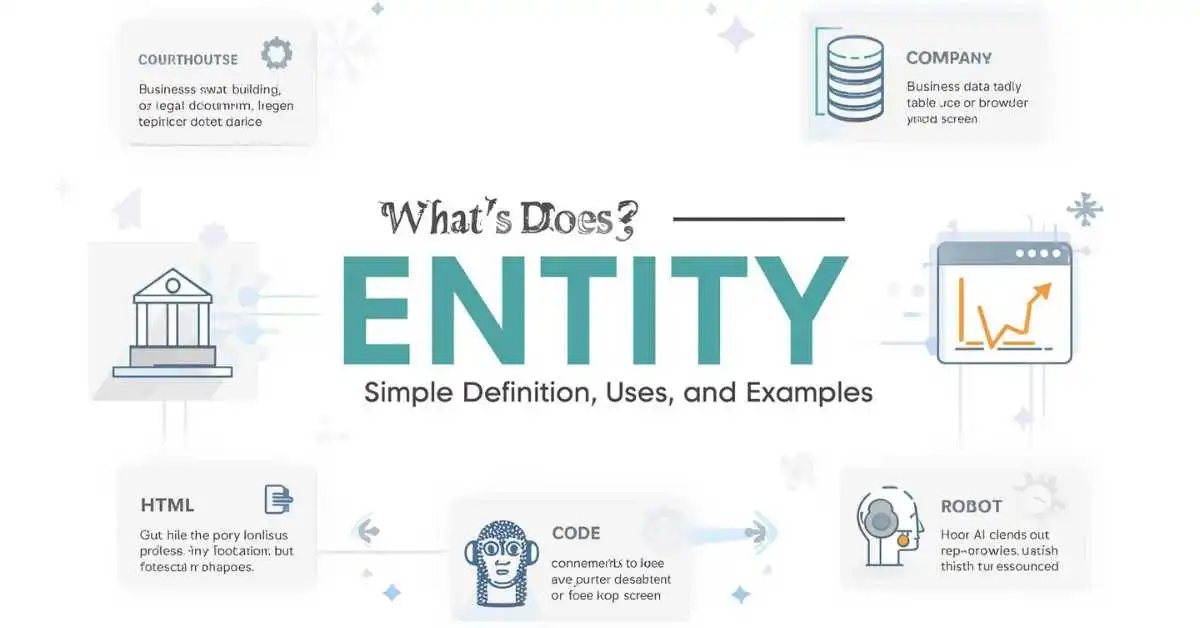
If you ask what does entity mean, the simple answer is this: an entity is something that exists as its own separate thing. It can be a person, a company, a place, a data record, or even a code used in HTML.
The main idea stays the same in every field. An entity has its own identity. It stands apart from other things.
Major dictionaries define an entity as something with separate and distinct existence, and that is the best place to start.
The good news is that the idea is simple once you break it into real-life examples. By the end of this guide, you will understand what entity means and why the word is used in so many different fields.
What Does Entity Mean in Simple Words?
A simple definition
The word entity means a thing that exists on its own. That thing can be real and physical, like a person or a building.
It can also be nonphysical, like a company, a legal body, or a record in a database. Entity is something with separate and distinct existence, and it also uses the word for an organization that has an identity separate from its members.
An easy way to remember it
A good way to remember entity meaning is this:
Entity = a separate thing with its own identity
That short line works in daily English, law, business, software, and AI.
Quick examples
Here are simple entity examples:
- A person is an entity.
- A school can be an entity.
- A company can be an entity.
- In a database, a customer can be an entity.
- In HTML,
&is often called an entity. - In AI, London can be an entity in a sentence.
Entity meaning by context
The word changes a little by context, but the core idea stays the same. This table shows the main uses.
| Context | What entity means | Easy example |
|---|---|---|
| Daily English | A separate thing | A person |
| Law | A body with legal standing | A corporation |
| Business | A business structure | An LLC |
| Database | A thing data is stored about | A customer |
| HTML | A character reference | < |
| AI | A named item in text | Paris |
What Is an Entity in Daily English?
A thing that stands on its own
In plain English, an entity is just something you can treat as a separate thing. That is why the word can point to a person, object, group, or idea. The word sounds formal, but the meaning is simple. It is about being separate.
Example in a sentence
You might say:
- “The team became its own entity.”
- “Each child is an entity.”
- “The club now acts as a separate entity.”
In each case, the speaker means the thing has its own identity. Merriam-Webster even gives example uses that show “entity” as something real and separate.
Why people search this term
Many people search what is an entity because they see the word in contracts, school work, coding, tax forms, or AI tools. The meaning feels hard at first, but the base meaning is always the same: a thing that exists on its own.
What Does Entity Mean in Law and Business?
Legal entity meaning
In law, an entity is often a person or group that has rights and duties under the law. Merriam-Webster’s legal entry says a legal entity is something like a corporation or labor union that can have rights and duties and can sue or be sued. That is why the term matters in contracts, taxes, and ownership.
Business entity meaning
In business, an entity is the form a business takes. The IRS says common business structures include a sole proprietorship, partnership, corporation, S corporation, and limited liability company (LLC). These forms matter because they affect taxes, rules, and liability.
Common business entities
This table makes the idea easier to understand. It shows the main types of business entity. The terms come from IRS guidance on business structures.
| Business entity | Simple meaning | Easy example |
|---|---|---|
| Sole proprietorship | One person owns the business | A local solo shop |
| Partnership | Two or more people own the business together | Two friends start a firm |
| Corporation | A separate legal and tax-paying body | A large company |
| S corporation | A corporation with special tax treatment | A small firm using S-corp status |
| LLC | A state-created business form | A small online brand |
Separate legal entity
A key phrase here is separate legal entity. This means the business is treated as different from the owner. The IRS says a corporation is separate and distinct from its owners, and it also notes that LLC rules can vary by tax treatment and ownership.
Example in real life
If a person owns a corporation, the law may treat the company as its own entity. The company can sign contracts, pay taxes, and hold assets in its own name. That is why lawyers and accountants use the word so often.
What Does Entity Mean in Databases?
A thing the system stores data about
In databases, an entity is a thing you keep data about. Common examples are Customer, Order, Product, and Employee. IBM explains that entity relationship diagrams show how data items relate to each other, and Oracle-style database systems use entities for tables and stored records.
Entity, attribute, and relationship
This is a common set of terms in database design:
- Entity = the thing
- Attribute = data about the thing
- Relationship = how one thing connects to another
This idea is the heart of an entity relationship diagram, often called an ER diagram. It helps people plan how data should be stored.
Easy database example
Here is a simple example:
| Part | Example |
|---|---|
| Entity | Customer |
| Attribute | Name, email, phone |
| Relationship | Customer places Order |
This is why people may ask for entity meaning in database or what is an entity in DBMS. In this field, the word means the thing your data is about.
What Does Entity Mean in HTML?
HTML entity meaning
In web development, people often say HTML entity. MDN explains that this term is commonly used as another name for a character reference. It is a code that stands for a character in HTML. This helps browsers show special characters the right way.
Why HTML entities are used
Some characters have special jobs in HTML. For example, < and > are used in tags. If you want to show those characters as text, you often use a character reference instead. That keeps the browser from reading them as code.
Common HTML entity examples
This table shows a few common ones.
| Code | Shows as | Use |
|---|---|---|
< | < | Less-than sign |
> | > | Greater-than sign |
& | & | Ampersand |
" | " | Quotation mark |
Simple coding example
If you write &, the browser shows &. So, in coding, entity definition often means a code that stands for a character. That is a very different use from law or business, but the term still points to a separate unit with its own meaning.
What Does Entity Mean in AI and Search?
Named entity recognition
In AI and natural language processing, an entity is a named thing found in text. Google Cloud says entity analysis can find known items in text, such as public figures, landmarks, organizations, and other named items. This is often called named entity recognition, or NER.
Examples of entities in text
Take this sentence:
“Apple opened a new office in London.”
An AI tool may mark:
- Apple as an organization
- London as a location
That is why entity is important in AI, machine learning, semantic search, and content analysis. Systems use entities to understand what a text is about.
Why this matters for search
Search engines try to understand people, places, brands, and topics. Entities help them connect meaning. That is why this term also matters in semantic SEO, topical relevance, and modern search systems. Entity-based understanding helps search tools see the subject of a page more clearly.
Entity vs Similar Words
Entity vs identity
These words sound close, but they are not the same.
- Entity = the thing itself
- Identity = the details that describe the thing
For example, a company is the entity. Its name, brand, and tax number are part of its identity. The core dictionary meaning supports this difference by treating the entity as the separate thing itself.
Entity vs object
An object is often any thing. Entity is more formal. It is used more in law, databases, and philosophy. In many cases, the ideas overlap, but entity usually carries the idea of a clear, separate unit.
Entity vs organization
An organization is one kind of entity. But not every entity is an organization. A person can be an entity. A database record can be an entity. A city can be an entity in text analysis. So, the word entity is wider than organization.
Quick comparison table
| Word | Meaning | Example |
|---|---|---|
| Entity | A separate thing | A company |
| Identity | Details about the thing | The company name |
| Object | A thing, often in a broad sense | A chair |
| Organization | A structured group | A charity |
Why Context Matters
The core meaning stays the same
The reason this word can feel hard is that it appears in many fields. Yet the core meaning does not change much. An entity is still a separate thing with its own existence or role. That is true in daily English, law, business, databases, HTML, and AI.
The field changes the exact use
The field changes what the “thing” is:
- In law, it may be a company or union.
- In business, it may be an LLC or corporation.
- In databases, it may be a customer record.
- In HTML, it may be a character reference.
- In AI, it may be a person, place, or brand in text.
Best way to understand the word
When you see the word, ask this simple question:
“What is the separate thing being talked about here?”
That question usually gives you the answer fast. It works for contracts, code, search, and school work.
Examples of Entity in Sentences
Daily life examples
- “Each student is an entity.”
- “The new club became its own entity.”
- “The city is an entity in the system.”
These uses fit the basic dictionary meaning of something separate and distinct.
Business examples
- “The corporation is a separate legal entity.”
- “They chose an LLC as their business entity.”
- “The tax form depends on the type of entity.”
These uses match IRS guidance on business forms and separate legal status.
Tech examples
- “Customer is an entity in the database.”
- “
<is an HTML entity.” - “The AI tool found two entities in the text.”
These uses match developer and AI documentation.
FAQ
What does entity mean in one line?
An entity is something that exists as its own separate thing.
Does entity always mean a company?
No. A company can be an entity, but so can a person, a place, a database record, or an HTML character reference.
What is a legal entity?
A legal entity is a person or group with rights and duties under the law, such as a corporation or labor union.
What is a business entity?
A business entity is the legal form of a business, such as a sole proprietorship, partnership, corporation, S corporation, or LLC.
What is an entity in a database?
In a database, an entity is the thing the system stores data about, such as a customer, order, or product.
What is an HTML entity?
An HTML entity is a character reference used to show a special character in HTML, such as & for &.
Conclusion
So, what does entity mean? It means a thing that exists on its own and can be treated as separate from other things. That is the core idea. In law, it can mean a legal body. In business, it can mean a business structure.
And In databases, it can mean a record type. In HTML, it can mean a character reference. In AI, it can mean a named item in text. Once you learn that one simple idea, the word becomes much easier to understand wherever you see it.
Click For Read More About: What does sic mean in writing? A simple guide

Hi, I’m Evan Lexor, the voice behind Meanpedia.com. I break down English words, slang, and phrases into clear, simple meanings that actually make sense. From modern internet terms to everyday expressions, my goal is straightforward: help you understand English better, faster, and with confidence, one word at a time.