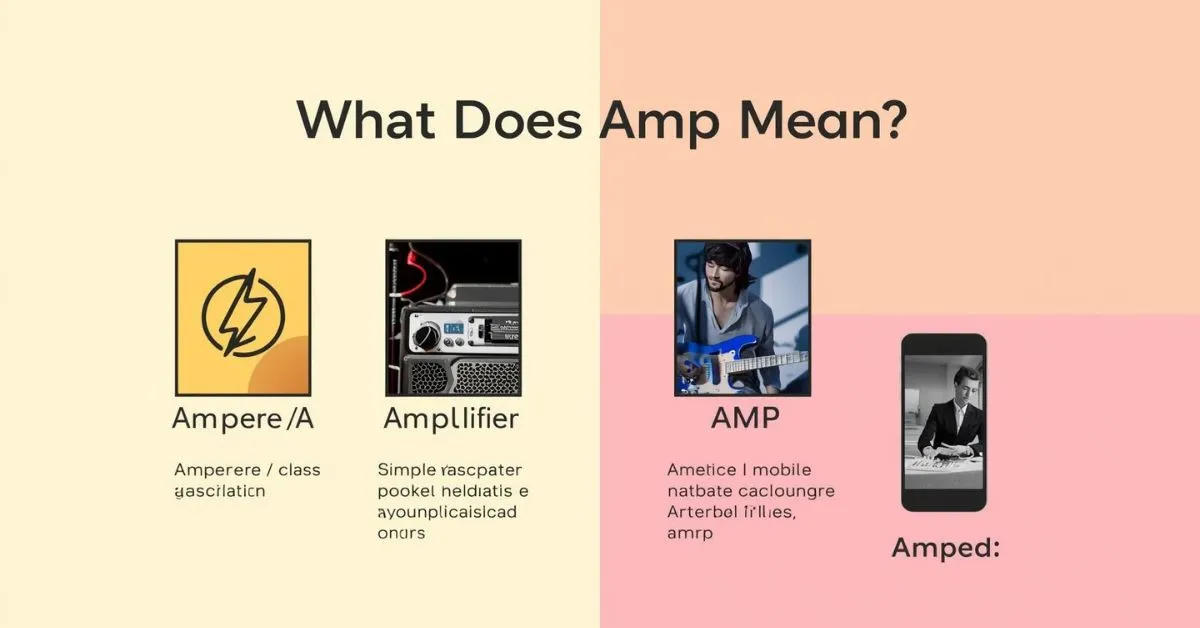
Amp usually means one of four things depending on context: an ampere in electricity, an amplifier in audio, AMP in web publishing, or amped / amp up in everyday speech, meaning excited or intensified. The right definition depends on where you saw the word.
If you searched “what does amp mean,” the shortest accurate answer is this: in most everyday situations, amp means either ampere or amplifier.
Dictionaries commonly define it both ways, and some also include the informal verb sense amp up. In technical or web-related contexts, AMP can also refer to the AMP framework.
The most common meanings of amp
For most readers, amp has these main meanings:
- Ampere: a unit used to measure electric current
- Amplifier: a device that makes an audio signal stronger or louder
- Amp / amp up / amped: to increase intensity, energy, or excitement
- AMP: a web framework used in publishing and SEO discussions
That means the word is context-based, not single-definition. If you saw it on a charger, fuse, or circuit label, it probably means ampere.
If you saw it in a music or sound setup, it probably means amplifier. If you saw it in a sentence like “the crowd was amped,” it means excited or energized.
Quick-reference table
The main meanings are easiest to understand when you match the word to the setting around it.
| Where you saw it | What amp means | Example |
|---|---|---|
| Charger, plug, fuse, wiring, circuit | Ampere | “Use a 3 amp fuse.” |
| Guitar, speaker, stereo, studio gear | Amplifier | “Plug the guitar into the amp.” |
| Everyday speech | Excited or intensified | “I’m amped for the game.” |
| SEO, developers, publishers, mobile pages | AMP framework | “The site still has AMP pages.” |
What amp means in electricity
In electricity, amp is short for ampere, the standard unit of electric current. Cambridge defines AMP as the short form of ampere, and Dictionary.com notes that the ampere is the basic SI unit of electric current with the symbol A.
In simple terms, amps tell you how much current is flowing. That is why you see phrases like:
- 2 amp charger
- 3 amp fuse
- 20 amp circuit
- 15 amp breaker
If someone says, “This device pulls 5 amps,” they are talking about electrical current, not audio equipment. In this context, amp does not mean amplifier.
Amp vs volt vs watt
This is where many readers get stuck:
- Amps measure current
- Volts measure electrical potential
- Watts measure power
You do not need to master electrical theory to understand the word, but this distinction helps when you see amp on plugs, chargers, batteries, or appliances.
What amp means in audio and music
In music and sound equipment, amp usually means amplifier. Merriam-Webster, Collins, Oxford, and Cambridge all recognize this use. An amplifier boosts an audio signal so it can drive speakers or make sound louder.
Common examples include:
- guitar amp
- bass amp
- headphone amp
- stereo amp
So if someone says, “Turn off the amp,” in a rehearsal room or studio, they almost certainly mean the amplifier, not an electrical current measurement. Context does the work.
What amp means in everyday speech
Outside technical contexts, amp often appears in phrases like amp up or amped. Merriam-Webster defines the verb sense as making someone more excited or energetic, making something more intense, or increasing the amount of something.
Examples:
- “The music really amped up the atmosphere.”
- “She was amped before the match.”
- “The ad campaign amped up attention around the launch.”
In this usage, amp is about energy, intensity, or excitement, not electricity or equipment. That is an important distinction because many articles ignore this meaning even though dictionaries include it.
What AMP means in SEO and web publishing
In SEO and web publishing, AMP refers to the AMP framework. Google says Search can index AMP pages and that AMP pages can appear in some search features such as rich results and carousels when applicable. Google also states clearly that AMP itself is not a ranking factor.
This is why marketers and site owners still talk about AMP, even though the broad query “what does amp mean” is usually not asking about SEO first. The web meaning is real and useful, but it is more field-specific than the electrical or audio meanings.
So if you see a sentence like “We removed AMP from the site,” that usually means the site stopped using the AMP framework, not that it changed anything about electrical current or sound systems.
Less common meanings you might still see
Some dictionaries also list AMP as short for adenosine monophosphate, a biology and chemistry term. That is not the dominant everyday meaning, but it does appear in scientific content.
This matters because a complete page should not pretend the word has only two meanings. Most readers will never need the scientific sense, but if you are reading medical, chemistry, or biology material, AMP may refer to adenosine monophosphate instead.
Amp vs amps vs amp-hour
Another common confusion is the difference between amp, amps, and amp-hour.
- amp = one unit of electric current
- amps = plural of amp
- amp-hour (Ah) = a measure used for electrical charge or battery capacity over time
So a battery described in amp-hours is not using the word in exactly the same way as a live current measurement in amps. Readers often mix those up because the words look similar.
How to tell which meaning is intended
A quick way to identify the correct meaning is to look at the topic around the word:
If the sentence is about electricity
Think ampere. Look for words like charger, circuit, fuse, wire, breaker, or battery.
If the sentence is about music or sound
Think amplifier. Look for guitar, speaker, stereo, signal, or volume.
If the sentence is about excitement or intensity
Think amp up or amped.
If the sentence is about websites, publishers, or Google Search
Think AMP as the web framework.
What Most Articles Miss About This Topic
Most articles miss the fact that context is the real definition.
They define amp once and stop there. That leaves readers half-informed, because the word changes meaning depending on where it appears. A better explanation does not just list definitions. It helps the reader tell which definition applies right now.
Another thing many pages miss is that AMP in SEO is real but secondary for this head term. It deserves a short, accurate explanation, but it should not crowd out the more common meanings like ampere and amplifier. Google’s own documentation makes that technical meaning clear, including the fact that AMP itself is not a direct ranking factor.
The strongest practical takeaway is simple:
If you know the topic, you usually know the meaning. That is what makes the word easy once the confusion is removed.
FAQ
Does amp mean ampere or amplifier?
It can mean either. In electrical contexts, amp usually means ampere. In music and audio contexts, it usually means amplifier.
What does amp mean on a charger?
On a charger, amp usually refers to electrical current, meaning ampere. It describes current flow or current rating.
What does amp mean in music?
In music, amp is usually short for amplifier, the equipment that boosts sound signals.
What does AMP mean in SEO?
In SEO and web publishing, AMP refers to the AMP framework. Google says AMP pages can be indexed and AMP itself is not a ranking factor.
What does amped mean in slang?
It usually means excited, energized, or more intense. Merriam-Webster includes this informal verb usage.
What is the difference between amp and amp-hour?
Amp measures current. Amp-hour measures capacity or charge over time, such as in batteries.
Can AMP also mean something in science?
Yes. In some biology and chemistry contexts, AMP can mean adenosine monophosphate.
Conclusion
Amp does not have just one meaning. Most often, it means ampere in electricity or amplifier in audio. In everyday speech, it can mean excited or intensified, and in web publishing, AMP refers to the AMP framework. Once you check the context, the right meaning becomes much easier to spot.
Click Below To Read About:
Mean Platelet Volume (MPV): What It Means on a Blood Test
What Does Fortnight Mean? Definition, Days, and Examples
What Does Lust Mean in the Bible? Key Verses, Common Misunderstandings

Hello! I’m Clara Lexis, creator of Meanpedia.com. I specialize in breaking down words, phrases, and idioms so that anyone can understand and enjoy the beauty of English. My goal? Making language approachable, fun, and meaningful, one word at a time.