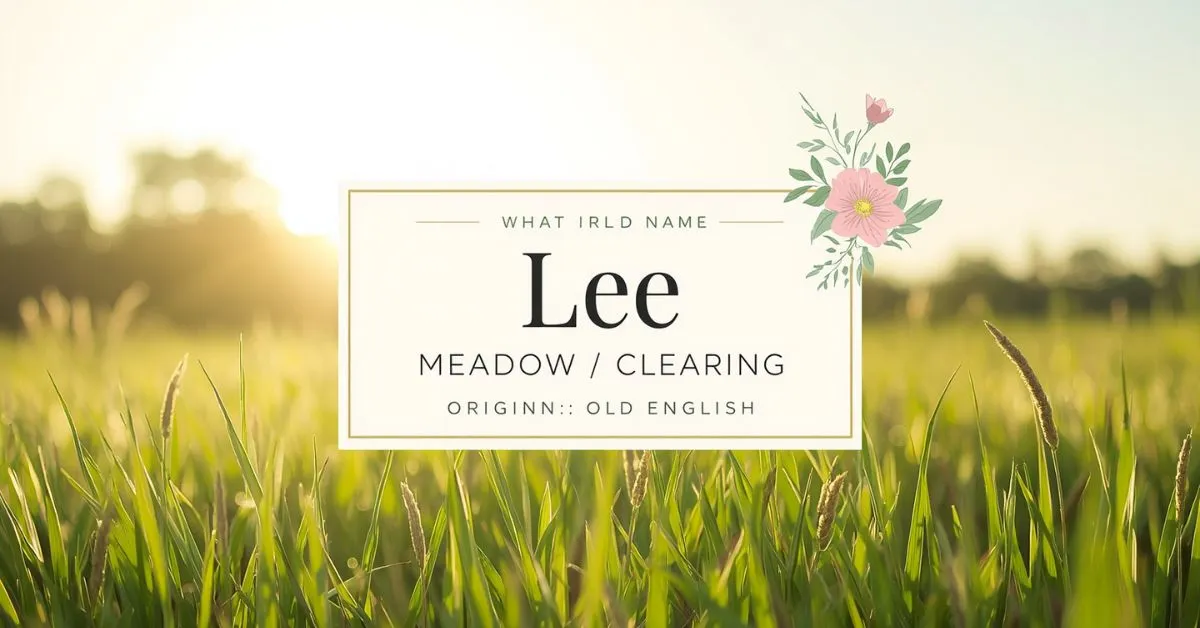
Lee is a short English name that usually means “meadow,” “clearing,” or “pasture.” It comes from an old surname linked to the Old English word leah, and it is now used as a first name, middle name, and last name. Lee is also widely treated as a gender-neutral name, though it has historically been more common for boys.
If you searched what does the name Lee mean, you probably want a fast answer first, then the details that actually help: origin, pronunciation, popularity, gender use, variants, and whether Lee still feels like a good baby name today. That is exactly where many weak articles miss the mark.
They answer the question, but they do not cover the full baby-name intent. Lee may look simple, but it has deep roots, several related spellings, and a long history in English-speaking naming.
Quick Facts About the Name Lee
The quick facts below reflect the main baby-name references currently surfacing for Lee, along with U.S. Social Security popularity data.
| Field | Details |
|---|---|
| Meaning | Meadow, clearing, pasture |
| Main origin | English / Old English |
| Root word | leah |
| Pronunciation | LEE |
| Name type | Given name, middle name, surname |
| Gender use | Mostly male historically, also gender-neutral |
| 2024 U.S. boy rank | #714 |
| Related spellings | Leigh, Lea, Leah |
What does the name Lee mean exactly?
In the strongest English baby-name sense, Lee means “meadow,” “clearing,” or “pasture.” The name comes from the Old English root leah, a word used for a woodland clearing or open field.
Parents explains that Lee comes from the English word laye, meaning “clearing in the woods” or “meadow,” while Behind the Name traces it to the Old English leah, meaning “clearing.” The Bump similarly defines Lee as “pasture” or “meadow.”
That meaning gives Lee a natural, open, calm feel. It belongs to the same broad family of landscape names that connect people to fields, woods, glades, and clearings. This is one reason Lee still appeals to parents who want a short, clean name with a quiet nature meaning.
How do you pronounce Lee?
Lee is pronounced exactly as it looks: LEE. That is one of its biggest strengths. It is easy to say, easy to spell, and unlikely to confuse people in school, work, or daily life.
Origin and history of the name Lee
Lee began as a surname of English origin before becoming a given name. In other words, it followed a very common naming path: a family name tied to place or landscape slowly moved into first-name use.
Behind the Name says the given name Lee comes from a surname derived from Old English leah, and Parents describes that surname as one originally given to someone who lived in or near a clearing.
Lee is also widely used as a middle name, which helps explain why it has stayed familiar even after falling from its earlier peak in baby-name charts.
Parents points to examples like Annabel Lee and Jamie Lee, while Behind the Name notes that Lee is common as a middle name.
Some modern baby-name references also list Irish and Chinese connections for Lee. The Bump notes that Lee may sometimes be linked to the Old Irish laoidh, meaning “poem,” and may also appear as a variant of Mandarin Li, meaning “plum.”
Those meanings are useful to mention, but for the main English baby-name query, the dominant meaning is still meadow or clearing.
Is Lee a boy name, girl name, or unisex name?
Lee is best described as a gender-neutral name, but historically it has been used more often for boys in the United States.
Parents explicitly labels Lee a gender-neutral name while also noting that it is most commonly used as a boy name. The same source adds that Leigh has more often been used for girls.
That makes Lee a flexible option. It can work as:
- a boy’s first name
- a girl’s first or middle name
- a gender-neutral middle name
- a surname passed into first-name use
Because it is only one syllable and very familiar, Lee fits many styles. It can sound classic, Southern, modern, minimal, or family-centered depending on the full name around it.
How popular is the name Lee?
Lee has a long popularity history in the United States, especially for boys. According to Parents, Lee first appeared in the Social Security Administration’s top 1,000 boys’ names at No. 39 in 1900 and stayed in the top 100 for the next 55 years.
SSA decade data also shows Lee ranked No. 46 among male names of the 1900s and No. 98 in the 1950s, which confirms that it was once a much stronger mainstream choice than it is now.
Lee is still in use today, but it is much less common than it used to be. Parents reports that Lee ranked No. 714 for boys in 2024, and SSA’s change-in-popularity table shows Lee moving from 706 in 2023 to 714 in 2024.
That puts it in a useful naming zone for many parents: familiar, easy, but no longer overused.
For girls, Lee also had a real history, though it faded earlier. Parents says Lee ranked No. 278 for girls in 1900, peaked at No. 183 in 1955, and fell out of the girls’ top 1,000 by 1991.
That makes Lee more historically masculine in the data, but still legitimately unisex in modern naming language.
Lee vs Leigh vs Lea vs Leah
One of the easiest ways to improve this topic is to explain names people often confuse with Lee. The names look similar, but they do not all mean the same thing. The summary below reflects current baby-name references for each.
| Name | Main origin | Main meaning | Common use |
|---|---|---|---|
| Lee | English / Old English | Meadow, clearing, pasture | Unisex, more often male historically |
| Leigh | English; sometimes Irish | Meadow, glade, woodland; sometimes linked to song/poem in Irish forms | Often feminine, also unisex |
| Lea | Usually Hebrew via Leah | Delicate or weary | More often feminine |
| Leah | Hebrew | Delicate or weary | Feminine |
This comparison matters for SEO and for real readers. Many people searching lee name meaning are also deciding between Lee, Leigh, Lea, and Leah.
If your goal is the English landscape meaning, Lee and Leigh are the closest match. If you want the biblical Hebrew line, Lea and Leah belong in that category instead.
Why parents still choose Lee
Lee stays appealing for a few practical reasons.
It is simple
Lee is one of the easiest names to pronounce, spell, and remember. There is no guesswork.
It has a nature meaning
Names tied to meadows, clearings, fields, and woodland imagery often feel calm and timeless rather than flashy.
It works in many positions
Lee works as a first name, middle name, and surname. It also pairs well with longer names, which is why forms like Jamie Lee and Annabel Lee feel natural.
It feels familiar but not overused
With a 2024 U.S. rank of No. 714 for boys, Lee is still recognizable without feeling common in today’s classrooms.
Famous people and cultural references tied to Lee
Entity-rich content helps readers connect the name to real life, and Lee has many recognizable examples.
Parents lists famous given-name bearers such as Lee Child, Lee Grant, Lee Greenwood, Lee Iacocca, Lee Pace, and Lee Wiley. The same source also mentions well-known uses of Lee in names like Annabel Lee, Bobby Lee, and Jamie Lee.
Other popular culture references keep the spelling highly visible, even when Lee is a surname rather than a given name. The Bump highlights famous figures like Bruce Lee, Harper Lee, Spike Lee, and Stan Lee.
These surname examples do not change the English first-name meaning, but they do make Lee feel familiar across books, film, music, fashion, and entertainment.
Common mistakes people make about the name Lee
Mistake 1: Assuming Lee has only one meaning
The main English meaning is clear: meadow, clearing, pasture. But some baby-name references also list Irish and Chinese associations. Context matters.
Mistake 2: Treating Lee, Leigh, Lea, and Leah as the same name
They overlap in sound, but not always in origin. Lee and Leigh usually point back to English landscape roots, while Lea and Leah are commonly linked to Hebrew naming traditions.
Mistake 3: Thinking Lee is only a boy name
Lee has stronger historical use for boys, but reliable baby-name references still describe it as gender-neutral.
Mistake 4: Ignoring surname history
Lee makes more sense when you know it started as a surname connected to landscape and place. That surname-to-first-name journey is part of why the name feels both traditional and flexible.
Is Lee a good baby name today?
Lee is a strong choice if you want a name that is:
- short
- timeless
- easy to spell
- easy to pair with other names
- quietly meaningful
- gender-flexible without feeling trendy
It is especially useful for parents who like one-syllable names, Old English names, nature-inspired names, or surname-style names. It also works well if you want a middle name that adds balance to a longer first name.
Lee may be less ideal if you want something highly distinctive or currently fashionable. It is a classic minimalist name, not a bold statement name. That said, many parents now prefer that exact quality.
FAQ
Is Lee a biblical name?
Lee is not mainly considered a biblical name. Its strongest baby-name origin is English, from the Old English root leah, meaning a clearing or meadow.
Is Lee a boy or girl name?
Lee is a gender-neutral name, but it has historically been used more often for boys in U.S. baby-name data.
What does Lee mean in Old English?
Lee comes from the Old English root leah, which refers to a clearing, meadow, or open field.
How do you pronounce the name Lee?
It is pronounced LEE.
Is Lee a common middle name?
Yes. Baby-name references note that Lee is common as a middle name and appears in combinations like Jamie Lee and Annabel Lee.
What is the difference between Lee and Leigh?
Lee and Leigh are closely related, but Leigh is more often used for girls in modern baby-name guides. Both are linked to English roots meaning meadow, glade, or clearing.
Is Lee still popular?
Lee is much less common than it once was, but it is still in use. It ranked No. 714 for boys in the U.S. in 2024.
Can Lee have other meanings in other cultures?
Yes. Some baby-name references also connect Lee to Irish and Chinese naming contexts, where meanings such as “poem” or “plum” may apply depending on the origin being used.
Final thoughts
So, what does the name Lee mean? In the clearest and most common English sense, Lee means meadow, clearing, or pasture. It comes from the Old English root leah, was first used as a surname, and later became a given name and middle name. It is easy to pronounce, historically stronger for boys, still valid as a unisex choice, and familiar without being heavily used today.
If you are building a baby-name shortlist, Lee is one of the safest classic options to keep on it. It has real history, a calm nature meaning, and enough flexibility to fit many naming styles.
Click Below To Read About:
What Does Miss Mean? Full Meaning, Uses, and Title Differences
What Does LKR Mean in Text? Meaning, Uses, and Examples
What Does Elphaba Mean in Wicked? Name Origin Explained

Hi, I’m Evan Lexor, the voice behind Meanpedia.com. I break down English words, slang, and phrases into clear, simple meanings that actually make sense. From modern internet terms to everyday expressions, my goal is straightforward: help you understand English better, faster, and with confidence, one word at a time.