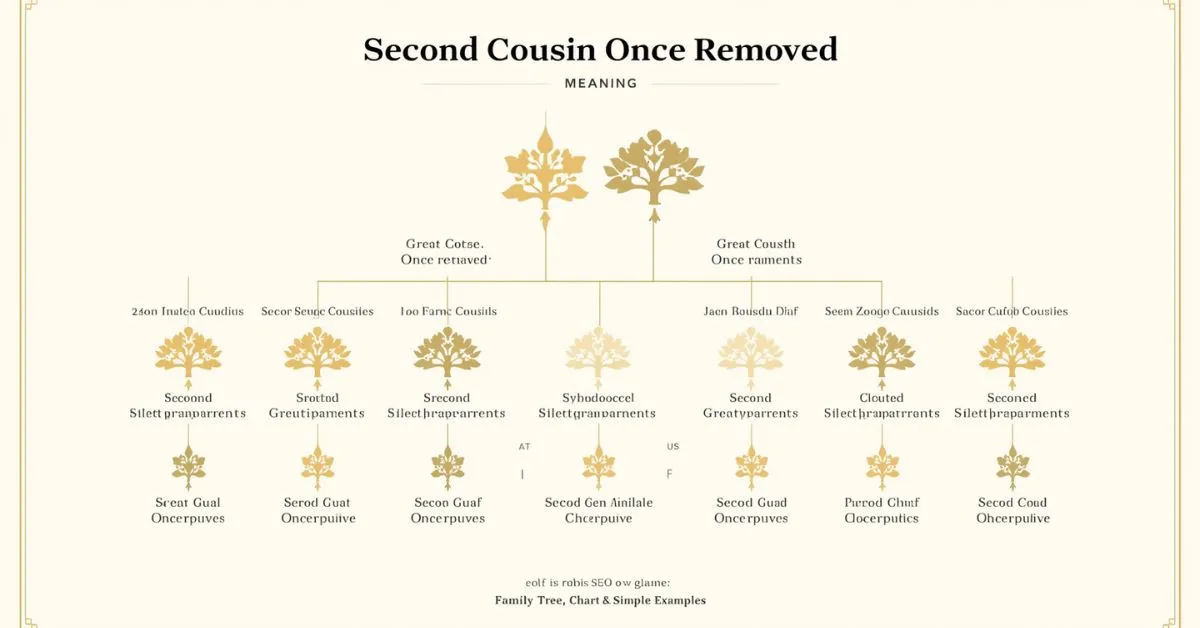
A second cousin once removed is usually either your second cousin’s child or your parent’s second cousin. “Second cousin” means two people share a great-grandparent as a common ancestor, and “once removed” means they are one generation apart on the family tree.
If this term has ever confused you, you are not alone. Family relationship terms can sound complex, especially when words like second, once removed, and cousin chart appear together.
The good news is that the meaning is simple once you break it into two parts: the cousin level and the generation gap. In genealogy, kinship terms are based on your nearest shared ancestor, not on age, closeness, or how often you meet that relative.
In this guide, you will learn exactly what second cousin once removed means, how it works on a family tree, how it compares with similar relationships like first cousin once removed and third cousin, and how to calculate it quickly without guessing.
The simple answer
The easiest way to understand a second cousin once removed is this:
- Your second cousin’s child is your second cousin once removed
- Your parent’s second cousin is also your second cousin once removed
That is because the shared family line stays the same, but one person is one generation higher or lower than the other.
What does “second cousin” mean?
A second cousin is someone who shares a great-grandparent with you. You and your second cousin are in the same generation, even if one of you is much older than the other.
Age does not change the relationship. The only thing that matters is where each person sits in relation to the shared ancestor.
Quick family tree example
Imagine this family line:
- You descend from Great-Grandparent Anna
- Another person also descends from Great-Grandparent Anna
- If both of you are the same number of generations away from Anna, you are second cousins
That shared great-grandparent is what makes the relationship “second cousin.”
What does “once removed” mean?
The word removed tells you the generation difference between two relatives. If two people are one generation apart, they are once removed. If they are two generations apart, they are twice removed.
So, when you combine the two parts:
- Second cousin = shared great-grandparent
- Once removed = one generation apart
That gives you second cousin once removed.
Second cousin once removed meaning on a family tree
A family tree makes this relationship much easier to see. In genealogy, you first find the common ancestor, then count how many generations each person is from that ancestor. The cousin number comes from the shared ancestor level, and the “removed” number comes from the gap in generations.
Example 1: Your second cousin’s child
If Emma is your second cousin, you and Emma share the same great-grandparents. If Emma has a daughter, that daughter is one generation below you. She is your second cousin once removed.
Example 2: Your mother’s second cousin
If your mother has a second cousin, that person is one generation above you. Since the relationship is still based on the same great-grandparent line but there is now a one-generation difference, that person is also your second cousin once removed.
Cousin chart: how cousin numbers work
Here is the easiest way to remember cousin levels.
| Relationship | Shared ancestor | Same generation? |
|---|---|---|
| First cousin | Grandparent | Yes |
| Second cousin | Great-grandparent | Yes |
| Third cousin | Great-great-grandparent | Yes |
This is the basic logic used in a standard cousin chart and in genealogy relationship calculators.
Now add “removed”:
| Relationship | Shared ancestor line | Generation gap |
|---|---|---|
| First cousin once removed | Grandparent line | 1 |
| Second cousin once removed | Great-grandparent line | 1 |
| Second cousin twice removed | Great-grandparent line | 2 |
| Third cousin once removed | Great-great-grandparent line | 1 |
This chart helps show that “removed” does not change the cousin line itself. It only tells you that one relative is above or below the other on the family tree.
Second cousin once removed vs similar relationships
Many readers mix up cousin terms because they sound similar. Here is the clear difference.
Second cousin vs second cousin once removed
A second cousin is in your generation and shares a great-grandparent with you. A second cousin once removed shares the same family line, but one of you is one generation higher or lower.
First cousin once removed vs second cousin once removed
A first cousin once removed is closer than a second cousin once removed. A first cousin once removed is tied to your grandparent line, while a second cousin once removed is tied to your great-grandparent line.
Third cousin vs second cousin once removed
A third cousin shares a great-great-grandparent and is usually in your generation. A second cousin once removed usually shares a closer ancestor line, even though the wording can sound more complicated.
How to calculate a second cousin once removed
You do not need to memorize every family term. Use this simple method instead.
Step 1: Find the nearest common ancestor
Look for the closest shared ancestor between you and the other person. This may be a grandparent, great-grandparent, or great-great-grandparent.
Step 2: Count generations down to each person
Count how many generations each of you is from that shared ancestor. A genealogy chart or family relationship calculator does the same thing.
Step 3: Name the cousin level
If the shared ancestor is a great-grandparent, the base relationship is second cousin.
Step 4: Check the generation gap
If one person is one generation farther away from the shared ancestor than the other, the relationship becomes once removed.
The fast memory trick
Use this shortcut:
- Shared grandparent = first cousin
- Shared great-grandparent = second cousin
- Shared great-great-grandparent = third cousin
- One generation apart = once removed
That one formula will help most readers identify cousin relationships in seconds.
Are second cousins once removed blood relatives?
Yes. In standard genealogy terms, they are blood relatives because they descend from a common ancestor. They are not a direct ancestor or direct descendant like a parent, grandparent, child, or grandchild.
Instead, they are a more distant collateral relative in your extended family. Kinship terms in family history describe these relationships through common ancestors, whether the connection is on your maternal side or paternal side.
Why this term matters in genealogy and DNA matches
The phrase “second cousin once removed” comes up often in genealogy, family history, and DNA match research. Family history platforms use cousin charts because they help place relatives correctly in your tree.
DNA tools also compare your tree with shared ancestors to suggest how someone may be related to you. That is why understanding relationship terms matters when you are organizing branches, identifying descendants, or reviewing possible maternal and paternal matches.
Common mistakes to avoid
Mistaking age for relationship
A person can be older than your parent and still be your cousin, not your aunt or uncle. Family relationships are based on the shared ancestor, not age.
Thinking “removed” means distant or unrelated
It does not. “Removed” only means there is a difference in generations. The relationship is still real and still based on the same family line.
Confusing second cousin once removed with first cousin once removed
These are different kinship terms. One is tied to a great-grandparent line and the other to a grandparent line.
Guessing instead of counting generations
The safest way to identify any cousin relationship is to find the common ancestor and count down. That is how genealogy charts and family relationship tools work.
Practical examples you can use right away
Here are quick answers to common real-life situations:
| If this person is… | They are your… |
|---|---|
| Your second cousin’s son | Second cousin once removed |
| Your second cousin’s daughter | Second cousin once removed |
| Your father’s second cousin | Second cousin once removed |
| Your mother’s second cousin | Second cousin once removed |
These examples reflect the one-generation difference built into the phrase “once removed.”
FAQs
What is a second cousin once removed in simple words?
It is usually your second cousin’s child or your parent’s second cousin. You share a great-grandparent line, but you are one generation apart.
Is my second cousin’s child my second cousin once removed?
Yes. Your second cousin’s child is your second cousin once removed.
What is my mom’s second cousin to me?
Your mom’s second cousin is your second cousin once removed.
What does once removed mean in genealogy?
It means two relatives are in different generations. Once removed means one generation apart.
Is a second cousin once removed closer than a third cousin?
Usually yes, because a second cousin once removed is tied to a great-grandparent line, while a third cousin shares a great-great-grandparent.
Are second cousins once removed on the maternal or paternal side?
They can be on either side. The relationship can come through your maternal family or your paternal family, depending on which ancestor line you share.
Can a second cousin once removed show up as a DNA match?
Yes. Genealogy and DNA platforms may use family trees and shared ancestors to suggest this kind of relationship among possible matches.
Is a second cousin once removed a direct ancestor?
No. This person is part of your extended family, not your direct line of ancestors or descendants.
Final takeaway
So, what does second cousin once removed mean? It means you and that person are connected through a great-grandparent line, but you are one generation apart. In most cases, it is either your second cousin’s child or your parent’s second cousin. Once you understand the shared ancestor and the generation gap, the term becomes much easier to remember and use on any family tree.
If you are building a genealogy site, this topic is perfect for internal links to pages like cousin relationship chart, what does first cousin once removed mean, how to build a family tree, and DNA match guide.
Read Also This Post:
What Does It Mean When Your Poop Is Yellow? Causes and When to Worry

Hi, I’m Evan Lexor, the voice behind Meanpedia.com. I break down English words, slang, and phrases into clear, simple meanings that actually make sense. From modern internet terms to everyday expressions, my goal is straightforward: help you understand English better, faster, and with confidence, one word at a time.