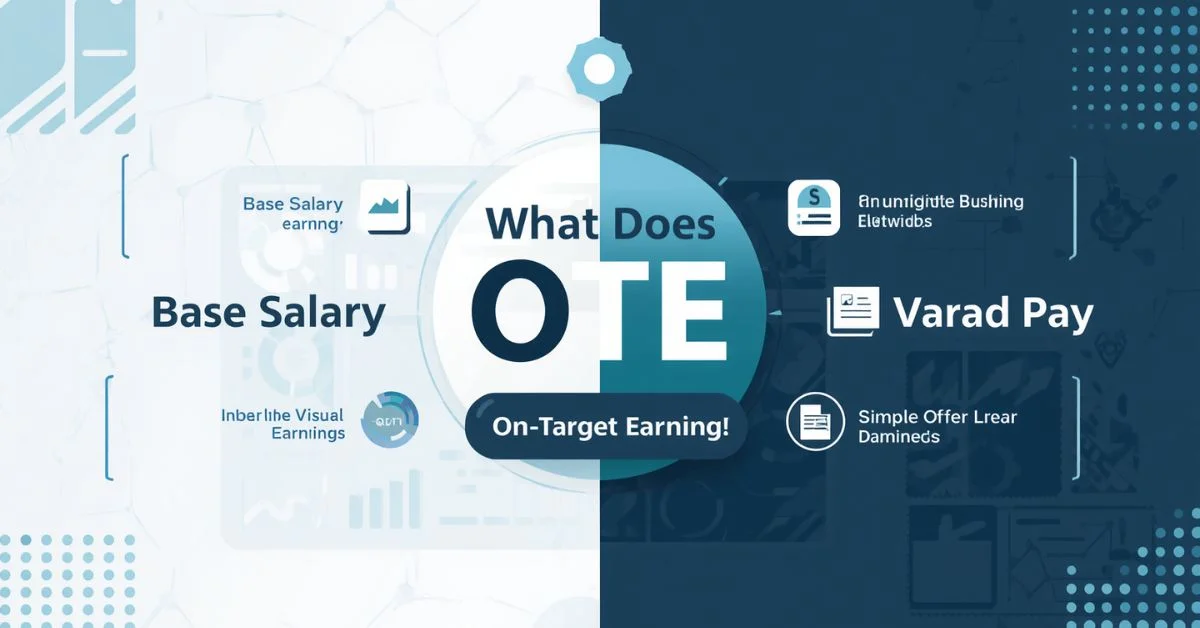
OTE in sales means on-target earnings. It is the total pay a sales rep is expected to earn at 100% of quota, usually made up of base salary plus target variable pay, such as commission or bonus. In most sales jobs, OTE is a target number, not a guaranteed amount.
If you saw OTE in a sales job post, recruiter message, or offer letter, the important question is not just “what does OTE stand for?” It is also: how realistic is that number, what is included in it, and what would I actually earn if I miss or exceed target?
Strong sales compensation guides consistently treat OTE as part definition and part offer-evaluation tool because actual earnings depend on quota, pay mix, ramp time, and commission structure.
OTE meaning in sales, in simple terms
OTE stands for on-target earnings. In sales, it usually means the amount a company expects you to make if you hit your assigned goal.
Most often, that goal is quota attainment at 100%. OTE normally combines fixed base pay and variable earnings tied to performance.
A simple way to think about it is this:
OTE = base salary + target variable pay
Some companies describe the variable part as commission, while others use bonus, incentives, or broader variable compensation language.
CaptivateIQ notes that OTE is commonly framed as base pay plus on-target variable (OTV), while other sources describe the same idea as base salary plus annual commission at target.
What does OTE include?
In most sales roles, OTE includes:
- base salary
- target commission
- target performance bonus, if the role uses one
Several current guides describe OTE as total compensation at target performance, but they usually mean the compensation directly tied to the role’s pay plan, not every possible benefit or perk.
Indeed notes that OTE includes base salary and commission, and its broader OTE explainer says it may not include one-time bonuses, overtime, or benefits.
What OTE usually does not include
OTE often does not include:
- health benefits
- retirement contributions
- equity
- one-time sign-on bonuses
- overtime pay
- perks not tied to quota or performance
This is why OTE should not automatically be treated as the same thing as total compensation.
Some employers use the term loosely in job ads, but the more precise meaning is base pay plus target variable earnings tied to the compensation plan.
How OTE is calculated in sales
Most explanations of OTE follow the same basic model: set the base salary, determine the sales quota or target, then calculate the variable pay earned at full attainment.
HiBob and Indeed both describe OTE as the result of combining base salary with the variable amount expected when the target is fully met.
Basic OTE formula
OTE = annual base salary + target variable pay at 100% quota
Hypothetical example 1: account executive
- Base salary: $70,000
- Target commission at 100% quota: $70,000
- OTE: $140,000
Hypothetical example 2: SDR
- Base salary: $45,000
- Target bonus or commission: $15,000
- OTE: $60,000
These examples show why OTE is useful in sales hiring. It tells you more than salary alone, but it still does not tell the full story unless you understand the quota, the commission rules, and the role’s ramp period.
Is OTE guaranteed?
Usually, no.
Multiple current sources make the same point: OTE is generally the amount you can expect if you achieve the target, but companies rarely guarantee the full figure because the variable part depends on performance.
Actual pay can fall below OTE if you miss quota or rise above OTE if the plan includes accelerators or uncapped commission.
That is the biggest misunderstanding around OTE. Many people read a job ad and assume OTE means fixed yearly income. In most sales roles, it does not. It is a target earning level based on a compensation plan and performance assumptions.
OTE vs base salary vs total compensation
| Term | What it means | Usually guaranteed? | What it may include |
|---|---|---|---|
| Base salary | Fixed pay | Usually yes | Salary only |
| OTE | Earnings at target performance | Usually no | Base salary + target variable pay |
| Total compensation | Full value of the package | Not always | Salary, incentives, equity, benefits, bonuses, and more |
This distinction matters because a job with an attractive OTE may still have a lower guaranteed income than another job with a stronger base salary.
It also means two jobs with the same OTE can feel very different in practice depending on their base-to-variable split.
What is pay mix?
Pay mix is the ratio of base salary to variable pay inside the OTE. Indeed and QuotaPath both describe pay mix as the split between fixed earnings and commission or bonus earnings.
For example:
- 50/50 OTE means half of the target earnings come from base salary and half come from variable pay
- 60/40 OTE means 60% base and 40% variable
- 70/30 OTE means more stability and less pay at risk
A heavier variable mix usually means more upside and more income risk. A heavier base mix usually means more stability but less dependence on commission. HiBob lists common pay mix ratios and explains that the ideal split varies by role, sales cycle, and business model.
What do OTV and OTC mean?
These terms show up less often in beginner articles, but they matter in real sales compensation discussions.
- OTV means on-target variable. CaptivateIQ describes OTV as the variable reward paid when a salesperson meets or exceeds targets.
- OTC means on-target commission. HiBob explains OTC as the commission portion of OTE only, excluding base salary.
So if a role offers:
- Base salary: $80,000
- OTV or OTC: $40,000
- OTE: $120,000
the $40,000 is the at-target variable portion, while the full OTE is $120,000.
Capped vs uncapped OTE
An OTE plan can be capped or uncapped.
With capped OTE, there is a limit on how much variable pay you can earn even if you exceed quota. With uncapped OTE, there is no ceiling on commission earnings, so high performers can continue earning above their target level.
Current HR and sales compensation explainers from Personio, HiBob, and others all make this distinction clearly.
This matters because the same listed OTE can lead to very different upside:
- A capped plan gives more cost control for the company
- An uncapped plan gives more earning potential for the rep
If you are comparing offers, always ask whether the commission plan is capped, whether accelerators exist above quota, and whether payouts change after 100% attainment.
What is fully-ramped OTE?
Fully-ramped OTE is the target earning level once a rep is carrying full quota rather than a reduced new-hire quota.
Several current sources explain that many sales roles require a ramp period, and first-year earnings can be lower than fully-ramped OTE because new reps need time to learn the product, build pipeline, and start closing consistently.
That means a job listing can show an impressive OTE, but your real earnings in the first months may depend on:
- reduced quota during ramp
- a draw against future commissions
- temporary guarantees
- how long the ramp lasts
Salesforce explains that new reps are often earning a draw during ramp rather than full commissions, and QuotaPath notes that good organizations may compensate for lower ramp quotas through a draw or higher commission rate during onboarding.
Why OTE can look better on paper than in real life
This is the part many thin articles miss.
OTE is a target model, not proof that most reps actually earn that amount.
QuotaPath specifically warns that OTE can become a false promise when too few reps are actually hitting those numbers, and it recommends looking at average quota attainment rather than treating OTE as the real-world average.
In practice, whether an OTE number is meaningful depends on things like:
- how realistic the quota is
- whether the territory is good
- how long the sales cycle is
- whether the rep is fully ramped
- whether the plan is capped or uncapped
- how often commissions are paid
- what percentage of the team actually reaches 100% attainment
Indeed also suggests asking how many reps are above, below, or around median OTE, which is one of the smartest questions a candidate can ask during interviews.
How to evaluate an OTE number in a job listing
If a recruiter says a role is “$150K OTE,” do not stop at the headline number. Ask:
- What is the base salary?
- What is the variable portion?
- What quota earns 100% OTE?
- How many reps hit quota last year?
- Is the role fully ramped, or is first-year pay lower?
- Is commission capped or uncapped?
- Are there accelerators above target?
- Are payouts monthly, quarterly, or delayed?
- Does OTE match the same time period as quota?
CaptivateIQ notes that OTE should match the same time period as the quota. If quota is annual, OTE should be annual. If quota is quarterly, the earnings figure should be aligned accordingly.
Quick-reference table
| What you see | What it usually means | What to check next |
|---|---|---|
| $120K OTE | Target earnings at 100% quota | Base vs variable split |
| 50/50 OTE | Half base, half variable | Income risk and upside |
| Uncapped OTE | You can earn above target | Accelerator rules |
| Fully-ramped OTE | Full target after ramp | First-year earnings during onboarding |
| Competitive OTE | Vague marketing language | Ask for exact pay breakdown |
FAQ
What does OTE stand for in sales?
OTE stands for on-target earnings, meaning the total pay a salesperson is expected to earn when they hit their target, usually including base salary and variable pay.
Is OTE the same as salary?
No. Salary usually means fixed base pay. OTE usually includes base salary plus commission or bonus at target performance.
Is OTE guaranteed?
Usually not. OTE is typically the expected pay at 100% attainment, not guaranteed annual income.
What is 50/50 OTE?
It means the OTE is split evenly between base salary and variable pay. For example, a $100,000 OTE on a 50/50 plan would usually mean $50,000 base and $50,000 variable at target.
What is fully-ramped OTE?
Fully-ramped OTE is the target earning level once a rep is carrying full quota rather than reduced new-hire quota during ramp.
Can you earn more than OTE?
Yes. On uncapped plans, reps can earn more than OTE by exceeding quota, especially when accelerators apply above 100% attainment.
What is the difference between OTE and OTC?
OTE is total target earnings, including base plus variable pay. OTC refers only to the at-target commission portion.
Conclusion
If you were wondering what OTE means in sales, the clearest answer is this: OTE is on-target earnings, or the total pay a sales rep is expected to make at 100% quota. It usually combines base salary and target variable pay, but it is not always guaranteed.
Click Below To Read About:
What Does IPO Mean? Initial Public Offering Explained
What Does Ambivert Mean? Traits, Signs, and Real-Life Examples
What Does YN Mean in Text, TikTok, and Fanfiction?

Hi, I’m Evan Lexor, the voice behind Meanpedia.com. I break down English words, slang, and phrases into clear, simple meanings that actually make sense. From modern internet terms to everyday expressions, my goal is straightforward: help you understand English better, faster, and with confidence, one word at a time.