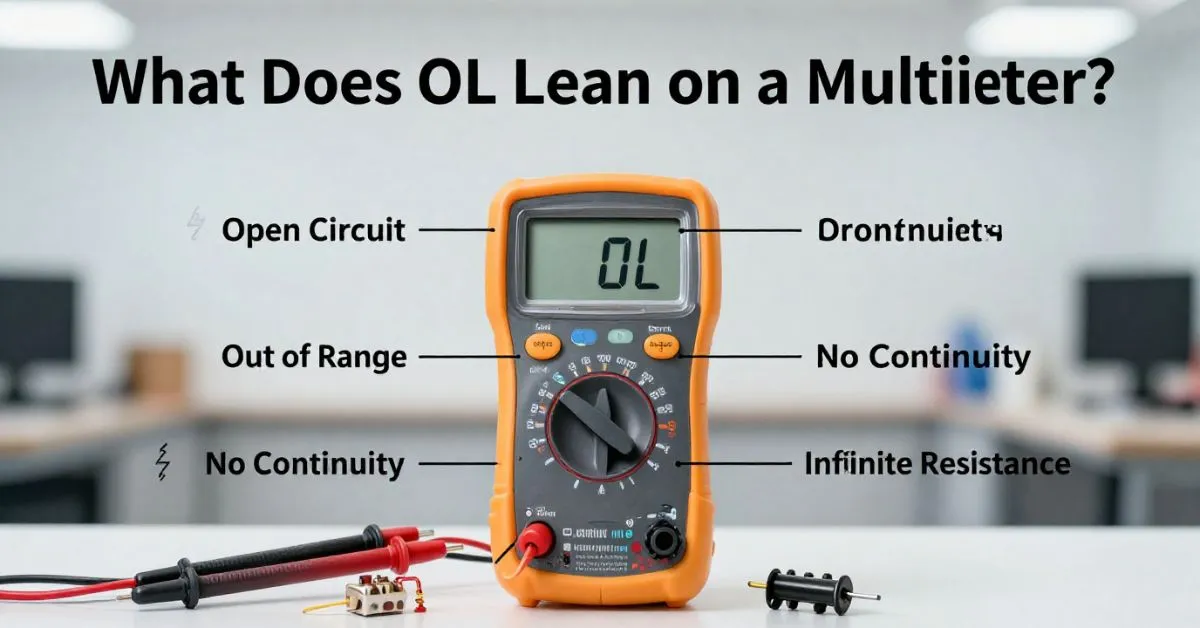
OL on a multimeter usually means open loop, open circuit, over limit, or out of range, depending on the mode and the meter model.
In resistance and continuity mode, OL usually means there is no complete electrical path. In voltage or current mode, OL often means the reading is above the selected range.
If you have ever looked at your digital multimeter and seen OL on the LCD display, you are not alone.
It is one of the most common readings that confuses beginners and even trips up DIY users when they switch between voltage, ohms, continuity, current, and diode test modes. The good news is that OL is not one fixed error code.
Its meaning changes slightly based on the setting, the input jacks, the test leads, the range, and what component or circuit you are checking.
Official guidance from Fluke and meter manuals from brands like Klein show that OL can mean an open circuit, infinite resistance, reverse bias, or an over-range condition depending on the test.
Quick Answer: What OL Usually Means
The easiest way to understand multimeter OL meaning is this:
- In ohms (Ω) mode, OL usually means infinite resistance or an open circuit
- In continuity mode, OL usually means no continuity
- In diode test mode, OL can mean reverse bias or an open diode
- In voltage or current mode, OL often means the value is outside the selected range or the meter is set up wrong
That is why two people can both ask, “why is my multimeter reading OL?” and still have different causes.
OL Meaning by Multimeter Function
| Multimeter setting | What OL usually means | What to check next |
|---|---|---|
| Resistance / ohms | Open circuit or infinite resistance | Broken wire, blown fuse, disconnected path |
| Continuity | No complete path | Fuse, switch, connector, wire |
| Diode test | Reverse bias or open diode | Reverse the probes, test both directions |
| Voltage | Over range or wrong range/setup | Function, range, lead ports |
| Current | Exceeds selected/current rating | Higher range, correct jack, internal fuse |
These patterns match official training material and brand manuals, though wording may vary by meter model.
Does OL Mean Open Circuit or Overload?
It can mean either one.
That is the part most articles oversimplify. On many digital multimeters, OL in resistance mode means the resistance is so high that the meter treats it as open. Fluke’s DMM guide states that infinite resistance (open circuit) is read as OL on the display. But manuals for manual-ranging meters also show OL when the measurement exceeds the selected range, which is closer to over limit or over range.
So the best definition is this:
OL means the meter cannot show a normal reading under the present test conditions. That may be because the circuit is open, the value is too high, the probes are reversed, or the selected range is too low.
What Does OL Mean on a Multimeter in Ohms Mode?
In resistance measurement mode, OL usually means the resistance is greater than the meter can measure on that setting, or the test leads are not connected across a closed path.
Fluke notes that when a meter is set to resistance, the display may show OLΩ even before the probes touch a component, because unattached leads create a very high-resistance open condition.
When OL Is Normal in Resistance Mode
OL is normal when:
- the probes are not touching anything
- the resistor or circuit path is open
- a switch is off
- the wire is broken
- the component is disconnected from the circuit path
Example
If you test a resistor, relay contact, heating element, or wire and expect some measurable resistance but get OL, that often means the part is open or failed. If you test a loose pair of probes in the air and see OL, that is normal.
Important Accuracy Tip
Official guidance also warns that resistance should be measured with the circuit power off, and readings can be distorted by parallel paths on a circuit board, dirty contact points, test lead resistance, and even touching the metal probe tips with your fingers.
What Does OL Mean in Continuity Mode?
In continuity test mode, OL usually means there is no continuous electrical path between the two points you are checking. A good path often causes a beep, while an open path does not.
Fluke explains that continuity mode is commonly used for switches, fuses, electrical connections, and conductors, and a good fuse should show continuity. Harbor Freight’s manual states that if the test leads are open or the circuit resistance is out of range, OL is displayed.
Real-World Continuity Examples
- Good fuse: beep or low resistance
- Blown fuse: OL
- Good wire: beep or near-zero ohms
- Broken wire: OL
- Closed switch: beep
- Open switch: OL
If you are searching multimeter says OL continuity, the answer is usually simple: the meter does not see a complete path.
What Does OL Mean in Diode Test Mode?
In diode test mode, OL is often normal in one direction. Fluke states that a good diode shows a forward voltage drop in one direction, and OL when reverse-biased, which means the diode is acting like an open switch.
Klein manuals say the same idea in simpler form: OL indicates reverse bias, while an open device may show OL in both directions.
How to Read OL on a Diode
- Forward bias: you should usually see a voltage drop
- Reverse bias: OL is often normal
- OL in both directions: the diode may be open and bad
- Near 0 in both directions: the diode may be shorted
This is why the phrase OL on a multimeter cannot be interpreted without knowing the test mode.
What Does OL Mean in Voltage Mode?
In AC voltage or DC voltage mode, OL usually does not mean open circuit in the same way it does in ohms mode.
Instead, it often means the reading exceeds the selected range, especially on a manual-ranging multimeter. Manuals for manual-range meters explain that OL appears when the measurement exceeds the range and a higher range should be selected.
Common Causes in Voltage Mode
- wrong function selected
- wrong range selected
- meter set too low
- leads in the wrong input jack
- unusual or unsafe voltage beyond the meter’s limit
If you are checking a battery, outlet, power supply, or control circuit and the meter shows OL, confirm that the black probe is in COM, the red probe is in the VΩ jack or input jack, and the function selector is on the correct AC or DC setting.
What Does OL Mean in Current Mode?
Current measurement is where setup mistakes happen most often. Brand manuals note that current must be measured in series, not across the circuit like voltage.
They also warn to use the correct A, mA, or μA jack and to start with the highest range if the amperage is unknown. If OL appears in current mode, some manuals explicitly say the measurement exceeds the current rating and you should move to a higher range.
Why a Multimeter Reads OL in Current Mode
- current is above the selected range
- red lead is in the wrong jack
- internal meter fuse is blown
- measurement is being attempted the wrong way
- range is too low on a manual-range meter
If you search why does my meter say OL during amperage testing, stop and recheck your setup before trying again.
Why Does My Multimeter Show OL on Everything?
If the meter shows OL in almost every mode, the issue is often setup, not the circuit.
Most Common Causes
- Wrong function
You may be trying to measure voltage while the dial is on ohms or continuity. - Wrong input jack
For resistance, continuity, diode, and most voltage checks, the black probe belongs in COM and the red probe belongs in VΩ/input. Current often uses a different jack. - Range set too low
On a manual-ranging meter, OL can simply mean the reading is above the selected scale. - Blown fuse
Klein’s MM1000 manual notes that O.L. indicates a blown fuse during fuse testing, and blown internal fuses can also affect current measurement behavior. - Open leads or damaged probes
Manuals state that open test leads can cause OL in continuity, resistance, or diode testing. - Trying to measure resistance on a live circuit
Official guidance warns that resistance checks should be done with power off and capacitors discharged.
OL vs 0 vs 1 vs Infinity on a Multimeter
These readings are easy to mix up, but they do not mean the same thing.
| Display reading | Typical meaning |
|---|---|
| OL | Open circuit, over limit, out of range, or reverse bias depending on mode |
| 0 or near 0 | Very low resistance or strong continuity |
| 1 on some meters | Often the same idea as OL on older or simpler displays |
| Infinity | Usually another way of describing OL in resistance mode |
Fluke’s documentation directly connects OL with infinite resistance in open-circuit resistance measurements.
Common Mistakes to Avoid
Measuring ohms on a live circuit
This is one of the biggest mistakes. Official meter guides say resistance measurements should be taken with the power off and capacitors discharged.
Ignoring auto-ranging vs manual-ranging behavior
An auto-ranging multimeter may handle many values automatically, while a manual-ranging meter may show OL until you select a higher range.
Using the wrong ports
The red probe in the amp jack instead of the VΩ jack causes confusion and can be unsafe for the wrong test.
Testing components in circuit without context
Fluke notes that a resistor left on a circuit board can read differently because the meter sees all possible parallel paths between the probes.
What to Do Next When You See OL
When your multimeter reads OL, follow this simple order:
- Check the dial setting
- Check the COM and VΩ / A jack placement
- Check whether the meter is auto-ranging or manual-ranging
- Increase the range if needed
- Confirm the circuit should actually be closed
- Inspect the test leads, fuse, and battery
- Test the meter on a known good battery, resistor, wire, or fuse
That process solves most cases where someone searches multimeter showing OL, multimeter says OL resistance, or multimeter reads OL on everything.
FAQ
Does OL always mean overload on a multimeter?
No. OL can mean open circuit, over limit, out of range, or reverse bias, depending on the mode and the meter model.
What does OL mean on a digital multimeter in ohms mode?
It usually means infinite resistance or an open circuit. Unattached probes can also show OL in resistance mode.
Why does my multimeter say OL in continuity mode?
It usually means there is no continuity between the test points, or the leads are open.
Is OL normal when the probes are not touching anything?
Yes, especially in resistance mode. Open test leads create a very high-resistance condition, so many meters display OL.
What does OL mean when testing a fuse?
If a fuse should conduct but shows OL, it is usually blown. Klein’s manual explicitly notes that O.L. indicates a blown fuse in fuse testing.
Why does OL appear when testing a diode?
A good diode often shows OL when reverse-biased. If it shows OL in both directions, it may be open and faulty.
Why does my multimeter show OL when measuring current?
That usually means the current exceeds the selected range, the wrong input jack is being used, or the meter fuse needs to be checked.
Is OL the same as infinity on a multimeter?
In resistance mode, it often is. Fluke describes infinite resistance, or open circuit, as OL on the meter display.
Final Answer
So, what does OL mean on a multimeter? It usually means the meter is seeing an open circuit, infinite resistance, reverse bias, or a value that is out of range for the current setting. In ohms and continuity, OL usually means no path. In voltage and current, OL often means over range or wrong setup. And in diode mode, OL may be completely normal in one direction. The key is to read OL in context: mode, range, component, and probe placement all matter. Official sources and meter manuals consistently support that mode-based interpretation.
For the best results, pair this page with guides on how to use a multimeter, how to test continuity, how to measure resistance, and how to check a fuse with a multimeter.
Click Here To Read About: What Does the Justice Tarot Card Mean? Upright, Reversed, Love

Hello! I’m Clara Lexis, creator of Meanpedia.com. I specialize in breaking down words, phrases, and idioms so that anyone can understand and enjoy the beauty of English. My goal? Making language approachable, fun, and meaningful, one word at a time.