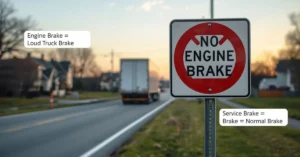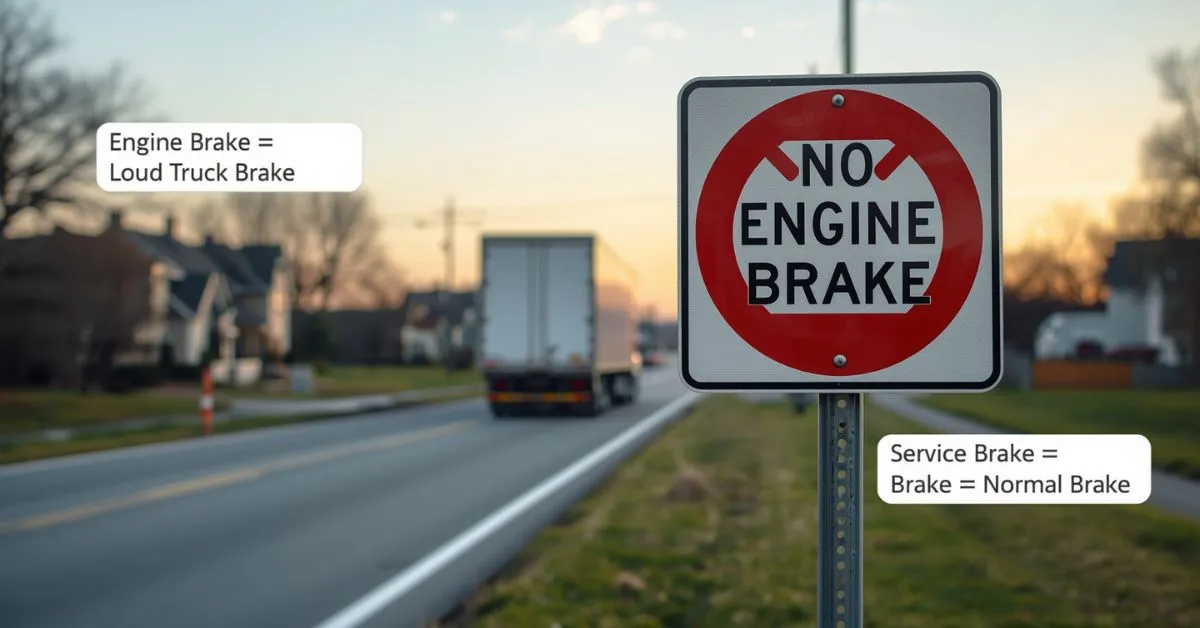
A No Engine Brake sign means drivers, especially truck drivers, should not use loud auxiliary braking systems such as engine brakes or Jake brakes in that area. The sign is usually there to reduce noise near residential zones or town limits. It does not ban normal service brakes or safe stopping.
If you search what does no engine brake mean, you usually want one fast answer: what the road sign is telling drivers to do. In most cases, the sign is aimed at heavy vehicles using a compression-release brake, often called a Jake Brake, or another noisy auxiliary brake.
Local governments use these signs because braking noise can disturb people living near busy roads. At the same time, transport guidance also makes clear that engine brakes are an important safety feature, so the rule is about reducing unnecessary noise, not preventing safe driving.
What the No Engine Brake Sign Actually Means
Plain-English meaning
A No Engine Brake sign tells drivers not to use a noisy engine-based braking system in the posted area. On trucks, that usually means an engine brake, engine retarder, compression brake, or Jake brake.
In some places, the wording in local rules focuses more specifically on unmuffled engine compression brakes or excessive noise rather than every possible braking device.
What it does not mean
The sign does not mean “no brakes.” It does not mean you should roll through town without slowing down.
A Jacobs operator manual states clearly that the Jacobs Engine Brake is a vehicle-slowing device, not a vehicle-stopping device, and that the vehicle’s service brakes are still required to bring the vehicle to a complete stop. That is why a No Engine Brake sign does not cancel normal braking with the brake pedal.
Why These Signs Exist
The main reason is noise
Local rules are usually about noise control, not about banning trucks. North Carolina guidance says local ordinances may prohibit the excessive noise caused by unmuffled engine compression brakes, and a Ford City Borough ordinance says engine brake noise can be treated as a nuisance when it creates excessive noise within the borough.
Why the noise stands out
Official transport guidance from New Zealand explains that engine and exhaust brakes can create pulses of sound often described as “machine gun” or “barking” noise.
It also notes that the noise issue is usually tied to a smaller number of trucks with noisier systems, not every truck on the road.
Why signs are often near town limits
Colorado DOT says its engine brake/noise ordinance signs are generally preferred at the city limit or county limit, while South Australia’s transport guidance says similar truck-noise advisory signs are considered mainly where major roads lead into built-up residential areas.
That is why drivers often first notice these signs when entering a town or quieter corridor from a faster rural road.
What Counts as an Engine Brake?
Jake brake or compression-release brake
The term Jake brake is commonly used for a compression-release engine brake used on heavy diesel trucks.
New Zealand transport guidance explains that an engine brake works by releasing compressed gases from the engine, and notes that “Jake” comes from the Jacobs brand name.
Exhaust brake
An exhaust brake is different. NZTA describes it as a device that intermittently blocks the exhaust to create back pressure on the engine. It is another type of supplementary braking system, and it is common on medium trucks.
Depending on local wording, a sign or ordinance may refer to engine brakes generally, unmuffled compression brakes specifically, or both engine and exhaust braking in emergency-related language.
Retarder
A retarder is another supplementary braking device. NZTA lists electric or hydrodynamic retarders as a third main category of heavy-vehicle supplementary braking systems.
This matters for SEO and user intent because people also search terms like engine retarder, brake retarder, and No Engine Retarder sign meaning, even though roadside signs often still use simpler wording such as No Engine Brake.
Engine braking in a regular car
Many passenger-car drivers use the phrase engine braking to mean slowing down by staying in gear or downshifting. That everyday driving habit is not the same thing as a truck’s compression-release brake.
Most No Engine Brake signs are posted because of heavy-vehicle noise concerns, not because a sedan driver eased off the gas pedal.
Engine Brake vs Service Brake
The easiest way to understand the sign is to compare the systems.
| Braking method | How it works | Main purpose | Noise risk | Usually targeted by a No Engine Brake sign |
|---|---|---|---|---|
| Service brakes | Wheel-end braking through the normal braking system | Stopping the vehicle | Low to moderate | No |
| Engine brake / Jake brake | Compression-release braking through the engine | Slowing heavy vehicles, especially on grades | Higher | Often yes |
| Exhaust brake | Creates back pressure in the exhaust system | Extra slowing support | Lower to moderate | Sometimes |
| Retarder | Electric or hydrodynamic driveline braking | Supplemental speed control | Varies | Sometimes |
| Normal car engine braking | Vehicle slows in gear when throttle is released | Routine slowing | Low | Usually no |
This comparison reflects guidance from Jacobs and NZTA: the service brake is still required for stopping, while engine brakes, exhaust brakes, and retarders are supplementary systems designed to assist speed control and reduce brake wear.
Does No Engine Brake Apply to Cars?
Usually, the practical target is heavy trucks, not ordinary cars. The official guidance and ordinances available for this topic focus on heavy vehicles, truck drivers, diesel-powered vehicles, and engine compression brakes that create excessive noise.
So if you drive a normal passenger car, the sign is generally not telling you to stop using your brake pedal or to avoid normal in-gear deceleration.
That said, exact wording matters. Some ordinances are written around noise rather than vehicle class. Ford City’s ordinance, for example, refers to gasoline-powered or diesel-powered motor vehicles using an engine brake in a way that creates excessive noise.
So the safest interpretation is this: the sign is mainly about noisy auxiliary braking, and local enforcement depends on the wording of the ordinance behind it.
Are No Engine Brake Signs Always Enforceable?
Sometimes they are regulatory
In some places, these signs are tied to a local ordinance and active enforcement. Colorado DOT requires documentation from local law enforcement committing to enforce the ordinance before certain engine brake/noise ordinance signs are installed on state highways.
North Carolina guidance also says a county, city, or town must first adopt an ordinance before approval is given for a prohibitory sign within municipal limits.
Sometimes they are advisory
Not every sign has the same force everywhere. South Australia’s transport guidance says its vehicle-noise advisory signs are purely advisory only and have no regulatory force. That is why readers should avoid assuming every No Engine Brake sign works the same way in every state, county, or country.
Emergency exceptions are common
Emergency exceptions are a major detail many weak articles miss. North Carolina’s model ordinance language says the sign should not be enforced when engine or exhaust braking is required due to an emergency driving situation.
Ford City’s ordinance says the rule does not apply in emergency situations requiring the engine brake to protect people or property.
How Truck Drivers Should Respond to the Sign
Slow down before the zone
North Carolina’s guidance mentions that speed reduction signs may be needed before a prohibitory engine-braking sign so drivers can slow down gradually.
That tells you something important: the safest response is to reduce speed before you reach the restricted area, not after you enter it.
Use the right gear and service brakes
Jacobs says engine brakes help with slowing, but the service brakes are still needed to bring the vehicle to a full stop.
It also says engine braking is most effective at higher engine speeds and that gear selection matters. In practical terms, drivers should choose the proper gear early and use the regular braking system smoothly as needed.
Remember the safety balance
Transport agencies do not treat this as a simple “never use it” issue. New Zealand guidance says supplementary brakes are important for safety on steep or long hills, and South Australia says engine brakes are an integral part of a truck’s braking system and should not be discouraged where a safe stop is required.
That is why local rules often focus on lower-speed built-up areas and noise-sensitive locations instead of every road.
No Engine Brake vs No Unmuffled Engine Braking
This is a very important distinction for both readers and rankings. Some official guidance does not frame the issue as “all engine braking is bad.” Instead, it focuses on unmuffled or excessively noisy systems.
North Carolina’s document explicitly refers to unmuffled engine compression brakes and also includes sample language about mufflers and exhaust systems that affect sound reduction. South Australia adds that heavy vehicles fitted with a good muffler system generally cause minimal noise when the engine brake is used.
So when people ask what does no engine brake mean, the best full answer is this: in many places, the real issue is not the mere existence of an engine brake but the noise it creates, especially if the system is unmuffled or used in a residential area.
Common Mistakes to Avoid
Mistake 1: Thinking the sign means no braking at all
That is false. The service brake is still required for stopping the vehicle. A No Engine Brake sign does not suspend safe driving or normal braking.
Mistake 2: Assuming the sign always applies the same way everywhere
It does not. Some places use enforceable ordinance-backed signs, while others use advisory signs. Local rules matter.
Mistake 3: Confusing a Jake brake with ordinary car downshifting
A truck’s compression-release brake is a specific supplementary braking system. That is different from normal in-gear slowing in a passenger car.
Mistake 4: Ignoring the sign completely
Even though safety comes first, these signs are usually installed because residents and road agencies have a real noise concern. Colorado and North Carolina both show that signs are normally tied to defined placement criteria or local ordinance steps, not random guesswork.
Real-World Example
Imagine a semi-truck approaching a town limit after a downhill stretch.
The driver sees a No Engine Brake sign at the edge of a residential zone, the correct response is not to stop braking altogether, and the correct response is to control speed early, use the appropriate gear, and rely on service brakes rather than activating a noisy compression-release brake inside the posted area unless an emergency makes it necessary.
That interpretation matches how official guidance balances noise reduction with safe vehicle control.
FAQ
What does a No Engine Brake sign mean?
It means drivers should not use noisy auxiliary braking systems such as engine brakes or Jake brakes in that area, usually because of local noise concerns.
Does No Engine Brake mean no regular brakes?
No. Jacobs states that service brakes are still required to stop the vehicle. The sign is about engine-based slowing systems, not normal stopping with the brake pedal.
Is a Jake brake the same as an engine brake?
A Jake brake is a common name for a compression-release engine brake. NZTA notes that “Jake” comes from the Jacobs brand name.
Why are engine brakes loud?
Official transport guidance says engine and exhaust brakes can create strong pulses of noise often described as barking or machine-gun-like sounds, especially on noisier systems.
Does the sign apply to cars?
Usually the practical target is heavy trucks and other vehicles using noisy supplementary braking systems, though exact enforcement depends on local ordinance wording.
Are No Engine Brake signs legally enforceable?
Often yes, when they are backed by a local ordinance and enforcement plan. But some jurisdictions use advisory signs with no direct regulatory force.
Can a driver use an engine brake in an emergency?
Emergency exceptions are common. Both North Carolina guidance and Ford City’s ordinance include emergency language that allows engine or exhaust braking when needed for safety.
Is No Engine Brake the same as No Unmuffled Engine Braking?
Not always, but they are closely related. Some official rules focus specifically on unmuffled engine compression brakes or excessive noise rather than every form of supplementary braking.
Final Takeaway
The best answer to what does no engine brake mean is simple: it means do not use a noisy engine-based braking system here, usually because the area is residential, noise-sensitive, or covered by a local ordinance.
It does not mean “no brakes,” and it does not remove the driver’s duty to slow down safely. If you publish this article, connect it internally to pages about Jake brakes, exhaust brakes, truck braking systems, and downhill driving safety to strengthen topical authority.
Click Below To Read About:
Mean Platelet Volume (MPV): What It Means on a Blood Test
What Does WTB Mean? Text, Marketplace, and Gaming Guide
What Does the Name Lee Mean? Origin, Popularity & More

Hi, I’m Evan Lexor, the voice behind Meanpedia.com. I break down English words, slang, and phrases into clear, simple meanings that actually make sense. From modern internet terms to everyday expressions, my goal is straightforward: help you understand English better, faster, and with confidence, one word at a time.