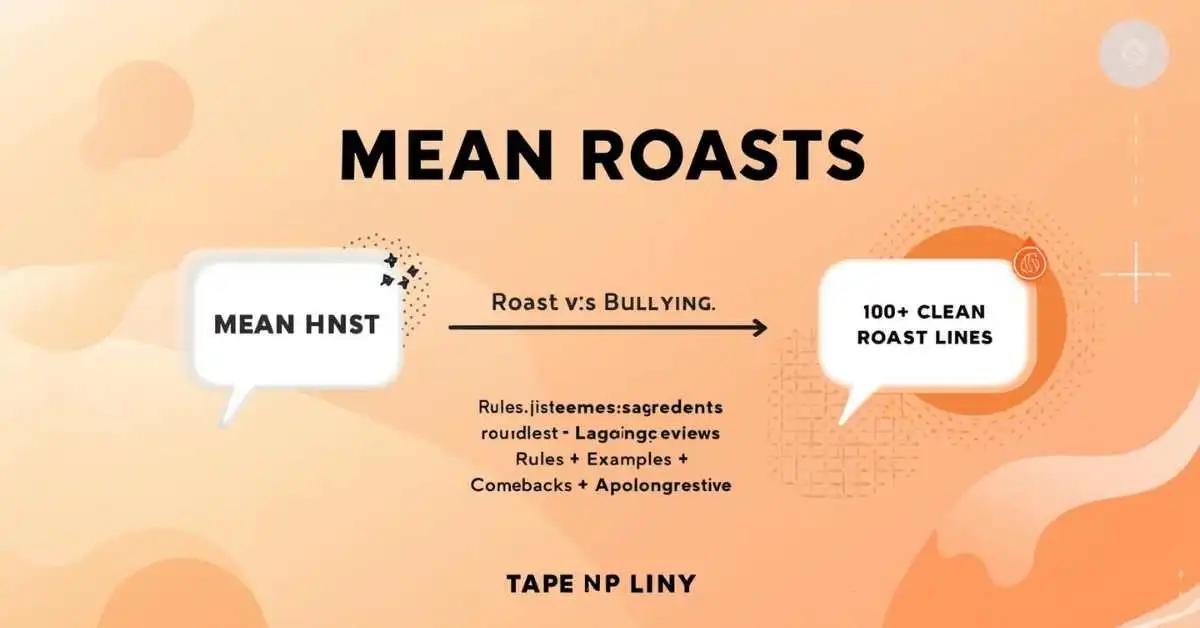
A roast is a friendly joke both people agree to. A mean roast is an insult wearing a smile. Bullying is when the “joke” keeps hitting the same person.
Some roasts feel like a high-five. Others feel like a slap.
You’ve seen it everywhere; friends in a group chat, a quick clip on TikTok, a Wild ’N Out moment, or a Comedy Central Roast where Jeff Ross or Nikki Glaser drops a sharp line and the crowd explodes. But real life isn’t a stage. There’s no script, no editing, and no timeout when someone’s face changes.
That’s why “mean roasts” spread so fast. They look funny for two seconds, then leave a long, quiet sting.
This guide makes roasting simple and safe. You’ll learn the exact line between funny and cruel, the rules that keep banter friendly, and a big list of clean roast lines you can use without hurting people. Because the best roast doesn’t win by being harsh; it wins by being clever, warm, and fair.
Quick Answer
A roast is only funny when it is consensual, light, and fair. If the other person can’t laugh and clap back, don’t say it.
1) Roast vs Mean Roast vs Bullying
Here is the easiest way to tell the difference:
| Thing | What it feels like | Consent | Power balance | After-feel |
|---|---|---|---|---|
| Roast | Playful teasing | Yes | Mostly equal | People feel closer |
| Mean roast | Joke-shaped insult | Maybe / unclear | Often unfair | One person feels small |
| Bullying | Repeated harm | No | One side has more power | Fear, stress, shame |
Simple rule:
If someone says “stop” and the jokes continue, it is not a roast.
2) The 7 Rules of a Funny Roast
If you remember nothing else, remember these.
Rule 1: Get consent
Some people love roasting. Some hate it. If you are not sure, skip it.
Rule 2: Roast habits, not wounds
Habits are safe. Deep pain is not.
Good targets: late replies, messy desk, “one more episode.”
Bad targets: body, money problems, family issues, trauma.
Rule 3: Keep it short
One line is enough. A roast is a tap, not a speech.
Rule 4: Give them an easy comeback
A good roast lets them clap back and still look good.
Rule 5: Don’t pile on
If others already roasted them, don’t add your joke. That becomes pressure.
Rule 6: Watch the face, not the laugh
People often laugh to be polite. If they look tense, stop.
Rule 7: Add warmth
A smile, a kind tone, or a quick compliment keeps it safe.
Roast light, then add warmth.
3) Punching Up vs Punching Down
Punching up means teasing ego and power.
Punching down means teasing someone’s weak spot or low status.
- Punching up = “Nice ego, big boss.”
- Punching down = “Nice struggle, shy person.”
The Punching down often feels like Mean Girls energy. It uses laughter to control people.
Fast test:
If your joke needs someone to feel embarrassed, it is not funny. It is mean.
4) Safe Zones and Danger Zones
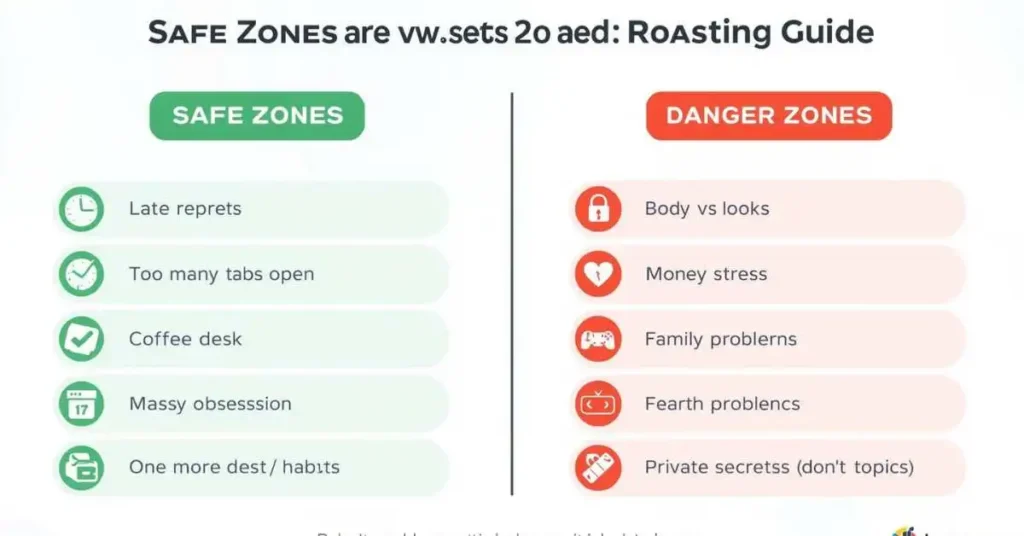
Safe zones (usually okay)
- Being late or being too early
- Taking forever to choose food
- Too many tabs open
- Too many alarms
- Always saying “bro” or “literally”
- Being a “one more episode” person
- Being extra neat or extra messy
- Loving one hobby too much (in a light way)
Danger zones (usually not okay)
- Body or looks
- Money problems or job stress
- Family pain or relationship drama
- Health, trauma, grief, addiction
- Private secrets
- Identity topics (race, religion, disability, nationality, gender, etc.)
Rule: If it would sting in silence later, don’t joke about it.
5) The Roast Safety Checklist (Use Before You Speak)
Ask these 7 questions:
- Did they opt in?
- Is the timing good? (not stressed, not embarrassed)
- Is it about a choice, not a trait?
- Would I say it one-on-one?
- Can they roast back easily?
- Is it one-and-done?
- Will they feel respected after?
If you can’t say “yes” to most of these, skip the roast.
6) 100+ Clean Roast Lines
These are clean and meant for friends who are okay with teasing. Keep the tone playful.
A) Late repliers and ghosters
- You reply so late I forgot the question.
- Your “seen” is doing all the talking.
- You text like Wi-Fi in the mountains.
- Your replies arrive by carrier pigeon.
- You make “brb” feel like a year.
- You reply like it costs money.
- Your phone must be in airplane mode 24/7.
- You treat messages like homework.
- You reply so slow even my patience got bored.
- You’re not busy. You’re just in your own world.
B) Always early / always prepared
- You’re so early the event isn’t ready yet.
- You plan “spontaneous” days.
- You pack snacks for a five-minute trip.
- You bring backup plans for your backup plans.
- You’re the reason calendars feel pressure.
- You arrive early and judge time itself.
- You treat punctuality like a sport.
- You act like being late is illegal.
- You schedule fun. Respect.
- You’re prepared for problems that don’t exist.
C) Overthinkers
- Your brain has 40 tabs open.
- You overthink a “hello.”
- You can worry in HD.
- You analyze vibes like a detective.
- You need a meeting to decide lunch.
- You rehearse phone calls like a movie.
- You think so much your thoughts need breaks.
- You ask “what if” like it’s your job.
- You could overthink breathing.
- You don’t have thoughts. You have committees.
D) Phone adddicts / screen time kings
- Your screen time is a full-time job.
- Your phone knows you better than your friends.
- You scroll like you’re mining for gold.
- You refresh apps like it’s cardio.
- Your thumb deserves a trophy.
- You live on low battery and high confidence.
- You can’t ignore notifications even in your sleep.
- Your phone is basically your best friend.
- You treat “offline” like a punishment.
- You scroll so much even the ads know you.
E) Coffee people
- You don’t drink coffee. You worship it.
- Your mood has two settings: “need coffee” and “had coffee.”
- You treat coffee like a personality trait.
- Your blood type is espresso.
- You need caffeine to open your eyes.
- You say “one cup” like it’s a lie you repeat daily.
- Your coffee order has a whole life story.
- You don’t wake up. Coffee wakes you.
- You run on caffeine and hope.
- You drink coffee like it owes you money.
F) Gym / fitness friends
- You say “rest day” like it’s a curse word.
- You treat stairs like a workout plan.
- You call walking “cardio.”
- You talk about protein like it’s a religion.
- You flex so much your sleeves are tired.
- You measure fun in calories.
- You do squats like it’s your love language.
- You bring “gym energy” to everything.
- You turn water into motivation speeches.
- You’re allergic to sitting still.
G) Gamers
- You say “one more game” like it’s a trap.
- Your bedtime is “after this match.”
- You have fast reflexes and slow replies.
- You treat snacks like game fuel.
- Your skills are high but your sleep is low.
- You speak in game terms in real life.
- You rage quietly, like a professional.
- You celebrate wins like it’s a world cup.
- You blame lag for everything.
- You would pause life if you could.
H) Messy people
- Your room looks like a storm had hobbies.
- You don’t lose things. Things escape you.
- Your “clean” is still brave.
- Your desk is a mystery map.
- You can’t find stuff because you live in “organized chaos.”
- Your laundry is doing a long-term project.
- You treat cleaning like a future problem.
- Your floor has layers.
- You make mess look creative.
- You could hide a whole person in your room.
I) Neat freaks
- Your room is cleaner than my thoughts.
- You wipe surfaces like it’s a hobby.
- You organize fun into neat lines.
- Your desk looks like a showroom.
- You fold things with emotional support.
- You clean while others relax.
- You see dust from far away.
- You treat mess like an enemy.
- You label everything like a boss.
- You could alphabetize air if you tried.
J) Food lovers
- You don’t “like” food. You commit to it.
- You plan your day around snacks.
- You say “I’m not hungry” and then eat everything.
- You treat dessert like a right, not a choice.
- You order food like you’re feeding a village.
- You pick restaurants like it’s a big life decision.
- Your love language is “extra sauce.”
- You don’t share fries. I respect the honesty.
- You eat like you earned it.
- You think about food more than most people think about goals.
Tip: Use one line only. Then stop.
7) Clean Comebacks
You can answer without turning it ugly.
- That was cute. Try again, but kinder.
- Keep it light. Don’t make it weird.
- Bold words for someone who also has flaws.
- Okay, roast me… but make it funny.
- Good attempt. Next time, less pain and more brain.
- I’ll allow it; once.
- That joke needs better manners.
- You’re close. Don’t cross the line.
- Let’s switch topics before this turns mean.
- I’m not laughing at that one.
8) What to Say When a Roast Goes Too Far
Use short lines. Short lines are strong.
- Direct: “Not funny to me. Stop.”
- Boundary: “Don’t joke about that.”
- Question: “What do you mean by that?”
- Exit: “I’m not doing this right now.”
If it keeps happening, talk privately:
“I’m okay with jokes. But that topic is off limits.”
If they mock your boundary, that is a red flag.
9) How to Apologize After a Bad Roast
Do not defend the joke. Fix it.
Say this:
- “That was mean.”
- “I’m sorry.”
- “I won’t do that again.”
Example:
“My bad. That roast was mean. I’m sorry. I won’t joke about that again.”
Then prove it by changing your behavior.
10) TV and Internet Roast Culture
Roasting looks easy on TV because it is planned.
A Comedy Central Roast on Comedy Central is a show. It has writers, timing, and editing. People like Jeff Ross are known for roast craft. Comics like Kevin Hart and Nikki Glaser have strong stage control. Even big names like Dave Chappelle succeed because they understand rhythm, timing, and risk.
A Roast Battle format works because both sides agree. It is a game with rules.
Shows like Wild ’N Out on MTV also feel fast and fun, but it is still a performance.
Online is different. Clips on TikTok, Instagram, and YouTube spread without context. People copy the harsh parts, not the careful parts. Then real feelings get hurt.
If you want to learn comedy craft the right way, books like The Comedy Bible and Born Standing Up can remind you of one truth: strong comedy takes skill. It does not need cruelty.
FAQ:
Is roasting always bad?
No. Roasting can be fun when it is mutual and light.
Why do “mean roasts” happen?
Often for attention, power, or to look cool in front of others.
Can a roast become bullying?
Yes. If it repeats, or if the person can’t safely say “stop,” it becomes bullying.
Are roasts okay at work?
Usually risky. Keep humor safe and professional.
What if they say “you’re too sensitive”?
Say: “Maybe. Still stop.” Your boundary is enough.
Final Takeaway
A roast should feel like a friendly game. It should build closeness, not fear.
Roast light, then add warmth.
Read Also This Post: What Does Boo Mean? Complete Guide with Explanation

Hi, I’m Evan Lexor, the voice behind Meanpedia.com. I break down English words, slang, and phrases into clear, simple meanings that actually make sense. From modern internet terms to everyday expressions, my goal is straightforward: help you understand English better, faster, and with confidence, one word at a time.