The Justice tarot card means fairness, truth, balance, and accountability. In tarot readings, it often appears when decisions must be made carefully, facts matter more than emotions, and actions have consequences.
Upright, Justice points to honesty, integrity, and fair outcomes. Reversed, it can show bias, dishonesty, denial, or avoiding responsibility. These meanings are widely consistent across major tarot references and trace back to the card’s role in the Major Arcana, especially in the Rider–Waite–Smith tradition.
If you are searching what does the Justice tarot card mean, you usually want more than one short definition. You want to know what it means in love, career, feelings, yes-or-no readings, and real life.
You also want to understand the symbols on the card and why this Major Arcana card feels so serious. Justice is not just about courtrooms or punishment. It is about truth, cause and effect, ethics, and making choices you can stand behind.
Justice tarot card meaning at a glance
Justice is one of the 22 Major Arcana cards, which in tarot usually point to bigger life lessons and more important turning points than the Minor Arcana.
In readings, Justice asks you to be honest, objective, and accountable. It often appears when a result is being weighed fairly, when the truth is coming out, or when you need to make a balanced decision instead of an emotional one.
| Position | Core meaning | Main message |
|---|---|---|
| Upright Justice | fairness, truth, balance, accountability | Be honest, act fairly, and accept consequences |
| Reversed Justice | bias, dishonesty, denial, unfairness | Look at the facts again and correct the imbalance |
This upright-versus-reversed contrast is one of the clearest in tarot, which is why Justice is often easy to recognize but harder to apply honestly to yourself.
Justice card symbolism and why it matters
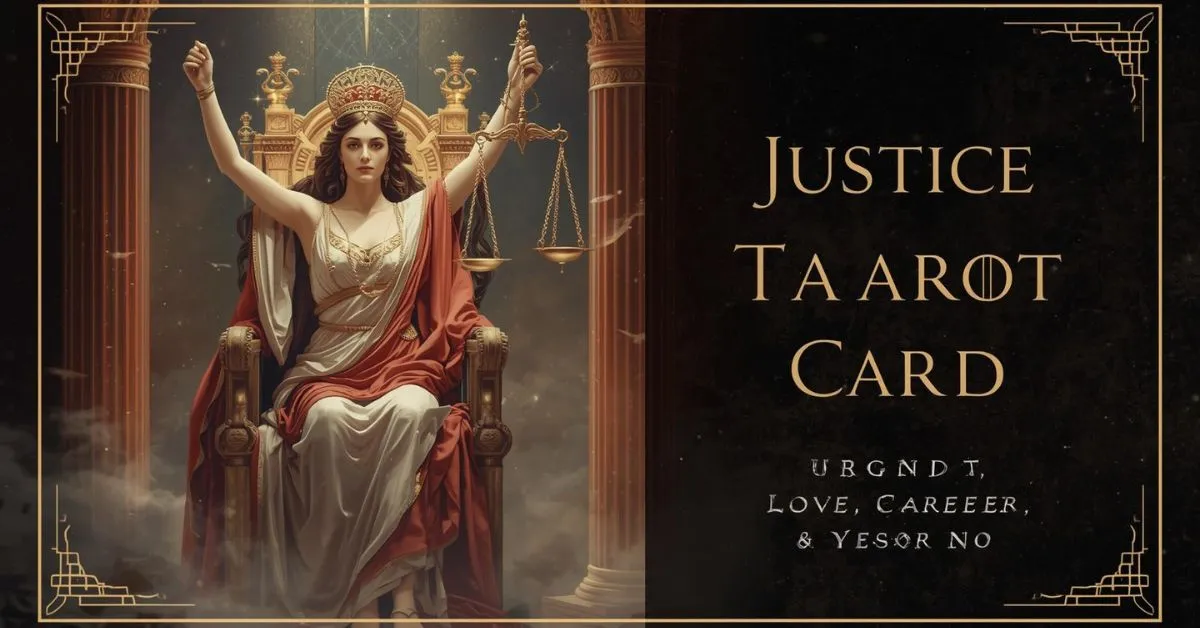
The Justice tarot card is rich in symbols, especially in the Rider–Waite–Smith deck created by A. E. Waite and illustrated by Pamela Colman Smith in the early 1900s. On the card, a seated figure holds scales in one hand and a double-edged sword in the other.
The figure sits between pillars, wears a crown, a red robe, and shows the tip of a white shoe beneath the robe. These details are not random. Together, they communicate balance, authority, truth, decisiveness, and moral clarity.
What the scales mean
The scales represent balance, evidence, and careful judgment. They remind you to weigh both sides before deciding. In readings, the scales often point to fairness, mutual effort, equal exchange, or the need to review facts instead of assumptions.
What the sword means
The sword represents truth, discernment, and action. It is double-edged, which suggests that truth cuts both ways. Justice does not flatter.
It reveals what is fair, what is not, and what must be faced. That is why this card often appears when difficult truths, legal matters, contracts, or serious choices are involved.
What the crown, pillars, robe, and white shoe mean
The square on the crown is commonly read as a sign of mental clarity and structured thought. The pillars suggest order, systems, and authority.
The red robe can point to action and seriousness, while the white shoe is often read as a quiet sign of spiritual grounding or pure intention beneath visible authority. These symbol details are especially emphasized in visual analyses of the Rider–Waite–Smith image.
Justice, Libra, Rider–Waite–Smith, Tarot de Marseille, and Thoth
Justice is strongly associated with Libra, the zodiac sign of balance, fairness, diplomacy, and weighing both sides. That connection is one reason the card often appears in relationship questions, ethical decisions, contracts, and situations that need equal give-and-take.
Some modern readers also connect Venus themes indirectly through Libra’s rulership, though the clearest tarot link is Justice with Libra itself.
Historically, Justice appears in older decks such as the Tarot de Marseille, where it is traditionally numbered VIII. In the influential Rider–Waite–Smith deck, Justice and Strength switched positions, making Justice XI and Strength VIII.
This change is widely explained through Golden Dawn astrological correspondences, aligning Justice with Libra and Strength with Leo. In the Thoth Tarot, the card appears under the related title Adjustment, which keeps the core themes of balance and correction but presents them through a different esoteric style.
Upright Justice tarot card meaning
When Justice appears upright, the message is usually clear: tell the truth, check the facts, and act with integrity. This card often shows that a fair outcome is possible, especially when the situation has been handled honestly.
It can point to accountability, ethical choices, balanced thinking, legal fairness, or a moment when your past actions are producing visible results.
Upright Justice can also mean that emotion needs to be balanced by reason. It does not ask you to become cold. It asks you to be fair.
If you are making a major decision, Justice says to pause, gather the full truth, and choose what is right rather than what is easiest.
Reversed Justice tarot card meaning
Reversed Justice usually points to imbalance. That may show up as dishonesty, one-sided thinking, blame, unfair treatment, denial, or refusing to take responsibility. Sometimes the card reversed means you are being treated unfairly. Other times it means you already know the truth but are resisting it because it is uncomfortable.
In practical readings, reversed Justice can also hint at delays in legal matters, contract problems, hidden facts, or a situation where the final result does not yet reflect the whole truth.
It is often a warning to slow down, review details, and be brutally honest about your own role in the matter.
What does the Justice tarot card mean in love?
In love readings, Justice is less about fantasy and more about fairness. It asks whether the relationship is balanced, honest, and respectful.
If both people are showing up equally, Justice can be a good sign for stability, commitment, and trust. If one person is giving much more than the other, the card may highlight the imbalance directly.
Justice in love for singles
For singles, Justice often suggests being clear about your standards and choosing partners based on truth rather than chemistry alone.
It can indicate meeting someone mature, thoughtful, and fair, or learning to stop repeating old patterns that were never balanced to begin with.
Justice in love for relationships
For established couples, Justice can point to honest conversations, setting boundaries, making commitments, or deciding where the relationship truly stands.
It may also appear around formal milestones such as defining the relationship, engagement, marriage, or shared agreements.
Justice and reconciliation
If you ask about reconciliation, Justice says reunion is only possible if both people admit the truth and take equal responsibility.
It is not a card of romantic illusion. It supports repair only when there is honesty, fairness, and real change. This is a practical interpretation drawn from the card’s core meanings of truth and accountability.
Justice tarot card meaning in career, money, and legal matters
Justice is especially strong in career readings because it is tied to rules, systems, performance, accountability, and fair judgment.
It can appear during reviews, interviews, promotions, audits, policy decisions, or any situation where results are measured carefully. It may also favor careers related to law, compliance, contracts, mediation, writing, administration, research, or analysis.
In money readings, Justice says to get organized. Review records, check contracts, understand the terms, and make decisions based on facts. It is a good card for fair settlements, balanced budgets, or correcting a financial mistake, but it is not a careless or lucky money card.
In legal matters, Justice is one of the clearest tarot cards for courts, disputes, official paperwork, and formal agreements. It often suggests that fairness and truth are central to the outcome. It is usually more favorable when the person asking has acted honestly and kept clear records.
Justice tarot card as feelings, as a person, yes or no, and timing
As feelings, Justice often shows controlled but sincere emotion. The person may care, but they are weighing the relationship carefully. They want clarity, honesty, and mutual effort before they fully open up. This is not a chaotic feelings card. It is thoughtful, measured, and serious.
As a person, Justice often describes someone logical, fair-minded, honest, mature, and not easily manipulated. At times, that person may seem reserved or highly rational, but their strength is objectivity and principle. Reversed, the same energy can become cold, judgmental, rigid, or biased.
For yes-or-no tarot, Justice is best read as yes, if the situation is fair and honest. It is usually not a reckless yes. It is a conditional yes based on truth, balance, and responsibility.
If important facts are missing, the answer may be delayed or lean no until the full truth is known. This is an interpretive reading approach built directly from the card’s traditional meanings.
For timing, Justice often points less to a sudden event and more to a process: paperwork, decisions, reviews, official results, or conversations that unfold when facts are fully weighed.
Because of its Libra connection, some readers associate it with Libra season, but timing in tarot is best confirmed by surrounding cards. The Libra link itself is well established; timing use is an interpretive extension.
Justice tarot card in past, present, and future
In the past position, Justice often shows that a past decision, truth, or consequence is still shaping the current situation. It may also show that earlier actions are now returning in visible ways.
In the present position, Justice says the truth matters now. This is the moment to be objective, fair, and responsible. Facts will matter more than excuses.
In the future position, Justice often suggests that a fair result, an official decision, a balancing event, or a revealing truth is ahead. The outcome usually depends on how honestly the situation is handled.
Justice tarot card combinations that change the reading
Realy Justice becomes even clearer when paired with nearby cards.
Justice and Two of Cups
This pairing often points to a relationship that needs equal effort, honesty, and mutual respect. It can support balanced partnership or clear discussions about commitment.
Justice and Seven of Swords
This combination can raise red flags about dishonesty, avoidance, or missing facts. Truth needs to come out before progress is possible.
Justice and Judgement
Together, these cards often intensify themes of accountability, truth, reckoning, and major decisions. Judgement adds awakening and final review to Justice’s fairness and logic.
Justice and Wheel of Fortune
This pairing can suggest a turning point where cause and effect become obvious. A cycle shifts, and the result often reflects earlier choices. Related combination references frequently tie this pair to changing circumstances around contracts, law, or outcomes.
Common mistakes when reading the Justice card
One common mistake is thinking Justice always means a lawsuit. Legal matters are part of the card, but not the whole card. Justice is more often about truth, ethics, balance, and consequences in everyday life.
Another mistake is reading Justice as pure punishment. It is better understood as balance and accountability. Sometimes that brings a reward. Sometimes it brings correction. The key point is that the outcome connects to truth and action, not random cruelty.
A third mistake is ignoring deck tradition. In Tarot de Marseille, Justice is traditionally VIII. In Rider–Waite–Smith, it is XI. And in Thoth, it becomes Adjustment. The card’s core meaning stays related, but the framing and symbolism can shift, which affects deeper interpretation.
Practical reading tips when Justice appears
When Justice shows up, ask simple but serious questions:
- What are the facts?
- What is fair to both sides?
- Am I being honest with myself?
- What action created this result?
- What needs to be corrected now?
Justice works best when you stop guessing and start weighing reality. That is why this card is so powerful in tarot. It does not just describe a mood. It points to truth, balance, systems, and the real consequences of choice.
FAQs
What does the Justice tarot card mean in a general reading?
It usually means fairness, truth, accountability, balanced judgment, and cause and effect. It often appears when a serious decision or honest review is needed.
Is Justice a good tarot card?
Usually yes. It is a strong card for fairness, honesty, clarity, and balanced results. It can feel strict, but it is generally helpful because it reveals what is true.
What does Justice reversed mean?
Reversed Justice often means unfairness, dishonesty, denial, blame, bias, or avoiding responsibility. It can also point to missing facts or an unbalanced outcome.
What does the Justice tarot card mean in love?
In love, Justice usually points to honesty, equal effort, mutual respect, and clear relationship decisions. It can also show the need to fix imbalance before the relationship can move forward.
What zodiac sign is linked to Justice?
Justice is strongly associated with Libra, which fits the card’s focus on balance, fairness, and weighing both sides.
Does Justice always mean legal matters?
No. Legal matters are one valid meaning, but Justice more often speaks to truth, ethics, fairness, contracts, consequences, and accountability in everyday life.
Why is Justice sometimes card VIII and sometimes XI?
In older traditions like Tarot de Marseille, Justice is usually VIII. In the Rider–Waite–Smith deck, Justice became XI after the switch with Strength, a change widely linked to Golden Dawn correspondences.
What is the Thoth version of Justice?
In the Thoth Tarot, Justice is presented as Adjustment. The core ideas of balance, correction, and measured alignment remain, but the imagery and esoteric framing change.
Conclusion
So, what does the Justice tarot card mean? It means fairness, truth, accountability, and balance. It is a Major Arcana card that asks you to think clearly, act honestly, and accept the natural results of your choices.
If it appears in love, career, legal matters, feelings, or a yes-or-no reading, Justice pushes the reading toward clarity and integrity. In the Rider–Waite–Smith deck by A. E. Waite and Pamela Colman Smith, and across older systems like Tarot de Marseille and later systems like Thoth’s Adjustment, the message stays remarkably consistent: truth matters, balance matters, and your choices matter.
Click Here To Read About: What Are Interpersonal Skills

Hi, I’m Evan Lexor, the voice behind Meanpedia.com. I break down English words, slang, and phrases into clear, simple meanings that actually make sense. From modern internet terms to everyday expressions, my goal is straightforward: help you understand English better, faster, and with confidence, one word at a time.