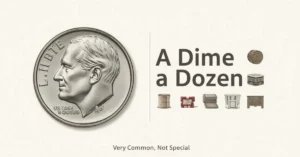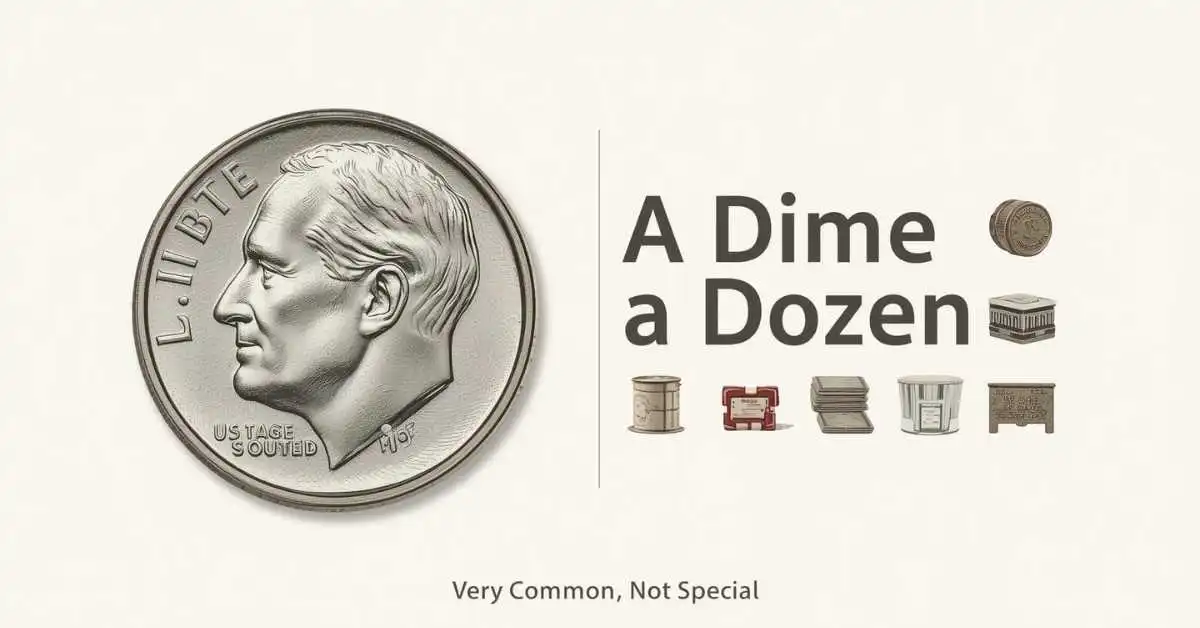
“A dime a dozen” means something is very common, easy to find, and not especially valuable or unique.
This American English idiom is often used to describe people, products, ideas, or trends that are plentiful and ordinary, sometimes with a slightly negative or dismissive tone.
If you are wondering what does a dime a dozen mean, the short answer is simple: it describes something that is everywhere.
In everyday English, this idiom is used when a thing, person, idea, or product is so common that it does not feel rare, special, or hard to replace. You may hear it in conversation, writing, reviews, business talk, and social media.
In this guide, you will learn the exact meaning, tone, origin, sentence examples, synonyms, common mistakes, and when to use this phrase naturally.
Meaning at a Glance
| Term | Meaning |
|---|---|
| Idiom | A phrase with a figurative meaning |
| A dime a dozen | Very common and not especially valuable |
| Tone | Often neutral to slightly negative |
| Type of English | Mainly American English |
| UK equivalent | Two a penny / ten a penny |
Cambridge defines “a dime a dozen” as something common and of very little value, and notes that it is a US idiom with the UK equivalent “two/ten a penny.”
What Does “A Dime a Dozen” Mean in Simple English?
The idiom a dime a dozen means very common, easy to find, and not special.
When someone uses this expression, they are saying that there are many similar things around. Because the thing is so plentiful, it may also seem less valuable, less impressive, or less unique. Merriam-Webster defines it as something so plentiful or commonplace that it is of little esteem or slight value.
Simple definition
In plain English:
- Rare things are hard to find
- A dime a dozen things are easy to find
- If something is a dime a dozen, it usually does not stand out
For example:
“Cheap phone cases are a dime a dozen online.”
This means cheap phone cases are very common on the internet. You can find them almost anywhere.
Does it always mean “cheap”?
Not exactly.
This is where many readers get confused. The main idea is commonness, not just price. Something can be expensive and still be described as a dime a dozen if many similar versions exist. The phrase points more to abundance, ordinariness, and lack of rarity than to actual cost.
Example:
“Self-help podcasts are a dime a dozen now.”
This is not mainly about money. It means there are so many of them that they no longer feel unique.
Is “A Dime a Dozen” Positive or Negative?
Usually, it is neutral to mildly negative.
The phrase often carries a dismissive connotation. It can suggest that something is ordinary, overused, or not very impressive. That is why tone and context matter.
Neutral use
Sometimes it simply means “common.”
Example:
“Coffee shops are a dime a dozen in the city.”
This sounds descriptive, not harsh.
Slightly negative use
Sometimes it implies that the thing lacks value or originality.
Example:
“Online gurrus are a dime a dozen these days.”
This sounds critical. It suggests there are too many similar people offering the same thing.
Can it be rude?
Yes, especially when used about people.
If you say a person, skill, or profession is a dime a dozen, it may sound insulting because it suggests they are replaceable or unremarkable.
For example:
“Influencers are a dime a dozen.”
That might be acceptable in casual commentary, but it could sound rude if directed at someone personally.
Origin of the Idiom “A Dime a Dozen”
The phrase comes from the United States. A dime is a US ten-cent coin, and the image behind the idiom suggests something so common that you could get many of them for a very small amount of money.
Cambridge identifies it as a US idiom, and Dictionary.com notes the expression means something so abundant that its value decreases.
Merriam-Webster lists the first known use of “a dime a dozen” as 1919, which supports the idea that the figurative idiom became established in the early 20th century. Dictionary.com also places the idiom in the first half of the 1900s.
Why the phrase makes sense
The image is easy to understand:
- a dime is a small amount of money
- a dozen is a large quantity
- together, they suggest something cheap, plentiful, and easy to get
That clear image is one reason the idiom has lasted so long in English vocabulary.
How to Use “A Dime a Dozen” Correctly
This phrase works best in informal English when you want to describe something as common, ordinary, or easy to find.
Common sentence patterns
These are the most natural patterns:
- [Plural noun] are a dime a dozen.
- [Type of thing] is a dime a dozen these days.
- You can find [thing] a dime a dozen.
Examples:
- Budget sunglasses are a dime a dozen at tourist shops.
- Fitness apps are a dime a dozen now.
- Basic resumes with buzzwords are a dime a dozen.
- Trend-based content is a dime a dozen on social media.
Best contexts for this idiom
You will often see or hear this phrase in these areas:
- business and marketing
- online content
- shopping and products
- job advice
- entertainment and reviews
- everyday conversation
- English learning and idiom lessons
Real Sentence Examples
Here are realistic examples that show how the phrase works in different contexts.
In business
“Low-cost freelancers are a dime a dozen, but reliable specialists are harder to find.”
This means general freelancers are common, but trusted experts are not.
In content and media
“Clickbait headlines are a dime a dozen, but useful articles still stand out.”
This shows contrast between common content and quality content.
In shopping
“Cheap chargers are a dime a dozen, so it pays to check reviews before buying.”
This means cheap chargers are easy to find everywhere.
In career advice
“Generic cover letters are a dime a dozen. Clear achievements make an applicant memorable.”
This highlights why originality matters.
In daily conversation
“Fast food chains are a dime a dozen around here.”
This means there are many of them nearby.
“A Dime a Dozen” vs Similar Phrases
Many people search for the dime a dozen meaning and also want to know how it compares with similar expressions. This is important because related idioms can look similar but carry different tones.
| Phrase | Meaning | Tone | Usage |
|---|---|---|---|
| a dime a dozen | very common, not special | mildly negative | American English idiom |
| common | not rare | neutral | general English |
| run-of-the-mill | ordinary, average | slightly negative | everyday speech |
| nothing special | unimpressive | direct, casual | conversation |
| two a penny / ten a penny | very common | informal | British English |
| ubiquitous | found everywhere | formal | academic or formal writing |
Cambridge and Collins both note that British English uses two a penny or ten a penny as the closest equivalent.
“A dime a dozen” vs “cheap”
These are not the same.
- Cheap focuses on price
- A dime a dozen focuses on abundance and low uniqueness
Something can be cheap without being common, and it can be common without literally being cheap.
“A dime a dozen” vs “rare”
The opposite idea of a dime a dozen is something rare, unique, special, scarce, one of a kind, or hard to find.
That contrast helps you understand the phrase faster.
Common Mistakes to Avoid
If you want to use this idiom naturally, avoid these mistakes.
1. Thinking it only means low price
The phrase may suggest low value, but the main meaning is common and easy to find.
2. Using it for something rare or premium
Do not use a dime a dozen for things that are special, limited, handmade, or difficult to get.
Wrong idea:
“Luxury vintage watches are a dime a dozen.”
That sounds incorrect because luxury vintage watches are not common.
3. Using it in a very formal context
This is an informal idiom, not the best choice for highly formal academic or legal writing.
4. Using the wrong wording
The fixed phrase is:
a dime a dozen
Not:
- dime by a dozen
- one dime a dozen
- a dime per dozen
Idioms usually work best in their standard form.
5. Using it carelessly about people
Because the phrase can sound dismissive, use it carefully when describing someone’s talent, career, or identity.
Why This Idiom Matters in English
Understanding what does a dime a dozen mean helps with more than vocabulary. It also improves your understanding of:
- idioms
- figurative language
- tone
- connotation
- context
- American English expressions
- synonyms and near-synonyms
That is important for reading articles, watching films, following conversations, and writing natural English. If you miss the tone of the idiom, you may understand the basic meaning but miss the speaker’s attitude.
For example, someone who says, “Ideas are a dime a dozen” is not only saying ideas are common. They are also implying that ideas alone are not enough and that execution matters more.
Practical Takeaways
Here is the easiest way to remember it:
A dime a dozen = easy to find, very common, not especially unique
Keep these quick points in mind:
- It is an idiom, not a literal price statement
- It is mainly used in American English
- It often describes things that are plentiful, ordinary, or overabundant
- It can sound mildly negative or dismissive
- The British equivalent is two a penny or ten a penny
FAQ
What does a dime a dozen mean in English?
It means something is very common, easy to find, and not especially unique or valuable. It is a common idiom in American English.
Is a dime a dozen an idiom?
Yes. It is an English idiom, which means its figurative meaning is different from its literal words.
Is “a dime a dozen” negative?
Usually it is neutral to slightly negative. It often suggests that something is ordinary, overused, or not very impressive.
Can “a dime a dozen” describe a person?
Yes, but it can sound rude or dismissive because it suggests the person is common or easily replaceable.
What is the origin of “a dime a dozen”?
It is an American phrase built around the image of a dime, or ten-cent coin, buying a dozen ordinary items. Merriam-Webster gives 1919 as the first known use of the idiom.
What is another way to say “a dime a dozen”?
Close alternatives include common, run-of-the-mill, ordinary, nothing special, and in British English, two a penny or ten a penny.
How do you use “a dime a dozen” in a sentence?
Example: “Cheap travel mugs are a dime a dozen, but a durable one is worth paying for.”
Does “a dime a dozen” mean cheap or worthless?
Not exactly. It mainly means common and plentiful. It may imply lower value, but it does not always mean something is literally cheap or worthless.
Conclusion
So, what does a dime a dozen mean? It means something is very common, easy to get, and not especially valuable, original, or rare. It is a useful English idiom because it says more than just “common.” And it adds meaning about value, rarity, and how much something stands out.
If you want to write or speak English more naturally, this is a smart phrase to learn. It appears often in everyday conversation, reviews, business talk, and opinion writing because it captures both abundance and attitude in a short, memorable expression.
Read Also This Post: What Does the Name Morgan Mean? Origin, Popularity & More

Hi, I’m Evan Lexor, the voice behind Meanpedia.com. I break down English words, slang, and phrases into clear, simple meanings that actually make sense. From modern internet terms to everyday expressions, my goal is straightforward: help you understand English better, faster, and with confidence, one word at a time.